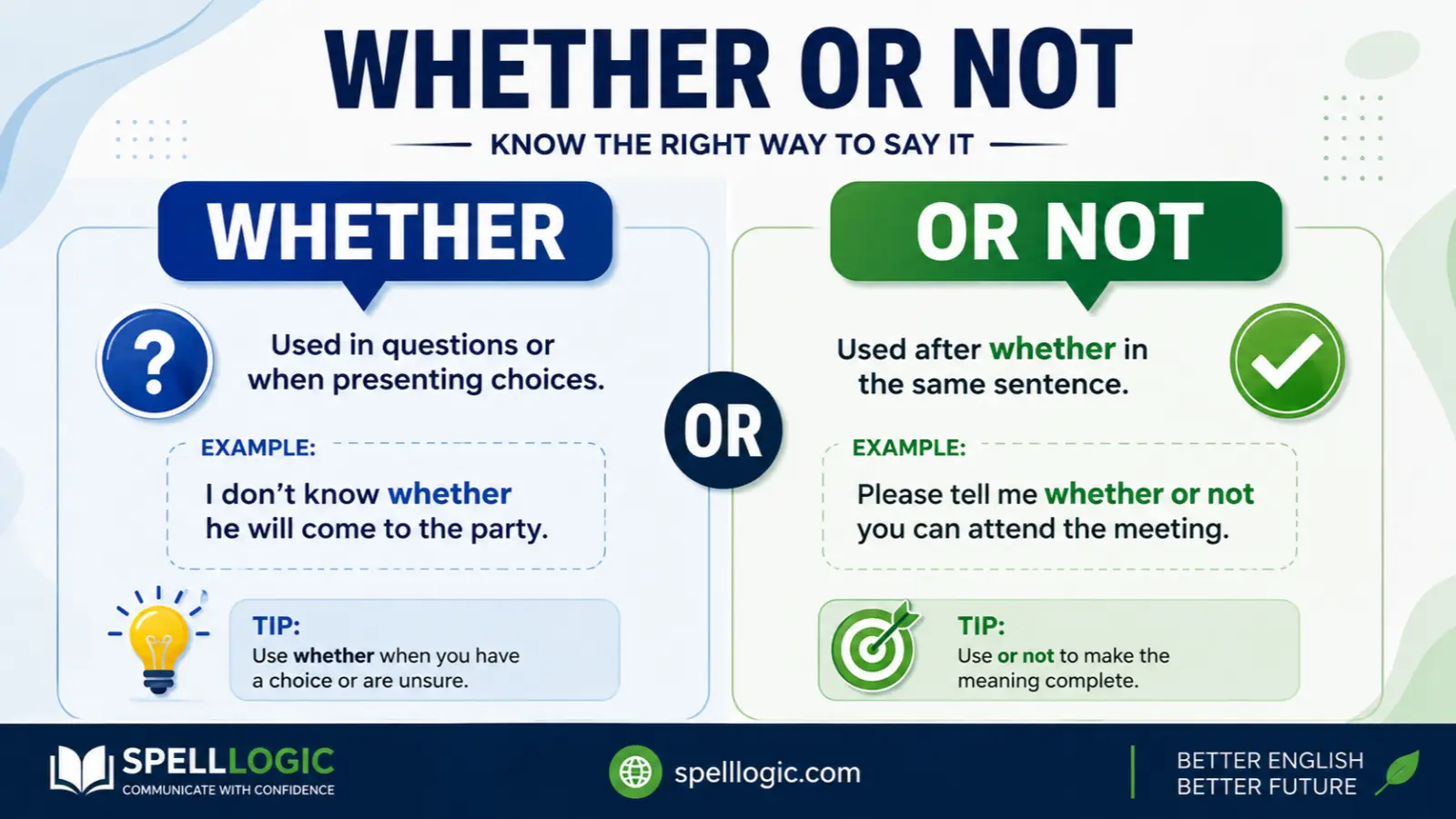
Many English learners wonder whether they should write whether or whether or not. These expressions look very similar, and in many sentences, both seem to work. However, they are not always interchangeable. Choosing the right form can make your writing clearer, more natural, and grammatically correct.
Understanding when to use whether alone and when to use whether or not helps you communicate more confidently in both spoken and written English. This guide explains the difference in simple language, provides practical examples, and offers memory tips so you can use both expressions correctly in everyday situations.
Why “Whether” and “Whether or Not” Are Confusing
Many English learners confuse whether and whether or not because they are closely related and often appear in the same types of sentences.
Similar Pronunciation
Both expressions begin with the word whether, making them sound almost identical in conversation.
Similar Spelling
The only difference is the addition of or not, so learners often think both expressions always mean exactly the same thing.
Context Confusion
Sometimes you can say:
- I don’t know whether he will come.
- I don’t know whether or not he will come.
Both are correct.
However, in some situations, whether or not adds emphasis or is required for clarity.
Common Learner Mistakes
- Using if instead of whether in formal writing.
- Adding or not when it is unnecessary.
- Omitting or not when emphasizing that both possibilities are included.
Whether vs Whether or Not Explained Simply
Simple Explanation
Whether introduces a choice or uncertainty between two possibilities.
Whether or not emphasizes that both possible outcomes are included or considered.
One-Line Distinction
Whether simply introduces alternatives, while whether or not stresses that the result remains the same regardless of the outcome.
Example Sentences
- Whether you agree is your decision.
- Whether or not you agree, we will continue the project.
Another example:
- I don’t know whether she has arrived.
- I’ll attend whether or not it rains.
Understanding Homophones in English
What Are Homophones?
Homophones are words that sound the same but have different meanings or spellings.
Example:
- Sea
- See
Although they sound alike, they have different meanings.
Note: Whether and whether or not are not homophones. They are related expressions, not separate words with identical pronunciation.
Why Homophones Cause Confusion
English contains many words that sound alike, causing learners to confuse spelling and meaning.
For example:
- They’re going to the park.
- Their dog is friendly.
These words sound the same but serve different grammatical purposes.
Similarly, learners confuse whether and whether or not because both appear in similar sentence structures.
What Does “Whether” Mean?
Definition and Core Meaning
Whether is a conjunction used to introduce alternatives or express uncertainty.
It usually means:
- if
- which of two possibilities
- regardless of which option is true
Origin and Historical Use
The word whether comes from Old English hwæther, meaning which of two. It has been used in English for hundreds of years to introduce choices and indirect questions.
Modern Usage and Synonyms
Depending on context, similar expressions include:
- if (in informal situations)
- regardless of
- whichever
- either
Key Points
- Introduces uncertainty.
- Often appears after verbs like know, wonder, ask, and decide.
- Common in formal English.
- Usually preferred over if in indirect questions.
Example Sentences
- I don’t know whether he is home.
- She asked whether the meeting had started.
- We’re deciding whether to move.
- Tell me whether you agree.
What Does “Whether or Not” Mean?
Definition and Core Meaning
Whether or not means regardless of which possibility is true. It emphasizes that both outcomes are included.
Origin and Historical Context
The phrase developed naturally by adding or not after whether to make both possibilities explicit.
Today, it is common in both spoken and written English.
Modern Usage and Synonyms
Possible alternatives include:
- regardless of whether
- no matter if
- irrespective of
Key Points
- Adds emphasis.
- Includes both possibilities clearly.
- Often used before the main clause.
- Common in formal and academic writing.
Example Sentences
- We’ll leave whether or not you’re ready.
- Whether or not she apologizes, I’ll forgive her.
- The event will happen whether or not it rains.
- You should apply whether or not you have experience.
Whether vs Whether or Not: Key Differences at a Glance
| Word | Part of Speech | Meaning | Example Context |
|---|---|---|---|
| Whether | Conjunction | Introduces uncertainty or alternatives | I wonder whether she called. |
| Whether or not | Conjunction phrase | Emphasizes that both outcomes are included | We’ll go whether or not it rains. |
How to Remember the Difference Between Whether and Whether or Not
Learning the difference is easier with a few memory tricks.
Easy Memory Tricks
- Whether asks about possibilities.
- Whether or not emphasizes both possibilities.
Association Technique
Think of or not as saying:
“No matter what happens.”
Whenever that meaning fits naturally, whether or not is often the better choice.
Memorable Example
- I don’t know whether she’s coming.
- I’ll go whether or not she comes.
The first sentence asks about uncertainty.
The second says the decision won’t change.
Common Mistakes and Confusions
Mistake 1
Wrong:
I wonder if or not he knows.
Correct:
I wonder whether or not he knows.
Explanation:
After wonder, whether is preferred.
Mistake 2
Wrong:
We’ll leave if or not it rains.
Correct:
We’ll leave whether or not it rains.
Explanation:
This sentence includes both possibilities.
Mistake 3
Wrong:
She asked if she passed the exam. (Formal writing)
Correct:
She asked whether she passed the exam.
Explanation:
Formal English usually prefers whether.
Mistake 4
Wrong:
Whether or not of the answers are correct.
Correct:
Whether the answers are correct.
Explanation:
Do not add unnecessary words after whether or not.
Examples Section: Correct and Incorrect Usage
Example 1
✔ Correct:
I don’t know whether he finished the report.
✘ Incorrect:
I don’t know whether or if he finished the report.
Example 2
✔ Correct:
We’ll travel whether or not it snows.
✘ Incorrect:
We’ll travel if or not it snows.
Example 3
✔ Correct:
She wondered whether she had enough money.
✘ Incorrect:
She wondered if or not she had enough money.
Example 4
✔ Correct:
Whether or not you agree, everyone deserves respect.
✘ Incorrect:
Whether you agree or not, everyone deserves respect. (This is grammatically acceptable, but whether or not is often smoother in formal writing.)
Self Assessment: Test Your Knowledge
Fill in the blanks with whether or whether or not.
- I don’t know ______ he accepted the offer.
- We’ll continue the meeting ______ everyone arrives on time.
- She asked ______ the package had been delivered.
- ______ you like coffee, you’re welcome to join us.
Self Assessment Answers
- whether
- whether or not
- whether
- Whether or not
FAQs
1. Is “whether or not” always necessary?
No. In many sentences, whether alone is enough. Use whether or not when you want to emphasize that both outcomes are included.
2. Can I replace “whether” with “if”?
Sometimes, yes. However, whether is generally preferred in formal writing and indirect questions.
3. Is “whether or not” more formal?
It is common in both formal and informal English, but it often appears in academic and professional writing because it adds clarity.
4. Can a sentence start with “whether”?
Yes. For example:
Whether we win or lose, we’ll do our best.
5. Is “whether or not” redundant?
Not always. It is useful when emphasizing that the result is the same in either situation.
6. Which is better in business writing?
Whether is concise, while whether or not is better when clarity or emphasis is needed.
7. Can I say “whether or whether not”?
No. The correct expression is whether or not.
Final Conclusion: Using “Whether” and “Whether or Not” Correctly
Understanding the difference between whether and whether or not can make your English sound more natural, precise, and confident. Although the two expressions are closely related, they are not always used in exactly the same way. Whether is mainly used to introduce uncertainty or present two possible choices, while whether or not adds emphasis by showing that the outcome remains the same regardless of which possibility is true. In many everyday conversations, whether alone is enough, but in situations where you want to stress that both options are included, whether or not is usually the better choice.
A simple way to remember the difference is this: if you can replace the phrase with “no matter what happens,” then whether or not is probably the right choice. Otherwise, whether will often be sufficient. Reading authentic English, practicing with example sentences, and paying attention to how native speakers use these expressions will help reinforce this rule over time.
Don’t worry if you occasionally confuse them—many learners do. With regular practice and the memory tips in this guide, you’ll soon know If to use whether or whether or not naturally and accurately. Every small improvement in grammar strengthens your communication skills, bringing you one step closer to fluent, confident English.