Many English learners wonder whether they should say aunt or aunty. Since both words refer to the same family member, it can be confusing to know which one sounds more natural in different situations. While they are closely related, they are not always used in the same way.
Understanding the difference helps you speak and write English more naturally, whether you’re talking to family, writing a greeting card, or reading books. In this guide, you’ll learn the meanings, origins, usage, and key differences between aunt and aunty with simple explanations and practical examples.
Why “Aunt” and “Aunty” Are Confusing
Many people mix up aunt and aunty because they describe the same family relationship. However, their usage depends on the situation and the level of formality.
Similar Pronunciation
Both words are pronounced similarly. In many English accents, the only difference is the extra “-y” sound at the end of aunty.
Similar Spelling
The words have almost identical spelling, with aunty simply adding -y to aunt.
Context Confusion
Learners often wonder:
- Should I say my aunt or my aunty?
- Is aunty only for children?
- Which word is more formal?
The answer depends on the context rather than grammar.
Common Learner Mistakes
- Using aunty in formal writing.
- Thinking aunt is incorrect in casual speech.
- Believing only one word is correct.
In reality, both are correct, but they suit different situations.
Aunt vs Aunty Explained Simply
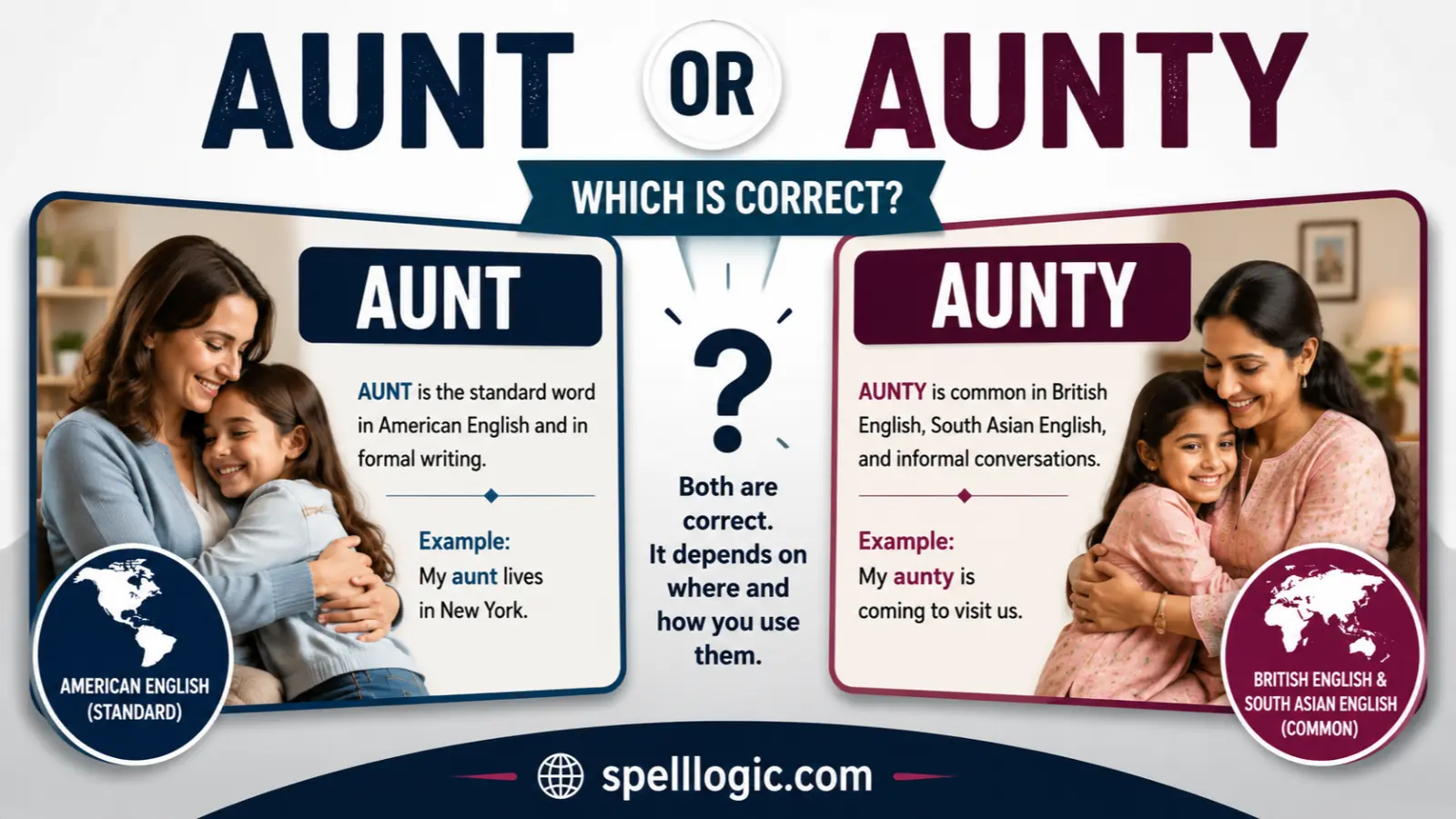
Aunt is the standard and more formal word for your parent’s sister or your uncle’s wife, while aunty is a warmer, more affectionate, and informal way of referring to an aunt.
One-Line Distinction
Aunt is the standard family title, while aunty is the affectionate nickname.
Example Sentences
- Aunt means your parent’s sister or uncle’s wife, while aunty is a loving or informal way to address that same person.
- My aunt lives in Canada.
- Thank you, Aunty Maria, for the delicious cookies.
Understanding Homophones in English
What Are Homophones?
Homophones are words that sound the same but have different meanings or spellings.
Example:
- Flower – a blooming plant
- Flour – powder used for baking
Although aunt and aunty are not true homophones, they sound very similar and often confuse English learners because they refer to the same person.
Why Homophones Cause Confusion
When two words sound alike, learners may assume they have identical meanings or uses.
For example:
- Their
- There
- They’re
These words sound alike but have different meanings.
Likewise, aunt and aunty are similar in pronunciation but differ mainly in tone and formality.
What Does “Aunt” Mean?
Definition and Core Meaning
An aunt is:
- Your mother’s sister.
- Your father’s sister.
- The wife of your uncle.
It is the standard dictionary term used in both British and American English.
Origin and Historical Use
The word aunt comes from Old French ante, which originated from the Latin word amita, meaning “father’s sister.”
It has been used in English for hundreds of years as the formal family relationship term.
Modern Usage and Synonyms
Today, aunt appears in:
- Family records
- Books
- Legal documents
- School writing
- Everyday conversation
Synonyms
- Relative
- Family member
- Parent’s sister
Example Sentences
- My aunt is a doctor.
- We visited our aunt during the holidays.
- My favorite aunt tells wonderful stories.
What Does “Aunty” Mean?
Definition and Core Meaning
Aunty (also spelled Auntie) is an affectionate or informal title used for an aunt.
Children commonly use this word when speaking directly to their aunt.
In many cultures, aunty is also used politely for an older woman who is not a blood relative.
Origin and Historical Context
The word developed as a loving nickname from aunt.
It became especially popular in British English, South Asian English, Australian English, and many other English-speaking communities.
Modern Usage and Synonyms
Today, aunty is commonly heard:
- Within families
- Among children
- As a respectful title
- In friendly conversations
Synonyms
- Auntie
- Aunt
- Family elder (depending on culture)
Example Sentences
- Aunty Jane bought me a birthday gift.
- We spent the weekend with Aunty Sarah.
- Thank you, Aunty, for helping me.
Aunt vs Aunty: Key Differences at a Glance
| Word | Part of Speech | Meaning | Example Context |
|---|---|---|---|
| Aunt | Noun | A parent’s sister or an uncle’s wife | My aunt teaches English. |
| Aunty | Noun (informal title) | An affectionate way of saying aunt | Aunty Emma baked a cake. |
How to Remember the Difference Between Aunt and Aunty
Here are some easy memory tricks.
Memory Trick 1
Think of aunt as the dictionary word.
Memory Trick 2
Think of aunty as the friendly nickname.
Memory Trick 3
If you’re writing an essay or formal document, choose aunt.
If you’re talking to family, aunty often sounds warmer.
Association Technique
- Aunt = Official
- Aunty = Affectionate
Memorable Example
“My aunt signed the school form, but I called her Aunty when I thanked her.”
Common Mistakes and Confusions
Mistake 1
❌ My aunty is listed in the legal document.
✔ My aunt is listed in the legal document.
Explanation: Formal writing usually prefers aunt.
Mistake 2
❌ Please welcome Aunt Lisa!
✔ Please welcome Aunty Lisa!
Explanation: When directly addressing a beloved family member, aunty often sounds more natural.
Mistake 3
❌ Only children can say aunty.
✔ Adults also use aunty in many families and cultures.
Explanation: Adults frequently use aunty, especially in informal settings.
Examples Section: Correct and Incorrect Usage
Example 1
✔ Correct: My aunt lives in Australia.
✘ Incorrect: My aunty appears in the legal contract.
Example 2
✔ Correct: Aunty Rose made my favorite dessert.
✘ Incorrect: Aunt Rose, can you play with us? (Less natural in many families.)
Example 3
✔ Correct: My aunt is an engineer.
✘ Incorrect: Every formal report referred to my aunty.
Example 4
✔ Correct: We always visit Aunty Linda during summer.
✘ Incorrect: My official family record lists my aunty.
Self Assessment: Test Your Knowledge
Fill in the blanks.
- My ______ lives in London and works as a nurse.
- Thank you, ______ Mary, for the wonderful gift.
- In formal writing, ______ is usually preferred.
- Many children lovingly call their ______ “Aunty.”
Self Assessment Answers
- aunt
- Aunty
- aunt
- aunt
FAQs
Is “aunt” or “aunty” more correct?
Both are correct. Aunt is more formal, while aunty is more affectionate and informal.
Is “aunty” proper English?
Yes. It is widely accepted in many English-speaking countries.
Can adults say “aunty”?
Yes. Many adults continue using aunty throughout their lives.
Is “auntie” the same as “aunty”?
Yes. Auntie and aunty are spelling variations with the same meaning.
Which word is better in formal writing?
Use aunt in essays, reports, legal documents, and professional writing.
Why do some people call unrelated women “aunty”?
In many cultures, aunty is a respectful way to address an older woman, even if she is not a relative.
Is “aunty” common in British English?
Yes. It is especially common in British English and many Commonwealth countries.
Final Conclusion: Using “Aunt” and “Aunty” Correctly
Understanding the difference between aunt and aunty is easier than it first appears. Both words refer to the same family relationship—a parent’s sister or an uncle’s wife—but they serve slightly different purposes. Aunt is the standard, formal term that you will see in dictionaries, official documents, academic writing, and professional communication. Aunty, on the other hand, adds warmth and affection. It is commonly used by children, family members, and in many cultures where it also serves as a respectful title for older women who may not be related by blood.
A simple way to remember the distinction is this: use “aunt” when the situation is formal and “aunty” when the situation is personal or affectionate. Neither word is grammatically wrong; choosing the right one depends on your audience and context. Reading books, listening to native speakers, and practicing with real-life examples will help you recognize when each word sounds most natural.
As you continue learning English, remember that small differences like these can make your communication sound more fluent and culturally appropriate. Keep practicing, pay attention to context, and don’t be afraid to ask questions. Every new word you master brings you one step closer to speaking and writing English with confidence.