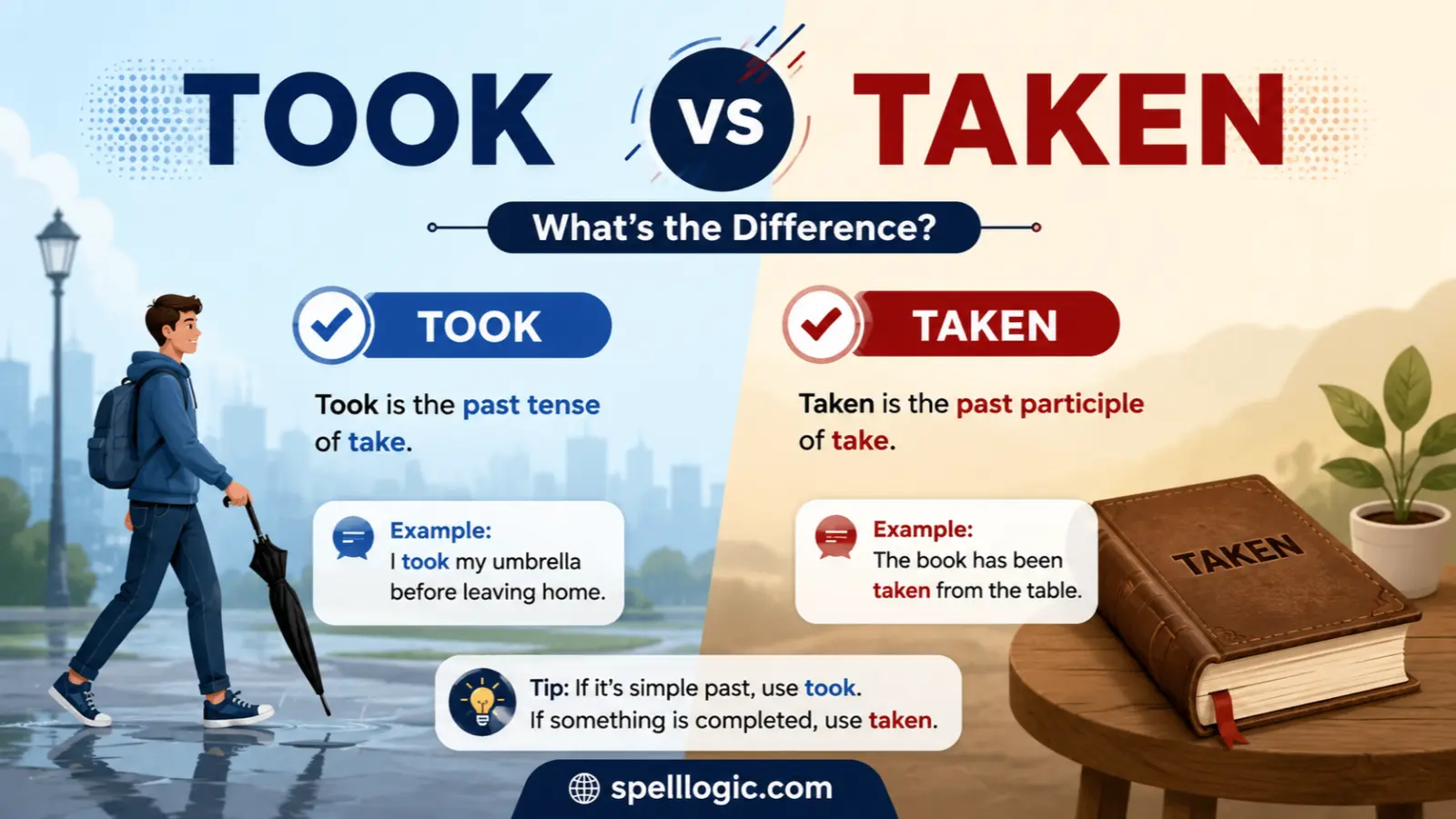
Many English learners confuse took and taken because both words come from the same verb, take, and both describe actions that happened in the past. However, they are not interchangeable. Using the wrong one can make your sentences sound awkward or grammatically incorrect.
Understanding when to use took and taken will help you speak and write English more naturally. In this guide, you’ll learn the difference in simple terms, see plenty of examples, avoid common mistakes, and discover easy memory tricks that will help you remember the correct usage every time.
Why “Took” and “Taken” Are Confusing
Many people struggle with took vs taken because both words come from the irregular verb take.
Here are the main reasons for the confusion:
Similar Pronunciation
Although took and taken sound different, learners often remember them as two past forms of the same verb and forget which one fits a sentence.
Similar Spelling
Both words begin with tak-, making them easy to confuse, especially for beginners.
Context Confusion
The biggest challenge is grammar.
- Took is the simple past tense.
- Taken is the past participle and usually needs a helping verb such as has, have, had, was, or were.
Common Learner Mistakes
Many learners write sentences like:
- I have took the book.
- She has took my pen.
These are incorrect because taken should follow helping verbs.
Took vs Taken Explained Simply
The easiest way to understand the difference is this:
Took is the simple past form of take, while taken is the past participle used with helping verbs.
One-Line Distinction
Took describes a completed action by itself, while taken needs an auxiliary (helping) verb.
Simple Explanation
- Took means someone performed the action in the past.
- Taken means the action is connected with a helping verb or passive voice.
Example Sentences
Took means…
- I took the bus yesterday.
- She took my notebook home.
Taken means…
- I have taken the bus many times.
- The documents were taken by the manager.
Understanding Homophones in English
What Are Homophones?
Homophones are words that sound the same but have different meanings and spellings.
For example:
- Sea and see
Although took and taken are not homophones, learners often confuse them because they are different forms of the same verb.
Why Homophones Cause Confusion
Words that sound alike can make writing difficult because people may choose the wrong spelling or grammar.
For example:
- Their house is large.
- They are going there tomorrow.
Similarly, learners confuse took and taken because they remember both as past forms without knowing which grammar rule applies.
What Does “Took” Mean?
Definition and Core Meaning
Took is the simple past tense of the verb take.
It describes an action that happened and finished in the past.
Origin and Historical Use
The verb take comes from Old Norse taka, meaning “to seize” or “to grasp.” Over time, English developed the irregular past tense took.
Modern Usage and Synonyms
Depending on the context, took may mean:
- Carried
- Grabbed
- Accepted
- Chose
- Removed
- Led
Key Points
- Simple past tense
- Used without a helping verb
- Describes completed past actions
- Very common in everyday English
Example Sentences
- I took my umbrella because it was raining.
- She took the train to work.
- We took several beautiful photographs.
- They took our advice seriously.
What Does “Taken” Mean?
Definition and Core Meaning
Taken is the past participle of take.
It cannot normally stand alone as the main verb. Instead, it works with helping verbs such as:
- has
- have
- had
- was
- were
- is
- been
Origin and Historical Context
Like took, taken developed from the Old Norse verb taka. English preserved it as the past participle form.
Modern Usage and Synonyms
Depending on context, taken can mean:
- Carried
- Captured
- Accepted
- Removed
- Occupied
- Chosen
Key Points
- Past participle
- Requires a helping verb
- Used in perfect tenses
- Used in passive voice
Example Sentences
- She has taken the exam.
- The package was taken yesterday.
- I had taken the wrong road.
- Your seat has already been taken.
Took vs Taken: Key Differences at a Glance
| Word | Part of Speech | Meaning | Example Context |
|---|---|---|---|
| Took | Simple past verb | Action completed in the past | I took the keys yesterday. |
| Taken | Past participle | Used with helping verbs or passive voice | I have taken the keys. |
How to Remember the Difference Between Took and Taken
Here are some simple memory tricks.
Easy Memory Trick 1
If there is has, have, or had, use taken.
- I have taken it.
- She had taken it.
Easy Memory Trick 2
If there is no helping verb, use took.
- I took it yesterday.
Association Technique
Think of this phrase:
Have = Taken
Whenever you see have, has, or had, your brain should automatically think taken.
Memorable Example
- Yesterday I took a picture.
- Today I have taken hundreds of pictures.
Common Mistakes and Confusions
Below are mistakes English learners often make.
Wrong
I have took your notebook.
Correct
I have taken your notebook.
Explanation: The helping verb have requires the past participle taken.
Wrong
She has took the train.
Correct
She has taken the train.
Explanation: Present perfect always uses taken.
Wrong
Yesterday I taken the bus.
Correct
Yesterday I took the bus.
Explanation: Simple past uses took.
Wrong
They had took our seats.
Correct
They had taken our seats.
Explanation: Past perfect uses taken.
Examples Section: Correct and Incorrect Usage
Example 1
✔ Correct: I took my passport yesterday.
✘ Incorrect: I taken my passport yesterday.
Example 2
✔ Correct: She has taken the medicine.
✘ Incorrect: She has took the medicine.
Example 3
✔ Correct: They took the wrong road.
✘ Incorrect: They have took the wrong road.
Example 4
✔ Correct: The books were taken from the shelf.
✘ Incorrect: The books were took from the shelf.
Example 5
✔ Correct: We had taken plenty of notes before the meeting.
✘ Incorrect: We had took plenty of notes before the meeting.
Example 6
✔ Correct: He took my advice seriously.
✘ Incorrect: He taken my advice seriously.
Self Assessment: Test Your Knowledge
Fill in the blanks with took or taken.
- I have ______ the wrong train.
- She ______ my umbrella yesterday.
- They had ______ all the books before noon.
- We ______ plenty of photos during the trip.
Self Assessment Answers
- taken
- took
- taken
- took
FAQs
Is it correct to say “I have took”?
No. The correct sentence is I have taken because the present perfect tense requires the past participle.
Is “took” the past tense of “take”?
Yes. Took is the simple past tense of take.
When should I use “taken”?
Use taken after helping verbs such as has, have, had, is, was, or were.
Can “taken” be used without a helping verb?
Generally, no. It normally requires a helping verb or appears in passive constructions.
Why is “taken” called a past participle?
Because it is the verb form used to create perfect tenses and passive voice.
Which is more common, “took” or “taken”?
Both are common, but they appear in different grammatical situations. Neither is more correct than the other—they simply serve different purposes.
How can I remember the difference quickly?
Remember this simple rule:
- Yesterday = took
- Have/Has/Had = taken
Final Conclusion: Using “Took” and “Taken” Correctly
Understanding the difference between took and taken is an important step toward mastering English grammar. Although both words come from the verb take, they have different grammatical roles. Took is the simple past tense and is used to describe an action that happened and finished in the past, such as “She took the train yesterday.” Taken, on the other hand, is the past participle and almost always appears with a helping verb, as in “She has taken the train many times.” Remembering this basic rule will help you avoid one of the most common mistakes made by English learners.
A helpful memory tip is to associate taken with helping verbs like has, have, and had, while using took whenever there is no helping verb and you are simply talking about a completed past action. Regular practice through reading, listening, and writing will make the distinction feel natural over time. Whenever you’re unsure, check whether your sentence includes a helping verb—if it does, taken is usually the correct choice. With consistent practice and attention to these simple rules, you’ll use took and taken confidently in everyday conversations, emails, school assignments, and professional writing. Every grammar rule you master brings you one step closer to speaking and writing English with greater clarity, accuracy, and confidence.