Introduction
Many English learners confuse general and generic because both words describe things that are broad or not specific. Although they sound somewhat similar and sometimes appear in related contexts, they do not have the same meaning. Using the wrong word can make your writing unclear or even change the meaning of your sentence.
If you are speaking English at work, writing an essay, or having a conversation, understanding the difference between general and generic will help you communicate more accurately. This guide explains both words in simple language with clear definitions, examples, comparison tables, and memory tips.
Why “General” and “Generic” Are Confusing
Many learners mistakenly think general and generic are interchangeable because both describe something that is not highly specific. However, they have different meanings and are used in different situations.
Similar Pronunciation
The words begin with the same sound, “gen-“, and their pronunciation is somewhat alike, making them easy to confuse in conversation.
Similar Spelling
Both words share the same first five letters (gener-), which can lead learners to assume they are simply different forms of the same word.
Context Confusion
Both words often appear in discussions about descriptions, products, medicine, education, and writing. For example:
- A general statement covers a broad topic.
- A generic product is not tied to a particular brand.
Because both involve the idea of “not being specific,” learners often mix them up.
Common Learner Mistakes
People commonly say:
- “This is a generic explanation.” (when they mean general explanation)
- “I bought a general medicine.” (when they mean generic medicine)
These mistakes happen because the meanings overlap slightly but are not identical.
General vs Generic Explained Simply
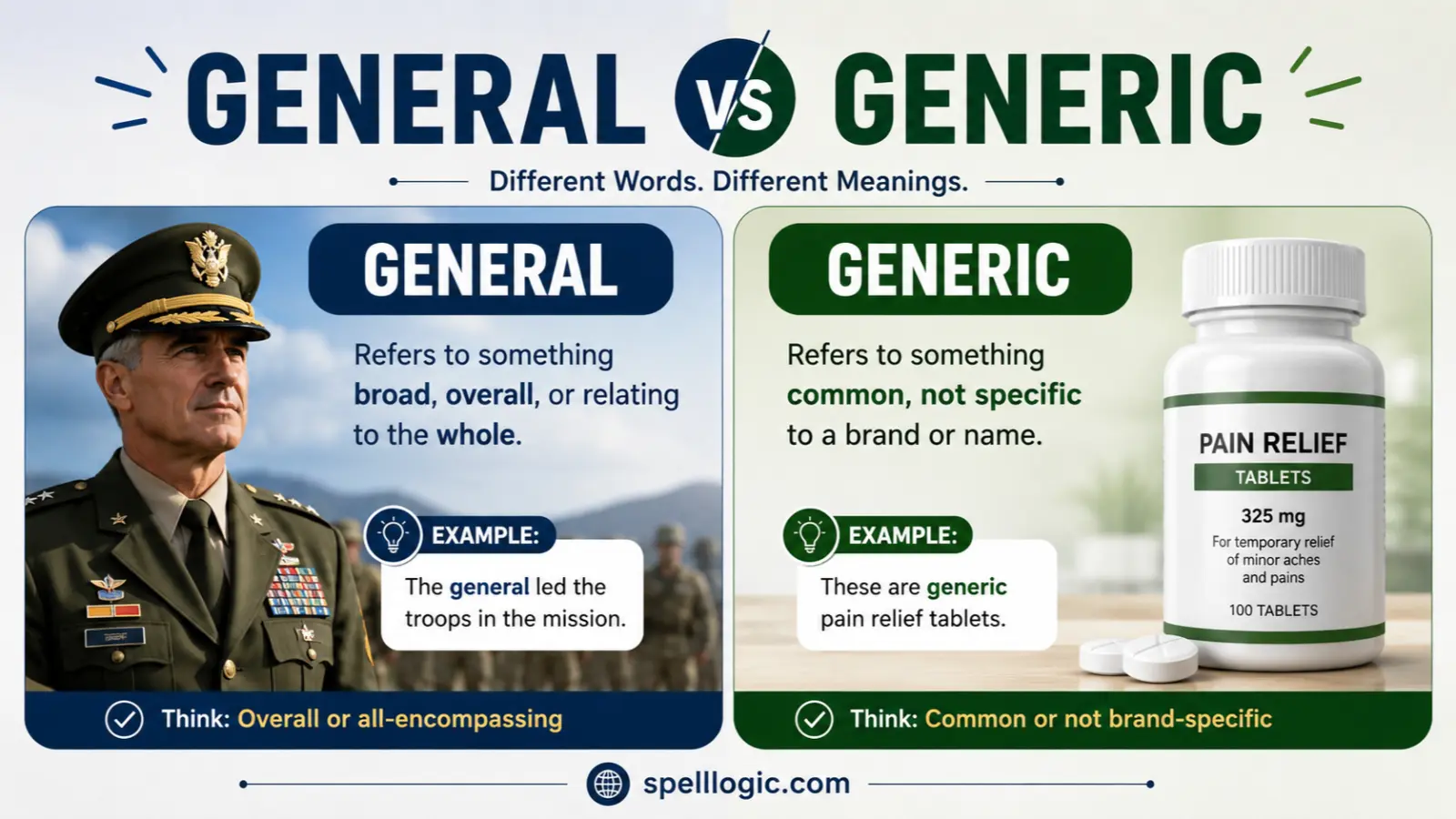
General means broad, overall, or covering many things.
Generic means common, non-branded, or lacking unique characteristics.
One-Line Distinction
General means broad or overall, while generic means standard, non-specific, or not associated with a particular brand.
Example Sentences
- We discussed the topic in general terms.
- The pharmacy offered a generic version of the medicine.
Another pair of examples:
- The manager gave a general overview of the project.
- That laptop bag has a generic design without any special features.
Understanding Homophones in English
What Are Homophones?
Homophones are words that sound the same but have different meanings and spellings.
Example:
- Sea and see
Although they sound identical, they have completely different meanings.
Note: General and generic are not true homophones because they do not sound exactly the same. However, they are commonly confused due to their similar pronunciation and related meanings.
Why Homophones Cause Confusion
English contains many words with similar sounds or spellings. Learners often rely on pronunciation instead of meaning, which can lead to mistakes.
For example:
- Their
- There
- They’re
These sound alike but have different meanings.
Likewise, general and generic are frequently confused because they look and sound similar, even though they serve different purposes.
What Does “General” Mean?
Definition and Core Meaning
General means broad, common, overall, or applying to many people or situations rather than one specific case.
It describes something that is wide in scope.
Origin and Historical Use
The word general comes from the Latin word generalis, meaning relating to a whole class or group. It entered English through Old French and has been used for centuries.
Modern Usage and Synonyms
Today, general is commonly used in education, business, government, medicine, and everyday conversation.
Synonyms
- Overall
- Broad
- Universal
- Common
- Widespread
- Comprehensive
Key Points
- Refers to a broad idea.
- Opposite of specific.
- Can describe information, rules, opinions, or situations.
- Used as both an adjective and a noun.
Example Sentences
- The teacher gave a general introduction to biology.
- I only have a general understanding of the topic.
- The report contains general recommendations.
- We discussed the issue in general terms.
What Does “Generic” Mean?
Definition and Core Meaning
Generic means relating to an entire class rather than a specific brand or unique item. It also refers to something plain, ordinary, or lacking distinctive qualities.
Origin and Historical Context
The word generic comes from the Latin genus, meaning kind or type. It has long been used in science and language, and today it is especially common in medicine and marketing.
Modern Usage and Synonyms
Today, generic often refers to products sold without a brand name or things that are ordinary in appearance.
Synonyms
- Non-branded
- Standard
- Ordinary
- Common
- Plain
- Conventional
Key Points
- Often refers to products without brand names.
- Can describe something lacking originality.
- Frequently used for medicines.
- Common in marketing and business.
Example Sentences
- The doctor prescribed a generic medicine.
- We bought the generic brand to save money.
- His presentation felt too generic.
- The packaging has a generic appearance.
General vs Generic: Key Differences at a Glance
| Word | Part of Speech | Meaning | Example Context |
|---|---|---|---|
| General | Adjective, Noun | Broad, overall, not specific | A general discussion about climate change |
| Generic | Adjective | Non-branded, ordinary, or lacking unique features | A generic version of a prescription drug |
How to Remember the Difference Between General and Generic
Here are some easy ways to remember the meanings.
Easy Memory Tricks
- General = Big Picture
- Generic = No Brand
Association Techniques
Imagine a classroom.
- The teacher gives a general explanation to everyone.
- Students buy generic notebooks without famous brand names.
One Memorable Example
General covers everyone; generic copies everyone.
This simple sentence helps you remember that general refers to broad ideas, while generic often refers to ordinary or non-branded things.
Common Mistakes and Confusions
Wrong Example
❌ I bought a general medicine.
✔ I bought a generic medicine.
Explanation: Medicines sold without brand names are called generic medicines.
Wrong Example
❌ The teacher gave a generic explanation.
✔ The teacher gave a general explanation.
Explanation: An explanation covering the main ideas is general, not generic.
Wrong Example
❌ This report is too generic because it discusses many topics.
✔ This report is too general because it discusses many topics.
Explanation: A broad discussion is general.
Wrong Example
❌ This company sells general products instead of branded ones.
✔ This company sells generic products instead of branded ones.
Explanation: Products without brand names are generic.
Examples Section: Correct and Incorrect Usage
Example 1
✔ Correct: The guide provides a general overview of the subject.
✘ Incorrect: The guide provides a generic overview of the subject.
Example 2
✔ Correct: The pharmacy recommended a generic medicine.
✘ Incorrect: The pharmacy recommended a general medicine.
Example 3
✔ Correct: We discussed the problem in general terms.
✘ Incorrect: We discussed the problem in generic terms.
Example 4
✔ Correct: The package has a generic design.
✘ Incorrect: The package has a general design.
Example 5
✔ Correct: She made a general statement about education.
✘ Incorrect: She made a generic statement about education.
Example 6
✔ Correct: Many supermarkets sell generic food products.
✘ Incorrect: Many supermarkets sell general food products.
Self Assessment: Test Your Knowledge
Fill in the blanks with general or generic.
- The teacher gave a __________ introduction to chemistry.
- Many customers choose __________ medicines because they cost less.
- His comments were too __________ and lacked detail.
- The supermarket sells several __________ brands.
Self Assessment Answers
- general
- generic
- general
- generic
FAQs
1. What is the main difference between general and generic?
General refers to something broad or overall, while generic refers to something non-branded, ordinary, or lacking unique features.
2. Can general and generic be used interchangeably?
No. Although they are related, they have different meanings and should be used in different contexts.
3. Why are generic medicines cheaper?
Generic medicines contain the same active ingredients as branded medicines but are usually sold without the costs associated with developing and marketing a brand.
4. Is a general statement always vague?
Not necessarily. A general statement covers a broad topic without focusing on specific details.
5. What does a generic product mean?
A generic product is a non-branded version of a product that performs the same basic function as a branded one.
6. Which word is more common in business writing?
Both are common, but general appears more often in reports and discussions, while generic is frequently used in marketing, retail, and healthcare.
7. How can I remember the difference easily?
Remember this simple rule:
- General = Overall idea
- Generic = No brand or ordinary
Final Conclusion: Using “General” and “Generic” Correctly
Understanding the difference between general and generic is an important step toward improving your English vocabulary and communication skills. Although these words look and sound similar, they serve different purposes. General describes something broad, overall, or applicable to many situations. It is commonly used when talking about ideas, information, discussions, opinions, or instructions that are not highly detailed. Generic, on the other hand, refers to something that belongs to a general class without being associated with a specific brand, or something that appears ordinary, standard, or lacking distinctive features. It is especially common when discussing medicines, products, marketing, and design.
A simple way to remember the difference is this: general gives the big picture, while generic describes something ordinary or non-branded. Keeping this memory trick in mind will help you choose the correct word with confidence in both speaking and writing.
As you continue learning English, pay attention to how these words appear in books, news articles, advertisements, and everyday conversations. The more examples you read and practice, the more natural the distinction will become. Small vocabulary improvements like this make a big difference in fluency, helping you write more accurately, speak more clearly, and understand English with greater confidence. Keep practicing, and you’ll master confusing word pairs one step at a time.