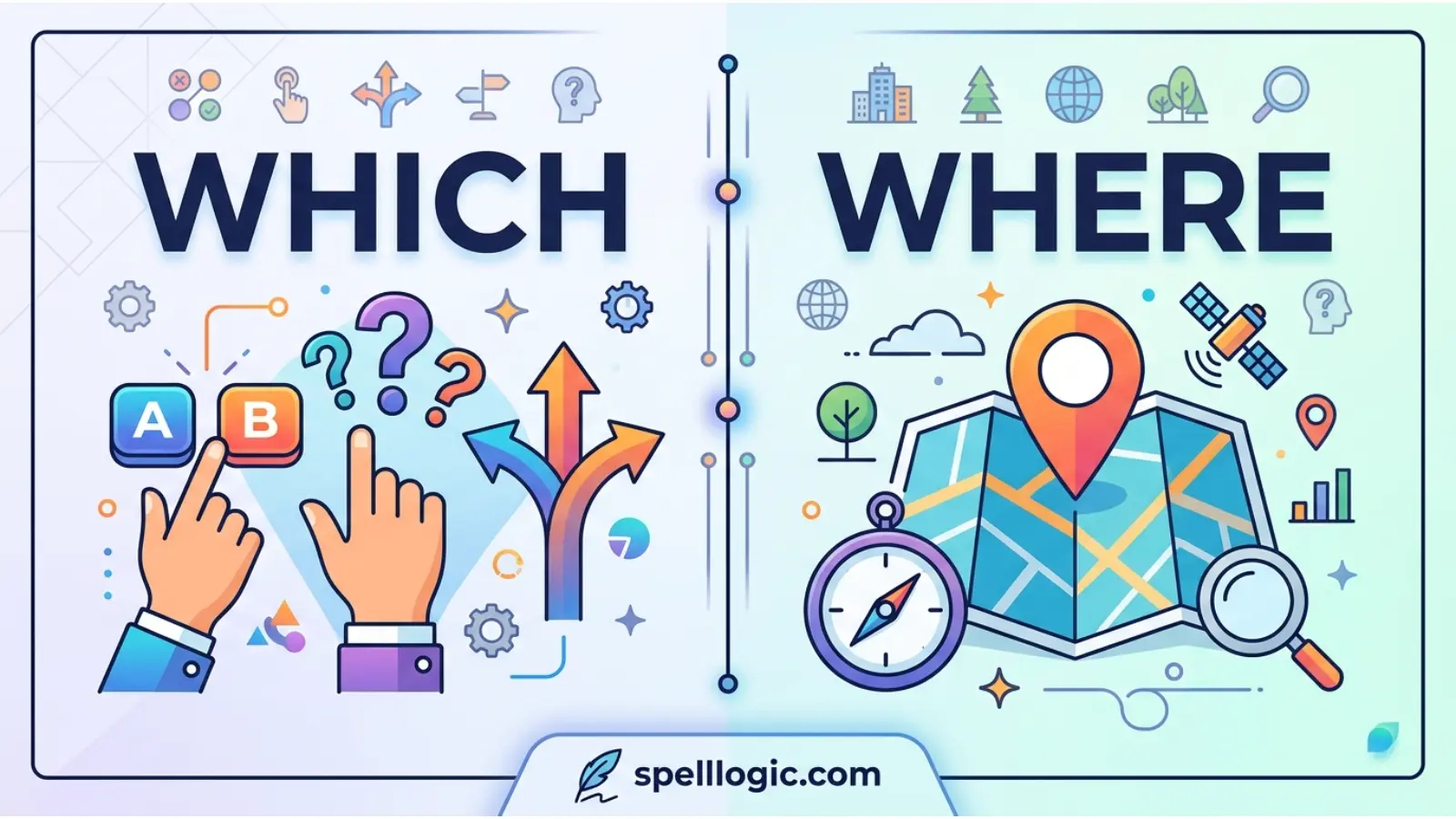
Many English learners confuse which and where because both words often appear in questions and relative clauses. Although they may seem similar in some sentences, they serve completely different purposes. Which helps identify or choose a person or thing from a group, while where refers to a place or location.
Using the wrong word can make your sentence sound unnatural or even change its meaning. Learning the difference between which vs where will improve your grammar, writing, and speaking skills. This guide explains each word in simple English, provides practical examples, and shares easy memory tips to help you use them correctly every time.
Why “Which” and “Where” Are Confusing
Many learners accidentally mix up which and where because both words introduce questions and relative clauses. However, they have different meanings and functions.
Similar Pronunciation
Both words begin with the “wh-“ sound, making them easy to confuse, especially for beginners.
Similar Spelling
- Both start with wh-.
- They are short words used frequently in English.
However, their endings and meanings are different.
Context Confusion
Both words appear in questions:
- Which book do you want?
- Where do you live?
They also introduce clauses:
- The restaurant where we met.
- The car which I bought.
Because they can appear in similar sentence structures, learners sometimes choose the wrong one.
Common Learner Mistakes
- Using where instead of which for objects.
- Using which instead of where for places.
- Forgetting that where always relates to location.
Which vs Where Explained Simply
The easiest way to remember the difference is this:
Which means what one or what choice, while where means in what place or location.
One-Line Distinction
Which is used for selecting from options, while where is used for talking about places.
Example Sentences
Which
- Which shirt do you prefer?
- Which movie won the award?
Where
- Where is your school?
- Where did you leave your phone?
Understanding Homophones in English
Although which and where are not homophones, learners often confuse them because they belong to the same family of WH- words used in questions.
What Are Homophones?
Homophones are words that sound the same but have different meanings and spellings.
Example:
- Sea
- See
Although they sound alike, they have different meanings.
Why Homophones Cause Confusion
English contains many words that sound similar or belong to similar word families. Learners may choose the wrong word because of pronunciation rather than meaning.
Example:
- Their
- There
Knowing each word’s meaning helps prevent these mistakes.
What Does “Which” Mean?
Definition and Core Meaning
Which is a determiner and pronoun used to identify or choose one or more people or things from a known group.
It asks about a specific choice.
Origin and Historical Use
The word which comes from Old English hwilc, meaning what one or which one. It has been part of English for centuries.
Modern Usage and Synonyms
Depending on the sentence, similar expressions include:
- What one
- Which one
- Whichever
- The one that
Key Points
- Used for choices.
- Refers to people, animals, or things.
- Appears in questions and relative clauses.
- Common in formal and informal English.
Example Sentences
- Which color do you like best?
- Which student answered correctly?
- This is the laptop which I bought yesterday.
- Which option is cheaper?
What Does “Where” Mean?
Definition and Core Meaning
Where is an adverb and conjunction used to ask or describe a location or place.
It answers the question:
In what place?
Origin and Historical Context
Where comes from Old English hwær, meaning at what place. It has always referred to location.
Modern Usage and Synonyms
Depending on context, similar expressions include:
- At what place
- In which place
- Wherever
- The place where
Key Points
- Refers to location.
- Used in questions.
- Introduces relative clauses about places.
- Common in everyday conversation.
Example Sentences
- Where are my keys?
- Where does she work?
- This is the park where we met.
- Tell me where you found it.
Which vs Where: Key Differences at a Glance
| Word | Part of Speech | Meaning | Example Context |
|---|---|---|---|
| Which | Pronoun, Determiner | Refers to a choice or selection | Which dress should I wear? |
| Where | Adverb, Conjunction | Refers to a place or location | Where do you live? |
How to Remember the Difference Between Which and Where
Here are some easy tricks.
Memory Trick 1
Ask yourself:
Am I choosing something?
If yes, use which.
Example:
- Which cake would you like?
Memory Trick 2
Ask yourself:
Am I talking about a place?
If yes, use where.
Example:
- Where is the library?
Association Technique
Think of:
- Which = Choice
- Where = Place
Notice that which and choice both involve selecting one item, while where reminds you of location.
Memorable Example
- Which restaurant should we visit?
- Where is that restaurant?
The first asks for a choice.
The second asks for its location.
Common Mistakes and ConfusionMistake 1
❌ Where color do you like?
✔ Which color do you like?
Explanation: Colors are choices, not places.
Mistake 2
❌ Which do you live?
✔ Where do you live?
Explanation: Living refers to a location.
Mistake 3
❌ This is the city which we met.
✔ This is the city where we met.
Explanation: The meeting happened in a place.
Mistake 4
❌ Where book is yours?
✔ Which book is yours?
Explanation: Books are choices.
Examples Section: Correct and Incorrect Usage
Example 1
✔ Correct: Which jacket fits you best?
✘ Incorrect: Where jacket fits you best?
Example 2
✔ Correct: Where did you park your car?
✘ Incorrect: Which did you park your car?
Example 3
✔ Correct: Which answer is correct?
✘ Incorrect: Where answer is correct?
Example 4
✔ Correct: This is the office where I work.
✘ Incorrect: This is the office which I work.
Example 5
✔ Correct: Which phone would you recommend?
✘ Incorrect: Where phone would you recommend?
Example 6
✔ Correct: Where are the children playing?
✘ Incorrect: Which are the children playing?
Self Assessment: Test Your Knowledge
Fill in the blanks with which or where.
- ______ city were you born in?
- ______ dress do you want to buy?
- Do you remember ______ we parked the car?
- ______ subject is your favorite?
Self Assessment Answers
- Where
- Which
- Where
- Which
FAQs
1. What is the main difference between which and where?
Which refers to choosing from options, while where refers to a place or location.
2. Can “which” refer to a place?
Yes, but only when identifying something rather than asking about its location.
Example:
- Which city is the largest?
3. Can “where” replace “which”?
No. Where is only used when talking about places or locations.
4. Is “where” a pronoun?
No. It is mainly an adverb and can also introduce relative clauses.
5. Is “which” used in relative clauses?
Yes.
Example:
- The book which I borrowed is interesting.
6. Why do learners confuse which and where?
Because both begin with WH-, frequently appear in questions, and are common in everyday English.
7. How can I remember the difference quickly?
Remember:
- Which = Choice
- Where = Place
This simple rule works in most situations.
Final Conclusion: Using “Which” and “Where” Correctly
Understanding the difference between which and where is an important step toward mastering English grammar. Although these two words often appear in similar sentence patterns, they perform very different jobs. Which is used when you need to identify or choose one person, object, or option from a known group. Where, on the other hand, is used whenever you are asking about or describing a place or location. Keeping this distinction in mind will help you avoid many common mistakes in speaking and writing.
A useful way to remember them is to think of which as the word for choice and where as the word for place. Before using either word, ask yourself a simple question: Am I selecting something, or am I talking about a location? If you’re making a choice, use which. If you’re referring to a place, use where. Practicing with real-life examples, reading English regularly, and paying attention to how native speakers use these words will make the difference feel natural over time. Every small grammar rule you learn builds stronger communication skills, so keep practicing, stay curious, and enjoy your journey toward confident English.