Many English learners get confused by millage and mileage because the two words look and sound very similar. However, they do not mean the same thing, and one of them is far more common in everyday English. Knowing the difference can help you avoid mistakes in writing, conversations, business documents, and discussions about vehicles or taxes.
Whether you’re learning English for school, work, or travel, understanding these confusing words will improve your vocabulary and make your communication more accurate. In this guide, you’ll learn the meaning, history, usage, and key differences between millage and mileage in simple, easy-to-understand language.
Table of Contents
- Introduction
- Why “Millage” and “Mileage” Are Confusing
- Millage vs Mileage Explained Simply
- Understanding Homophones in English
- What Does “Millage” Mean?
- What Does “Mileage” Mean?
- Millage vs Mileage: Key Differences at a Glance
- How to Remember the Difference Between Millage and Mileage
- Common Mistakes and Confusions
- Examples Section: Correct and Incorrect Usage
- Self Assessment: Test Your Knowledge
- Self Assessment Answers
- FAQs About “Millage and Mileage”
- Final Conclusion: Using “Millage” and “Mileage” Correctly
Why “Millage” and “Mileage” Are Confusing
Many people accidentally mix up millage and mileage because they share several similarities.
Similar Pronunciation
Both words begin with mill- and are pronounced in a similar way, making them easy to confuse when spoken.
Similar Spelling
Only one letter separates the two words:
- Millage
- Mileage
That extra “e” changes the meaning completely.
Context Confusion
People often hear these words in discussions about money, transportation, or local government. Since both can appear in official documents, learners sometimes assume they are interchangeable.
Common Learner Mistakes
Some common mistakes include:
- Using millage when talking about a car’s fuel efficiency.
- Writing mileage tax when referring to a property tax rate.
- Assuming millage is simply another spelling of mileage.
Remember: these words belong to different contexts.
Millage vs Mileage Explained Simply
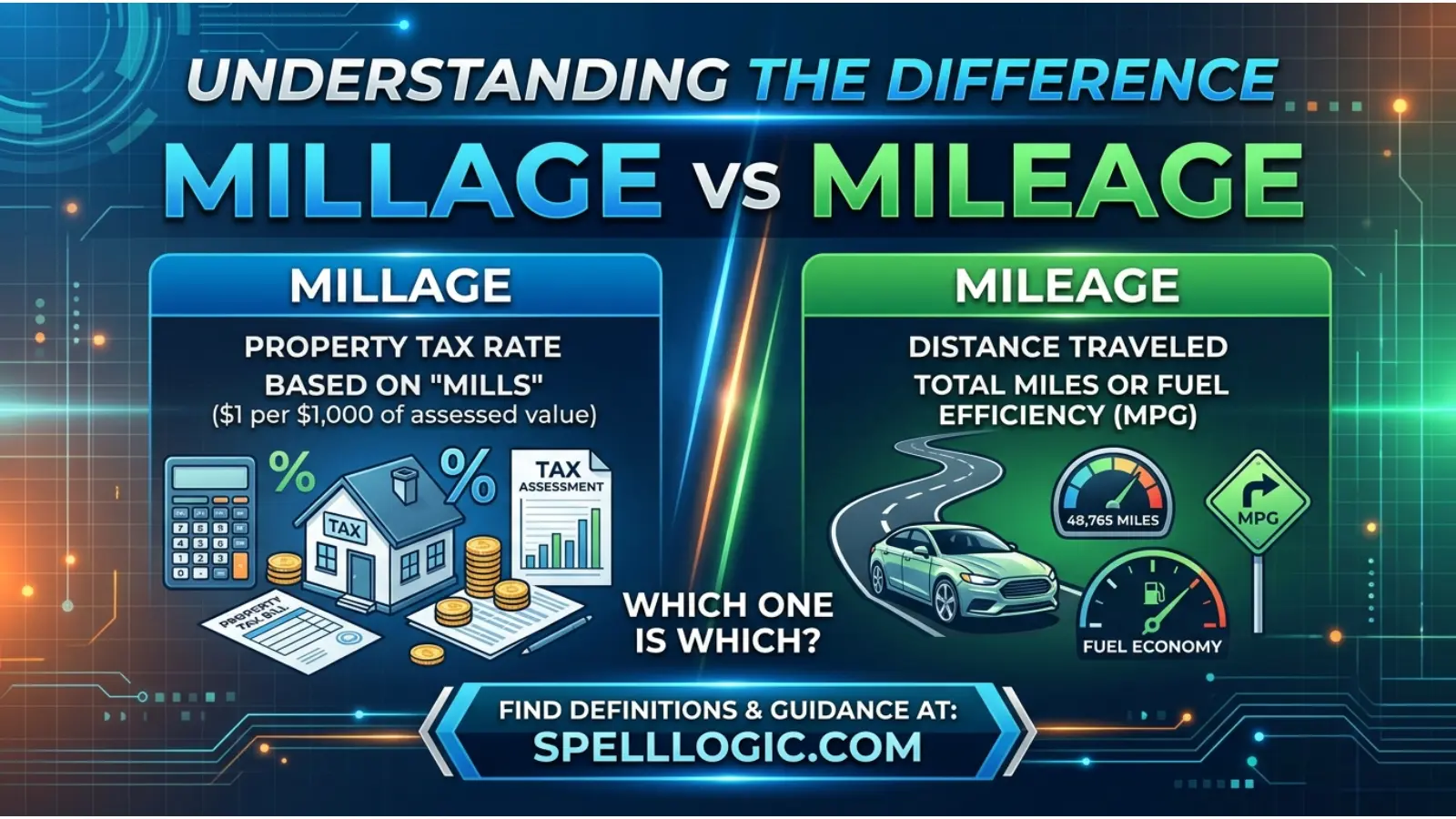
Millage refers to a property tax rate calculated in mills.
Mileage refers to the distance a vehicle has traveled or its fuel efficiency.
One-Line Distinction
Millage relates to taxes, while mileage relates to travel and vehicles.
Example Sentences
- Millage means the tax rate used by local governments, while mileage means the distance traveled by a vehicle.
- The city increased its millage rate to fund public schools.
- This car gets excellent mileage on the highway.
Understanding Homophones in English
Although millage and mileage sound somewhat alike, they are not true homophones because their pronunciations are slightly different. However, they are commonly confused due to their similar spelling and pronunciation.
What Are Homophones?
Homophones are words that sound the same but have different meanings and spellings.
Example:
- Sea
- See
These words sound identical but have different meanings.
Why Homophones Cause Confusion
English contains many words with similar sounds. Learners often rely on pronunciation, leading to spelling mistakes.
For example:
- They’re going to the park.
- I have two dogs.
The words sound alike but have different meanings.
Similarly, millage and mileage can confuse learners because of their similar appearance and pronunciation.
What Does “Millage” Mean?
Definition and Core Meaning
Millage is the tax rate used to calculate property taxes.
A mill equals one dollar of tax for every $1,000 of assessed property value.
Millage is mainly used in government, finance, and real estate.
Origin and Historical Use
The word millage comes from the word mill, which was once a monetary unit equal to one-thousandth of a dollar. Governments later adopted it to express property tax rates.
Modern Usage and Synonyms
Today, millage appears mostly in:
- Property tax documents
- Government budgets
- Municipal finance
- School district tax discussions
Possible related terms include:
- Property tax rate
- Tax levy
- Assessment rate
Example Sentences
- The county approved a higher millage rate this year.
- Residents voted against increasing the school millage.
- The property’s taxes depend on the local millage rate.
What Does “Mileage” Mean?
Definition and Core Meaning
Mileage refers to:
- The number of miles a vehicle has traveled.
- A vehicle’s fuel efficiency.
- The usefulness or benefit someone gets from something (figurative meaning).
Origin and Historical Context
The word mileage developed from mile, a unit of distance, combined with the suffix -age, indicating measurement or result.
It has been widely used since automobiles became common.
Modern Usage and Synonyms
Today, mileage commonly refers to:
- Vehicle distance
- Fuel economy
- Travel distance
- Practical benefit
Related words include:
- Distance
- Fuel economy
- Fuel efficiency
- Range
- Travel distance
Example Sentences
- My car has low mileage, so it’s still in excellent condition.
- This hybrid offers outstanding mileage.
- Your actual mileage may vary depending on driving conditions.
- We claimed business mileage for our work trips.
Millage vs Mileage: Key Differences at a Glance
| Word | Part of Speech | Meaning | Example Context |
|---|---|---|---|
| Millage | Noun | Property tax rate measured in mills | The city raised the millage rate. |
| Mileage | Noun | Distance traveled or fuel efficiency | This SUV gets great highway mileage. |
How to Remember the Difference Between Millage and Mileage
Here are some easy memory tricks.
Memory Trick 1
Millage = Mill = Money = Taxes
Think of mill as a financial term.
Memory Trick 2
Mileage = Mile = Distance
If you see the word mile, think about roads, cars, and travel.
Association Technique
- Millage → Government → Property Tax
- Mileage → Vehicle → Miles Driven
Memorable Example
Taxes use millage. Cars use mileage.
This simple sentence helps most learners remember the difference.
Common Mistakes and Confusions
Wrong Example
❌ My new car gets excellent millage.
✅ My new car gets excellent mileage.
Explanation: Fuel efficiency uses mileage, not millage.
Wrong Example
❌ The county increased its mileage rate.
✅ The county increased its millage rate.
Explanation: Property taxes use millage.
Wrong Example
❌ The school board voted on the new mileage.
✅ The school board voted on the new millage.
Explanation: School funding often involves property tax rates.
Wrong Example
❌ This truck has very low millage.
✅ This truck has very low mileage.
Explanation: Vehicle distance is always mileage.
Examples Section: Correct and Incorrect Usage
Example 1
✔ Correct: The county approved a new millage rate.
✘ Incorrect: The county approved a new mileage rate.
Example 2
✔ Correct: My car gets 40 miles per gallon, so its mileage is excellent.
✘ Incorrect: My car gets great millage.
Example 3
✔ Correct: The homeowners discussed the proposed millage increase.
✘ Incorrect: The homeowners discussed the proposed mileage increase.
Example 4
✔ Correct: High mileage cars often cost less than low-mileage cars.
✘ Incorrect: High millage cars often cost less.
Self Assessment: Test Your Knowledge
Fill in the blanks with millage or mileage.
- The city voted to increase the property tax ________.
- My new hybrid gets excellent ________.
- The county reduced the ________ rate for homeowners.
- We tracked our business ________ for reimbursement.
Self Assessment Answers
- millage
- mileage
- millage
- mileage
FAQs
No. Millage refers to a property tax rate, while mileage refers to distance traveled or fuel efficiency.
2. Which word is used for cars?
Mileage is the correct word when discussing vehicles, travel distance, or fuel economy.
3. What does millage mean in property taxes?
It is the tax rate used to calculate how much property tax a homeowner must pay.
4. Is millage a common English word?
It is less common than mileage and is mainly used in government, finance, and real estate.
5. Why do people confuse millage and mileage?
They look and sound similar, making them easy to mix up, especially for English learners.
6. Can mileage mean usefulness?
Yes. In informal English, mileage can also mean the value or benefit gained from something, as in “You’ll get a lot of mileage out of that idea.”
7. Which spelling should I use for fuel efficiency?
Always use mileage when talking about fuel efficiency or the distance a vehicle travels.
Final Conclusion: Using “Millage” and “Mileage” Correctly
Understanding the difference between millage and mileage is easier once you know the context in which each word is used. Millage is a financial term that refers to a property tax rate measured in mills. It is commonly found in government reports, tax documents, and discussions about public funding. Mileage, on the other hand, relates to miles traveled, a vehicle’s fuel efficiency, or even the practical value gained from something over time. Although the words look and sound similar, they serve completely different purposes in English.
A simple way to remember them is this: millage is about money and taxes, while mileage is about miles and movement. Whenever you’re discussing cars, fuel economy, road trips, or travel expenses, mileage is almost always the correct choice. If you’re reading about property taxes or municipal budgets, millage is the word you need.
Learning the difference between commonly confused words like these will make your English more accurate and confident. Keep practicing with real-life examples, pay attention to context, and review new vocabulary regularly. Over time, choosing between millage and mileage will become second nature, helping you communicate more clearly in both everyday conversations and professional writing.