Many English learners struggle with less and lesser because both words refer to a smaller amount or lower degree. Since they look and sound similar, people often use them interchangeably, even though they have different meanings and grammatical roles. Knowing when to use less instead of lesser can make your English sound more natural and accurate.
Whether you’re writing essays, emails, or having everyday conversations, understanding this distinction will help you avoid common mistakes. In this guide, you’ll learn the meanings, differences, examples, and memory tips that make using less and lesser simple and confident.
Table of Contents
- Introduction
- Why “Less” and “Lesser” Are Confusing
- Less vs Lesser Explained Simply
- Understanding Homophones in English
- What Does “Less” Mean?
- What Does “Lesser” Mean?
- Less vs Lesser: Key Differences at a Glance
- How to Remember the Difference Between Less and Lesser
- Common Mistakes and Confusions
- Examples Section: Correct and Incorrect Usage
- Self Assessment: Test Your Knowledge
- Self Assessment Answers
- FAQs About Less and Lesser
- Final Conclusion: Using Less and Lesser Correctly
Why “Less” and “Lesser” Are Confusing
Many learners mix up less and lesser because they come from the same word family and express the idea of something being smaller or lower.
Similar Pronunciation
The two words sound almost alike. The only noticeable difference is the extra -er at the end of lesser.
Similar Spelling
Both words begin with less, making them easy to confuse while reading or writing.
Context Confusion
Both words describe a lower amount, degree, or importance. However, less is much more common and is used in many everyday situations, while lesser is mainly used before nouns to describe something of lower importance or quality.
Common Learner Mistakes
- Saying less importance when lesser importance is more appropriate in formal writing.
- Saying less person instead of fewer people.
- Using lesser before numbers or quantities where less is correct.
- Assuming lesser is simply a stronger version of less.
Less vs Lesser Explained Simply
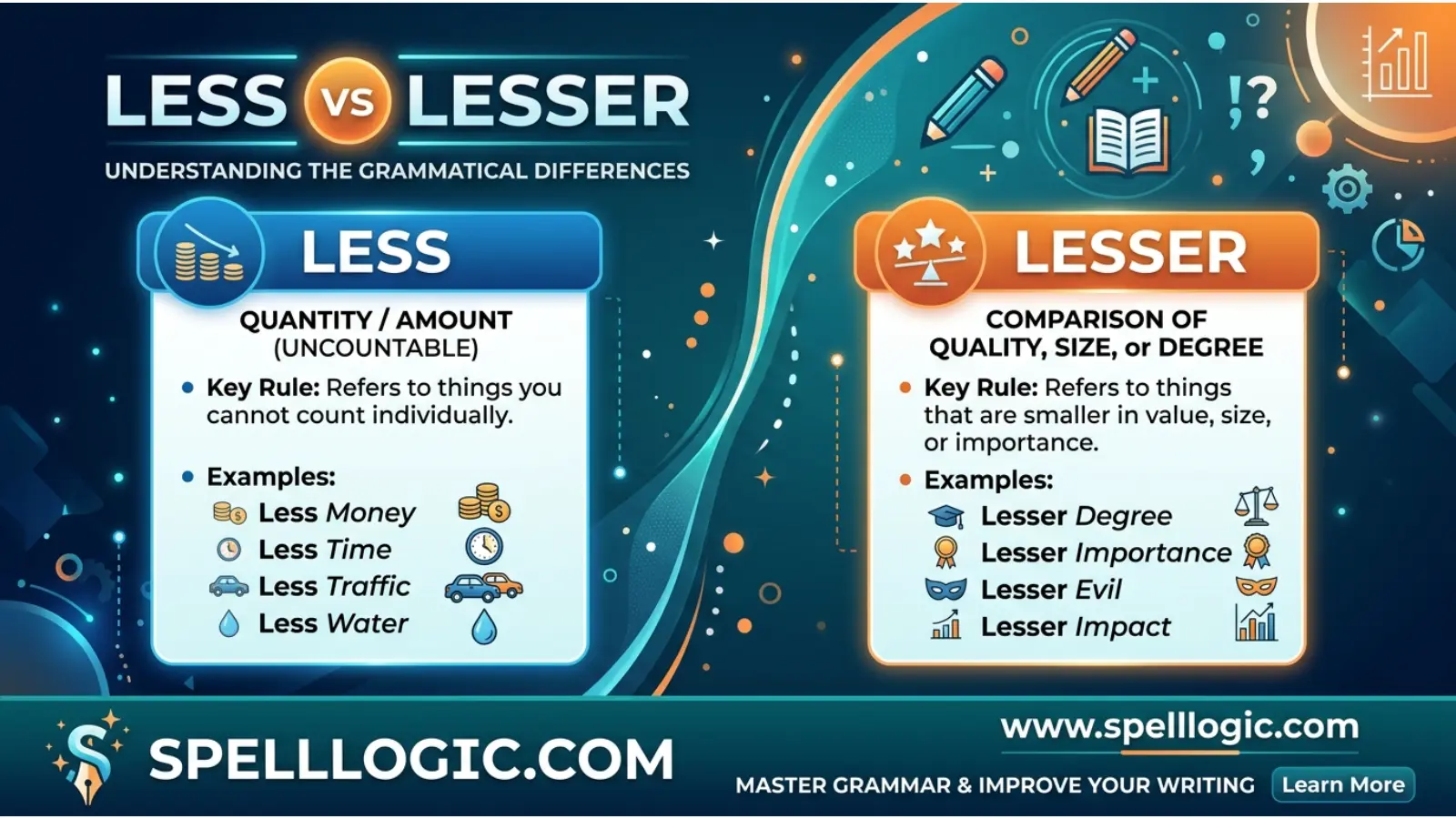
Less means a smaller amount, degree, or extent, while lesser means lower in importance, rank, quality, or status.
One-Line Distinction
Less is usually about quantity or degree, while lesser describes importance, rank, or quality.
Example Sentences
- We need less sugar in this recipe.
- She chose the lesser of the two problems.
Another example:
- Less means a smaller amount, while lesser means lower in importance or status.
- I spend less time on social media now.
- The committee discussed the lesser issue first.
Understanding Homophones in English
What Are Homophones?
Homophones are words that sound the same or nearly the same but have different meanings and often different spellings.
Example:
- Sea and see
These words sound alike but have completely different meanings.
Note: Less and lesser are not homophones because they do not sound exactly the same. They are simply similar-sounding words that learners often confuse.
Why Homophones Cause Confusion
When two words sound similar, learners may rely on pronunciation instead of meaning.
For example:
- Their house is beautiful.
- They are standing there.
Although less and lesser are not homophones, their similar appearance and related meanings create similar confusion.
What Does “Less” Mean?
Definition and Core Meaning
Less means a smaller amount, lower degree, or reduced quantity.
It is commonly used with uncountable nouns and comparisons.
Origin and Historical Use
The word less comes from Old English lǣssa, meaning “smaller” or “not as much.” It has been used in English for over one thousand years.
Modern Usage and Synonyms
Common synonyms include:
- Smaller amount
- Lower
- Reduced
- Not as much
- Fewer (in some informal contexts, though fewer is preferred for countable nouns)
Key Points
- Used with uncountable nouns.
- Used in comparisons.
- Very common in everyday English.
- Functions as an adjective, adverb, determiner, and pronoun.
Example Sentences
- I have less money than last month.
- Please use less salt.
- She feels less confident today.
- We need less noise during the meeting.
What Does “Lesser” Mean?
Definition and Core Meaning
Lesser means lower in importance, rank, quality, or significance.
It usually describes something that is not the main or more important option.
Origin and Historical Context
Lesser developed as the comparative adjective related to little and has long been used in English to compare importance or status rather than quantity.
It often appears in formal writing, literature, and legal language.
Modern Usage and Synonyms
Common synonyms include:
- Inferior
- Minor
- Secondary
- Smaller
- Lower-ranking
- Less important
Key Points
- Usually comes before a noun.
- Describes importance rather than amount.
- Common in formal English.
- Less common in everyday conversation.
Example Sentences
- He accepted the lesser role in the play.
- Choose the lesser evil.
- The museum also displays works by lesser artists.
- We focused on the lesser concern first.
Less vs Lesser: Key Differences at a Glance
| Word | Part of Speech | Meaning | Example Context |
|---|---|---|---|
| Less | Determiner, adjective, adverb, pronoun | Smaller amount or lower degree | I drink less coffee now. |
| Lesser | Adjective | Lower in importance, quality, or rank | He accepted the lesser position. |
How to Remember the Difference Between Less and Lesser
Learning a simple memory trick can help you choose the correct word every time.
Easy Memory Tricks
- Less = Amount
- Lesser = Importance
Association Technique
Think of the extra -er in lesser as standing for rank or role.
If you’re talking about how much there is, use less.
If you’re talking about importance or status, use lesser.
Memorable Example
- We need less water.
- This is the lesser problem.
The first sentence refers to quantity.
The second refers to importance.
Common Mistakes and Confusions
Wrong
We need lesser water.
Correct
We need less water.
Explanation: Water is an amount, not a level of importance.
Wrong
He accepted the less position.
Correct
He accepted the lesser position.
Explanation: The position has lower rank or status.
Wrong
She has lesser homework today.
Correct
She has less homework today.
Explanation: Homework refers to quantity.
Wrong
This is the less of two evils.
Correct
This is the lesser of two evils.
Explanation: The expression refers to choosing the option that is less harmful.
Examples Section: Correct and Incorrect Usage
Example 1
✔ Correct: I spend less time watching television.
✘ Incorrect: I spend lesser time watching television.
Example 2
✔ Correct: We chose the lesser risk.
✘ Incorrect: We chose the less risk.
Example 3
✔ Correct: Please add less sugar.
✘ Incorrect: Please add lesser sugar.
Example 4
✔ Correct: The judge punished the lesser offense.
✘ Incorrect: The judge punished the less offense.
Example 5
✔ Correct: She earns less than her brother.
✘ Incorrect: She earns lesser than her brother.
Example 6
✔ Correct: The company focused on lesser priorities later.
✘ Incorrect: The company focused on less priorities later.
Self Assessment: Test Your Knowledge
Fill in the blanks with less or lesser.
- Please use ______ milk in your coffee.
- They selected the ______ of the two risks.
- We have ______ information than before.
- The manager handled the ______ issue first.
Self Assessment Answers
- less
- lesser
- less
- lesser
FAQs
No. Less refers to quantity or degree, while lesser refers to lower importance, quality, or rank.
Which word is more common?
Less is much more common in everyday English.
Can I say “lesser amount”?
Yes. Although less amount is common, lesser amount can appear in formal contexts to emphasize a comparatively smaller amount. However, less is usually the more natural choice.
Why do people say “the lesser of two evils”?
Because lesser compares two undesirable choices and refers to the one that is less harmful or less serious.
Is “lesser” formal?
Yes. It appears more often in formal writing, legal language, and literature than in casual conversation.
Can “less” be an adverb?
Yes. For example:
- She works less now than before.
Should I use “less” or “lesser” with uncountable nouns?
Use less.
Example:
- Less water
- Less money
- Less information
Final Conclusion: Using “Less” and “Lesser” Correctly
Understanding the difference between less and lesser can greatly improve your English speaking and writing skills. Although these two words share the same root and express the idea of something being smaller or lower, they are not interchangeable. Less is the word you should use when talking about a smaller amount, lower degree, or reduced quantity. It appears frequently in everyday conversations and is one of the most common comparison words in English. Lesser, on the other hand, describes something that has lower importance, status, quality, or significance. You will often see it in formal writing, academic texts, legal documents, and fixed expressions such as “the lesser of two evils.”
A simple way to remember the difference is this: less measures quantity, while lesser compares importance. Whenever you are discussing how much of something there is, choose less. If you are comparing rank, value, or significance, choose lesser. Practicing with real examples and paying attention to context will help these distinctions become second nature. As you continue learning English, small grammar differences like this will make your communication clearer, more natural, and more confident. Keep reading, writing, and practicing, and you’ll soon find that choosing between less and lesser becomes easy.