Introduction
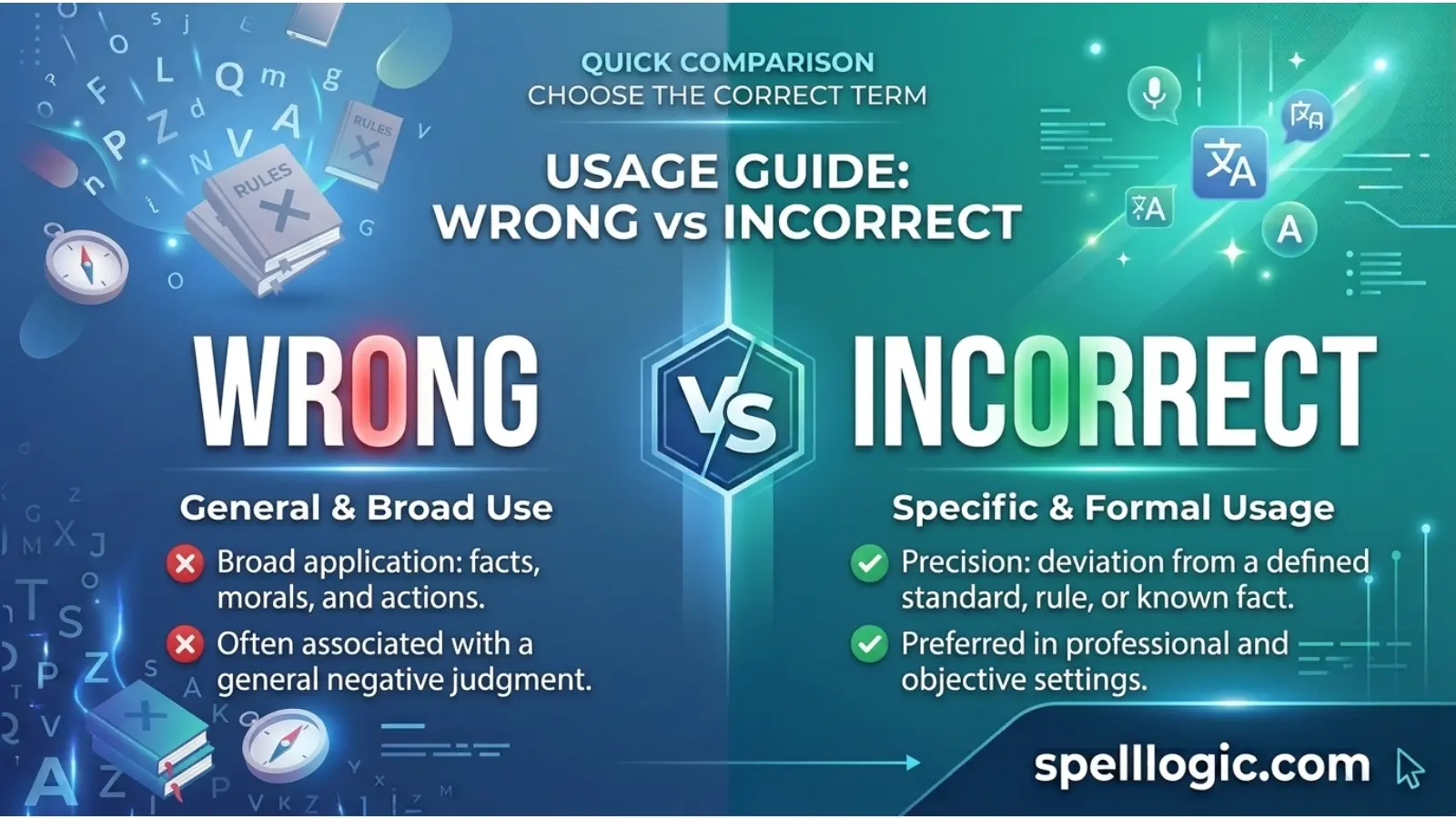
Many English learners use wrong and incorrect as if they mean exactly the same thing. While both words describe something that is not right or not true, they are not always interchangeable. In everyday conversations, people often say wrong, while incorrect is more common in formal writing, education, and professional settings.
Knowing the difference can help you sound more natural and choose the most suitable word for every situation. In this guide, you’ll learn the meanings, uses, examples, memory tips, and common mistakes so you can confidently use wrong and incorrect in both spoken and written English.
Why “Wrong” and “Incorrect” Are Confusing
Many learners confuse wrong and incorrect because both words describe mistakes or something that is not right.
Similar Pronunciation
Although they do not sound alike, both words are commonly heard in discussions about mistakes, tests, and answers. This makes learners believe they have exactly the same meaning.
Similar Spelling
The words are not spelled similarly. However, they frequently appear in similar contexts, especially in classrooms and written exercises.
Context Confusion
In many situations, both words can describe an incorrect answer.
For example:
- Your answer is wrong.
- Your answer is incorrect.
Both sentences are correct, but incorrect sounds more formal.
Common Learner Mistakes
Learners often:
- Use incorrect in casual conversations where wrong sounds more natural.
- Think wrong only refers to moral behavior.
- Believe the two words can always replace each other without changing the tone.
Wrong vs Incorrect Explained Simply
The easiest way to understand the difference is by thinking about formality.
Wrong is an everyday word that means not right, mistaken, unsuitable, or morally bad.
Incorrect mainly means not accurate or not according to facts, rules, or standards.
One-Line Distinction
Wrong is broader and more common in everyday English, while incorrect is more formal and usually refers to factual or grammatical errors.
Simple Explanation
Wrong means something is not right, while incorrect means something is not accurate according to rules or facts.
Example Sentences
- She took the wrong bus.
- Your answer is incorrect.
Another pair:
- I dialed the wrong number.
- The report contains incorrect information.
Understanding Homophones in English
What Are Homophones?
Homophones are words that sound the same but have different meanings and spellings.
Example:
- Sea
- See
They sound identical but have different meanings.
Wrong and incorrect are not homophones. They are simply words with similar meanings (near synonyms).
Why Homophones Cause Confusion
Homophones confuse learners because pronunciation is identical while meanings differ.
Example:
- I went to the sea.
- I can see the mountains.
Although wrong and incorrect are not homophones, they still confuse learners because they often appear in the same situations.
What Does “Wrong” Mean?
Definition and Core Meaning
Wrong means:
- Not correct
- Mistaken
- Untrue
- Unsuitable
- Morally bad or unfair
It is one of the most common English words.
Origin and Historical Use
The word wrong comes from Old Norse and Old English influences, where it originally referred to something crooked, twisted, or unjust. Over time, its meaning expanded to include mistakes, errors, and unfair actions.
Modern Usage and Synonyms
Today, wrong is widely used in everyday English.
Common synonyms include:
- Mistaken
- False
- Inaccurate
- Improper
- Faulty
- Untrue
- Unjust
Key Points
- Common in conversations
- Can describe facts or behavior
- Used in both formal and informal English
- Often expresses opinions
Example Sentences
- You are wrong about the meeting time.
- We went the wrong way.
- It is wrong to cheat.
- She entered the wrong password.
What Does “Incorrect” Mean?
Definition and Core Meaning
Incorrect means:
- Not correct
- Not accurate
- Not following rules or facts
It focuses on factual or technical accuracy.
Origin and Historical Context
The word comes from Latin roots through French. It has been used in English for centuries to describe information, grammar, mathematics, and facts that do not meet accepted standards.
Modern Usage and Synonyms
Today, incorrect commonly appears in:
- Schools
- Exams
- Business writing
- Technical documents
- Academic English
Common synonyms include:
- Inaccurate
- Mistaken
- False
- Erroneous
- Invalid
Key Points
- More formal than wrong
- Focuses on facts and rules
- Frequently used in education
- Common in professional writing
Example Sentences
- Your calculation is incorrect.
- The address on the form is incorrect.
- His grammar was incorrect.
- The information provided was incorrect.
Wrong vs Incorrect: Key Differences at a Glance
| Word | Part of Speech | Meaning | Example Context |
|---|---|---|---|
| Wrong | Adjective, adverb, noun, verb | Not right, mistaken, unsuitable, morally bad | Wrong answer, wrong decision, wrong direction |
| Incorrect | Adjective | Not accurate or not according to facts or rules | Incorrect spelling, incorrect information, incorrect calculation |
How to Remember the Difference Between Wrong and Incorrect
Here are some simple memory tricks.
Easy Memory Tricks
- Think Wrong = Everyday.
- Think Incorrect = Exams and Formal Writing.
Association Techniques
Imagine a teacher marking a test.
The teacher writes:
“Incorrect Answer.”
Now imagine talking with your friend.
You naturally say:
“I got it wrong.”
One Memorable Example
At school:
- The answer is incorrect.
Talking later:
- I was wrong.
This simple situation helps you remember when each word sounds most natural.
Common Mistakes and Confusions
Mistake 1
❌ The weather report is wrong according to scientific measurements.
✅ The weather report is incorrect according to scientific measurements.
Explanation: Formal reports usually use incorrect.
Mistake 2
❌ You selected the incorrect door.
✅ You selected the wrong door.
Explanation: Everyday situations usually use wrong.
Mistake 3
❌ It is incorrect to steal.
✅ It is wrong to steal.
Explanation: Moral actions normally use wrong, not incorrect.
Mistake 4
❌ My grammar is wrong in this academic paper.
✅ My grammar is incorrect in this academic paper.
Explanation: Academic writing often prefers incorrect.
Examples Section: Correct and Incorrect Usage
Example 1
✔ Correct: I chose the wrong train.
✘ Incorrect: I chose the incorrect train. (Possible, but less natural in everyday speech.)
Example 2
✔ Correct: Your answer is incorrect.
✘ Incorrect: Your answer is wrong in the official report. (Possible, but “incorrect” is more appropriate in formal contexts.)
Example 3
✔ Correct: It is wrong to lie.
✘ Incorrect: It is incorrect to lie.
Example 4
✔ Correct: The data in the report is incorrect.
✘ Incorrect: The data in the report is wrong. (Not grammatically wrong, but less formal.)
Self Assessment: Test Your Knowledge
Fill in the blanks with wrong or incorrect.
- The teacher said my answer was __________.
- We took the __________ road.
- It is __________ to treat people unfairly.
- The email address you entered is __________.
Self Assessment Answers
- incorrect
- wrong
- wrong
- incorrect
FAQs
1. Are wrong and incorrect synonyms?
Yes. They have similar meanings, but wrong is broader and more common in everyday English, while incorrect is more formal.
2. Which word is more formal?
Incorrect is more formal than wrong.
3. Can I say “wrong answer”?
Yes. “Wrong answer” is very common and perfectly natural.
4. Why do teachers often use “incorrect”?
Teachers frequently use incorrect because it sounds objective and focuses on factual accuracy rather than personal judgment.
5. Is “wrong information” correct English?
Yes. However, in formal writing, incorrect information is often preferred.
6. Can “wrong” describe behavior?
Yes. For example:
- It is wrong to cheat.
- It was wrong to blame her.
7. Which word should English learners use more often?
Learn both. Use wrong in everyday conversations and incorrect in formal, academic, or professional situations.
Final Conclusion: Using “Wrong” and “Incorrect” Correctly
Understanding the difference between wrong and incorrect will make your English clearer, more accurate, and more natural. Although both words describe something that is not right, they are not always used in exactly the same way. Wrong is the more flexible word. It can describe mistakes, poor decisions, incorrect directions, or even actions that are morally unacceptable. Because of its broad meaning, it appears frequently in everyday conversations and informal writing. Incorrect, on the other hand, focuses on factual accuracy and compliance with rules, making it the preferred choice in classrooms, exams, business communication, technical documents, and academic writing.
A helpful way to remember the difference is to connect wrong with daily life and incorrect with formal situations. If you are talking about choosing the wrong bus, making the wrong decision, or doing something morally wrong, use wrong. If you are discussing an incorrect answer, incorrect spelling, or incorrect information, incorrect is usually the better option. As you continue learning English, pay attention to how native speakers and professional writers use these words in different contexts. With regular practice, reading, and speaking, choosing between wrong and incorrect will become second nature. Every mistake is an opportunity to improve, so keep learning, stay curious, and enjoy building your English vocabulary with confidence.