Many English learners become confused by Mathew and Matthew because the two names look almost identical and sound the same in everyday speech. At first glance, it may seem that both spellings are equally correct, but that is not usually the case.
Understanding the difference is important because using the wrong spelling can lead to mistakes in official documents, emails, school assignments, and personal communication. In this guide, you’ll learn the difference between Mathew and Matthew, discover which spelling is more common, and find easy memory tips to help you remember the correct form.
Why “Mathew” and “Matthew” Are Confusing
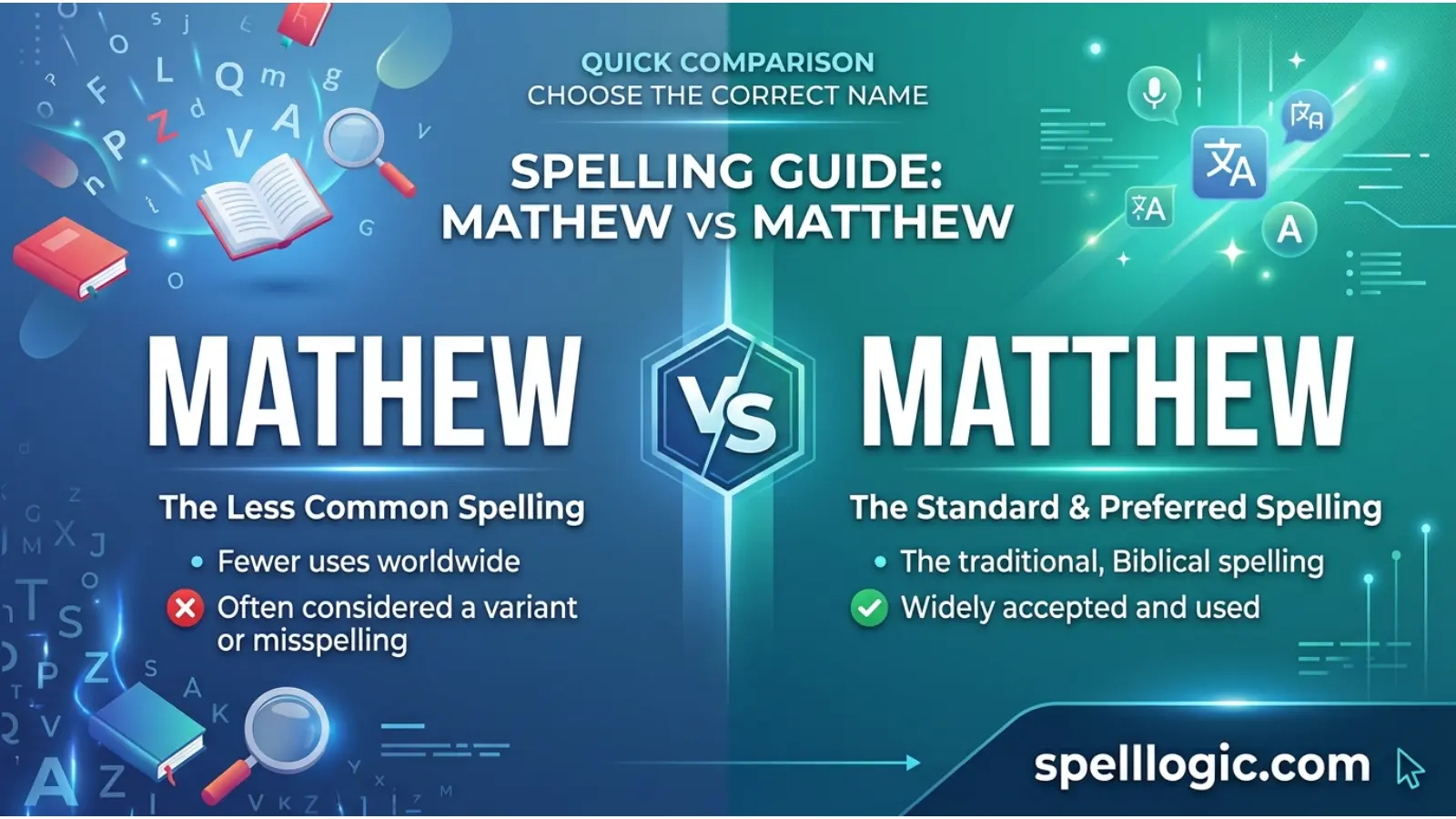
Many people mistakenly think Mathew and Matthew are simply two acceptable spellings of the same name. Although both spellings exist, Matthew is by far the standard and most widely used English spelling.
Here are the main reasons for the confusion:
Similar Pronunciation
Both names are pronounced almost exactly the same:
/ˈmæθjuː/
Since there is no noticeable difference in pronunciation, people often miss the extra “t” when writing.
Similar Spelling
The only spelling difference is one extra t.
- Mathew
- Matthew
Because the difference is so small, typing or spelling mistakes happen frequently.
Context Confusion
Many learners assume both spellings are interchangeable. However, Matthew is the traditional and standard English spelling, while Mathew is much less common and is usually someone’s personal name rather than the standard form.
Common Learner Mistakes
Learners often:
- Forget the second t.
- Copy the wrong spelling from social media.
- Misspell the name in emails or official forms.
- Assume shorter spellings are always acceptable.
Mathew vs Matthew Explained Simply
The simplest way to understand the difference is this:
Mathew means a less common variant spelling of the personal name, while Matthew is the standard and most widely accepted English spelling of the biblical name.
One-Line Distinction
Matthew is the standard spelling, while Mathew is an uncommon alternative spelling used by some individuals.
Example Sentences
- Matthew won the science competition.
- My friend’s legal name is Mathew, without the second t.
Understanding Homophones in English
What Are Homophones?
Homophones are words that sound the same but have different spellings, meanings, or both.
Example:
- flower
- flour
These two words sound alike but have different meanings.
Although Mathew and Matthew are names rather than ordinary vocabulary words, they are pronounced the same and therefore can create similar confusion.
Why Homophones Cause Confusion
People often hear a word before they see it written. Since pronunciation doesn’t reveal spelling, learners may write the wrong version.
Example:
Someone says:
“Matthew is coming tomorrow.”
A learner who has never seen the name written might write:
“Mathew is coming tomorrow.”
The pronunciation gives no clue about the extra t.
What Does “Mathew” Mean?
Definition and Core Meaning
Mathew is a personal name. It is an uncommon spelling variation of Matthew.
Its meaning remains the same:
Gift of God
The name comes from the Hebrew name Mattityahu.
Origin and Historical Use
- Derived from Hebrew.
- Entered English through Greek and Latin forms.
- Rarely used compared with Matthew.
- Sometimes chosen because families prefer a unique spelling.
Modern Usage and Synonyms
Since it is a proper name, it has no true synonyms.
Related forms include:
- Matthew
- Mateo
- Matteo
- Matthias
- Matias
Key Points
- Less common spelling
- Used as a first name
- Usually reflects personal preference
- Correct if it matches someone’s legal name
Example Sentences
- Mathew submitted his university application.
- My colleague spells his name Mathew, not Matthew.
What Does “Matthew” Mean?
Definition and Core Meaning
Matthew is the standard English spelling of a male given name meaning:
Gift of God
It has been widely used for centuries and remains popular in many English-speaking countries.
Origin and Historical Context
The name comes from:
Hebrew → Greek → Latin → English
It became especially popular because of Saint Matthew, one of the twelve apostles and traditionally regarded as the author of the Gospel of Matthew.
Modern Usage and Synonyms
Related versions include:
- Mateo
- Matteo
- Matthias
- Matias
- Matthieu (French)
Key Points
- Standard English spelling
- Very common worldwide
- Frequently appears in literature, history, and official records
- Preferred spelling in English
Example Sentences
- Matthew graduated with honors.
- Matthew will attend the meeting tomorrow.
Mathew vs Matthew: Key Differences at a Glance
| Word | Part of Speech | Meaning | Example Context |
|---|---|---|---|
| Mathew | Proper noun | Less common spelling of the name | My friend’s name is Mathew. |
| Matthew | Proper noun | Standard English spelling of the name | Matthew sent the report yesterday. |
How to Remember the Difference Between Mathew and Matthew
Remember these simple tricks.
Easy Memory Trick
Think:
Matthew has two “t”s because it is the standard spelling.
The double t helps you remember the common version.
Association Technique
Imagine the two t letters standing together like two friends.
Ma + tt + hew
Seeing the pair of t letters makes the correct spelling easier to remember.
Memorable Example
If you’re unsure, ask yourself:
“Am I writing the standard English spelling?”
If yes, choose Matthew.
Common Mistakes and Confusions
Wrong
Mathew wrote the Gospel according to the Bible.
Correct
Matthew wrote the Gospel according to the Bible.
Explanation:
The biblical figure is traditionally spelled Matthew in English.
Wrong
My teacher’s name is Matthew.
Correct
My teacher’s name is Mathew.
Explanation:
If someone’s legal name is Mathew, you must use that spelling.
Wrong
Everyone named Matthew spells it with one t.
Correct
Most people named Matthew spell it with two ts.
Explanation:
The standard spelling includes two t letters.
Examples Section: Correct and Incorrect Usage
Example 1
✔ Correct: Matthew received the award.
✘ Incorrect: Mathew received the award. (if his official name is Matthew)
Example 2
✔ Correct: My cousin’s legal name is Mathew.
✘ Incorrect: My cousin’s legal name is Matthew. (if his official spelling is Mathew)
Example 3
✔ Correct: Matthew emailed the documents yesterday.
✘ Incorrect: Mathew emailed the documents yesterday. (when referring to someone named Matthew)
Example 4
✔ Correct: Always check how someone spells their name.
✘ Incorrect: Assume every Mathew is actually Matthew.
Self Assessment: Test Your Knowledge
Fill in the blanks.
1.
The standard English spelling is ________.
2.
If someone’s legal name is spelled ________, you should respect that spelling.
3.
The name Matthew means “Gift of ________.”
4.
Matthew is usually spelled with two ________ letters.
Self Assessment Answers
- Matthew
- Mathew
- God
- t
FAQs
Is Matthew the correct spelling?
Yes. Matthew is the standard English spelling and is the most widely used.
Is Mathew a real name?
Yes. Mathew is a real given name, although it is much less common than Matthew.
Do Mathew and Matthew have different meanings?
No. Both spellings share the same meaning: Gift of God.
Why do people spell Matthew as Mathew?
Many people accidentally leave out one t, while others genuinely have Mathew as their legal name.
Which spelling should I use in school or business writing?
Use the spelling that matches the person’s official name. If you are referring to the traditional English name in general, use Matthew.
Is Matthew a biblical name?
Yes. Matthew is a well-known biblical name associated with one of the twelve apostles.
How can I remember the correct spelling?
Remember that the standard spelling has two t’s:
Ma-tt-hew
Final Conclusion: Using “Mathew” and “Matthew” Correctly
Understanding the difference between Mathew and Matthew is easier than it first appears. Both spellings refer to the same personal name and share the meaning “Gift of God.” However, the key difference lies in usage. Matthew is the traditional and standard English spelling, recognized in dictionaries, literature, history, and most official documents. Mathew, on the other hand, is a genuine but much less common spelling that some individuals use as their legal name. This means neither spelling is automatically “wrong”—the correct choice depends on whether you are using the standard form or referring to a specific person’s preferred spelling.
A simple way to remember the difference is to think of Matthew as the version with two “t” letters, which is the spelling you will encounter most often in books, schools, workplaces, and everyday English. Whenever you write someone’s name, it is always best to check the exact spelling rather than relying on memory or pronunciation alone. Paying attention to these small details shows respect, improves your writing accuracy, and helps you communicate more confidently. As you continue learning English, noticing differences like Mathew vs Matthew will strengthen your spelling skills and make your written communication clearer and more professional.