Many English learners confuse inflection and intonation because both terms describe changes in speech. They are often discussed together in pronunciation lessons, public speaking, and linguistics, making it easy to assume they mean the same thing. However, they refer to different aspects of language.
Understanding the difference between inflection vs intonation can improve your speaking, listening, and grammar skills. Whether you are preparing for an English exam, improving your pronunciation, or learning linguistics, knowing when to use each term will help you communicate more naturally and confidently.
Why “Inflection” and “Intonation” Are Confusing
Many learners mix up these words because they both relate to spoken language and pronunciation.
Similar Pronunciation
- Both begin with the letters “in-“.
- Both have a similar rhythm and ending.
- They are often introduced in pronunciation lessons together.
Similar Spelling
Although not identical, inflection and intonation share similar prefixes and language-related meanings, making them look related.
Context Confusion
Both words appear in discussions about:
- English pronunciation
- Speech patterns
- Linguistics
- Public speaking
- Communication skills
Because of this, learners sometimes think they are interchangeable.
Common Learner Mistakes
People often say:
- “Your inflection sounds friendly.”
when they actually mean:
- “Your intonation sounds friendly.”
Likewise, learners may use intonation when discussing grammar changes, where inflection is the correct term.
Inflection vs Intonation Explained Simply
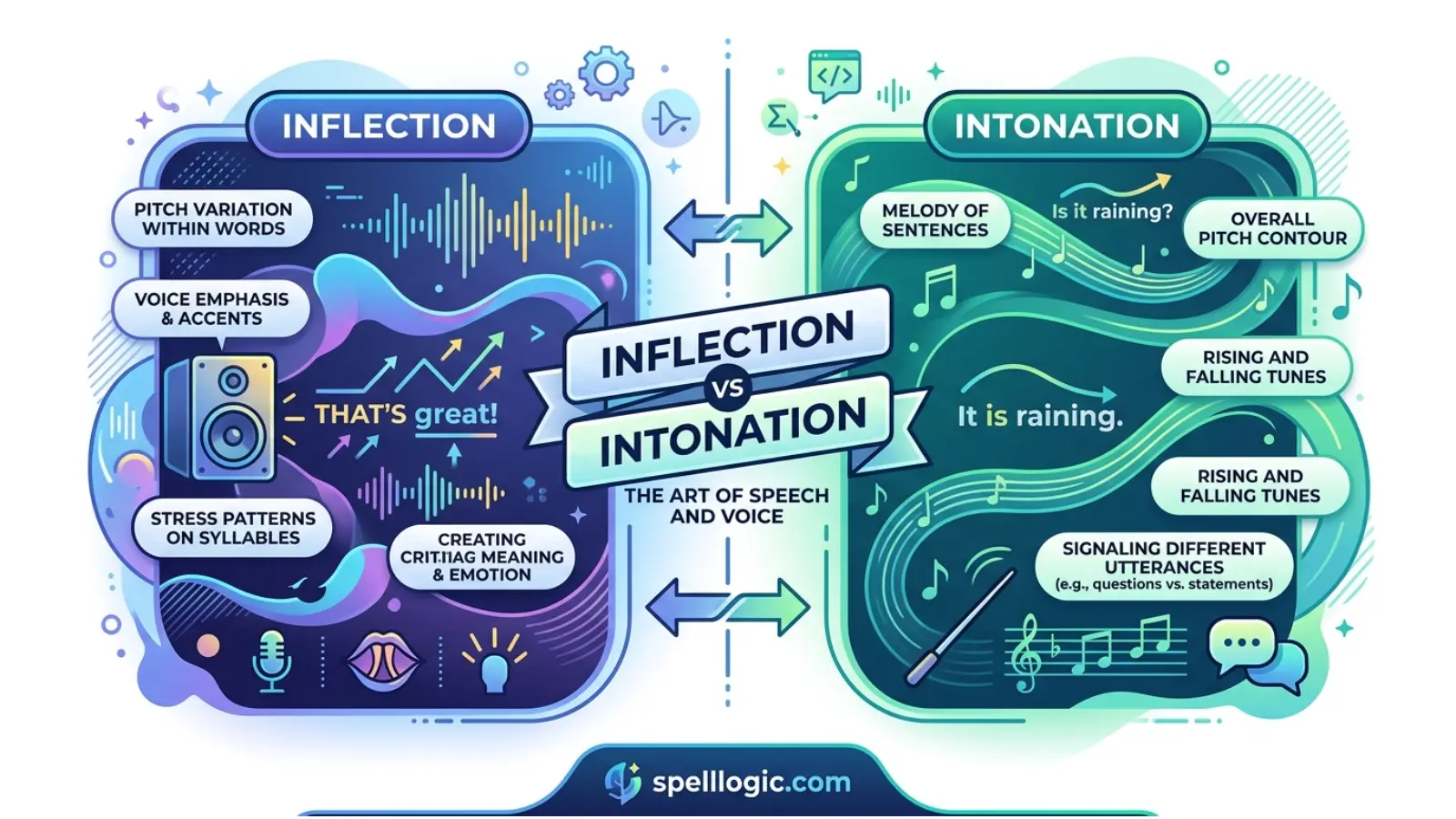
Inflection means changing the form of a word or making slight changes in the tone of a voice, while intonation refers specifically to the rise and fall of pitch during speech.
One-Line Distinction
Inflection changes words or voice expression, while intonation changes pitch patterns to express meaning or emotion.
Example Sentences
Inflection
- English verbs use inflection to show tense.
- Her voice had a gentle inflection at the end of the sentence.
Intonation
- His intonation made the question sound polite.
- Rising intonation usually indicates a question.
Understanding Homophones in English
What Are Homophones?
Homophones are words that sound the same but have different meanings and spellings.
Example:
- Sea and see
Although they sound alike, they have different meanings.
Why Homophones Cause Confusion
English contains many words with similar sounds, spellings, or meanings. Learners often confuse them because they appear in similar contexts.
Example:
- Their
- There
- They’re
These words sound alike but serve different purposes.
Inflection and intonation are not homophones, but they are commonly confused because they relate to speech and language.
What Does “Inflection” Mean?
Definition and Core Meaning
Inflection is the modification of a word to express grammatical information, such as tense, number, person, or case. It can also refer to a slight change in the tone or pitch of a person’s voice.
Origin and Historical Use
The word inflection comes from the Latin inflectere, meaning to bend or curve. It entered English during the Middle Ages and has long been used in grammar and linguistics.
Modern Usage and Synonyms
Common synonyms include:
- Word modification
- Grammatical change
- Voice variation
- Tone change
- Accent variation
Key Points
- Used in grammar and linguistics
- Shows tense, number, or case
- Can describe slight voice changes
- Common in language learning
Example Sentences
- The plural ending -s is an inflection.
- The speaker’s inflection revealed excitement.
- Verb inflections help identify tense.
- She spoke with little vocal inflection.
What Does “Intonation” Mean?
Definition and Core Meaning
Intonation is the pattern of rising and falling pitch while speaking. It helps express emotions, attitudes, and sentence meaning.
Origin and Historical Context
The word comes from the Latin intonare, meaning to thunder or raise the voice. It became widely used in phonetics and speech studies.
Modern Usage and Synonyms
Common synonyms include:
- Pitch pattern
- Voice melody
- Speech rhythm
- Vocal tone
- Pitch movement
Key Points
- Relates to spoken language
- Shows emotion and intention
- Helps distinguish statements from questions
- Important for natural pronunciation
Example Sentences
- Rising intonation often signals a question.
- Her intonation sounded enthusiastic.
- Good intonation improves communication.
- English learners should practice sentence intonation.
Inflection vs Intonation: Key Differences at a Glance
| Word | Part of Speech | Meaning | Example Context |
|---|---|---|---|
| Inflection | Noun | Change in a word’s form or slight change in voice | Adding -ed to show past tense |
| Intonation | Noun | Rise and fall of pitch during speech | Asking a question with rising pitch |
How to Remember the Difference Between Inflection and Intonation
Here are some simple memory tricks.
Easy Memory Tricks
- Inflection = Form
- Think of grammar changes like walk → walked.
- Intonation = Tone
- Think of your voice rising or falling while speaking.
Association Techniques
Imagine this sentence:
Grammar changes the word. Intonation changes the music of your voice.
One Memorable Example
When you ask:
“Are you coming?”
The rising pitch is intonation, not inflection.
When you change:
play → played
That is inflection.
Common Mistakes and Confusions
Wrong
The teacher explained English intonation by adding -ed to verbs.
Correct
The teacher explained English inflection by adding -ed to verbs.
Explanation
Adding -ed changes the grammatical form of the word, so it is an inflection.
Wrong
Your inflection made that sound like a question.
Correct
Your intonation made that sound like a question.
Explanation
Question patterns depend on pitch movement, which is intonation.
Wrong
English intonation changes nouns into plurals.
Correct
English inflection changes nouns into plurals.
Explanation
Plural endings are grammatical inflections.
Examples Section: Correct and Incorrect Usage
Example 1
✔ Correct: Rising intonation usually signals a yes-no question.
✘ Incorrect: Rising inflection usually signals a yes-no question.
Example 2
✔ Correct: The verb talked shows an inflection.
✘ Incorrect: The verb talked shows an intonation.
Example 3
✔ Correct: Her cheerful intonation made everyone smile.
✘ Incorrect: Her cheerful inflection made everyone smile.
Example 4
✔ Correct: English uses inflection to mark plural nouns.
✘ Incorrect: English uses intonation to mark plural nouns.
Example 5
✔ Correct: Practice your intonation to sound more natural.
✘ Incorrect: Practice your inflection to sound more natural.
Self Assessment: Test Your Knowledge
Fill in the blanks.
- Rising __________ often indicates a question.
- Adding -s to make a noun plural is an example of __________.
- Good __________ helps express emotion while speaking.
- Verb endings are examples of grammatical __________.
Self Assessment Answers
- intonation
- inflection
- intonation
- inflection
FAQs
1. What is the main difference between inflection and intonation?
Inflection refers to grammatical word changes or slight voice variations, while intonation describes the rise and fall of pitch during speech.
2. Are inflection and intonation the same?
No. They are related to language but describe different concepts.
3. Is inflection used in grammar?
Yes. Inflection is an important grammatical process that changes word forms.
4. What is intonation in English?
Intonation is the pattern of pitch changes that expresses questions, emotions, and emphasis.
5. Which is more important for pronunciation?
Intonation is more directly connected to pronunciation because it affects how sentences sound.
6. Can inflection refer to voice?
Yes. In everyday English, inflection can also describe subtle changes in vocal tone or expression. In linguistics, however, it most commonly refers to changes in word forms, while intonation specifically describes pitch patterns across phrases and sentences.
7. How can I remember the difference easily?
Remember this phrase:
Inflection changes words; intonation changes voice melody.
Final Conclusion: Using “Inflection” and “Intonation” Correctly
Understanding the difference between inflection and intonation is an important step toward mastering English. Although both terms relate to language and speech, they describe different ideas. Inflection mainly refers to changes in the form of words to express grammatical meaning, such as tense, number, or person. It can also describe subtle changes in vocal expression. Intonation, on the other hand, focuses on the rise and fall of pitch when we speak. It helps listeners understand whether we are asking a question, making a statement, expressing surprise, or showing emotion.
In everyday communication, using the correct term makes your English more accurate, especially in classrooms, language exams, and discussions about grammar or pronunciation. A simple way to remember the distinction is this: inflection changes the form of words, while intonation changes the melody of speech. Keep practicing by listening to native speakers, reading aloud, and paying attention to both grammatical endings and pitch patterns. Over time, these concepts will become second nature. Every new distinction you learn strengthens your vocabulary and improves your confidence, bringing you one step closer to speaking and understanding English with greater clarity and fluency.