Many English learners become confused by seal and seel because these words look almost identical and sound very similar. However, they have very different meanings and are used in completely different contexts. While seal is a common everyday English word, seel is an old and rarely used term that most native speakers never use in daily conversation.
Understanding the difference helps you choose the correct word, avoid writing mistakes, and improve your vocabulary. In this guide, you’ll learn what each word means, how to use them correctly, and simple tricks to remember the difference forever.
Table of Contents
- Introduction
- Why “Seal” and “Seel” Are Confusing
- Seal vs Seel Explained Simply
- Understanding Homophones in English
- What Does “Seal” Mean?
- What Does “Seel” Mean?
- Seal vs Seel: Key Differences at a Glance
- How to Remember the Difference Between Seal and Seel
- Common Mistakes and Confusions
- Examples Section: Correct and Incorrect Usage
- Self Assessment: Test Your Knowledge
- Self Assessment Answers
- FAQs About “Seal” and “Seel”
- Final Conclusion: Using “Seal” and “Seel” Correctly
Why “Seal” and “Seel” Are Confusing
Many learners accidentally confuse seal and seel because they are pronounced almost the same in modern English.
Similar pronunciation
Both words are commonly pronounced like “seel.” This makes it difficult to distinguish them when listening to spoken English.
Similar spelling
Only one letter differs between the two words:
- Seal
- Seel
Since the spellings are nearly identical, it’s easy to type or write the wrong one.
Context confusion
The confusion increases because many learners have never seen seel before. They may assume it is simply another spelling of seal, but it is actually a completely different word with a historical meaning.
Common learner mistakes
Learners often:
- Write seel when they mean seal.
- Believe both spellings are interchangeable.
- Think seel is the British spelling of seal, which is incorrect.
- Use seel in modern business or everyday writing.
Seal vs Seel Explained Simply
The easiest way to understand these words is to remember their everyday use.
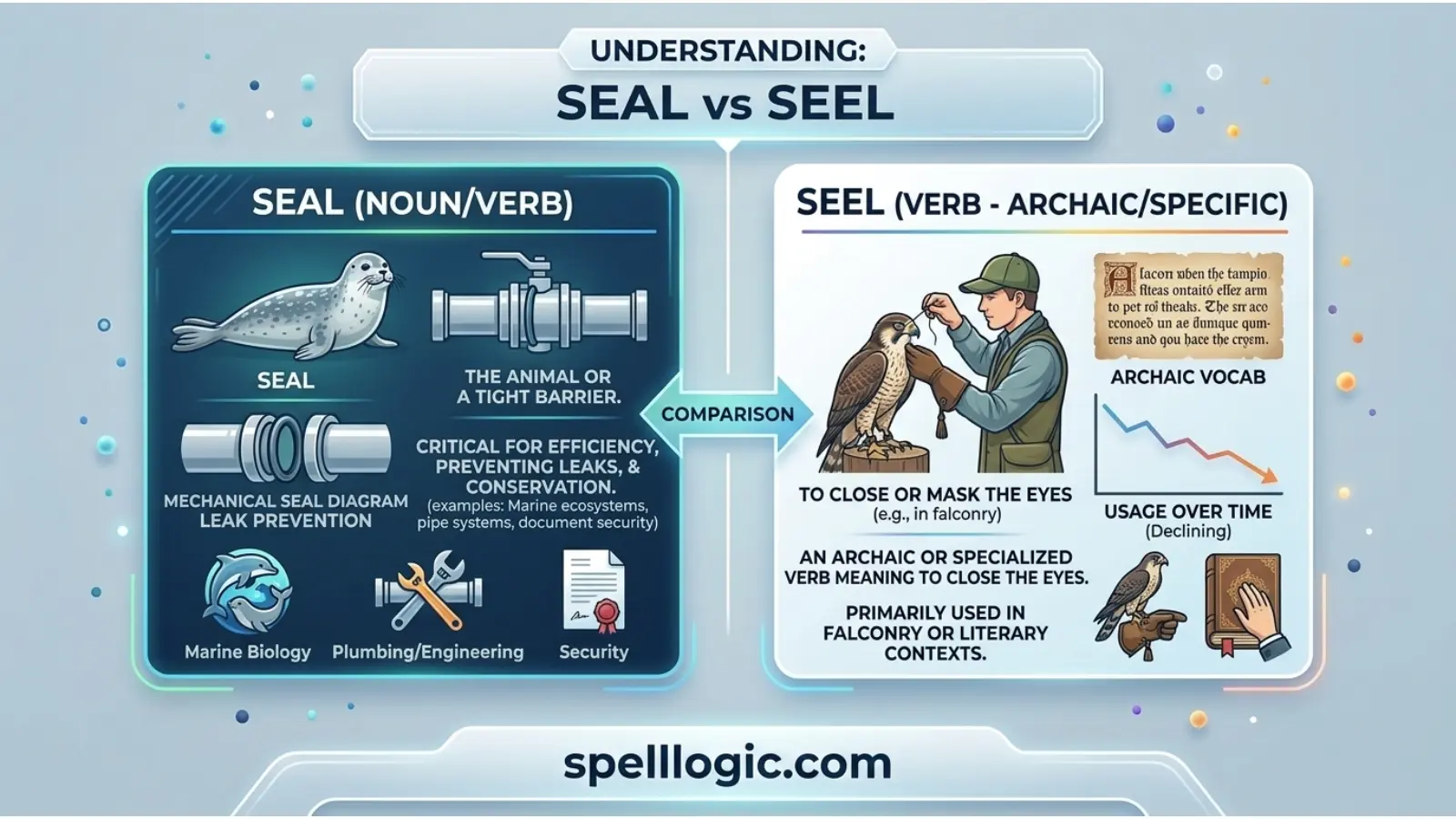
Seal means to close, fasten, confirm, or refers to a marine animal.
Seel means to sew or close the eyes of a bird, especially a falcon, and is an old or literary word.
One-line distinction
Seal means to close or secure something, while seel refers to an old practice involving a bird’s eyes.
Example sentences
Seal
- Please seal the envelope before mailing it.
- We saw a seal swimming near the shore.
Seel
- Hunters once seeled falcons before training them.
- The old text describes how people would seel hunting birds.
Understanding Homophones in English
What Are Homophones?
Homophones are words that sound the same but have different meanings and often different spellings.
Example
- Flower
- Flour
These words sound alike but mean completely different things.
Although seal and seel are not perfect homophones in every accent, they are close enough to confuse many learners.
Why Homophones Cause Confusion
English contains many words that share similar pronunciation but different meanings.
For example:
- Their
- There
- They’re
If you only hear these words without seeing the spelling, it can be difficult to know which one is correct.
The same happens with seal and seel, especially because seel is unfamiliar to most people.
What Does “Seal” Mean?
Definition and Core Meaning
Seal is a common English noun and verb.
As a noun, it can mean:
- A marine mammal
- An official stamp
- A tight closure
As a verb, it means:
- To close securely
- To make airtight or watertight
- To confirm officially
Origin and Historical Use
The word seal comes from Old English and has been used for over a thousand years.
Historically, kings and governments used wax seals to authenticate official documents.
Modern Usage and Synonyms
Today, seal appears in everyday English.
Common synonyms include:
- Close
- Fasten
- Secure
- Lock
- Confirm
- Stamp
Key points
- Common modern word
- Used as both noun and verb
- Frequently appears in business, legal, and everyday English
- Also names a marine animal
Example sentences
- Please seal the package carefully.
- The company placed its official seal on the certificate.
- The diver photographed a playful seal.
- Seal the container tightly to keep the food fresh.
What Does “Seel” Mean?
Definition and Core Meaning
Seel is an old English verb.
It means:
- To close or sew shut the eyes of a bird, especially a falcon.
- In literature, it may also suggest blinding someone metaphorically.
Today, this word is considered archaic.
Origin and Historical Context
The word comes from Middle English and was mainly associated with falconry.
Falconers sometimes stitched a bird’s eyelids partly closed during training to calm it.
Modern bird training no longer uses this practice in most places because of animal welfare standards.
Modern Usage and Synonyms
Today, seel appears mainly in:
- Historical books
- Shakespeare
- Literature
- Falconry history
Possible related words include:
- Blind
- Stitch shut
- Close the eyes
Key points
- Rarely used today
- Mostly historical
- Found in literature
- Not suitable for everyday writing
Example sentences
- The ancient guide explained how to seel a falcon.
- Shakespeare used the word seel in one of his plays.
- Few people know the historical meaning of seel today.
- The museum displayed tools once used to seel hunting birds.
Seal vs Seel: Key Differences at a Glance
| Word | Part of Speech | Meaning | Example Context |
|---|---|---|---|
| Seal | Noun, Verb | To close securely, official stamp, or marine animal | Seal the envelope before sending it. |
| Seel | Verb | To stitch or close a bird’s eyes; archaic term | Falconers once seeled hunting birds. |
How to Remember the Difference Between Seal and Seel
Learning a simple memory trick can help you avoid mistakes.
Easy memory tricks
- Seal has the letter A, which reminds you of airtight.
- Seal is the word you will use almost every day.
- Seel has two E’s, making it look unusual—just like the unusual old word it is.
Association techniques
Think:
Seal = Secure
Both begin with the letter S and refer to closing something.
Remember:
Seel = Shakespeare
You’ll mostly encounter seel in historical or literary texts.
One memorable example
“If you’re closing an envelope, always use seal. If you’re reading medieval falconry, you may find seel.”
Common Mistakes and Confusions
Wrong
❌ Please seel the package.
Correct
✅ Please seal the package.
Explanation: Closing a package always uses seal.
Wrong
❌ The government placed its official seel on the document.
Correct
✅ The government placed its official seal on the document.
Explanation: Official stamps are called seals.
Wrong
❌ We watched a seel swimming in the ocean.
Correct
✅ We watched a seal swimming in the ocean.
Explanation: The marine animal is always spelled seal.
Wrong
❌ Modern offices often use seel on contracts.
Correct
✅ Modern offices often use a seal on contracts.
Explanation: Seel is not used in modern business English.
Examples Section: Correct and Incorrect Usage
Example 1
✔ Correct: Please seal the bottle tightly.
✘ Incorrect: Please seel the bottle tightly.
Example 2
✔ Correct: The children watched a seal at the aquarium.
✘ Incorrect: The children watched a seel at the aquarium.
Example 3
✔ Correct: The old manuscript mentions how trainers would seel falcons.
✘ Incorrect: The old manuscript mentions how trainers would seal falcons.
Example 4
✔ Correct: The lawyer placed the official seal on the document.
✘ Incorrect: The lawyer placed the official seel on the document.
Self Assessment: Test Your Knowledge
Fill in the blanks with seal or seel.
- Please ______ the envelope before mailing it.
- The aquarium has a friendly ______.
- Ancient falconers sometimes ______ hunting birds.
- The certificate carried the official company ______.
Self Assessment Answers
- seal
- seal
- seel
- seal
FAQs
1. Is seel a correct English word?
Yes. It is a real English word, but it is archaic and rarely used today.
2. Which word should I use in everyday English?
You should almost always use seal, as it is the standard modern word.
3. Is seel another spelling of seal?
No. They have completely different meanings.
4. Can seal be both a noun and a verb?
Yes. It can refer to an animal, an official mark, or the act of closing something securely.
5. Why do English learners confuse seal and seel?
They look nearly identical and are pronounced very similarly, making them easy to mix up.
6. Will I see seel in modern writing?
Rarely. It mainly appears in historical texts, older literature, and discussions of falconry.
7. How can I remember the difference?
Remember that seal is the common everyday word for closing or securing something, while seel is an old literary term related to falconry.
Final Conclusion: Using “Seal” and “Seel” Correctly
Understanding the difference between seal and seel is much easier once you know how each word is used. Seal is the common modern English word that refers to closing or securing something, an official mark, or even the marine mammal found in oceans around the world. It appears in everyday conversations, business documents, schools, legal writing, and countless other situations. Seel, by contrast, is an archaic verb with roots in historical falconry, meaning to stitch or close a bird’s eyes during training. Because this practice belongs to the past, the word itself is now found mainly in literature, historical works, and discussions of medieval hunting traditions.
For most English learners, the safest choice is simple: use seal whenever you mean to close, secure, or refer to the animal or official stamp. Reserve seel for historical or literary contexts where its specialized meaning is appropriate. A useful memory trick is to associate seal with secure and seel with Shakespeare or old stories. The more you read, write, and practice with real examples, the more natural the distinction will become. Building your vocabulary one pair of confusing words at a time strengthens both your confidence and your accuracy, helping you communicate more clearly in every situation.