Many English learners become confused by leed vs lead because these words look almost the same but are not used in the same way. In fact, one of them is a common English word, while the other is usually a misspelling or a proper noun. Understanding the difference helps you write more accurately, avoid embarrassing mistakes, and communicate with confidence.
Whether you’re writing an email, an essay, or speaking in everyday conversations, knowing when to use lead and why leed is generally incorrect will improve your English skills. This guide explains everything in simple language with clear examples.
Table of Contents
- Introduction
- Why “Leed” and “Lead” Are Confusing
- Leed vs Lead Explained Simply
- Understanding Homophones in English
- What Does “Leed” Mean?
- What Does “Lead” Mean?
- Leed vs Lead: Key Differences at a Glance
- How to Remember the Difference Between Leed and Lead
- Common Mistakes and Confusions
- Examples Section: Correct and Incorrect Usage
- Self Assessment: Test Your Knowledge
- Self Assessment Answers
- FAQs About “Leed” and “Lead”
- Final Conclusion: Using “Leed” and “Lead” Correctly
Why “Leed” and “Lead” Are Confusing
Many learners accidentally write leed instead of lead because the words appear similar. However, they are not interchangeable.
Similar Pronunciation
The verb lead is often pronounced like “leed” (/liːd/). Because of this pronunciation, many people think it should be spelled leed.
Similar Spelling
Only one letter is different between the two spellings:
- Lead ✅
- Leed ❌
This small spelling difference makes typing mistakes common.
Context Confusion
People hear someone say “lead” and assume the spelling should match the pronunciation. English spelling, however, often does not match pronunciation exactly.
Common Learner Mistakes
Common errors include:
- Writing leed the team instead of lead the team
- Using leed in school assignments
- Assuming leed is another accepted spelling
Important: In standard English, lead is correct. Leed is generally considered a misspelling unless it is part of a proper name, surname, or place name.
Leed vs Lead Explained Simply
The easiest way to understand these words is this:
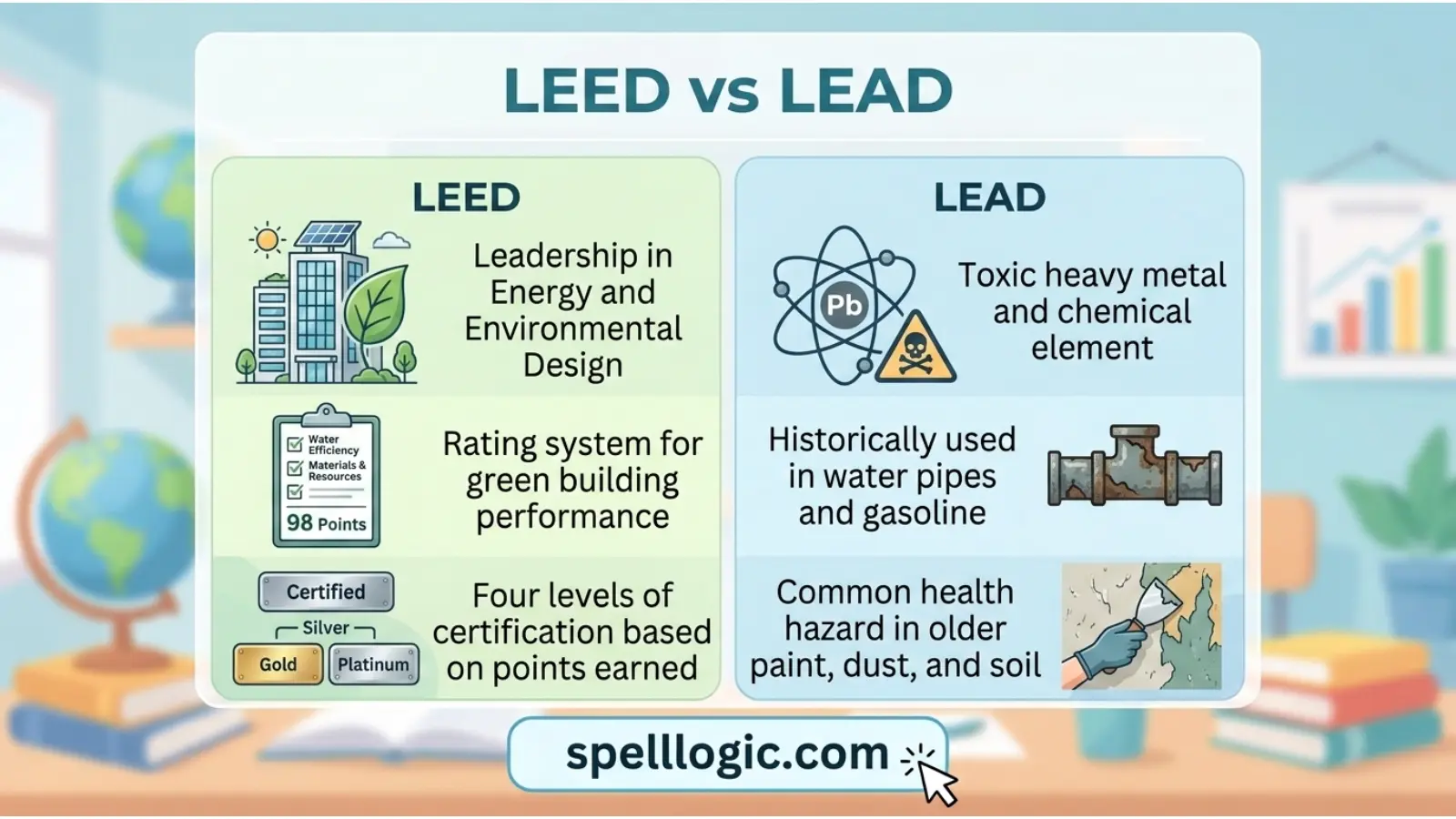
Leed means nothing in standard English and is usually a spelling mistake, while lead is the correct English word used as a verb, noun, and adjective.
One-Line Distinction
Leed is usually incorrect, while lead is the correct spelling.
Example Sentences
- She will lead the project next month.
- A good captain knows how to lead a team successfully.
Notice that replacing lead with leed would make these sentences incorrect.
Understanding Homophones in English
What Are Homophones?
Homophones are words that sound the same but have different spellings or meanings.
Example:
- Pair
- Pear
Both sound alike but have different meanings.
Interestingly, lead (verb) sounds like how many people pronounce leed, which contributes to the confusion.
Why Homophones Cause Confusion
English pronunciation does not always match spelling.
For example:
- Right
- Write
These sound identical but have different spellings and meanings.
Similarly, people hear lead pronounced as “leed” and mistakenly spell it leed.
What Does “Leed” Mean?
Definition and Core Meaning
In standard English, leed is not an accepted dictionary word.
Instead, it is usually:
- A spelling error for lead
- A surname
- Part of certain place names or historical names
It should not be used when writing standard English.
Origin and Historical Use
Historically, Leed has appeared:
- As a family name
- In place names
- In historical records
However, it has never become the standard English spelling of lead.
Modern Usage and Synonyms
Since leed is not a standard English word, it has no modern synonyms.
Instead, replace it with:
- Lead
- Guide
- Direct
- Manage
- Head
Example Sentences
Correct:
- She will lead the discussion.
Incorrect:
- She will leed the discussion.
Correct:
- Good teachers lead by example.
Incorrect:
- Good teachers leed by example.
What Does “Lead” Mean?
Definition and Core Meaning
Lead is a versatile English word with several meanings.
As a verb, it means:
- To guide
- To direct
- To be in charge
- To show the way
As a noun, it can mean:
- The first position
- An advantage
- A clue
- A connection
- A soft metal (pronounced differently as led)
Origin and Historical Context
The word lead comes from Old English.
Over hundreds of years, it developed multiple meanings related to:
- Guiding people
- Taking charge
- Going first
- Being ahead
- The metal lead
Its pronunciation changes depending on the meaning.
Modern Usage and Synonyms
Common synonyms include:
- Guide
- Direct
- Manage
- Head
- Conduct
- Supervise
- Control
Example Sentences
- Sarah will lead today’s meeting.
- The coach can lead the players to victory.
- Our company has taken the lead in innovation.
- Detectives finally found a useful lead.
Leed vs Lead: Key Differences at a Glance
| Word | Part of Speech | Meaning | Example Context |
|---|---|---|---|
| Leed | Not a standard English word | Usually a misspelling of lead | ✘ She will leed the meeting. |
| Lead | Verb, noun, adjective | To guide, direct, or be ahead; also a clue or a type of metal | ✔ She will lead the meeting. |
How to Remember the Difference Between Leed and Lead
Fortunately, remembering the correct spelling is easy.
Easy Memory Tricks
- Lead is the only correct English spelling.
- If you mean guide, always write lead.
- Never spell it leed in standard writing.
Association Techniques
Think of this sentence:
Leaders always LEAD.
Notice that both words begin with Lea-.
That makes it easier to remember.
One Memorable Example
✔ Great teachers lead students.
Since teachers are leaders, the word must be lead, not leed.
Common Mistakes and Confusions
Here are mistakes learners often make.
Wrong
She will leed the group.
Correct
She will lead the group.
Explanation: Lead is the correct verb.
Wrong
He is the leed singer.
Correct
He is the lead singer.
Explanation: A lead singer is the main singer.
Wrong
The manager leed the meeting.
Correct
The manager led the meeting.
Explanation: The past tense of lead is led, not leed.
Wrong
Please leed the way.
Correct
Please lead the way.
Explanation: Always use lead when you mean “guide.”
Examples Section: Correct and Incorrect Usage
Example 1
✔ Correct: Emma will lead the project.
✘ Incorrect: Emma will leed the project.
Example 2
✔ Correct: The guide will lead us through the museum.
✘ Incorrect: The guide will leed us through the museum.
Example 3
✔ Correct: Our team has the lead by two points.
✘ Incorrect: Our team has the leed by two points.
Example 4
✔ Correct: The actor played the lead role.
✘ Incorrect: The actor played the leed role.
Example 5
✔ Correct: Strong leaders lead with honesty.
✘ Incorrect: Strong leaders leed with honesty.
Self Assessment: Test Your Knowledge
Fill in the blanks with lead or leed.
- She will ______ the class discussion.
- The detective finally found an important ______.
- Our captain will ______ the team onto the field.
- Which spelling is correct in standard English: ______?
Self Assessment Answers
- lead
- lead
- lead
- lead
FAQs
Is “leed” a real English word?
No. In standard English, leed is generally considered a misspelling of lead, though it may appear as a surname or place name.
Which spelling is correct: leed or lead?
Lead is the correct spelling for standard English writing.
Why is “lead” pronounced like “leed”?
English spelling and pronunciation do not always match. The verb lead is pronounced /liːd/, even though it is spelled lead.
Is “lead” a verb or a noun?
It can be both. As a verb, it means “to guide.” As a noun, it can mean “the first position,” “an advantage,” “a clue,” or a type of metal (pronounced differently).
What is the past tense of “lead”?
The past tense is led.
Can I ever use “leed”?
Only if it is part of a person’s name, surname, or a specific place name. Otherwise, use lead.
How can I avoid this spelling mistake?
Remember the phrase: Leaders lead people. If you mean “guide,” always write lead.
Final Conclusion: Using “Leed” and “Lead” Correctly
Understanding the difference between leed and lead is easier once you know that only lead is the correct spelling in standard English. Many learners write leed because the verb lead is pronounced like “leed,” but English spelling often follows historical patterns rather than pronunciation. As a result, the correct choice is always lead when you mean to guide, direct, manage, or be in front.
The word lead can also function as a noun, referring to an advantage, an important clue, the main role in a performance, or a type of metal with a different pronunciation. In contrast, leed is not an accepted English word in normal writing and usually appears only as a surname or place name. A simple way to remember the difference is the phrase “Leaders lead.”
If you are talking about someone showing the way or taking charge, write lead every time. Reading, writing, and practicing sentences with the correct spelling will help make it a natural habit. The more you pay attention to common spelling patterns in English, the more confident and accurate your communication will become. Keep practicing, review new vocabulary regularly, and don’t be discouraged by confusing spellings—every mistake is an opportunity to become a stronger English learner.