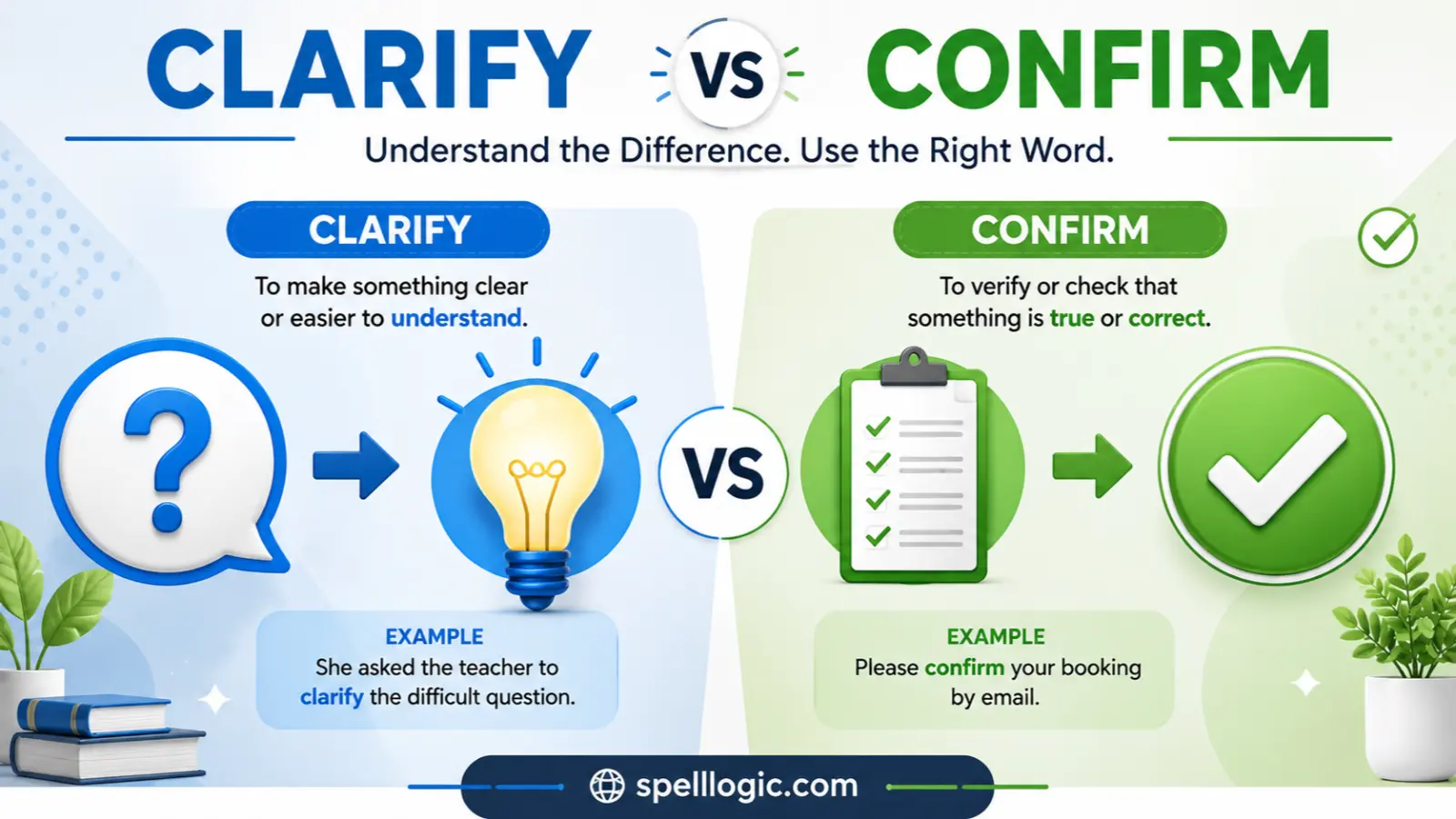
Many English learners confuse clarify and confirm because both words are often used when discussing information, communication, or understanding. They frequently appear in emails, meetings, customer service conversations, and everyday speech, making it easy to think they mean the same thing.
However, these words serve different purposes. Clarify means to make something easier to understand, while confirm means to verify or state that something is true or correct. Learning the difference will help you communicate more accurately and confidently in both professional and casual situations. This guide explains everything you need to know using simple language and practical examples.
Why “Clarify” and “Confirm” Are Confusing
Many people mistakenly use clarify and confirm interchangeably because they both involve communication and information. However, their meanings are different.
Similar Pronunciation
Both words begin with the same “cl” or “c” sound and have a similar rhythm, making them easy to confuse during conversation.
Similar Spelling
Although they are not spelled alike, both are formal verbs commonly used in business writing, education, and professional communication.
Context Confusion
People often ask questions to either understand information better or verify that it is correct. Since both actions happen during conversations, learners sometimes choose the wrong word.
For example:
- “Could you clarify the instructions?” means explain them more clearly.
- “Could you confirm the meeting time?” means verify that the meeting time is correct.
Common Learner Mistakes
Many learners incorrectly write:
- “Please confirm what this sentence means.”
- “Can you clarify my booking?”
The first sentence should use clarify, while the second usually requires confirm, depending on the intended meaning.
Clarify vs Confirm Explained Simply
The difference is straightforward.
Clarify means to make something clear or easier to understand, while confirm means to verify or prove that something is true or correct.
One-Line Distinction
Clarify explains. Confirm verifies.
Example Sentences
- The teacher clarified the difficult grammar rule.
- The airline confirmed my flight reservation.
Another pair:
- Please clarify your question before I answer.
- Please confirm your attendance by Friday.
Understanding Homophones in English
Although clarify and confirm are not homophones, learners sometimes group them together because they appear in similar situations.
What Are Homophones?
Homophones are words that sound the same but have different meanings and spellings.
Example:
- Flower
- Flour
These two words sound alike but have different meanings.
Why Homophones Cause Confusion
English contains many words that sound similar or are used in similar contexts. This often causes learners to select the wrong word.
For example:
- They’re
- Their
- There
Although clarify and confirm are not homophones, they create confusion because both relate to communication and information.
What Does “Clarify” Mean?
Definition and Core Meaning
Clarify means to make something easier to understand by explaining it more clearly.
It removes confusion and adds detail when something is unclear.
Origin and Historical Use
The word clarify comes from the Latin word clarus, meaning clear or bright. It entered English in the late Middle Ages and originally referred to making liquids clear before developing its modern meaning of making ideas understandable.
Modern Usage and Synonyms
Today, clarify is common in schools, workplaces, customer support, and everyday conversations.
Common synonyms include:
- Explain
- Simplify
- Elucidate
- Make clear
- Interpret
- Define
Key Points
- Used to improve understanding.
- Focuses on explanation.
- Often answers questions.
- Common in academic and professional writing.
Example Sentences
- Could you clarify the last paragraph?
- The manager clarified the company’s new policy.
- She clarified her opinion during the discussion.
- I need you to clarify these instructions.
What Does “Confirm” Mean?
Definition and Core Meaning
Confirm means to verify, approve, or state that something is true, correct, or certain.
It removes doubt by providing verification.
Origin and Historical Context
The word confirm comes from the Latin confirmare, meaning to strengthen or establish firmly. Over time, it became associated with proving that information is correct.
Modern Usage and Synonyms
Today, confirm appears frequently in emails, reservations, appointments, travel, banking, and business communication.
Common synonyms include:
- Verify
- Approve
- Validate
- Certify
- Acknowledge
- Authenticate
Key Points
- Used to verify facts.
- Focuses on certainty.
- Often confirms appointments or reservations.
- Common in business communication.
Example Sentences
- Please confirm your appointment.
- The hotel confirmed my reservation.
- She confirmed that the report was accurate.
- Can you confirm the delivery date?
Clarify vs Confirm: Key Differences at a Glance
| Word | Part of Speech | Meaning | Example Context |
|---|---|---|---|
| Clarify | Verb | To make something easier to understand | Please clarify your explanation. |
| Confirm | Verb | To verify that something is true or correct | Please confirm your booking. |
How to Remember the Difference Between Clarify and Confirm
Here are a few easy tricks.
Easy Memory Tricks
- Clarify = Clear
- Confirm = Correct
Think of the first few letters.
- Clarify starts like clear.
- Confirm reminds you of confirming facts.
Association Techniques
Imagine someone explaining confusing directions.
They are clarifying them.
Now imagine someone checking your flight reservation.
They are confirming it.
One Memorable Example
Clarify the message before you confirm the decision.
First understand it.
Then verify it.
Common Mistakes and Confusions
Here are mistakes English learners often make.
Wrong
Please confirm what this paragraph means.
Correct
Please clarify what this paragraph means.
Explanation: You want an explanation, not verification.
Wrong
Could you clarify my hotel booking?
Correct
Could you confirm my hotel booking?
Explanation: A booking needs verification.
Wrong
The teacher confirmed the difficult grammar rule.
Correct
The teacher clarified the difficult grammar rule.
Explanation: Teachers explain concepts rather than verify them.
Wrong
Please clarify whether my payment was received.
Correct
Please confirm whether my payment was received.
Explanation: Payment status needs confirmation.
Examples Section: Correct and Incorrect Usage
Example 1
✔ Correct: Please clarify the instructions before we begin.
✘ Incorrect: Please confirm the instructions before we understand them.
Example 2
✔ Correct: The airline confirmed our flight yesterday.
✘ Incorrect: The airline clarified our flight yesterday.
Example 3
✔ Correct: She clarified her answer with another example.
✘ Incorrect: She confirmed her answer with another example.
Example 4
✔ Correct: Could you confirm today’s meeting time?
✘ Incorrect: Could you clarify today’s meeting time?
Example 5
✔ Correct: The professor clarified the theory during class.
✘ Incorrect: The professor confirmed the theory during class.
Self Assessment: Test Your Knowledge
Fill in the blanks using clarify or confirm.
- Could you ________ the meeting time?
- The teacher helped ________ the difficult lesson.
- Please ________ your email address.
- I asked the manager to ________ the company policy.
Self Assessment Answers
- Confirm
- Clarify
- Confirm
- Clarify
FAQs
1. What is the difference between clarify and confirm?
Clarify means to explain something so it becomes easier to understand, while confirm means to verify that something is correct or true.
2. Can clarify and confirm be used interchangeably?
No. Although both relate to communication, they serve different purposes. One explains, and the other verifies.
3. When should I use clarify?
Use clarify whenever information is confusing and needs further explanation.
4. When should I use confirm?
Use confirm when checking appointments, reservations, facts, schedules, or decisions.
5. Which word is more common in business emails?
Both are common.
Use clarify for explanations and confirm for verification.
6. Is “confirm” more formal than “clarify”?
Both words are formal enough for business, academic, and professional communication.
7. How can I remember the difference quickly?
Remember:
- Clarify = Make clear
- Confirm = Check correctness
Final Conclusion: Using “Clarify” and “Confirm” Correctly
Understanding the difference between clarify and confirm will make your English more accurate and professional. Although these words often appear in similar conversations, they perform different jobs. Clarify is used when something needs a better explanation or additional details so that it becomes easier to understand. Confirm, on the other hand, is used when you need to verify that information is true, accurate, or officially accepted. Whether you are writing an email, attending a meeting, speaking with a customer, or studying English, choosing the right word helps prevent misunderstandings and improves communication. A simple way to remember the difference is this: clarify makes things clear, while confirm makes things certain.
If someone explains instructions, they clarify them. If someone checks a reservation or verifies a date, they confirm it. Practice using both words in everyday conversations, emails, and writing exercises. The more examples you read and create, the more natural the distinction will become. With regular practice, you’ll confidently know when to ask someone to clarify an idea and when to ask them to confirm a fact, making your English clearer, more precise, and more effective in every situation.