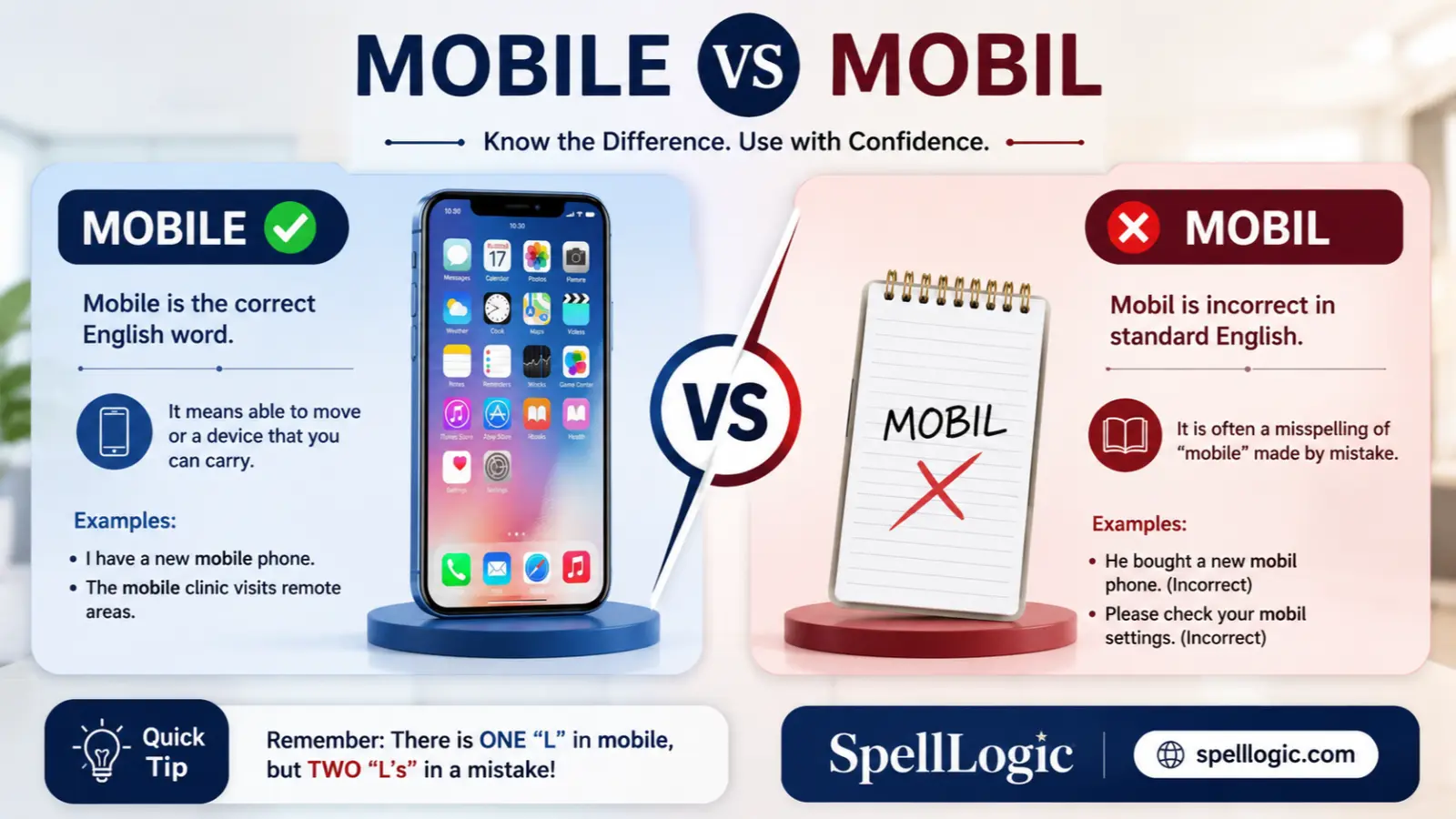
Many English learners get confused by mobile and mobil because the two words look almost identical. At first glance, it is easy to think they are simply different spellings of the same word. However, mobile is a standard English word with several meanings, while mobil is usually not a correct English spelling.
It mainly appears as a brand name or in historical contexts. Understanding the difference helps you avoid spelling mistakes in writing, improve your vocabulary, and communicate more clearly in both everyday and professional English.
Table of Contents
- Introduction
- Why “Mobile” and “Mobil” Are Confusing
- Mobile vs Mobil Explained Simply
- Understanding Homophones in English
- What Does “Mobile” Mean?
- What Does “Mobil” Mean?
- Mobile vs Mobil: Key Differences at a Glance
- How to Remember the Difference Between Mobile and Mobil
- Common Mistakes and Confusions
- Examples Section: Correct and Incorrect Usage
- Self Assessment: Test Your Knowledge
- Self Assessment Answers
- FAQs About “Mobile” and “Mobil”
- Final Conclusion: Using “Mobile” and “Mobil” Correctly
Why “Mobile” and “Mobil” Are Confusing
Many people accidentally write mobil instead of mobile because the two words are very similar.
Similar Pronunciation
In many accents, mobile and mobil sound almost the same. This makes it difficult for learners to know which spelling is correct.
Similar Spelling
The only difference is the final letter “e.” Since it is just one letter, many people leave it out by mistake.
Context Confusion
The confusion increases because Mobil is a famous company name, while mobile is a common English word. People who frequently see the brand name may think both spellings are acceptable.
Common Learner Mistakes
Some typical mistakes include:
- Writing mobil phone instead of mobile phone
- Typing mobil app instead of mobile app
- Assuming mobil is an alternative British spelling
In reality, mobile is the correct English word in almost every everyday situation.
Mobile vs Mobil Explained Simply
Mobile is the correct English word that refers to something movable, portable, or a mobile phone.
Mobil is generally not a standard English word. It is mainly recognized as a company or brand name.
One-Line Distinction
Mobile means movable or a mobile phone, while Mobil is primarily a proper noun used as a brand name.
Example Sentences
- I bought a new mobile phone yesterday.
- Please keep your mobile on silent during the meeting.
- Mobil was once the name of a major oil company.
- The Mobil logo is recognized around the world.
Understanding Homophones in English
What Are Homophones?
Homophones are words that sound the same or nearly the same but have different meanings or spellings.
Example:
- flower
- flour
Although they sound alike, they have different meanings.
Why Homophones Cause Confusion
Homophones often confuse English learners because pronunciation does not always reveal the correct spelling.
For example:
“I need a new mobile.”
Someone might mistakenly write mobil because both sound similar.
This is why learning spelling alongside meaning is important.
What Does “Mobile” Mean?
Definition and Core Meaning
The word mobile has several meanings depending on the context.
It can describe:
- Something that can move easily
- A mobile phone
- A person or object capable of moving freely
It can be used as both an adjective and a noun.
Origin and Historical Use
The word mobile comes from the Latin word mobilis, meaning movable.
English adopted the word centuries ago to describe things that could move. Later, with advances in technology, it became the common word for mobile phones.
Modern Usage and Synonyms
Modern meanings include:
- Cell phone
- Portable
- Movable
- Transportable
- Wireless (in some contexts)
Key Points
- Standard English word
- Used worldwide
- Can be a noun or adjective
- Common in technology and daily conversation
Example Sentences
- She forgot her mobile at home.
- Mobile banking has become very popular.
- The hospital uses mobile medical units.
- We need a mobile workforce.
What Does “Mobil” Mean?
Definition and Core Meaning
Mobil is generally not an English vocabulary word.
Instead, it is most commonly recognized as:
- A historical petroleum company name
- Part of the company name ExxonMobil
- A trademark
Origin and Historical Context
The name Mobil originated as a brand in the petroleum industry during the 20th century.
It later became part of ExxonMobil, one of the world’s largest energy companies.
Outside of this proper noun, mobil is not considered the correct spelling of mobile.
Modern Usage and Synonyms
Because it is a brand name, Mobil has no direct English synonyms.
Key Points
- Proper noun
- Brand name
- Not an alternative spelling of mobile
- Rarely used outside company names
Example Sentences
- Mobil introduced many fuel products.
- ExxonMobil is an international energy company.
Mobile vs Mobil: Key Differences at a Glance
| Word | Part of Speech | Meaning | Example Context |
|---|---|---|---|
| Mobile | Noun, Adjective | A cell phone or something movable | I lost my mobile phone. |
| Mobil | Proper Noun | A company or brand name | Mobil was a well-known oil company. |
How to Remember the Difference Between Mobile and Mobil
Remember these simple tricks.
Easy Memory Tricks
- Mobile ends with “e” because everyday English uses the extra “e.”
- If you are talking about a phone, always write mobile.
Association Technique
Think of:
E = Everyday English
If the word ends with e, it is probably the correct English word.
Memorable Example
“I use my mobile every day.”
If you remove the e, it no longer refers to the common English word.
Common Mistakes and Confusions
Wrong
I forgot my mobil at school.
Correct
I forgot my mobile at school.
Explanation:
A phone is called a mobile, not mobil.
Wrong
She downloaded a mobil application.
Correct
She downloaded a mobile application.
Explanation:
The adjective describing phone technology is mobile.
Wrong
My mobil battery is dead.
Correct
My mobile battery is dead.
Explanation:
Only mobile is correct here.
Wrong
Mobil learning has become popular.
Correct
Mobile learning has become popular.
Explanation:
The educational term is mobile learning.
Examples Section: Correct and Incorrect Usage
Example 1
✔ Correct: I use my mobile every day.
✘ Incorrect: I use my mobil every day.
Example 2
✔ Correct: Mobile banking saves time.
✘ Incorrect: Mobil banking saves time.
Example 3
✔ Correct: Mobil merged with Exxon.
✘ Incorrect: Mobile merged with Exxon.
Example 4
✔ Correct: She purchased a new mobile phone.
✘ Incorrect: She purchased a new mobil phone.
Example 5
✔ Correct: The mobile library visits our town every week.
✘ Incorrect: The mobil library visits our town every week.
Example 6
✔ Correct: ExxonMobil owns the Mobil brand.
✘ Incorrect: ExxonMobile owns the Mobile brand.
Self Assessment: Test Your Knowledge
Fill in the blanks with mobile or Mobil.
- I forgot my ______ phone at home.
- ______ was a well-known petroleum company.
- Many people use ______ banking to pay bills.
- The ______ brand later became part of ExxonMobil.
Self Assessment Answers
- mobile
- Mobil
- mobile
- Mobil
FAQs
No. Mobile is the correct English spelling for the common word.
What does “Mobil” mean?
It is mainly a company or brand name associated with the petroleum industry.
Can I write “mobil phone”?
No. The correct expression is mobile phone.
Is “mobile” a noun or an adjective?
It can be both. It refers to a phone as a noun and describes something movable as an adjective.
Why do people confuse mobile and mobil?
Because they look almost identical and sound very similar.
Is Mobil used outside company names?
Rarely. In general English writing, you should use mobile unless you are referring to the brand.
Which spelling should English learners remember?
Always remember mobile for phones, technology, and anything movable. Use Mobil only when referring to the company or brand.
Final Conclusion: Using “Mobile” and “Mobil” Correctly
Understanding the difference between mobile and Mobil is easier once you know that they belong to completely different categories. Mobile is a standard English word used every day. It can refer to a mobile phone, something portable, or anything that can move easily. You will see this word in conversations, newspapers, websites, schools, workplaces, and technology-related discussions. Mobil, on the other hand, is not a general English vocabulary word. It is primarily a proper noun that refers to the historic petroleum brand now associated with ExxonMobil.
This means you should not use mobil when writing about phones, apps, banking, learning, or other everyday topics. A simple way to remember the difference is to think of the extra “e” in mobile as standing for Everyday English. If you are talking about a phone or something portable, always choose mobile. Reserve Mobil only for the company name. By practicing with examples, paying attention to spelling, and reviewing common mistakes, you will quickly build confidence in using these words correctly. Every new distinction you learn strengthens your English skills, so keep reading, writing, and practicing—small improvements lead to lasting fluency.