Many English learners feel unsure about whether they should say “congratulations on” or “congratulations for.” Since both on and for are common prepositions, it is easy to think they can be used in the same way. However, native English speakers usually prefer one over the other in most situations.
Choosing the correct preposition makes your English sound more natural and grammatically accurate. In this guide, you’ll learn the difference between congratulations on and congratulations for, discover when each expression is appropriate, and see plenty of simple examples to help you remember the correct usage.
Why “Congratulations On” and “Congratulations For” Are Confusing
Many learners accidentally mix up these expressions because both use the noun congratulations followed by a preposition.
Here are the main reasons for the confusion:
Similar pronunciation
- Both expressions begin with congratulations, so they sound almost identical until the final word.
Similar spelling
- The only visible difference is the preposition on or for, making them easy to confuse while writing.
Context confusion
- Learners often translate directly from their native language, where a different preposition may be used.
- Because for often explains a reason, many people incorrectly assume it always fits after congratulations.
Common learner mistakes
- ❌ Congratulations for your promotion.
- ❌ Congratulations for passing the exam.
Native speakers almost always say:
- ✔ Congratulations on your promotion.
- ✔ Congratulations on passing the exam.
Congratulations On vs Congratulations For Explained Simply
The easiest way to understand the difference is this:
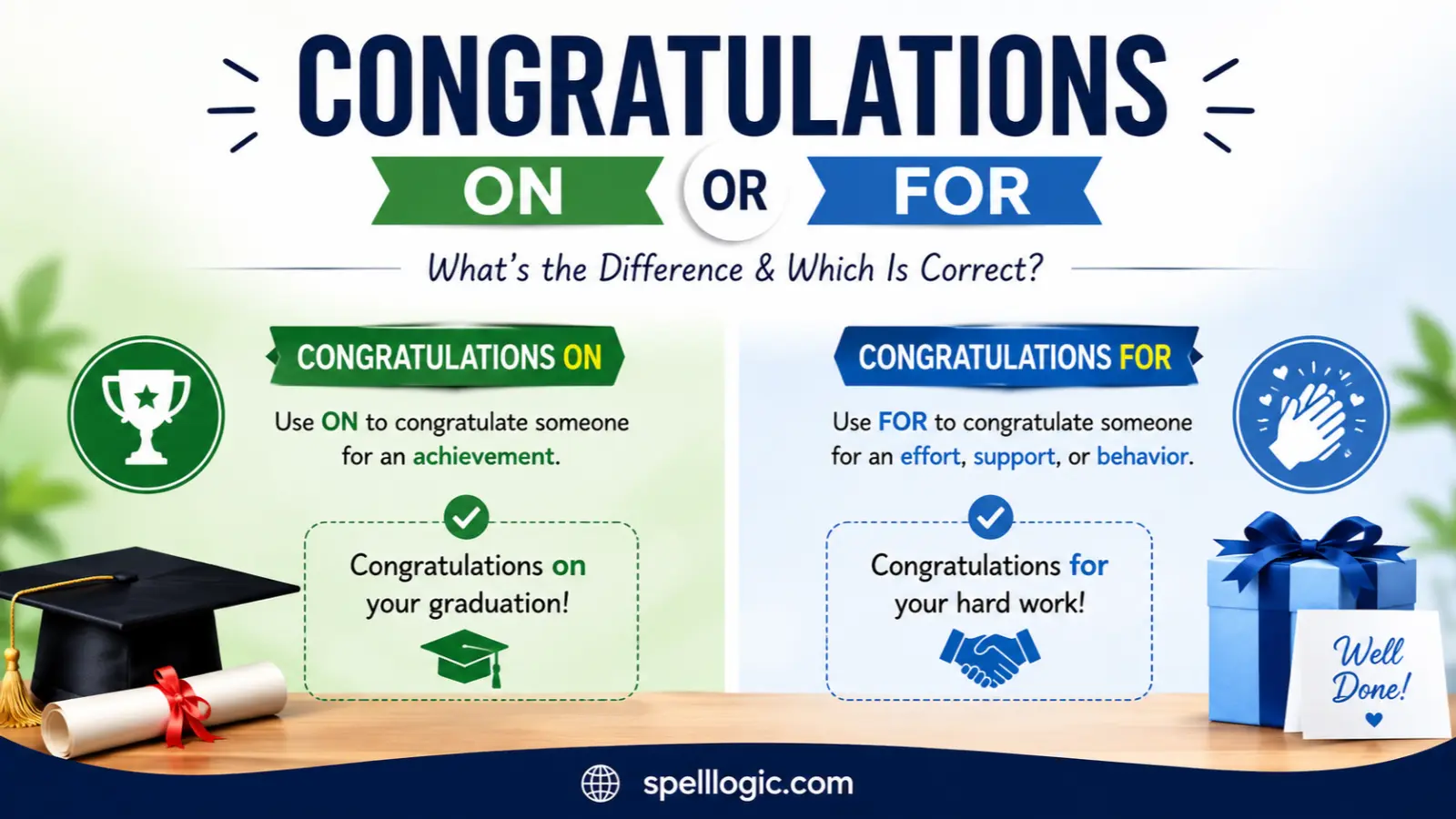
“Congratulations on” is the standard and correct expression for celebrating an achievement, success, or happy event, while “congratulations for” is uncommon and usually considered incorrect in everyday English.
One-line distinction
Congratulations on celebrates an achievement, while congratulations for is rarely used and usually replaced with congratulations on.
Example sentences
- Congratulations on your new job!
- Congratulations on winning first prize.
Although you may occasionally hear congratulations for before certain actions in informal speech, modern English strongly prefers on.
Understanding Homophones in English
What Are Homophones?
Homophones are words that sound the same but have different meanings or spellings.
Example:
- Sea and see
They sound alike but have different meanings.
Congratulations on and congratulations for are not homophones. They contain the same main word but different prepositions.
Why Homophones Cause Confusion
English learners often focus on pronunciation. When two expressions sound very similar, they may assume both are equally correct.
For example:
- Their
- There
- They’re
These words sound the same but have different meanings.
Similarly, learners may think on and for can be exchanged freely after congratulations, but English grammar does not allow this in most situations.
What Does “Congratulations On” Mean?
Definition and Core Meaning
Congratulations on is the standard English expression used to praise someone for an achievement, success, milestone, or happy occasion.
It introduces the event or accomplishment being celebrated.
Origin and Historical Use
The word congratulations comes from the Latin congratulatio, meaning “expression of joy.”
For centuries, English speakers have paired congratulations with on to indicate the event deserving praise.
Modern Usage and Synonyms
Common situations include:
- Passing an exam
- Winning a competition
- Getting married
- Buying a new home
- Receiving a promotion
- Graduating
- Having a baby
Synonyms include:
- Best wishes
- Well done
- Great job
- Hats off
- Good for you
Example sentences
- Congratulations on your graduation.
- Congratulations on finishing the project.
- Congratulations on your engagement.
- Congratulations on becoming a father.
What Does “Congratulations For” Mean?
Definition and Core Meaning
Congratulations for is generally not the preferred expression in standard English.
Native speakers almost always replace it with congratulations on.
Origin and Historical Context
Historically, English has strongly favored on after congratulations. While for sometimes appears in older texts or very specific contexts, it is uncommon in modern English.
Modern Usage and Synonyms
In everyday English:
- Avoid using congratulations for.
- Choose congratulations on instead.
Better alternatives include:
- Congratulations on…
- Well done on…
- Great job on…
Example sentences
Incorrect:
- Congratulations for your success.
- Congratulations for winning.
Correct:
- Congratulations on your success.
- Congratulations on winning.
Congratulations On vs Congratulations For: Key Differences at a Glance
| Word | Part of Speech | Meaning | Example Context |
|---|---|---|---|
| Congratulations on | Noun phrase + preposition | Correct expression for celebrating an achievement | Congratulations on your promotion. |
| Congratulations for | Noun phrase + preposition | Rarely used and generally avoided in modern English | Usually replaced with “Congratulations on…” |
How to Remember the Difference Between Congratulations On and Congratulations For
Here are some simple memory tricks.
Easy memory tricks
- Think of on as pointing onto an achievement.
- Whenever someone succeeds, automatically say Congratulations on…
Association techniques
Imagine placing a gold medal on someone’s neck after they win.
You congratulate them on their achievement.
Memorable example
You stand ON the winner’s podium, so you say “Congratulations ON your victory.”
Common Mistakes and Confusions
Mistake 1
❌ Congratulations for your promotion.
✔ Congratulations on your promotion.
Explanation: Promotions are achievements, so use on.
Mistake 2
❌ Congratulations for graduating.
✔ Congratulations on graduating.
Explanation: Graduation is an accomplishment.
Mistake 3
❌ Congratulations for your new baby.
✔ Congratulations on your new baby.
Explanation: Happy life events also take on.
Mistake 4
❌ Congratulations for winning first place.
✔ Congratulations on winning first place.
Explanation: Winning is celebrated with on.
Examples Section: Correct and Incorrect Usage
Example 1
✔ Correct:
Congratulations on passing your driving test.
✘ Incorrect:
Congratulations for passing your driving test.
Example 2
✔ Correct:
Congratulations on your wedding.
✘ Incorrect:
Congratulations for your wedding.
Example 3
✔ Correct:
Congratulations on completing the marathon.
✘ Incorrect:
Congratulations for completing the marathon.
Example 4
✔ Correct:
Congratulations on your excellent presentation.
✘ Incorrect:
Congratulations for your excellent presentation.
Example 5
✔ Correct:
Congratulations on winning the scholarship.
✘ Incorrect:
Congratulations for winning the scholarship.
Self Assessment: Test Your Knowledge
Fill in the blanks.
- Congratulations _____ your new job!
- Congratulations _____ passing the final exam.
- We all said congratulations _____ their engagement.
- Congratulations _____ winning the competition.
Self Assessment Answers
- on
- on
- on
- on
FAQs
Is “Congratulations on” grammatically correct?
Yes. It is the standard and most natural English expression.
Is “Congratulations for” wrong?
In most everyday situations, yes. Native speakers strongly prefer congratulations on.
Why do native speakers use “on” instead of “for”?
English grammar has traditionally paired congratulations with on when referring to achievements or happy events.
Can I say “Congratulations on passing the exam”?
Yes. This is completely correct.
Can I say “Congratulations for passing the exam”?
It is generally considered unnatural. Use congratulations on passing the exam instead.
Is “Congratulations on your birthday” correct?
People usually say Happy Birthday rather than Congratulations on your birthday, although the latter is grammatically possible in very specific contexts.
What should I remember for exams?
Remember this simple rule:
Achievement or happy event = Congratulations on
Final Conclusion: Using “Congratulations On” and “Congratulations For” Correctly
Understanding the difference between congratulations on and congratulations for is much easier than it first appears. Although both expressions contain the same noun, modern English almost always uses congratulations on when celebrating an achievement, milestone, success, or joyful event. Whether someone graduates, earns a promotion, wins a competition, gets married, buys a new home, or welcomes a new baby, congratulations on is the natural and grammatically correct choice. In contrast, congratulations for sounds unnatural to most native speakers and is generally avoided in everyday conversation and writing.
A simple way to remember this rule is to imagine placing an award on someone after they succeed—you congratulate them on what they achieved. Reading authentic English, listening to native speakers, and practicing with real-life examples will help this pattern become second nature. As you continue improving your English, paying attention to common word combinations like this will make your speaking and writing sound more fluent and confident. Keep practicing, review the examples in this guide whenever needed, and soon choosing congratulations on instead of congratulations for will become an easy habit that helps you communicate clearly and naturally.