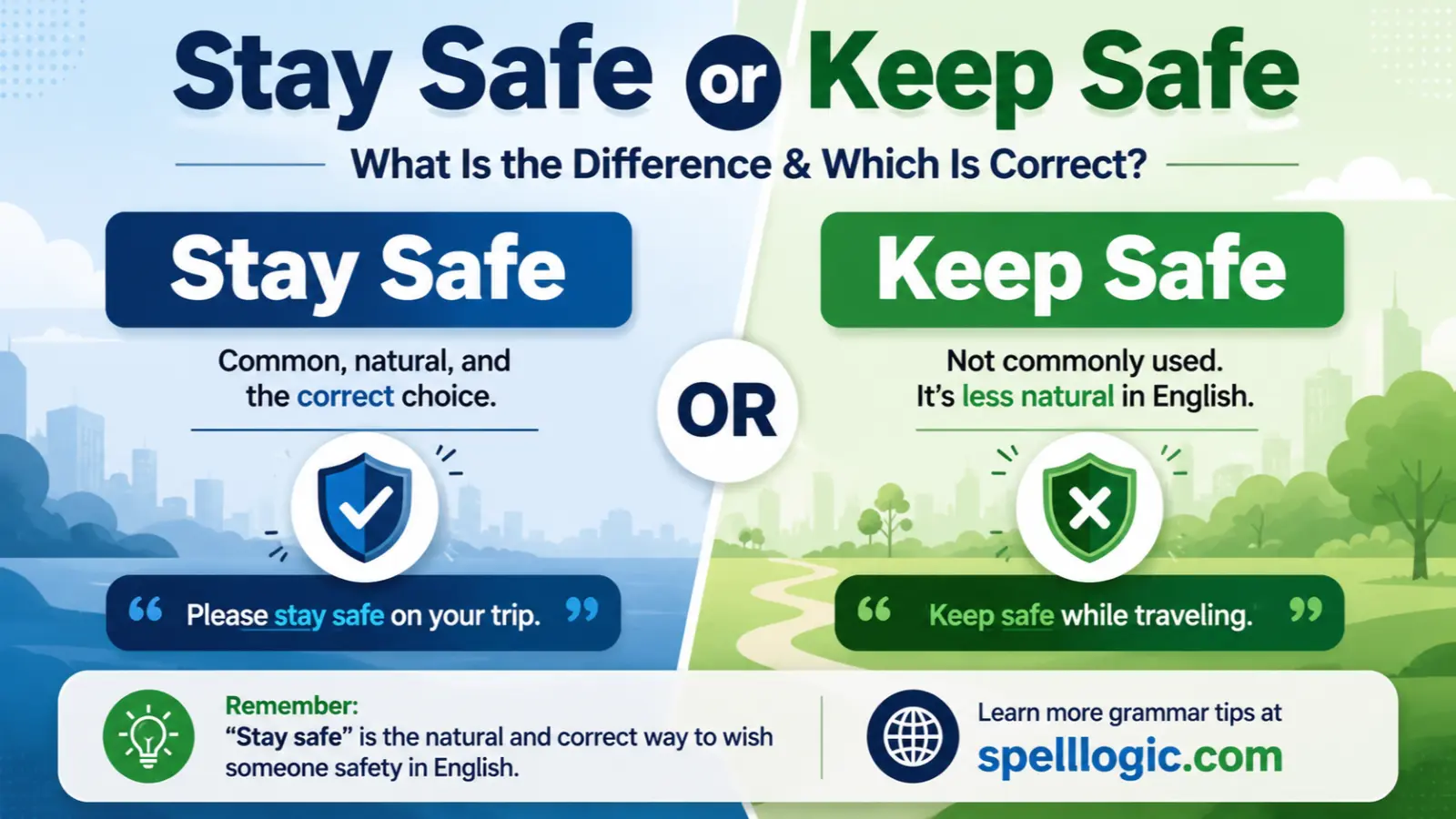
Many English learners wonder whether they should say “stay safe” or “keep safe.” Since both expressions include the word safe and are used to talk about protection from danger, they can seem interchangeable. However, they are not always used in the same way. In everyday English, one phrase is much more common than the other, especially in conversations, emails, and social media messages.
Understanding the difference between stay safe and keep safe will help you sound more natural and communicate clearly with native English speakers. This guide explains both expressions in simple language with plenty of examples.
Table of Contents
- Introduction
- Why “Stay Safe” and “Keep Safe” Are Confusing
- Stay Safe vs Keep Safe Explained Simply
- Understanding Homophones in English
- What Are Homophones?
- Why Homophones Cause Confusion
- What Does “Stay Safe” Mean?
- What Does “Keep Safe” Mean?
- Stay Safe vs Keep Safe: Key Differences at a Glance
- How to Remember the Difference Between Stay Safe and Keep Safe
- Common Mistakes and Confusions
- Examples Section: Correct and Incorrect Usage
- Self Assessment: Test Your Knowledge
- Self Assessment Answers
- FAQs About “Stay Safe” and “Keep Safe”
- Final Conclusion: Using “Stay Safe” and “Keep Safe” Correctly
Understanding the Confusion Between “Stay Safe” and “Keep Safe”
Many people mix up stay safe and keep safe because they both relate to safety and protection. However, they serve different purposes in English.
Similar Pronunciation
Both expressions are short, easy to pronounce, and contain the word safe, making them sound closely related.
Similar Spelling
The only difference is the verbs stay and keep, which are both common English verbs. This similarity often causes confusion.
Context Confusion
Both expressions appear in conversations about health, travel, emergencies, and everyday life. Learners often assume they mean exactly the same thing.
Common Learner Mistakes
- Saying keep safe when wishing someone well.
- Using stay safe to describe protecting an object.
- Assuming both expressions are equally common in every situation.
Stay Safe vs Keep Safe Explained Simply
Stay safe means remain safe or continue being safe.
Keep safe means protect someone or something so that it remains safe.
One-line distinction
Stay safe is a wish or advice for someone, while keep safe means to protect or preserve safety.
Example Sentences
- Stay safe means remain protected from danger, while keep safe means protect someone or something from harm.
- Please stay safe during the storm.
- We keep important documents safe in a locked cabinet.
Understanding Homophones in English
What Are Homophones?
Homophones are words that sound the same but have different meanings and often different spellings.
Example:
- Sea – a large body of salt water
- See – to use your eyes
Although stay safe and keep safe are not homophones, learners often confuse them because they are used in similar situations.
Why Homophones Cause Confusion
English contains many words that sound alike, making it easy to choose the wrong one.
For example:
- I went to the sea.
- I can see the beach.
Likewise, learners confuse stay safe and keep safe because both involve the idea of safety, even though their meanings differ.
What Does “Stay Safe” Mean?
Definition and Core Meaning
Stay safe is a common expression used to encourage someone to remain protected from danger, illness, accidents, or harm.
It is often used as a friendly goodbye or caring message.
Origin and Historical Use
The verb stay has existed in English for centuries, meaning to remain in a particular condition or place. The phrase stay safe became especially popular in modern English during natural disasters, health emergencies, and the COVID-19 pandemic.
Modern Usage and Synonyms
Common uses
- Saying goodbye
- Giving advice
- Showing care
- Offering encouragement
Synonyms
- Remain safe
- Be careful
- Take care
- Look after yourself
- Stay protected
Example Sentences
- Stay safe while traveling abroad.
- Stay safe and call me when you arrive.
- Everyone should stay safe during the heatwave.
- Stay safe on your way home.
What Does “Keep Safe” Mean?
Definition and Core Meaning
Keep safe means to protect someone or something from danger or damage.
Unlike stay safe, this phrase usually involves an action taken by someone to ensure safety.
Origin and Historical Context
The verb keep has long meant to guard, protect, or preserve. Over time, keep safe became a natural expression for protecting people, valuables, memories, and important items.
Modern Usage and Synonyms
Common uses
- Protecting people
- Protecting belongings
- Preserving valuable items
- Giving instructions
Synonyms
- Protect
- Guard
- Preserve
- Secure
- Safeguard
Example Sentences
- Keep your passport safe.
- Parents work hard to keep their children safe.
- Please keep all valuables safe.
- Firefighters helped keep everyone safe.
Stay Safe vs Keep Safe: Key Differences at a Glance
| Word | Part of Speech | Meaning | Example Context |
|---|---|---|---|
| Stay safe | Verb phrase | Remain protected from harm | Stay safe during your trip. |
| Keep safe | Verb phrase | Protect someone or something | Keep your phone safe in your bag. |
How to Remember the Difference Between Stay Safe and Keep Safe
Here are a few simple tricks to remember which phrase to use.
Easy Memory Tricks
- Stay = remain
- Keep = protect
Association Techniques
Imagine someone leaving for vacation.
You say:
Stay safe!
Now imagine putting your passport in a secure place.
You think:
Keep your passport safe.
One Memorable Example
- People stay safe.
- People keep things safe.
This simple rule works in most everyday situations.
Common Mistakes and Confusions
Wrong
❌ Keep safe on your journey.
Correct
✔ Stay safe on your journey.
Explanation: You are wishing someone continued safety.
Wrong
❌ Stay your important papers safe.
Correct
✔ Keep your important papers safe.
Explanation: You are protecting an object.
Wrong
❌ We stayed the documents safe.
Correct
✔ We kept the documents safe.
Explanation: Documents cannot “stay” safe by themselves in this context.
Wrong
❌ Keep safe when crossing the road.
Correct
✔ Stay safe when crossing the road.
Explanation: This is advice directed at a person.
Examples Section: Correct and Incorrect Usage
Example 1
✔ Correct: Stay safe while driving at night.
✘ Incorrect: Keep safe while driving at night.
Example 2
✔ Correct: Please keep your jewelry safe.
✘ Incorrect: Please stay your jewelry safe.
Example 3
✔ Correct: Stay safe during the storm.
✘ Incorrect: Keep safe during the storm.
Example 4
✔ Correct: We keep our savings safe in the bank.
✘ Incorrect: We stay our savings safe in the bank.
Example 5
✔ Correct: Stay safe and enjoy your vacation.
✘ Incorrect: Keep safe and enjoy your vacation.
Example 6
✔ Correct: Security guards keep visitors safe.
✘ Incorrect: Security guards stay visitors safe.
Self Assessment: Test Your Knowledge
Fill in the blanks with stay safe or keep safe.
- Please ________ while traveling overseas.
- We always ________ our important files in a secure cabinet.
- Doctors work hard to ________ patients safe.
- I hope you ________ during the heavy snowfall.
Self Assessment Answers
- stay safe
- keep
- keep
- stay safe
FAQs
1. Which expression is more common?
Stay safe is much more common when wishing someone well.
2. Can I say “keep safe” to a friend?
It is grammatically correct but much less natural than stay safe when saying goodbye.
3. Is “stay safe” grammatically correct?
Yes. It is a very common and natural English expression.
4. When should I use “keep safe”?
Use keep safe when talking about protecting people or objects.
5. Can both expressions mean the same thing?
They share the general idea of safety, but they are used differently depending on whether someone is remaining safe or protecting something.
6. Which phrase is better for emails and messages?
Stay safe is the preferred choice when ending emails, texts, or letters.
7. Can “keep safe” be used with objects?
Yes. It is commonly used with valuables, documents, money, photographs, and other important items.
Final Conclusion: Using “Stay Safe” and “Keep Safe” Correctly
Although stay safe and keep safe both relate to protection and safety, they are not used in exactly the same way. Stay safe is the expression you use when you want someone to remain free from danger. It is friendly, caring, and extremely common in conversations, emails, text messages, and social media posts. If you are saying goodbye or offering good wishes, stay safe is usually the best choice.
On the other hand, keep safe focuses on the act of protecting someone or something. It often describes making sure that people, valuable possessions, important documents, or personal belongings are secure. In many sentences, keep is followed by an object, such as keep your passport safe or keep the children safe. This makes it different from stay safe, which is directed at the person who should remain safe.
A simple way to remember the difference is this: people stay safe, while people keep other people or things safe. Keeping this rule in mind will help you choose the correct expression in everyday English. The more you read, listen, and practice these phrases in real conversations, the more natural they will become. Continue learning, notice how native speakers use them, and don’t be afraid to practice. Every new expression you master brings you one step closer to speaking English with confidence and accuracy.