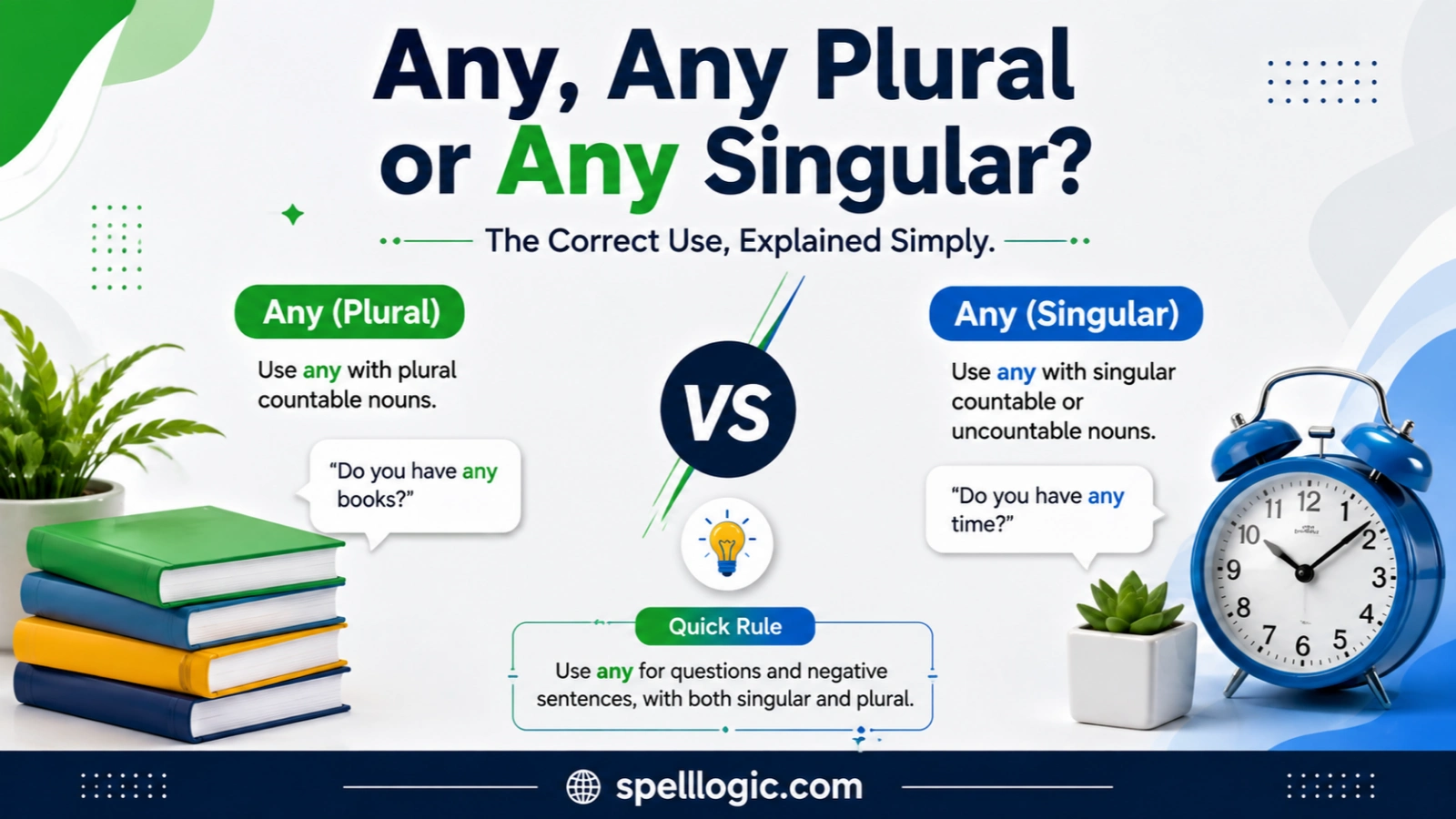
English learners often search for any plural or singular because they wonder whether any is singular or plural. The confusion happens because any can be used with singular countable nouns, plural countable nouns, and uncountable nouns. Its meaning can also change slightly depending on whether the sentence is a question, a negative statement, or a conditional sentence.
Understanding this small but important grammar point helps you choose the right noun form and avoid common errors in everyday English. In this guide, we will explain how any works, when it takes a singular noun, when it takes a plural noun, and when it is used with an uncountable noun.
Why “Any Plural or Singular” Is Confusing
Many learners search for any plural or singular because they expect any to behave like a normal singular or plural word. However, any is a determiner and pronoun that can work with different types of nouns. The noun that follows it usually determines whether the sentence contains a singular countable noun, a plural countable noun, or an uncountable noun.
Similar pronunciation
There is no special pronunciation problem between the words involved. The main difficulty is grammatical rather than phonetic. Learners may hear “any” in fast speech and focus on the noun that follows it instead of noticing the whole grammatical pattern.
Similar spelling
The spelling of any is short and simple, but learners may connect it incorrectly with one, some, or other quantity words. This can lead to uncertainty about the form of the noun that follows.
Context confusion
Context is especially important. Compare these sentences:
- Do you have any book about grammar?
- Do you have any books about grammar?
- Do you have any information about grammar?
All three can be grammatical, but they use different noun types. The first uses a singular countable noun, the second uses a plural countable noun, and the third uses an uncountable noun.
Common learner mistakes
A common error is assuming that any always requires a plural noun. Another is assuming that any always requires a singular noun. In reality, its choice depends on the noun and the intended meaning.
Any Plural or Singular Explained Simply
The simplest answer to any plural or singular is that any can be used with singular countable nouns, plural countable nouns, and uncountable nouns. When learners ask about any plural or singular, they are usually asking which noun form should follow any.
The key point is that any itself does not have a fixed singular or plural form in these uses. Instead, the noun after it shows the number when a countable noun is involved.
One-line distinction: Any can introduce a singular countable noun, a plural countable noun, or an uncountable noun, depending on meaning and context.
Examples:
- If you need any book, choose one from the shelf.
- If you need any books, you can borrow them from the library.
A useful pattern for any plural or singular is:
- any + singular countable noun = one of a group, often with the meaning “whichever” or “any one”
- any + plural countable noun = one or more from a group
- any + uncountable noun = an unspecified amount
Understanding Homophones in English
What Are Homophones?
Homophones are words that sound the same but have different meanings, spellings, or both. For example, right and write sound alike but have different meanings and spellings.
This is a grammar problem, not a homophone problem, although the distinction is useful to understand.
Why Homophones Cause Confusion
Homophones can cause confusion because listening alone may not tell you which word a speaker means. For example, “I want to write” and “I want the right answer” contain words that sound similar but have different functions.
With any, however, the challenge comes from understanding how the word combines with different noun types.
What Does “Any” Mean?
Definition and Core Meaning
Any is commonly used to refer to an unspecified person, thing, amount, or number. It often appears in questions and negative sentences, but it can also appear in affirmative and conditional sentences.
For any plural or singular, the important point is that any does not itself tell you whether the following noun must be singular or plural.
Origin and Historical Use
The word any comes from Old English ænig, related to the idea of “one,” “some,” or “any one.” Over time, its uses expanded, allowing English speakers to refer to an indefinite member, an indefinite number, or an indefinite amount.
Modern Usage and Synonyms
The word any is extremely common in everyday English, which is why any plural or singular questions appear often.
Today, any is used in many everyday situations:
- Questions: Do you have any questions?
- Negative statements: I don’t have any questions.
- Conditions: If you have any questions, ask me.
- Affirmative meaning: You may choose any seat.
- With uncountable nouns: We don’t have any water.
Depending on context, related words can include some, whichever, whatever, or every, although these are not always exact synonyms.
Example sentences
- Do you have any questions?
- I don’t have any money.
- You can choose any color you like.
- If you see any problems, tell me.
- She didn’t buy any apples.
Notice that any can appear before plural nouns such as questions and apples, uncountable nouns such as money, and a singular countable noun such as color.
What Does “Plural” Mean?
Definition and Core Meaning
A plural noun refers to more than one person, place, thing, or idea. For example, books, students, and cars are plural nouns.
A singular noun refers to one person, place, thing, or idea. Examples include book, student, and car.
Origin and Historical Context
The word plural comes from Latin pluralis, meaning “more than one.” This helps explain any plural or singular discussions. English developed several ways to form plurals, with -s and -es being the most common endings. Some nouns have irregular plural forms, such as child → children and person → people.
Modern Usage and Synonyms
In grammar, plural describes number. Related terms include multiple, more than one, and plural form, while singular describes one.
When discussing any plural or singular, remember that the noun following any can show either number.
- any student = one student, without specifying which one
- any students = one or more students, without specifying which ones
- any advice = an unspecified amount of advice
Example sentences
- Any student can join the activity.
- Any students who finish early may leave.
- Do you have any questions?
- Is there any reason to worry?
- We don’t need any equipment.
The correct noun form depends on what you want to express when learning any plural or singular.
Any Plural or Singular: Key Differences at a Glance
| Word | Part of Speech | Meaning | Example Context |
|---|---|---|---|
| any | Determiner/pronoun | An unspecified one, number, or amount | Do you have any questions? |
| singular noun | Noun form | One person or thing | Any student may participate. |
| plural noun | Noun form | More than one person or thing | Any students may participate. |
| uncountable noun | Noun form | An unspecified amount | Do you have any information? |
The central lesson about any plural or singular is that the noun type matters more than any itself. For any plural or singular, always check whether the noun is countable and how many items you mean.
How to Remember the Difference Between Any and Singular or Plural Nouns
Use these simple memory tricks to make any plural or singular easier to remember. If any plural or singular still feels confusing, focus on the noun rather than the determiner.
Memory trick 1: Look at the noun
Do not ask only, “Is any singular or plural?” Instead, look at the noun after any.
- any + book → singular countable
- any + books → plural countable
- any + water → uncountable
Memory trick 2: Think “one, many, or amount”
Ask yourself three questions:
- Am I talking about one possible item?
- Am I talking about one or more items?
- Am I talking about an amount that cannot normally be counted?
The answer will help you select the correct noun form.
Association technique
Remember this sentence:
“Any can point to one, many, or an amount.”
This short rule covers most everyday uses.
One memorable example
You can choose any book, any books, or any information you need, depending on what you mean.
The grammar changes because the nouns have different meanings and types, a key point in any plural or singular questions.
Common Mistakes and Confusions
Understanding any plural or singular becomes easier when you recognize the mistakes learners commonly make. These patterns answer most everyday questions about any plural or singular.
Mistake 1: Using a plural noun every time
✘ Do you have any book? is not always wrong, but it may sound unnatural if the speaker means “Do you have any books at all?”
✔ Do you have any books?
If the speaker means one book of any kind, any book can be correct.
Mistake 2: Using a singular noun when talking about several items
✘ I don’t have any book in my bag.
✔ I don’t have any books in my bag.
The plural form is natural when the speaker means there are no books in the bag.
Mistake 3: Treating uncountable nouns as plural
✘ Do you have any informations?
✔ Do you have any information?
Information is normally uncountable in standard English, so it does not take a plural -s in this meaning.
Mistake 4: Assuming any always means “some”
Any can have different meanings. In a negative sentence, “I don’t have any money” means zero amount. In “Choose any seat,” it means whichever seat you want.
Examples Section: Correct and Incorrect Usage
Here are practical examples to strengthen your understanding of any plural or singular. Reading examples is one of the fastest ways to understand any plural or singular in real sentences.
Example 1
✔ Correct: Do you have any questions?
✘ Incorrect: Do you have any question?
Explanation: The plural form is natural when asking whether the listener has one or more questions.
Example 2
✔ Correct: You can choose any book from the shelf.
✘ Incorrect: You can choose any books from the shelf.
Explanation: The singular form can mean one book of your choice. The plural form would suggest multiple books.
Example 3
✔ Correct: We don’t have any information about the meeting.
✘ Incorrect: We don’t have any informations about the meeting.
Explanation: Information is uncountable in standard English.
Example 4
✔ Correct: If you have any problems, contact the manager.
✘ Incorrect: If you have any problem, contact the manager.
Explanation: Both forms can be grammatical in different contexts, but the plural is more natural when referring generally to possible problems.
Example 5
✔ Correct: You may choose any seat.
✘ Incorrect: You may choose any seats.
Explanation: The singular version naturally means you may select one seat of your choice.
Self Assessment: Test Your Knowledge
Complete each sentence with the most suitable noun form.
- Do you have any ________ about the new course? (question/questions)
- You can choose any ________ from this menu. (dish/dishes)
- We don’t have any ________ left. (water/waters)
- If you have any ________, please contact us. (problem/problems)
Self Assessment Answers
- questions — The sentence asks generally whether the person has one or more questions.
- dish — The sentence can mean one dish of the customer’s choice.
- water — Water is normally an uncountable noun in this meaning.
- problems — The plural is natural for general possible problems.
FAQs
Is any singular or plural?
Any can be used with singular countable nouns, plural countable nouns, and uncountable nouns. It does not have one fixed number.
Can I use any with a singular noun?
Yes. For example: You can choose any book. Here, any means one book of your choice.
Can I use any with plural nouns?
Yes. For example: Do you have any books? The plural form refers to one or more books.
Can any be used with uncountable nouns?
Yes. Examples include any water, any money, any advice, and any information.
Is “any questions” correct?
Yes. Any questions? is a very common shortened question. The full version is Do you have any questions?
Is “any information” correct?
Yes. Information is generally uncountable, so we say any information, not any informations.
Does any always mean “some”?
No. Its meaning depends on context. In “I don’t have any money,” it means no amount. In “Choose any seat,” it means whichever one you want.
Final Conclusion: Using Any Plural or Singular Correctly
The most important lesson about any plural or singular is that any itself is not simply a singular or plural word. It is a flexible determiner and pronoun that can be used with singular countable nouns, plural countable nouns, and uncountable nouns. If you remember one rule about any plural or singular, remember that the noun after any carries the number when a countable noun is used.
Use any + singular countable noun when you mean one possible person or thing, especially when the meaning is “whichever one.” For example, You can choose any seat means you may choose one seat from the available options. Use any + plural countable noun when you are referring generally to one or more members of a group, as in Do you have any questions? Use any + uncountable noun when you mean an unspecified amount, such as any water, any money, or any advice.
A simple memory rule is: look at the noun, not just the word any. Ask whether you mean one, more than one, or an uncountable amount. With regular practice, these patterns will become natural. Do not worry if the distinction feels confusing at first. Every correct example you read or write helps you build a stronger understanding of English grammar.