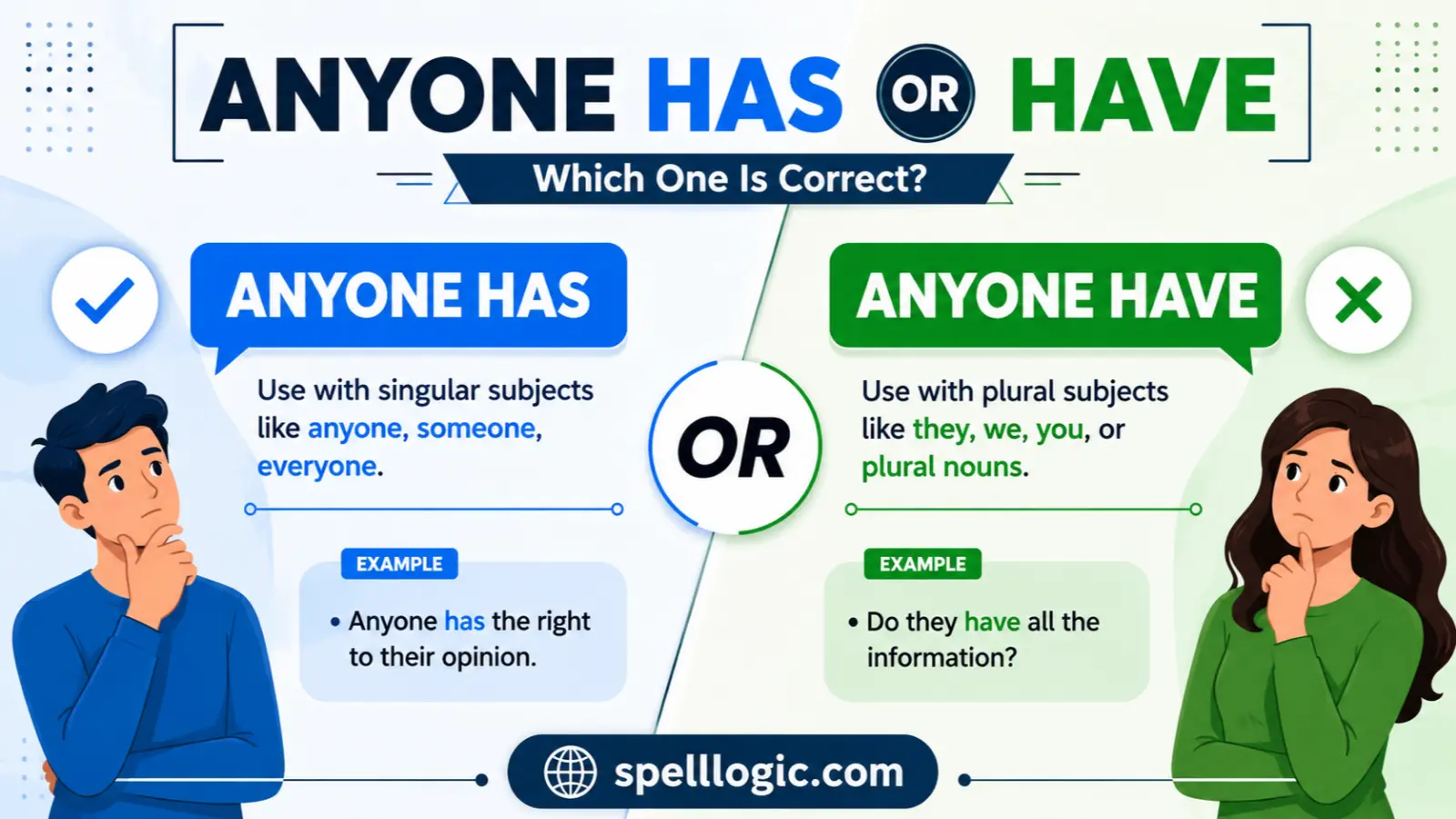
English learners often wonder whether to say “anyone has” or “anyone have” because the word anyone refers to people but takes a singular verb. This can be confusing, especially in questions such as “Does anyone have a pen?” or statements such as “If anyone has a question, please ask.”
Understanding anyone has or have becomes much easier once you learn how subject–verb agreement works with indefinite pronouns. The key is to look at the structure of the sentence rather than simply focusing on the meaning of anyone. This guide explains the difference clearly, with simple rules, examples, common mistakes, and useful memory tricks.
Why “Anyone Has or Have” Is Confusing
The question “anyone has or have” is common because anyone sounds as if it could refer to several people. However, grammatically, anyone is an indefinite pronoun that is treated as singular.
Several factors create confusion:
Similar pronunciation
In normal speech, has and have can appear in similar sentence structures. Learners may choose the form that sounds more natural instead of checking the grammar.
Similar spelling and structure
Both has and have are forms of the verb to have. Their meanings are closely related, but their grammatical uses are different.
Context confusion
The correct form depends heavily on the sentence structure. Compare:
- “If anyone has a question, please ask.”
- “Does anyone have a question?”
Both sentences refer to the same idea, but the auxiliary verb does changes the form of the main verb.
Common learner mistakes
A common mistake is to write “Does anyone has a question?” because anyone is singular. However, after does, the main verb must use its base form: have.
This makes anyone has or have an especially useful grammar question for understanding subject–verb agreement and auxiliary verbs.
“Anyone Has or Have” Explained Simply
The basic rule is simple:
“Anyone” is singular, so use “has” in a normal affirmative statement. Use “have” after auxiliary verbs such as “does,” “can,” “will,” or “may.”
In other words, anyone has or have depends on the grammatical structure of the sentence.
One-line distinction
Use “has” when anyone directly takes the verb; use “have” when an auxiliary or modal requires the base form of the verb.
Examples:
- Anyone has the right to ask questions.
- Does anyone have a spare pen?
So, anyone has or have does not have one universal answer. The correct choice depends on what comes before the verb.
Understanding Homophones in English
What Are Homophones?
Homophones are words that sound the same but have different meanings, spellings, or grammatical functions. For example, right and write sound alike but have different meanings.
However, anyone has or have is not a homophone issue. Has and have are different forms of the same verb, to have. The confusion comes from grammar rather than pronunciation.
Why Homophones Cause Confusion
Homophones can make English spelling difficult because listeners cannot always tell which word is intended from sound alone. For example:
- “Please write your name.”
- “You are right.”
With anyone has or have, the challenge is different. Learners must understand subject–verb agreement and auxiliary verbs.
What Does “Anyone Has” Mean?
Definition and Core Meaning
“Anyone has” uses has as the main verb when anyone is the subject. Because anyone is grammatically singular, the third-person singular form has is normally required in an affirmative clause.
For example:
- “Anyone has the opportunity to participate.”
- “If anyone has a problem, tell the manager.”
- “Anyone who has experience can apply.”
The phrase anyone has or have often appears when learners are deciding whether anyone should be treated as singular or plural.
Origin and Historical Use
Anyone developed from the combination of any and one. The word has long been used to refer to an unspecified person. Although it can refer to one person from a group, English grammar treats it as singular.
This explains why we say:
- “Anyone is welcome.”
- “Anyone has the right to speak.”
- “Anyone can join.”
We do not normally say “Anyone are welcome” or “Anyone have the right” in a standard affirmative sentence.
Modern Usage and Synonyms
Modern English commonly uses anyone in questions, negative sentences, conditional clauses, and general statements.
Related expressions include:
- anybody
- any person
- whoever
- any individual
Examples:
- “If anyone has information, please contact us.”
- “Anyone who has a ticket may enter.”
- “Anyone can learn a new language.”
- “Anyone who has concerns should speak to the supervisor.”
A useful point about anyone has or have is that has is correct when there is no auxiliary verb forcing the base form.
What Does “Anyone Have” Mean?
Definition and Core Meaning
“Anyone have” can be correct when have follows an auxiliary verb or modal, such as does, did, can, will, would, should, or might.
For example:
- “Does anyone have a question?”
- “Did anyone have a problem?”
- “Can anyone have access to this file?”
- “Will anyone have enough time?”
Here, anyone remains singular, but the auxiliary verb carries the grammatical marking. Therefore, the main verb stays in its base form: have.
Origin and Historical Context
Have is an old English verb with forms that developed over centuries. Modern English uses have as the base form and has as the third-person singular present form.
This distinction remains important in modern grammar. Compare:
- “She has a car.”
- “Does she have a car?”
The same rule applies to anyone:
- “Anyone has a choice.”
- “Does anyone have a choice?”
Therefore, the correct answer to anyone has or have changes according to the presence of an auxiliary verb.
Modern Usage and Synonyms
Have appears frequently in questions and constructions involving auxiliary verbs.
Common patterns include:
- Does anyone have…?
- Did anyone have…?
- Can anyone have…?
- Will anyone have…?
- Would anyone have…?
- Should anyone have…?
Examples:
- “Does anyone have my notebook?”
- “Did anyone have trouble finding the building?”
- “Can anyone have access to these records?”
- “Would anyone have a suggestion?”
One special case is informal conversation. People sometimes say, “Anyone have a pen?” This is a shortened form of “Does anyone have a pen?” It is common in casual speech but is less formal.
“Anyone Has or Have”: Key Differences at a Glance
| Word | Part of Speech | Meaning | Example Context |
|---|---|---|---|
| Anyone | Indefinite pronoun | Any person, no specific person identified | “Anyone can participate.” |
| Has | Verb, third-person singular | Possesses, experiences, or holds | “Anyone has the right to complain.” |
| Have | Base-form verb | Possess, experience, or hold | “Does anyone have a question?” |
The central grammar rule behind anyone has or have is that anyone is singular, but an auxiliary verb can require have.
How to Remember the Difference Between Anyone Has and Anyone Have
Learning anyone has or have becomes easier with a few simple memory tricks.
Memory Trick 1: “Anyone” acts like “he” or “she”
Think of anyone as grammatically similar to he or she.
- He has a book.
- She has a book.
- Anyone has a choice.
This helps you remember that anyone takes has in a straightforward present-tense statement.
Memory Trick 2: “Does” takes the job
When you see does, remember that does carries the singular grammar.
- She has a car.
- Does she have a car?
- Anyone has a question.
- Does anyone have a question?
Therefore, after does, use have, not has.
Memory Trick 3: Watch for helping verbs
Words such as does, did, can, will, and should are clues that the main verb should remain in its base form.
A memorable example is:
Anyone has a question.
Does anyone have a question?
The meaning is similar, but the sentence structure changes the verb form.
Common Mistakes and Confusions
Understanding anyone has or have also means knowing which patterns to avoid.
Mistake 1
✘ “Does anyone has a question?”
✔ “Does anyone have a question?”
Explanation: Does is already the auxiliary verb. The main verb must use its base form, have.
Mistake 2
✘ “Anyone have the right to complain.”
✔ “Anyone has the right to complain.”
Explanation: In a standard affirmative sentence without an auxiliary verb, anyone takes the singular form has.
Mistake 3
✘ “If anyone have a problem, call me.”
✔ “If anyone has a problem, call me.”
Explanation: The conditional clause has no auxiliary before the main verb, so has is required.
Mistake 4
✘ “Can anyone has access to the room?”
✔ “Can anyone have access to the room?”
Explanation: After the modal verb can, use the base form have.
These examples show why anyone has or have should be answered by examining the complete sentence instead of looking at anyone alone.
Examples Section: Correct and Incorrect Usage
Example 1
✔ Correct: “If anyone has a question, please raise your hand.”
✘ Incorrect: “If anyone have a question, please raise your hand.”
Why? Anyone is the subject, and there is no auxiliary verb before have. Use has.
Example 2
✔ Correct: “Does anyone have an extra chair?”
✘ Incorrect: “Does anyone has an extra chair?”
Why? Does already marks the present-tense singular form, so the main verb becomes have.
Example 3
✔ Correct: “Anyone who has relevant experience may apply.”
✘ Incorrect: “Anyone who have relevant experience may apply.”
Why? The relative clause refers to anyone, which is singular. Therefore, use has.
Example 4
✔ Correct: “Can anyone have access to the document?”
✘ Incorrect: “Can anyone has access to the document?”
Why? A modal verb such as can is followed by the base form of the verb.
Example 5
✔ Correct: “Did anyone have difficulty finding the office?”
✘ Incorrect: “Did anyone has difficulty finding the office?”
Why? After did, use the base form have.
Example 6
✔ Correct: “Anyone has the opportunity to improve.”
✘ Incorrect: “Anyone have the opportunity to improve.”
Why? In this standard affirmative structure, anyone directly takes the singular verb has.
These patterns make anyone has or have easier to recognize in everyday writing and conversation.
Self Assessment: Test Your Knowledge
Fill in each blank with has or have.
- If anyone ______ a question, please ask it now.
- Does anyone ______ a copy of the report?
- Anyone who ______ experience in sales can apply.
- Can anyone ______ a look at this document?
Self Assessment Answers
- has — “If anyone has a question, please ask it now.”
- have — “Does anyone have a copy of the report?”
- has — “Anyone who has experience in sales can apply.”
- have — “Can anyone have a look at this document?”
The easiest way to solve these questions is to identify whether an auxiliary or modal verb comes before the main verb.
FAQs
1. Is “anyone has” grammatically correct?
Yes. “Anyone has” is correct when anyone directly functions as the singular subject of an affirmative clause, such as “Anyone has the right to speak.”
2. Is “anyone have” grammatically correct?
Yes, but the structure matters. It is correct after auxiliary or modal verbs, as in “Does anyone have a question?” In informal speech, “Anyone have a question?” can also occur as an abbreviated question.
3. Should I say “Does anyone have” or “Does anyone has”?
Use “Does anyone have.” After does, the main verb must be in its base form.
4. Why does anyone use “has” instead of “have”?
Anyone is an indefinite pronoun treated as singular in standard English. Therefore, it takes has when it directly controls the verb in the present tense.
5. Is “If anyone have” correct?
No, not in standard English. Say, “If anyone has a question.” The word if does not change the singular subject–verb agreement.
6. Is “Anyone have a pen?” correct?
It is common in informal spoken English as a shortened form of “Does anyone have a pen?” In formal writing, “Does anyone have a pen?” is the safer choice.
7. What is the easiest rule for anyone has or have?
Use has when anyone directly takes the verb. Use have after helping or modal verbs such as does, did, can, and will.
Final Conclusion: Using “Anyone Has and Have” Correctly
The key to understanding anyone has or have is recognizing that anyone is a singular indefinite pronoun. When anyone directly takes a present-tense verb, use has: “Anyone has the right to participate.” The situation changes when an auxiliary or modal verb comes before the main verb. After does, did, can, will, would, and similar helping verbs, use the base form have: “Does anyone have a question?” This same principle applies to many other subjects and verbs in English, so learning it will improve both your writing and speaking.
Remember the simple pattern: anyone has, but does anyone have. Also use have after modal verbs, as in “Can anyone have access?” When you are unsure, look for the helping verb first. If does or another auxiliary is already carrying the grammatical information, the main verb usually stays in its base form. With regular practice, these patterns will become natural. Keep checking complete sentence structures rather than relying only on how a phrase sounds, and your confidence with English grammar will steadily improve.