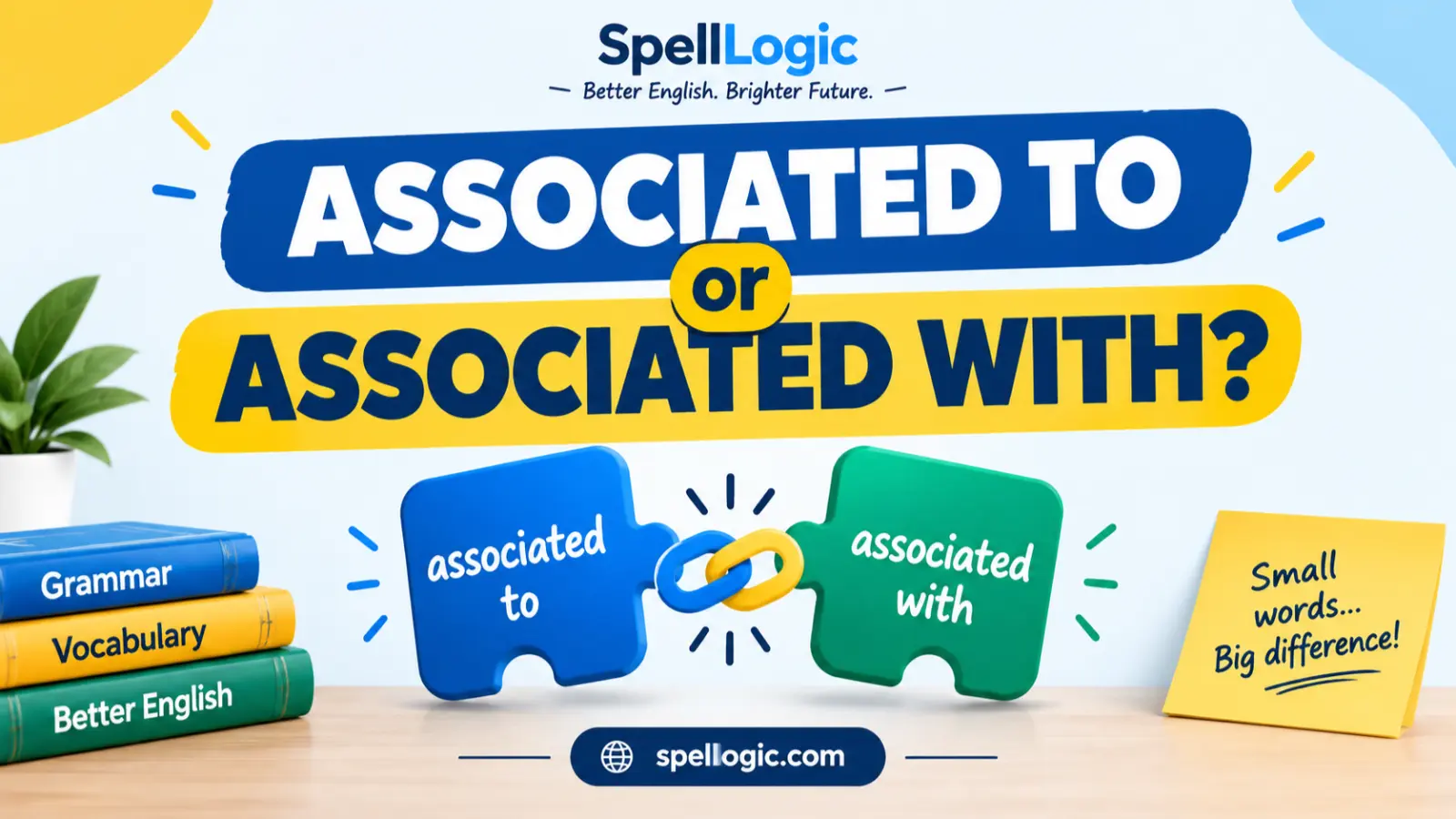
English learners often wonder whether associated to or with is the correct expression when they want to show a connection between two people, things, ideas, or events. The confusion usually comes from the fact that both to and with can follow other English words in similar-looking constructions.
However, when we use the verb associate to describe a connection, standard English normally uses associated with. The phrase associated to is much less common and is generally not the preferred choice in standard modern English. Learning this small difference can make your writing sound more natural and accurate, especially in academic, professional, and everyday communication.
Why “Associated To” and “Associated With” Are Confusing
The expression associated to or with can be confusing because learners may see both prepositions used after words that describe relationships or connections. In particular, English has many combinations in which to and with appear naturally, so it is easy to transfer a familiar pattern to another verb.
Similar Pronunciation
The words to and with sound different, so this is not a pronunciation-based confusion in the strict sense. However, in fast speech, short grammatical words can receive little stress. Learners may therefore focus more on the main word, associated, and pay less attention to the preposition that follows it.
Similar Spelling
There is no direct spelling similarity between to and with. The confusion comes mainly from sentence structure rather than spelling.
For example, English learners may know expressions such as:
- connected to something
- related to something
- linked to something
- associated with something
Because these expressions have similar meanings, learners sometimes replace one preposition with another.
Context Confusion
Both expressions can be understood as describing a relationship, but standard English strongly prefers associated with.
For example:
The color red is often associated with danger.
Here, with introduces the thing connected to the subject.
Common Learner Mistakes
A common mistake is to use associated to because learners remember other expressions such as related to or connected to.
For instance:
✘ This symbol is associated to the company.
A more natural standard-English version is:
✔ This symbol is associated with the company.
Understanding the difference helps learners avoid direct translation and preposition errors.
Associated To vs Associated With Explained Simply
The easiest way to understand associated to or with is to remember that associate normally takes with when it means “to connect or link one thing with another.”
Simple Explanation
Associated with is the standard and widely accepted construction used to describe a connection, relationship, or link.
Associated to may appear in some English varieties or specialized contexts, but it is not normally the preferred construction in standard English when associate means “connected with.”
One-Line Distinction
Associated with is the normal standard-English expression for showing a connection, while associated to is generally avoided in this meaning.
Example Sentences
- The company is closely associated with environmental research.
- His name is associated with several successful projects.
A useful pattern is:
Associated with means connected or linked with something or someone.
When learners encounter associated to or with, they should usually choose with.
Understanding Homophones in English
The issue of associated to or with is not actually a homophone problem. It is primarily a preposition-choice problem. Still, understanding homophones is useful because English learners often encounter several types of confusing word pairs.
What Are Homophones?
Homophones are words that sound the same, or nearly the same in some varieties of English, but have different meanings, spellings, or grammatical functions.
For example:
- two
- to
- too
These words have different meanings even though they share the same pronunciation in standard English.
Why Homophones Cause Confusion
Homophones can cause spelling mistakes because a speaker may know the correct sound but choose the wrong written word.
For example:
I have two books.
and:
I want to read.
The meaning and grammar determine which spelling is correct. In contrast, the choice between associated to or with depends mainly on the normal grammatical pattern of the verb associate.
What Does “Associated To” Mean?
Definition and Core Meaning
When learners use associated to or with, they may intend associated to to mean “connected to,” “related to,” or “linked to.” The intended meaning is usually understandable from context.
However, in standard modern English, associate with is the established construction for this meaning. Therefore, learners should normally avoid associated to when they mean that one person, thing, idea, or event has a connection with another.
For example:
✘ The disease is associated to several risk factors.
The preferred version is:
✔ The disease is associated with several risk factors.
Origin and Historical Use
The verb associate comes from Latin associare, meaning to join or unite. English developed the verb to describe the act of joining, connecting, or linking people and ideas.
Over time, associate with became the established English pattern when describing a relationship or connection.
Modern Usage and Synonyms
Although associated to or with may appear as a learner question, standard English generally favors associated with.
Useful alternatives include:
- connected with
- linked with
- related to
- tied to
- connected to
- affiliated with
- correlated with
Notice that different verbs can take different prepositions. For example, related to is normal, but associated with is the usual form.
Example Sentences
- The brand is strongly associated with quality.
- Exercise is associated with several health benefits.
- The artist became associated with a new style of music.
- Certain colors are traditionally associated with particular emotions.
These examples show why choosing a preposition according to the verb’s established pattern is important.
What Does “Associated With” Mean?
Definition and Core Meaning
Associated with means connected, linked, related, or commonly connected in people’s minds or in a particular situation.
It can describe a physical, professional, social, cultural, academic, or conceptual relationship.
For example:
The word “winter” is often associated with cold weather.
Here, associated with tells us that people commonly connect winter and cold weather in their minds.
Origin and Historical Context
The word associate entered English through French and ultimately traces back to Latin roots connected with joining or sharing. The basic idea of bringing things together has remained important to its modern meaning.
The preposition with naturally reinforces this idea of connection between two entities.
Modern Usage and Synonyms
Today, associated with is common in both formal and informal English.
It can describe:
- a person connected with an organization
- an idea connected with a belief
- a product connected with a brand
- a symptom connected with a condition
- an event connected with a particular period
- a behavior connected with a result
Common synonyms include:
- connected with
- linked to
- related to
- affiliated with
- tied to
- connected to
Example Sentences
- She is associated with a leading research organization.
- This smell is associated with freshly baked bread.
- The building is associated with an important historical event.
- High costs are often associated with premium products.
In each sentence, associated with clearly expresses a relationship or connection.
Associated To vs Associated With: Key Differences at a Glance
| Word | Part of Speech | Meaning | Example Context |
|---|---|---|---|
| Associated to | Adjective/participial construction | Intended to mean connected to, but generally not preferred in standard English | Usually replace it with “associated with” |
| Associated with | Adjective/participial construction | Connected, linked, or related to someone or something | “The product is associated with quality.” |
The main lesson is simple: when associate means “connect” or “link,” use with in standard English.
This is an important distinction when deciding between associated to or with in professional writing, school assignments, articles, and everyday communication.
How to Remember the Difference Between Associated To and Associated With
Remembering prepositions can be difficult because there is no universal rule that works for every English verb. However, a few simple techniques can make the choice easier.
Memory Trick 1: Associate = Together
Think of associate as bringing two things together.
The phrase associated with therefore describes two things that are connected together.
A is associated with B.
Memory Trick 2: Learn the Whole Expression
Instead of memorizing only the word associate, memorize the complete phrase:
associated with
Learning word combinations, also called collocations, is one of the most effective ways to improve natural English.
Association Technique
Connect with to the idea of a relationship.
For example:
- friends are with friends
- partners work with each other
- things can be associated with each other
This mental connection can help you remember the correct preposition.
One Memorable Example
Think of this sentence:
Success is often associated with hard work.
If you remember this sentence, you can use its structure in many situations.
For example:
The city is associated with history.
The brand is associated with quality.
The color is associated with peace.
When you see associated to or with, mentally complete the phrase with with.
Common Mistakes and Confusions
One of the most frequent mistakes is choosing to because several related expressions use to.
Wrong Example 1
✘ The problem is associated to poor planning.
Correct Version
✔ The problem is associated with poor planning.
Explanation: The standard collocation is associated with.
Wrong Example 2
✘ This disease is associated to smoking.
Correct Version
✔ This disease is associated with smoking.
Explanation: The sentence describes a connection between the disease and smoking.
Wrong Example 3
✘ His name is associated to the organization.
Correct Version
✔ His name is associated with the organization.
Explanation: The person and organization have a connection, so with is preferred.
Why Learners Make This Mistake
Learners often remember:
- related to
- connected to
- linked to
These expressions are correct, but they do not mean that every similar verb must take to.
Compare:
The issue is related to money.
but:
The issue is associated with money.
The meanings are close, but the prepositions follow different established patterns.
Examples Section: Correct and Incorrect Usage
Here are several examples to make the difference clearer.
Example 1
✔ Correct: The product is associated with high quality.
✘ Incorrect: The product is associated to high quality.
Why? The standard collocation is associated with.
Example 2
✔ Correct: The festival is associated with the beginning of spring.
✘ Incorrect: The festival is associated to the beginning of spring.
Why? The sentence describes a connection between the festival and spring.
Example 3
✔ Correct: His work is closely associated with modern technology.
✘ Incorrect: His work is closely associated to modern technology.
Why? With is the conventional preposition after associated in this meaning.
Example 4
✔ Correct: Certain foods are associated with childhood memories.
✘ Incorrect: Certain foods are associated to childhood memories.
Why? The sentence explains an emotional or mental connection.
Example 5
✔ Correct: The organization is associated with several educational programs.
✘ Incorrect: The organization is associated to several educational programs.
Why? The organization has a connection or affiliation with those programs.
Example 6
✔ Correct: The term is associated with a particular historical period.
✘ Incorrect: The term is associated to a particular historical period.
Why? Standard English uses associated with to show this relationship.
Self Assessment: Test Your Knowledge
Fill in each blank with associated to or associated with.
- The famous building is closely __________ the city’s history.
- Regular exercise is often __________ better physical health.
- The brand became strongly __________ luxury and quality.
- The artist is __________ several important cultural movements.
Take a moment to choose your answers before checking the section below.
Self Assessment Answers
- associated with — The building has a connection with the city’s history.
- associated with — Exercise is connected with better physical health.
- associated with — The brand has a strong connection with luxury and quality.
- associated with — The artist is connected with those cultural movements.
In all four examples, associated with is the standard choice.
FAQs
1. Is “associated with” correct English?
Yes. Associated with is the standard English construction used to describe a connection, relationship, or link between people, things, ideas, or events.
2. Is “associated to” grammatically correct?
Associated to can appear in some varieties of English and in certain specialized or translated contexts, but it is generally not the preferred construction in standard English when the intended meaning is “connected with.”
3. Should I use “associated with” in formal writing?
Yes. Associated with is a natural choice for academic writing, business communication, reports, essays, and professional documents.
4. Why do people say “related to” but “associated with”?
English verbs have established collocations. Related to and associated with are both standard expressions, but they use different prepositions. Their similarity in meaning does not require them to have the same grammatical pattern.
5. Can “associated with” describe people?
Yes. For example:
She is associated with a well-known research institution.
It can describe professional, social, organizational, or other relationships.
6. What is another word for “associated with”?
Depending on the context, alternatives include connected with, linked to, related to, affiliated with, and tied to.
7. What should English learners remember about associated to or with?
The easiest rule is to remember the complete collocation associated with. When you mean “connected” or “linked,” with is normally the correct choice in standard English.
Final Conclusion: Using Associated To and Associated With Correctly
The main difference in associated to or with is not a difference in meaning between two equally common standard expressions. Instead, it is mainly a question of choosing the natural preposition after associate. When associate means to connect, link, or relate one thing to another, standard English normally uses associated with. For example, we say, “The company is associated with innovation,” and “The tradition is associated with the local community.” Although associated to may be encountered in some varieties of English or in contexts influenced by other languages, it is generally not the preferred form for standard English learners.
A useful way to remember the pattern is to learn associated with as one complete expression rather than trying to choose the preposition separately each time. You can also remember that with often highlights a relationship or connection between two things. At the same time, do not assume that every similar expression follows the same rule: related to and connected to are standard patterns, while associated with is the usual pattern.
Whenever you are unsure between associated to or with, choose associated with in standard English. With regular practice, this collocation will become natural and automatic. Keep learning common word combinations, use them in your own sentences, and your English will become clearer, more accurate, and more confident.