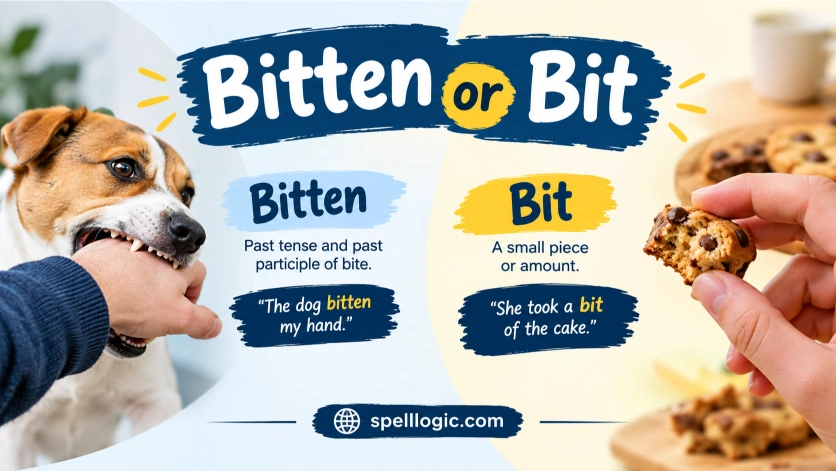
English learners often find bitten or bit confusing because both forms come from the same verb, bite, but they are used in different grammatical situations. The main difference is connected to verb tense: bit is the simple past form, while bitten is the past participle. Knowing when to use each form can make your speaking and writing much more accurate.
For example, you can say, “The dog bit me yesterday,” but you need “has bitten” when using the present perfect tense. This guide explains bitten or bit in simple language, with clear rules, examples, memory tricks, and practice questions.
Why “Bitten or Bit” Are Confusing
Many learners mix up bitten or bit because both words are forms of the irregular verb bite. Unlike regular verbs, which usually form the past tense and past participle by adding -ed, irregular verbs change in special ways.
Here are the main reasons for the confusion:
- Similar pronunciation: The forms are related in sound, although their pronunciation is not identical.
- Similar spelling: Both forms begin with bit, making them visually similar.
- Context confusion: Learners may know that both describe an action involving biting but may not know which grammatical form the sentence requires.
- Common learner mistakes: A frequent error is using bitten alone as the simple past form or using bit after have, has, or had.
The key is to focus on the helping verb and the tense of the sentence rather than only on the meaning.
Bitten or Bit Explained Simply
The easiest way to understand bitten or bit is to remember that they perform different grammatical jobs.
- Bit is the simple past form of bite.
- Bitten is the past participle of bite and normally needs a helping verb such as have, has, had, or sometimes be in passive constructions.
One-line distinction: Bit describes a completed past action, while bitten is used mainly with auxiliary verbs to form perfect or passive structures.
For example:
- “The snake bit him yesterday.”
- “The snake has bitten him before.”
A useful sentence pattern is: “Bit means the past action of bite, while bitten is the past participle used with helping verbs.”
Understanding Homophones in English
What Are Homophones?
Homophones are words that have the same pronunciation but different meanings, spellings, or grammatical functions. For example, right and write sound alike but have different meanings and spellings.
The forms discussed here are not true homophones. They are different grammatical forms of the same irregular verb. Their similar appearance and connection to the same action can nevertheless cause confusion.
Why Homophones Cause Confusion
Homophones can make learners choose a word based only on sound. However, grammar and context are also important. For example, there, their, and they’re sound similar but cannot be exchanged freely.
In the case of bitten or bit, the important issue is not simply pronunciation. The learner must identify whether the sentence needs a simple past verb or a past participle.
What Does “Bit” Mean?
Definition and Core Meaning
Bit is the simple past form of the verb bite. It describes an action that happened and was completed in the past.
The basic forms of the verb are:
- Base form: bite
- Simple past: bit
- Past participle: bitten
- Present participle: biting
So, when talking about a completed event at a definite time in the past, bit is generally the correct choice.
Origin and Historical Use
The verb bite is an old English word with Germanic roots. Its forms have changed over centuries, but it has remained an important everyday English verb. The irregular forms bit and bitten developed as part of the historical pattern of strong and irregular verbs in English.
Modern Usage and Synonyms
Today, bit is commonly used when someone or something made contact with the teeth and caused a bite.
Depending on the context, related words include:
- nipped
- gnawed
- chewed
- clamped
- stung, in some figurative contexts
These words are not always exact synonyms because the action and meaning can differ.
Example Sentences
- The puppy bit my shoe.
- A mosquito bit me last night.
- She bit her lip during the interview.
- The horse bit the fence.
- The child bit into the apple.
Notice that bit can stand as the main verb without have, has, or had.
What Does “Bitten” Mean?
Definition and Core Meaning
Bitten is the past participle of bite. It is usually used with an auxiliary verb.
Common combinations include:
- has bitten
- have bitten
- had bitten
- was bitten
- were bitten
- has been bitten
- had been bitten
For example, “The dog has bitten three people” uses the present perfect tense.
Origin and Historical Context
Bitten comes from the same historical verb as bite and bit. English retained different forms of this irregular verb rather than creating a regular past form such as bited. This is why learners need to memorize its three principal forms.
Modern Usage and Synonyms
In modern English, bitten appears especially often in perfect and passive constructions.
Depending on context, related expressions may include:
- attacked with the teeth
- nipped
- chewed
- gnawed
- wounded by a bite
Again, these expressions are context-dependent and are not perfect grammatical substitutes for bitten.
Example Sentences
- The dog has bitten my brother.
- She had bitten her tongue.
- Several hikers have been bitten by insects.
- The snake has bitten twice.
- He realized that he had bitten his lip.
A crucial point is that bitten generally cannot replace bit when the sentence simply describes one completed past action.
Bitten or Bit: Key Differences at a Glance
The following table makes the difference easy to see:
| Word | Part of Speech | Meaning | Example Context |
|---|---|---|---|
| Bit | Simple past verb | An action of biting completed in the past | “The dog bit me yesterday.” |
| Bitten | Past participle | Used with auxiliary verbs in perfect or passive constructions | “The dog has bitten me before.” |
The most important grammatical distinction is therefore simple past vs. past participle.
If the sentence has a finished past event with no perfect auxiliary, bit is usually appropriate. If the sentence contains have, has, had, or forms a passive construction, bitten may be required.
How to Remember the Difference Between Bitten and Bit
Here are some easy ways to remember bitten or bit:
1. Remember the Three Forms
Memorize the complete pattern:
bite → bit → bitten
This is one of the simplest ways to avoid mistakes.
2. Look for Helping Verbs
When you see have, has, or had, think of bitten.
- She bit me yesterday.
- She has bitten me before.
3. Connect “Bit” With a Finished Past Time
Words such as yesterday, last night, last week, and two days ago often signal the simple past.
- The dog bit him yesterday.
4. Connect “Bitten” With “Have”
A useful association is:
Have + bitten
- I have bitten my lip.
- He has bitten his tongue.
- They had bitten into the fruit.
One Memorable Example
Think of this pair:
“The dog bit me yesterday, but it has never bitten me before.”
The first clause describes a specific past event. The second connects a past experience to the present.
Common Mistakes and Confusions
One of the most common errors is treating bitten as though it were the simple past form.
Wrong:
“The dog bitten me yesterday.”
Correct:
“The dog bit me yesterday.”
Explanation: “Yesterday” points to a completed past event, so the simple past form is needed.
Another common mistake is using bit after has or have.
Wrong:
“The dog has bit me.”
Correct:
“The dog has bitten me.”
Explanation: The present perfect requires has/have + past participle.
A third mistake occurs with the past perfect.
Wrong:
“The dog had bit him before we arrived.”
Correct:
“The dog had bitten him before we arrived.”
Explanation: The past perfect requires had + past participle.
Examples Section: Correct and Incorrect Usage
Example 1
✔ Correct: The cat bit my hand yesterday.
✘ Incorrect: The cat bitten my hand yesterday.
The word yesterday describes a completed past event, so the simple past form is appropriate.
Example 2
✔ Correct: The cat has bitten my hand before.
✘ Incorrect: The cat has bit my hand before.
The word has requires the past participle.
Example 3
✔ Correct: He bit his lip during the game.
✘ Incorrect: He bitten his lip during the game.
There is no auxiliary verb before the main verb, so the simple past form is needed.
Example 4
✔ Correct: She had bitten the apple before lunch.
✘ Incorrect: She had bit the apple before lunch.
The construction had + past participle requires bitten.
Example 5
✔ Correct: I was bitten by a mosquito.
✘ Incorrect: I was bit by a mosquito.
This is a passive construction, so the past participle bitten is used.
Example 6
✔ Correct: The dog bit the ball and ran away.
✘ Incorrect: The dog bitten the ball and ran away.
The sentence describes a simple past sequence, so bit is correct.
Self Assessment: Test Your Knowledge
Fill in each blank with bit or bitten.
- The dog ______ my shoe yesterday.
- She has ______ her tongue.
- The snake had ______ the man before help arrived.
- I was ______ by an insect while walking outside.
Take a moment to choose your answers before checking the solutions below.
Self Assessment Answers
- bit — “Yesterday” indicates the simple past.
- bitten — “Has” requires the past participle.
- bitten — “Had” requires the past participle.
- bitten — “Was bitten” is a passive construction.
FAQs
Is “bit” the past tense of bite?
Yes. Bit is the simple past form of bite. For example, “The dog bit the boy.”
Is “bitten” the past tense of bite?
No. Bitten is the past participle. It normally appears with an auxiliary verb, such as has, have, had, or be.
Which is correct: “I bit my tongue” or “I bitten my tongue”?
“I bit my tongue” is correct when describing a simple past action. “I have bitten my tongue” is correct when using the present perfect.
Can I use “bitten” without a helping verb?
In standard modern English, bitten normally needs an auxiliary verb in a finite verb phrase. For example, say “She has bitten her lip,” not “She bitten her lip.”
Is “was bitten” correct?
Yes. “Was bitten” is a passive construction. For example, “He was bitten by a dog.”
What are the three forms of bite?
The three principal forms are bite, bit, bitten. Remembering this sequence helps learners use the verb correctly.
How can I quickly choose between bit and bitten?
Check the grammar. If you are describing a straightforward completed past action, use bit. If the sentence uses has, have, had, or a passive structure, bitten is usually the correct form.
Final Conclusion: Using “Bitten and Bit” Correctly
Understanding bitten or bit becomes much easier once you remember that they are different forms of the same irregular verb, bite. Bit is the simple past form, so it is used for completed actions in the past: “The dog bit me yesterday.” Bitten, on the other hand, is the past participle. It normally appears with helping verbs such as has, have, had, or be: “The dog has bitten me before” and “He was bitten by a dog.”
In everyday English, pay attention to the structure around the verb. Time expressions such as yesterday, last night, and two days ago often point toward bit. Helping verbs such as has, have, and had usually signal bitten. The easiest memory trick is to learn the complete sequence: bite → bit → bitten. Once this pattern becomes familiar, choosing the correct form will feel much more natural. Keep practicing with short sentences, notice how native speakers use these forms, and do not worry about making occasional mistakes. With regular practice, your understanding of irregular English verbs will become stronger and more confident.