English learners often wonder whether they should say “compare to” or “compare with” when discussing two people, things, ideas, or situations. Both forms are grammatically correct, but they are often used for slightly different purposes. The question of compare to or with is therefore mainly about meaning and context.
In general, “compare to” is often used to highlight a similarity or analogy, while “compare with” is commonly used when examining two or more things side by side for similarities and differences. Understanding this difference helps you choose the natural expression for the context.
Why “compare to” and “compare with” Are Confusing
The expressions contain the same main verb, and the small preposition creates most of the confusion. When learners ask about compare to or with, they are usually trying to understand the role of the preposition.
Similar pronunciation
The two expressions begin with the same word, compare, and the final words are short, common prepositions. Learners may not always notice which preposition a speaker uses.
Similar spelling
There is no major spelling difference in the word compare itself. The only change is the preposition: to versus with. That small difference can carry a useful difference in meaning.
Context confusion
Both expressions can describe a comparison. Since the basic action is the same, context determines which construction sounds more appropriate.
Common learner mistakes
A common mistake is to treat the two forms as completely interchangeable. A quick search for compare to or with can show many examples, but examples should always be interpreted in context. Another mistake is to think that one form is always correct and the other is always wrong.
“compare to” vs “compare with” Explained Simply
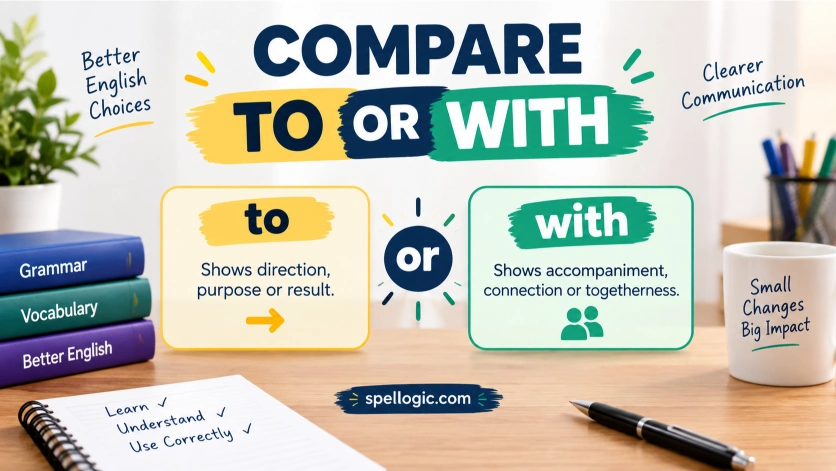
“Compare to” usually presents one person, thing, or idea as similar or analogous to another. “Compare with” usually emphasizes a detailed examination of two or more things to identify similarities and differences.
One-line distinction: Use compare to mainly for an analogy or resemblance; use compare with mainly for a side-by-side examination.
In a compare to or with question, this is the first distinction to remember.
Examples:
- The poet compared the moon to a silver coin.
- The researcher compared the new results with the earlier results.
If you are unsure about compare to or with, first ask whether you are showing a resemblance or examining details.
Understanding Homophones in English
Homophones are an important part of English vocabulary, but they are not the reason these two expressions cause confusion. The choice between to and with is mainly a matter of preposition and context.
What Are Homophones?
Homophones are words that sound the same but have different meanings or spellings. For example, flower and flour have the same pronunciation but different meanings.
Why Homophones Cause Confusion
Homophones can confuse learners because listening alone may not reveal which word a speaker means. For instance, someone hearing “flour” cannot determine the intended spelling without context. By contrast, the choice between to and with in a comparison is visible in writing and meaningful in context.
What Does “compare to” Mean?
Definition and Core Meaning
“Compare to” is used when one thing is described as being similar to, resembling, or being analogous to another. It often creates a figurative or descriptive connection.
Saying that a child’s smile is compared to sunshine highlights a shared quality, such as brightness or warmth, rather than suggesting that the two things are literally identical.
Origin and Historical Use
The verb compare comes from Latin comparare, meaning to pair, match, or make equal. English has used forms of the verb for centuries. The preposition to developed an established role in constructions that draw an analogy between two things.
This history helps explain why compare to or with has long allowed more than one useful construction.
Modern Usage and Synonyms
In modern English, this construction is common in descriptive, literary, academic, and everyday language. For learners studying compare to or with, descriptive examples are especially helpful.
It can be useful when you want to:
- highlight a resemblance;
- create an analogy;
- describe one thing in terms of another;
- emphasize a shared quality;
- make a vivid comparison.
Related words and expressions include liken to, equate with, resemble, and draw a parallel with, although these are not exact replacements in every sentence.
Example Sentences
- The coach compared the team’s discipline to that of a professional club.
- The author compared the busy city to a living machine.
- Her voice was compared to a soft musical instrument.
- Many people compare learning a language to training a muscle.
The important point is that this pattern often focuses attention on a particular similarity or analogy. That is one of the clearest clues when choosing compare to or with.
What Does “compare with” Mean?
Definition and Core Meaning
“Compare with” is commonly used when two or more things are examined side by side. The purpose may be to identify similarities, differences, strengths, characteristics, results, or other measurable features.
Origin and Historical Context
Like compare to, this expression comes from the long history of the English verb compare. The preposition with naturally supports the idea of placing things alongside one another for examination.
Its development also explains why compare to or with cannot always be reduced to a strict either-or rule.
Modern Usage and Synonyms
This form is frequent in academic writing, reports, business communication, research, reviews, and everyday discussion. These are common settings for questions about compare to or with.
It can be useful when you want to:
- examine two sets of information;
- identify similarities and differences;
- evaluate results side by side;
- check changes over time;
- discuss measurable characteristics.
Related expressions include contrast with, match against, assess alongside, and set beside, depending on the context.
Example Sentences
- We compared this year’s sales with last year’s figures.
- Please compare the two plans with each other before deciding.
- The doctor compared the current scan with an earlier scan.
- Consumers often compare prices with those offered by other stores.
compare to or with: Key Differences at a Glance
| Word | Part of Speech | Meaning | Example Context |
|---|---|---|---|
| compare to | Verb phrase | Relate one thing to another because of a similarity or analogy | “She compared his voice to a trumpet.” |
| compare with | Verb phrase | Examine things side by side for similarities and differences | “She compared the two reports with each other.” |
A useful rule is that to often points toward an analogy, while with often suggests an analytical comparison. This is the central lesson for anyone searching for compare to or with.
How to Remember the Difference Between compare to and compare with
Here are a few simple memory tricks for remembering compare to or with:
1. Think “to = resemblance”
Imagine an arrow pointing from one image to another. If you are saying that one thing is like another, compare to is often a natural choice.
Memory clue: compare to = “looks like / is like.”
2. Think “with = side by side”
Picture two documents lying next to each other on a desk. You are examining them with one another.
Memory clue: compare with = “check side by side.”
3. Ask yourself what you are doing
If you are creating an analogy, compare to may fit better. If you are examining details, compare with is often more suitable.
One memorable example
- Analogy: The dancer was compared to a butterfly.
- Analysis: The judges compared the dancer’s performance with the previous performance.
Common Mistakes and Confusions
Mistake 1: Assuming one form is always correct
Do not assume that compare to must be used whenever two things are mentioned, or that compare with is required whenever details are examined. Choose according to the purpose of the comparison.
Mistake 2: Treating the distinction as absolute
English usage is flexible here. Many sentences allow either form when the intended meaning is simply to examine one thing in relation to another.
Mistake 3: Forgetting the object
Naming both sides can make a comparison clearer.
- Unclear: The manager compared the figures.
- Clearer: The manager compared the figures with last month’s figures.
Examples Section: Correct and Incorrect Usage
Example 1
✔ Correct: The writer compared the hero to a lion.
✘ Incorrect: The writer compared the hero with a lion.
Explanation: The first sentence creates a figurative analogy. The second is not necessarily grammatically impossible, but it changes the feel and can sound as though the writer is conducting a direct examination.
Example 2
✔ Correct: The accountant compared this month’s expenses with last month’s expenses.
✘ Incorrect: The accountant compared this month’s expenses to last month’s expenses.
Explanation: The version with with clearly emphasizes a side-by-side examination.
Example 3
✔ Correct: Critics compared the young actor to a famous star.
✘ Incorrect: Critics compared the young actor with a famous star.
Explanation: The intended idea is resemblance, so to works naturally.
Example 4
✔ Correct: Researchers compared the new treatment with the standard treatment.
✘ Incorrect: Researchers compared the new treatment to the standard treatment.
Explanation: With clearly signals a systematic examination, although to can occur when the meaning is broader.
Self Assessment: Test Your Knowledge
Fill in each blank with to or with. These questions give you practice with compare to or with in realistic contexts.
- The singer was compared ___ a nightingale.
- The researchers compared the new data ___ the original data.
- The teacher compared the student’s writing ___ that of a professional author.
- Before buying, I compared the two phones ___ each other.
Self Assessment Answers
- to — The sentence highlights resemblance or analogy.
- with — The sentence describes a side-by-side examination of data.
- to — The comparison presents the student’s writing as similar to professional writing.
- with — The phrase describes examining two products alongside each other.
FAQs
Is “compare to” grammatically correct?
Yes. Compare to is a standard English construction, especially when the purpose is to show resemblance, analogy, or a shared quality.
Is “compare with” grammatically correct?
Yes. Compare with is also standard English. It is especially common when things are examined side by side for similarities and differences.
What is the simplest difference between compare to or with?
The usual distinction is that compare to emphasizes resemblance or analogy, while compare with emphasizes detailed examination. This short rule answers many compare to or with questions.
Can compare to and compare with be interchangeable?
Sometimes. Speakers and writers may use either form when the intended meaning is simply to examine one thing in relation to another. This is why compare to or with can seem confusing.
Which form is better for academic writing?
For a detailed, analytical comparison, compare with often makes the intended relationship especially clear. This can be a useful choice when a compare to or with question arises in formal writing.
Which form should I use for a metaphor?
Use compare to when you are presenting one thing as resembling another. This is often the clearest answer in a compare to or with question involving figurative language.
Does punctuation change the meaning?
Punctuation does not normally determine the choice. The main issue is the relationship between the things being compared and what the writer wants to emphasize. That principle is more useful than memorizing compare to or with as a rigid rule.
Final Conclusion: Using “compare to” and “compare with” Correctly
Learning the difference between compare to or with becomes much easier when you focus on the purpose of the comparison rather than memorizing a rigid rule. Compare to commonly introduces an analogy, resemblance, or figurative connection. For example, a writer may compare a bright smile to sunshine. Compare with, on the other hand, is often used when two or more things are examined side by side to discover similarities and differences, as in comparing this year’s results with last year’s results.
Still, remember that English usage allows some overlap. Native speakers and professional writers do not always follow a strict separation between the two forms, particularly when the intended meaning is simply to examine one thing in relation to another. When you need a practical rule, think “to = like” and “with = side by side.” This memory trick is particularly useful whenever compare to or with appears in your writing. As you read more English, notice how authors use each preposition in context. With regular practice, choosing the natural form will become automatic. The more examples of compare to or with you read, the easier it becomes to recognize the intended relationship.
Quick reference: For compare to or with, remember that purpose matters more than a rigid rule. Compare to commonly highlights likeness, while compare with commonly highlights examination.
Study tip: Keep compare to or with in mind as you read articles, reports, and stories; noticing real examples builds natural intuition.
Final reminder: If compare to or with feels confusing, replace the phrase mentally with “show a likeness” or “examine side by side” and see which idea fits.