English learners often wonder whether to say help in or with when describing assistance with a task, activity, or situation. Both structures can be correct, but they are normally used in slightly different ways. The choice depends on what comes after the word help and on whether you are talking about an activity, process, or specific thing.
This small difference can make a sentence sound more natural and precise. Understanding the pattern is especially useful in everyday conversations, emails, academic writing, and professional communication. Once you learn the basic rule, choosing the right preposition becomes much easier and more natural.
Why “Help in or With” Are Confusing
The expressions help in or with are confusing because both prepositions can follow help when someone provides assistance. In many situations, their meanings are very close, so even fluent speakers may use them interchangeably.
Similar Pronunciation
The main words, in and with, are short and common English words. Learners often focus on the meaning of help rather than the preposition that follows it. As a result, they may choose whichever expression they have heard most often.
Similar Spelling
There is no major spelling similarity between in and with, but both are short prepositions that connect help to another word or phrase. Their grammatical function can therefore feel similar.
Context Confusion
The biggest difficulty is context. Help in is often followed by an activity, process, or area in which assistance is provided. Help with is commonly followed by a task, problem, object, or subject that needs assistance.
For example:
- She helped me in preparing the presentation.
- She helped me with the presentation.
Both sentences are grammatical, but the first emphasizes the process of preparing, while the second focuses more directly on the presentation.
Common Learner Mistakes
A common mistake is assuming that only one preposition can be correct. Another is using in before a noun when with would sound more natural.
For example:
- She helped me with my homework.
- She helped me in completing my homework.
Both can work, although the second emphasizes the completion process.
Help in or With Explained Simply
The basic distinction is quite simple once you look at what follows the preposition.
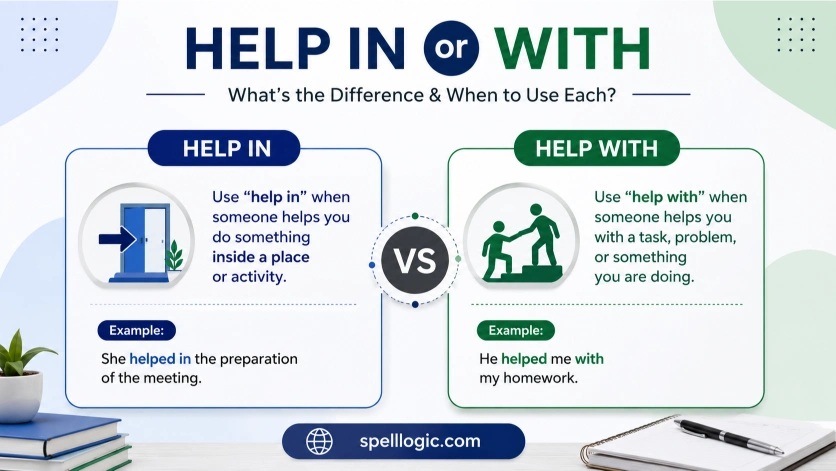
Help in generally introduces an activity, process, or field in which someone receives assistance.
Help with generally introduces a particular task, problem, object, subject, or responsibility that someone assists with.
One-Line Distinction
Help in focuses more on participation in an activity or process, while help with focuses more directly on the thing or task receiving assistance.
Two Example Sentences
- My colleague helped me in organizing the meeting.
- My colleague helped me with the meeting.
In the first sentence, the emphasis is on the activity of organizing. In the second, the emphasis is on the meeting itself.
A useful rule for learners is this: help in is frequently followed by a gerund or an area of activity, while help with is frequently followed by a noun or noun phrase.
Understanding Homophones in English
The expressions help in or with do not involve homophones. However, learners sometimes study them alongside other confusing English expressions because prepositions can be difficult to distinguish from one another.
What Are Homophones?
Homophones are words that sound the same, or almost the same, but have different meanings or spellings.
For example:
- right = correct
- write = to put words on paper
These words sound alike but have different meanings and spellings.
Why Homophones Cause Confusion
Homophones can confuse learners because listening alone may not reveal which word a speaker means. Context and spelling usually provide the answer.
Prepositions create a different kind of difficulty. With expressions such as help in or with, the words sound different, but learners must understand the grammatical context to choose the natural form.
What Does “Help in” Mean?
Definition and Core Meaning
Help in means providing assistance during an activity, process, area of work, or particular action. It is especially common when in is followed by a gerund ending in -ing.
For example:
- He helped me in finding a suitable apartment.
- The teacher helped students in understanding the lesson.
- We helped them in preparing the documents.
The structure can be written as:
help + someone + in + activity/process
However, modern English often prefers help with or simply help + someone + verb in many everyday situations.
For example:
- She helped me in completing the report.
- She helped me with the report.
- She helped me complete the report.
All three can be understood, but the most natural choice depends on the intended emphasis and style.
Origin and Historical Use
The word help has very old Germanic roots. It is related to Old English forms such as helpan, meaning to assist or support. The preposition in also has a long history in English and traditionally expresses location, involvement, circumstances, or participation.
Over time, combinations involving help in developed naturally to describe assistance within an activity or process.
Modern Usage and Synonyms
Today, help in is often used in formal, academic, business, and process-focused contexts.
Common alternatives include:
- assist in
- support in
- aid in
- contribute to
- take part in
- assist with
For example:
- The software helps in reducing errors.
- Regular practice helps in improving pronunciation.
- Training helps employees in developing new skills.
The expression can be useful when the following activity is important.
Example Sentences
- The guide helped us in planning our journey.
- This tool helps students in learning new vocabulary.
- Her experience helped the team in solving the problem.
- The assistant helped me in preparing the presentation.
- Good communication helps in avoiding misunderstandings.
Notice that the words after in often describe an action or process.
What Does “Help With” Mean?
Definition and Core Meaning
Help with means to provide assistance concerning a particular thing, task, problem, subject, or responsibility. It is extremely common in everyday English.
The basic structure is:
help + someone + with + noun/noun phrase
Examples include:
- Can you help me with this question?
- She helped him with his homework.
- They helped us with the project.
This construction directly identifies what needs assistance.
Origin and Historical Context
Like help, the preposition with has Old English and Germanic origins. Historically, it expressed association, accompaniment, or connection. In modern English, it is commonly used to identify the thing involved in an action.
Therefore, help with naturally connects assistance to a specific task or matter.
Modern Usage and Synonyms
Help with is one of the most natural choices in everyday spoken and written English.
Similar expressions include:
- assist with
- aid with
- provide assistance with
- support someone with
- give someone a hand with
For example:
- Can you help me with my assignment?
- The technician assisted me with the installation.
- She gave me a hand with the boxes.
Example Sentences
- Could you help me with this form?
- Tom helped his sister with her homework.
- We need someone to help with the arrangements.
- The technician helped me with my computer.
- Can you help us with this problem?
When a specific thing or task is the focus, with is usually the most natural choice.
Help in or With: Key Differences at a Glance
| Word | Part of Speech | Meaning | Example Context |
|---|---|---|---|
| Help in | Verb + preposition | Assistance during an activity or process | She helped me in preparing the report. |
| Help with | Verb + preposition | Assistance concerning a task, thing, subject, or problem | She helped me with the report. |
The two structures can sometimes describe the same situation. The difference is often one of focus rather than completely different meaning.
Compare:
- The teacher helped me in understanding the topic.
- The teacher helped me with the topic.
The first sentence emphasizes the process of understanding. The second is broader and focuses on the topic as the matter receiving assistance.
In everyday English, help with is often the safer and more natural choice when a noun follows it.
How to Remember the Difference Between Help in and Help With
A few simple memory techniques can make the distinction easier.
Memory Trick 1: “In” = Inside an Activity
Think of in as being involved inside an activity or process.
- help in learning
- help in preparing
- help in organizing
- help in solving
If an -ing activity follows the preposition, in may be appropriate.
Memory Trick 2: “With” = The Thing You Need
Think of with as pointing toward the thing that needs assistance.
- help with homework
- help with a project
- help with a problem
- help with a computer
- help with paperwork
Association Technique
Ask yourself:
Am I talking about an activity/process?
→ in may fit.
Am I talking about a thing/task/problem?
→ with will often fit.
One Memorable Example
Remember this pair:
She helped me in preparing dinner.
She helped me with dinner.
The first emphasizes the activity of preparation. The second emphasizes dinner as the task or matter involved.
Common Mistakes and Confusions
Learners often make mistakes because they translate prepositions directly from their first language. English prepositions do not always match the patterns used in other languages.
Mistake 1
✘ She helped me in my homework.
✔ She helped me with my homework.
Explanation:
When homework is treated as the task receiving assistance, with is the natural choice.
Mistake 2
✘ He helped me with preparing the report.
✔ He helped me in preparing the report.
Explanation:
The second version clearly presents preparing as the activity. However, helped me prepare the report is also very natural and often simpler.
Mistake 3
✘ Can you help me in this problem?
✔ Can you help me with this problem?
Explanation:
A specific problem normally takes with after help.
Mistake 4
✘ The training helped employees with improving their communication skills.
✔ The training helped employees in improving their communication skills.
Explanation:
Because improving describes an activity or process, in can work. An even more natural alternative is:
✔ The training helped employees improve their communication skills.
This illustrates an important point: English often allows help + object + base verb without either preposition.
Examples Section: Correct and Incorrect Usage
Example 1
✔ Correct: She helped me with my assignment.
✘ Incorrect: She helped me in my assignment.
Why?
The assignment is a specific task, so with is the natural choice.
Example 2
✔ Correct: He helped me in organizing the event.
✘ Incorrect: He helped me with organizing the event.
Why?
The first version focuses on the process of organizing. However, the second may be heard in informal English, and helped me organize the event is also very natural.
Example 3
✔ Correct: Can you help me with this computer problem?
✘ Incorrect: Can you help me in this computer problem?
Why?
A particular problem normally follows with.
Example 4
✔ Correct: Her advice helped me in making the decision.
✘ Incorrect: Her advice helped me with making the decision.
Why?
The phrase in making emphasizes the process of making the decision. A simpler alternative is Her advice helped me make the decision.
Example 5
✔ Correct: They helped us with the project.
✘ Incorrect: They helped us in the project.
Why?
When the project is the specific matter receiving assistance, with is more natural.
Example 6
✔ Correct: This guide helps learners in understanding difficult grammar rules.
✘ Incorrect: This guide helps learners with understanding difficult grammar rules.
Why?
The first sentence treats understanding as a process. However, helps learners understand difficult grammar rules is usually the most direct and natural construction.
Self Assessment: Test Your Knowledge
Choose in or with to complete each sentence.
- Can you help me ___ this application form?
- The teacher helped students ___ understanding the new grammar rule.
- My brother helped me ___ my science project.
- This exercise can help you ___ improving your pronunciation.
Try answering all four questions before checking the answers.
Self Assessment Answers
- with — “Help with this application form” refers to a specific thing requiring assistance.
- in — “Help in understanding” focuses on the process of understanding.
- with — A science project is a particular task or piece of work.
- in — “Help in improving” focuses on the activity or process of improvement.
Remember that English sometimes offers another natural option without a preposition. For example, The exercise can help you improve your pronunciation is especially concise and natural.
FAQs
1. Is “help in” grammatically correct?
Yes. Help in is grammatically correct when it introduces an activity, process, or area in which assistance is provided. For example, “She helped in organizing the event.”
2. Is “help with” grammatically correct?
Yes. Help with is very common and natural when referring to a particular task, object, problem, subject, or responsibility. For example, “Can you help me with my homework?”
3. Which is more common: “help in” or “help with”?
Help with is generally more common in everyday English when a specific noun follows. For example, people commonly say “help with homework,” “help with a project,” and “help with a problem.”
4. Can I say “help in doing something”?
Yes. Help in doing something can be grammatical, particularly when the activity or process is being emphasized. However, help someone do something is often simpler and more natural.
5. Should I say “help in my homework” or “help with my homework”?
Say help with my homework. Homework is treated as a specific task, so with is the normal choice.
6. Can “help with” be followed by a verb ending in -ing?
Yes, it can occur in some contexts, but the construction may not always be the most natural choice. For example, “She helped me with cleaning the room” is possible, while “She helped me clean the room” is often more direct.
7. Is there an easy rule for choosing between the two?
A useful guideline is to use in when emphasizing an activity or process and with when identifying a specific thing, task, or problem. Still, context matters, and native speakers may choose different constructions depending on emphasis and style.
Final Conclusion: Using “Help in” and “Help With” Correctly
Understanding help in or with becomes much easier when you focus on what follows the preposition. Help in commonly emphasizes participation in an activity, process, or area of action, especially when followed by an -ing form. For example, “She helped me in preparing the report” focuses on the process of preparation. Help with, on the other hand, usually points to a specific thing, task, subject, problem, or responsibility, as in “She helped me with the report.” In everyday English, help with is often the more natural choice when a noun follows.
However, these patterns are guidelines rather than absolute rules. English speakers can express the same idea in several ways, and help + object + base verb is often an excellent alternative: “She helped me prepare the report.” When you are unsure, identify whether you are emphasizing an activity or the thing receiving assistance. Think in = activity/process and with = thing/task. With regular practice and attention to real examples, choosing the appropriate preposition will become automatic. Keep practicing, and you will soon use these useful English structures with greater confidence and accuracy.