English possessives can be confusing, especially when a proper noun already ends in s. The phrase illinois’s or illinois’ creates this problem because Illinois ends with the letter s, yet different style guides handle its possessive form differently. For English learners, the main challenge is deciding whether to add ‘s or only an apostrophe.
The good news is that both forms can be found in published English, but they are not equally preferred in every style guide. Understanding the difference helps you write accurately in school assignments, professional documents, websites, and everyday communication. Once you learn the basic rule and style differences, choosing the correct form becomes much easier.
Why “illinois’s or illinois’” Are Confusing
The confusion surrounding illinois’s or illinois’ comes mainly from the fact that Illinois is a proper noun ending in s. Learners often remember the rule that nouns ending in s can take an apostrophe, but they may not know that style guides differ when a singular proper noun ends in s.
Similar pronunciation
The pronunciation of Illinois itself does not cause the main grammatical problem. Instead, speakers may pronounce the possessive forms differently depending on the spelling and style being used. The form with ‘s is commonly read with an additional possessive sound, while the apostrophe-only form may retain the original sound more naturally.
Similar spelling
The two forms look almost identical:
- Illinois’s
- Illinois’
The only visible difference is the additional s after the apostrophe. This small spelling difference can create uncertainty.
Context confusion
Both forms can show possession or association. For example, a writer might need to describe the government, history, economy, or universities associated with Illinois. The meaning is usually clear from context, even when the spelling style differs.
Common learner mistakes
English learners often make these mistakes:
- Assuming every noun ending in s must use only an apostrophe.
- Assuming every singular noun must always take ‘s.
- Treating one style guide’s rule as universal.
- Confusing possession with simple plural usage.
- Thinking the apostrophe changes the meaning of Illinois.
The best approach is to identify the style you are following and use it consistently.
“illinois’s or illinois’” Explained Simply
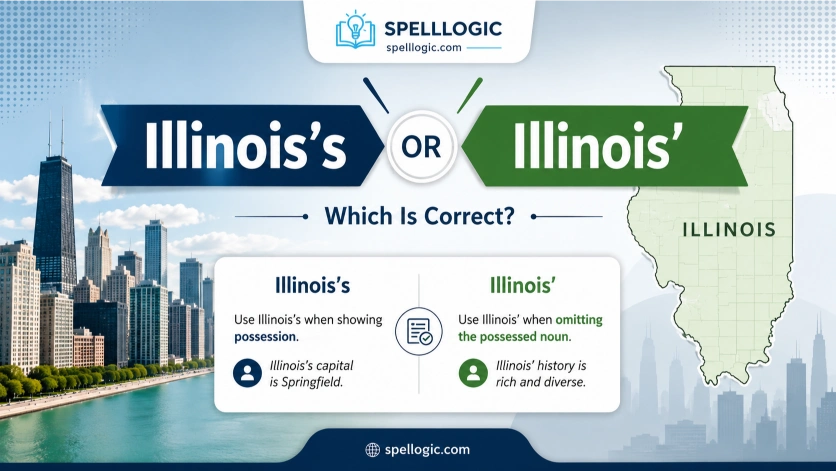
The simplest explanation is that both forms can represent the possessive of the singular proper noun Illinois, but different style systems prefer different forms.
In traditional grammar, singular proper nouns ending in s are often written with ‘s. Therefore, Illinois’s is a standard possessive form in many contexts.
Some style guides, especially journalism-oriented styles, prefer an apostrophe alone after a proper name ending in s. Under that convention, Illinois’ is used.
One-line distinction: illinois’s or illinois’ can both indicate possession by Illinois, but the preferred spelling depends on the style guide.
Examples
- Illinois’s economy has changed significantly over the years.
- Illinois’ economy has changed significantly over the years.
Both sentences communicate the same basic idea. The difference is primarily one of editorial style and pronunciation.
Understanding Homophones in English
What Are Homophones?
Homophones are words that have different meanings and spellings but sound the same or nearly the same. A classic example is “right” and “write.” They sound alike but have different meanings and functions.
The forms discussed in illinois’s or illinois’ are not technically homophones. Their confusion comes from possessive spelling and style conventions rather than from two unrelated words having the same pronunciation.
Why Homophones Cause Confusion
Homophones can confuse learners because listening alone does not always reveal which spelling is correct. For example, someone hearing right cannot know from sound alone whether the speaker means the direction, correctness, or the act of writing.
The issue with illinois’s or illinois’ is different. A reader can see the spelling, but the writer must know which possessive convention is appropriate for the document.
What Does “illinois’s” Mean?
Definition and Core Meaning
Illinois’s is the possessive form of the singular proper noun Illinois. It normally means “belonging to Illinois” or “associated with Illinois.”
For example:
- Illinois’s population is diverse.
- Illinois’s government announced a new program.
- Illinois’s history includes many important events.
The form uses the familiar possessive pattern of adding ‘s to a singular noun.
Origin and Historical Use
Illinois is the name of a U.S. state. The state’s name comes from a term associated with the Illinois Confederation and ultimately reflects an Algonquian-language history. In English, the name became established as Illinois, ending in the letter s.
English possessive rules have developed over time, and writers have not always treated names ending in s in exactly the same way. As a result, both apostrophe-based conventions can be encountered in edited writing.
Modern Usage and Synonyms
There is no true synonym for a possessive form such as Illinois’s. However, writers can sometimes avoid the possessive construction by using phrases such as:
- the state of Illinois
- the government of Illinois
- the history of Illinois
- Illinois state government
- the economy of Illinois
Key points
- Illinois’s is a singular possessive form.
- It commonly means “belonging to Illinois.”
- It follows the ‘s convention.
- Many general and academic style systems accept or prefer it.
- It can be replaced with an of phrase when clarity is important.
Example sentences
- Illinois’s agricultural industry is important to the state’s economy.
- Illinois’s universities attract students from many countries.
- The report examines Illinois’s transportation system.
- Illinois’s history is an interesting subject for students.
What Does “illinois’” Mean?
Definition and Core Meaning
Illinois’ is another possessive spelling for the singular proper noun Illinois. It also means “belonging to Illinois” or “associated with Illinois.”
For example:
- Illinois’ economy is diverse.
- Illinois’ governor addressed the issue.
- Illinois’ universities serve thousands of students.
The main difference is that this form places the apostrophe after the existing s without adding another s.
Origin and Historical Context
The apostrophe-only convention is particularly familiar in journalistic and editorial writing. Some style guides recommend using only an apostrophe after singular proper names that end in s, especially when adding another spoken syllable would be considered unnecessary.
Consequently, a newspaper, government publication, or website may use Illinois’ even though another publication uses Illinois’s.
Modern Usage and Synonyms
Like Illinois’s, Illinois’ does not have a direct synonym. Writers can use alternative constructions when they want to avoid the possessive issue.
Useful alternatives include:
- the state of Illinois
- Illinois government
- Illinois history
- the economy of Illinois
- Illinois residents
Key points
- Illinois’ is a possessive form of Illinois.
- It indicates association or ownership.
- It uses the apostrophe-only convention.
- Some style guides prefer this form for proper names ending in s.
- It is common in journalism and other style-sensitive writing.
Example sentences
- Illinois’ economy depends on several major industries.
- The article discusses Illinois’ educational system.
- Illinois’ history is closely connected with the development of the Midwest.
- The museum displays artifacts from Illinois’ past.
“illinois’s or illinois’”: Key Differences at a Glance
The important point about illinois’s or illinois’ is that the two spellings generally express the same possessive relationship. The major difference is the writing convention being followed.
| Word | Part of Speech | Meaning | Example Context |
|---|---|---|---|
| Illinois’s | Possessive proper noun | Belonging to or associated with Illinois | Illinois’s economy is growing. |
| Illinois’ | Possessive proper noun | Belonging to or associated with Illinois | Illinois’ economy is growing. |
Which form is correct?
There is no single answer that applies to every style guide. Illinois’s is widely accepted and follows the convention of adding ‘s to a singular proper noun. Illinois’ is also accepted by style systems that use an apostrophe alone for proper names ending in s.
For formal academic writing, check the style guide required by your school or institution. Common style systems can have different preferences.
If no style guide is specified, Illinois’s is a clear choice because it follows the general singular possessive pattern. However, consistency is more important than switching between forms within the same document.
How to Remember the Difference Between Illinois’s and Illinois’
Learning the difference between illinois’s or illinois’ becomes easier when you connect each spelling with a simple rule.
Memory trick 1: Singular + ‘s
Remember:
Singular name → often add ‘s.
Since Illinois refers to one state, the form Illinois’s follows this familiar pattern.
Memory trick 2: Style guide matters
Think:
Apostrophe choice = style choice.
If your required style says that singular proper names ending in s take only an apostrophe, use Illinois’. If it follows the ‘s convention, use Illinois’s.
Association technique
Imagine a sentence such as:
The history belongs to Illinois → Illinois’s history.
Then remember that some editorial styles shorten the possessive spelling to:
Illinois’ history.
One memorable example
Imagine a school assignment titled “The History of Illinois.” If you write about the state’s history using a possessive, you could write:
- Illinois’s history is fascinating.
- Illinois’ history is fascinating.
The meaning remains the same; the style determines the preferred form.
Common Mistakes and Confusions
Many mistakes involving illinois’s or illinois’ happen because writers apply a possessive rule without checking whether they are dealing with a singular noun, a plural noun, or a particular style guide.
Mistake 1: Treating Illinois as a plural noun
✘ Incorrect reasoning: “Illinois ends in s, so it must be plural.”
Why? The final s is part of the proper name. Illinois is the name of one state.
Mistake 2: Assuming only one spelling is ever correct
✘ Incorrect: “Illinois’ is always wrong.”
Why? Some recognized style guides use the apostrophe-only form for singular proper names ending in s.
Mistake 3: Assuming Illinois’s is always required
✘ Incorrect: “Every English style guide requires Illinois’s.”
Why? Editorial conventions vary. Some prefer Illinois’.
Mistake 4: Mixing styles
A document may become inconsistent if it uses Illinois’s in one paragraph and Illinois’ in another without a reason.
Better approach: Choose the convention required by your audience, instructor, publisher, or organization and use it consistently.
Mistake 5: Forgetting the apostrophe
✘ Illinois history’s importance when the intended meaning is possession by Illinois.
✔ Illinois’s history is important.
An apostrophe is needed when the possessive form is used.
Examples Section: Correct and Incorrect Usage
Example 1
✔ Correct: Illinois’s economy includes agriculture, manufacturing, and services.
✘ Incorrect: Illinois economy includes agriculture, manufacturing, and services.
Explanation: The first sentence uses a possessive construction. The apostrophe shows the relationship between Illinois and its economy.
Example 2
✔ Correct: Illinois’ universities attract students from around the world.
✘ Incorrect: Illinois’s’ universities attract students from around the world.
Explanation: Do not combine the two possessive patterns. Choose either Illinois’s or Illinois’ according to your style guide.
Example 3
✔ Correct: The report examines Illinois’s transportation network.
✘ Incorrect: The report examines Illinois transportation’s network.
Explanation: The intended relationship is between Illinois and its transportation network, so the possessive form belongs with Illinois.
Example 4
✔ Correct: Illinois’ agricultural sector supports many communities.
✘ Incorrect: Illinois agricultural sector’s supports many communities.
Explanation: The possessive relationship should be formed correctly with the name of the state.
Example 5
✔ Correct: According to our style guide, Illinois’s government is the preferred form.
✘ Incorrect: According to our style guide, Illinois’ government is the preferred form.
Explanation: In this example, the second sentence may not be grammatically wrong in general, but it does not follow the stated style preference. This shows why style consistency matters.
Self Assessment: Test Your Knowledge
Fill in each blank with the appropriate possessive form: Illinois’s or Illinois’.
- ________ population has changed over time.
- The article discusses ________ educational system.
- ________ history includes many significant events.
- Our newspaper style guide prefers ________ government.
Self Assessment Answers
- Illinois’s — or Illinois’ if your chosen style guide prefers the apostrophe-only form.
- Illinois’s — or Illinois’ under the apostrophe-only convention.
- Illinois’s — or Illinois’ depending on style.
- Illinois’ — because the question specifically says the newspaper style guide prefers the apostrophe-only convention.
The first three answers demonstrate an important point: both possessive spellings can be grammatically acceptable depending on the style system. The fourth tests whether you can follow an explicitly stated editorial preference.
FAQs
Is Illinois’s grammatically correct?
Yes. Illinois’s is a standard possessive form for the singular proper noun Illinois and is preferred by many style conventions.
Is Illinois’ grammatically correct?
Yes. Illinois’ is also used as a possessive form, particularly by style guides that recommend an apostrophe alone after singular proper names ending in s.
Which is more common, Illinois’s or Illinois’?
Usage varies by publication and style guide. Neither spelling should automatically be labeled incorrect without considering the applicable editorial convention.
Should I use Illinois’s in academic writing?
If your school or instructor does not specify another style, Illinois’s is a clear and widely accepted choice. However, always follow the required style guide when one is provided.
Are Illinois’s and Illinois’ homophones?
Not exactly. They are alternative possessive spellings, not two unrelated words that happen to have the same pronunciation. Their main difference is grammatical spelling and style.
Does Illinois’ mean something different from Illinois’s?
Usually, no. Both forms indicate possession or association with Illinois. The difference is primarily the possessive convention used by the writer or publication.
How can I avoid the problem completely?
You can sometimes rewrite the sentence with an of phrase. For example, instead of Illinois’s history, write the history of Illinois. This can be useful when a particular style is unclear.
Final Conclusion: Using Illinois’s and Illinois’ Correctly
Understanding illinois’s or illinois’ is mainly a matter of knowing how English forms possessives and recognizing that style guides do not always agree. Illinois is a singular proper noun, even though it ends in s. The form Illinois’s follows the common rule of adding ‘s to a singular name, while Illinois’ follows a convention that uses only an apostrophe after a name ending in s. Therefore, both forms can be found in correct edited English, depending on the style being followed.
For everyday and general formal writing, Illinois’s is a straightforward choice when no specific style guide tells you otherwise. In journalism or publications that follow an apostrophe-only convention, Illinois’ may be preferred. The most important rule is to remain consistent throughout your writing. Do not switch between the two forms randomly.
A useful memory tip is simple: think “singular name, often add ‘s,” but remember that style guides can change the preferred form. If you are unsure, check your school’s, employer’s, publisher’s, or newspaper’s style requirements. You can also avoid the issue by writing phrases such as the history of Illinois. With regular practice, possessives ending in s will become much easier to recognize and use confidently.