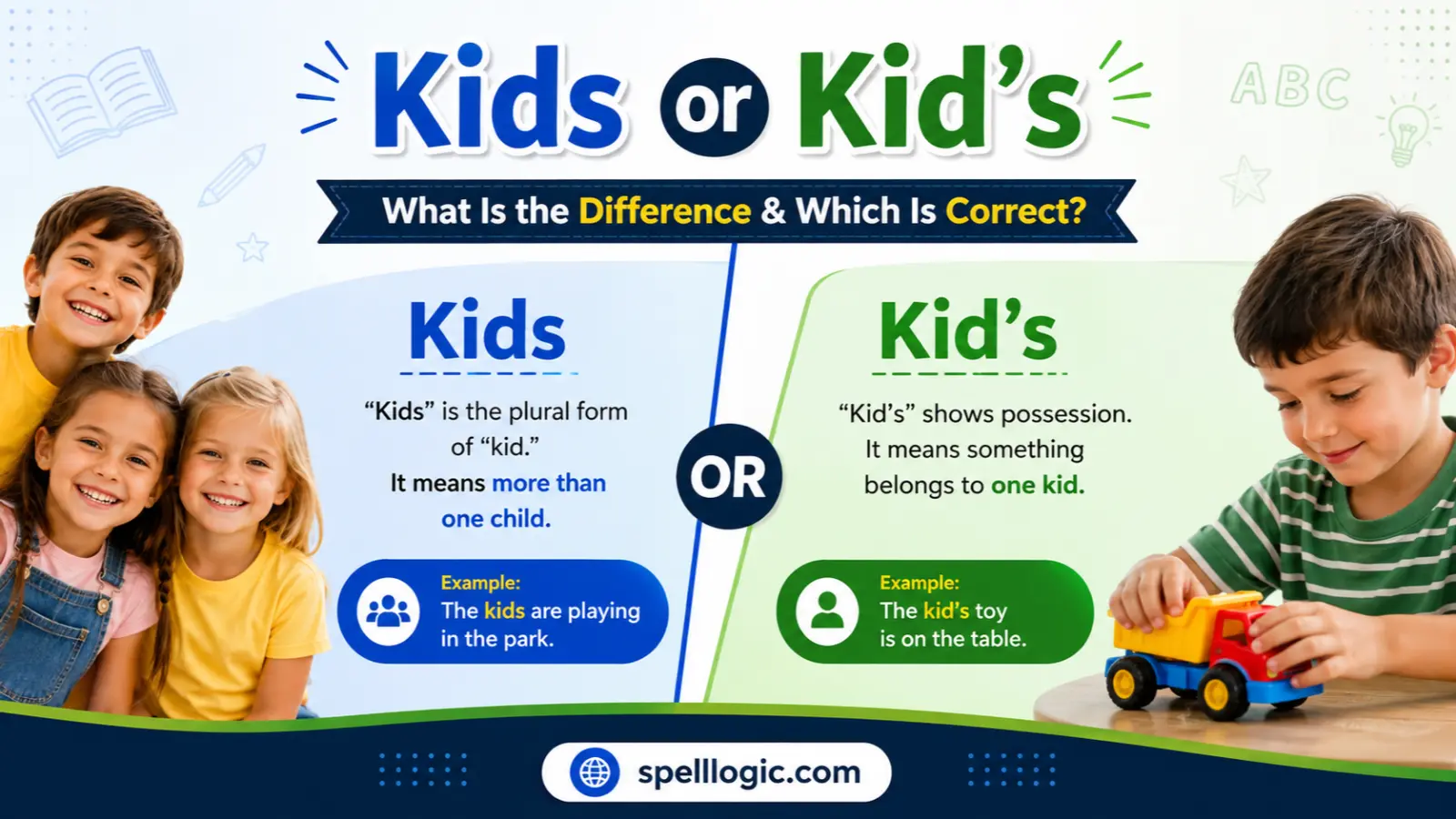
The difference between kids or kid’s can be confusing because both forms contain the word “kid,” but they do not have the same meaning or grammatical function. The main difference is simple: kids is the plural form of “kid,” while kid’s is the possessive form of the singular noun “kid.” In other words, “kids” refers to two or more children, whereas “kid’s” shows that something belongs to one child.
Understanding this small apostrophe difference can help English learners avoid common grammar mistakes in writing, texting, schoolwork, and professional communication.
Why “Kids” and “Kid’s” Are Confusing
English learners often confuse kids or kid’s because the two forms look almost identical. The only visible difference is the apostrophe in “kid’s,” but that tiny punctuation mark changes the grammatical meaning.
Similar pronunciation
In ordinary speech, “kids” and “kid’s” are pronounced very similarly. The apostrophe does not create a clearly different sound. As a result, listeners usually need to understand the sentence from context.
For example:
- “The kids are playing.”
- “The kid’s bag is blue.”
The first sentence talks about several children. The second sentence identifies something belonging to one child.
Similar spelling
Both forms begin with “kid” and contain the letter sequence “kid.” The plural ending -s and the possessive ending -‘s make them easy to mix up when writing quickly.
Context confusion
The surrounding words usually reveal the intended meaning. A sentence such as “The kids shoes are outside” may make the reader wonder whether the writer means several children’s shoes or one child’s shoes.
For one child, the standard form is “kid’s shoes.” For several children, the possessive plural is “kids’ shoes.”
Common learner mistakes
A frequent mistake is adding an apostrophe simply because a noun is plural. However, apostrophes do not normally make nouns plural.
- kids = more than one kid
- kid’s = belonging to one kid
- kids’ = belonging to more than one kid
This three-way distinction is especially useful when discussing possession.
Kids vs Kid’s Explained Simply
The easiest way to understand kids or kid’s is to focus on the apostrophe.
Kids is the plural form of “kid.” It means two or more children.
Kid’s is the singular possessive form of “kid.” It means that something belongs to one child.
One-line distinction
Kids means more than one child, while kid’s means something belongs to one child.
Example sentences
- The kids are playing in the garden.
Here, “kids” refers to several children. - The kid’s bicycle is near the door.
Here, “kid’s” shows that the bicycle belongs to one child.
A useful way to remember kids or kid’s is this: when you see an apostrophe before the s, think ownership rather than simply more than one.
Understanding Homophones in English
What Are Homophones?
Homophones are words that sound the same or nearly the same but have different meanings, spellings, or grammatical functions. For example, their, there, and they’re can sound very similar in normal speech but perform different roles in a sentence.
Although “kids” and “kid’s” are not traditionally treated as separate homophones, their pronunciation can sound extremely similar in everyday speech. Their written forms, however, communicate different grammatical information.
Why Homophones Cause Confusion
Pronunciation alone cannot always tell us which written form to use. Consider:
- “The kids laughed.”
- “The kid’s toy broke.”
When spoken naturally, the difference may be difficult to notice. Writing requires you to identify whether you mean a plural noun or a possessive noun.
Therefore, learners should look at the meaning and grammatical role before choosing the spelling.
What Does “Kids” Mean?
Definition and Core Meaning
“Kids” is the plural form of the noun kid. In everyday English, “kid” commonly means a child or young person. Therefore, “kids” means two or more children.
It can also be used informally to refer to young people, depending on the context.
Origin and Historical Use
The word “kid” originally referred to a young goat. Over time, English speakers began using it informally for a child. This sense became widely established in everyday English, and today “kid” is a very common informal word for a young person.
The plural form “kids” developed naturally by adding the regular plural ending -s.
Modern Usage and Synonyms
Today, “kids” is common in casual conversation, advertising, family discussions, education, and entertainment.
Depending on the context, possible synonyms include:
- children
- youngsters
- young people
- minors
- little ones
“Children” is generally more neutral or formal, while “kids” is more conversational.
Important grammar points
- kids is a plural noun.
- It refers to two or more children.
- It does not require an apostrophe when it simply means “children.”
- A plural verb normally follows it.
Example sentences
- The kids are watching a movie.
- Several kids joined the school competition.
- The kids enjoy playing outside.
- Those kids are learning how to swim.
- Many kids love stories about animals.
Notice that none of these sentences needs an apostrophe after “kid.”
What Does “Kid’s” Mean?
Definition and Core Meaning
“Kid’s” is the singular possessive form of “kid.” It indicates that something belongs to, is connected with, or is associated with one child.
For example, in “the kid’s jacket,” the jacket belongs to one child.
Origin and Historical Context
The possessive construction comes from the traditional English use of ‘s to show possession or association. The same pattern appears with many singular nouns:
- the teacher’s desk
- the student’s book
- the dog’s collar
- the child’s toy
- the kid’s backpack
Thus, the apostrophe and s have a grammatical purpose.
Modern Usage and Synonyms
The form “kid’s” is widely used in everyday English whenever one child owns or is associated with something.
Depending on the sentence, it can often be understood as:
- belonging to the child
- owned by the child
- associated with the child
- related to the child
Important grammar points
- kid’s refers to one child.
- The apostrophe comes before the s.
- It commonly appears before a noun.
- It expresses possession or association.
Example sentences
- The kid’s backpack is on the chair.
- I found the kid’s shoes under the bed.
- The kid’s mother called the school.
- The kid’s drawing won first prize.
- We repaired the kid’s bicycle yesterday.
In each example, one particular child is connected to the following noun.
Kids vs Kid’s: Key Differences at a Glance
| Word | Part of Speech | Meaning | Example Context |
|---|---|---|---|
| Kids | Plural noun | Two or more children | The kids are outside. |
| Kid’s | Singular possessive noun | Something belonging to one child | The kid’s coat is wet. |
There is also a third form worth learning:
| Form | Meaning | Example |
|---|---|---|
| Kids’ | Something belonging to two or more children | The kids’ classroom is upstairs. |
This third form is important because learners sometimes use “kid’s” when they actually mean possession by several children.
For example:
- The kid’s toys are on the floor. → toys belonging to one child.
- The kids’ toys are on the floor. → toys belonging to several children.
The position of the apostrophe changes the meaning.
How to Remember the Difference Between Kids and Kid’s
Learning kids or kid’s becomes easier when you connect the apostrophe with ownership.
Easy memory tricks
1. No apostrophe = plural
When you simply mean more than one child, use kids.
Kids = children
2. Apostrophe + s = one child’s possession
When something belongs to one child, use kid’s.
Kid’s = belonging to one kid
3. Apostrophe after s = several children’s possession
When something belongs to multiple children, use kids’.
Kids’ = belonging to several kids
Association technique
Think of the apostrophe as a small ownership sign.
- kid’s toy → one kid owns or has the toy
- kids’ toys → several kids own or have the toys
- kids play → several kids are doing the action
One memorable example
Imagine a school playground:
The kids are playing, and the kid’s ball is under the bench.
“Kids” tells you there are several children. “Kid’s” tells you the ball belongs to one child.
That single sentence can help you remember the distinction.
Common Mistakes and Confusions
Mistake 1: Using “kid’s” for a plural
✘ The kid’s are playing outside.
✔ The kids are playing outside.
Explanation: “Are playing” describes several children, so the plural form kids is required. No apostrophe is needed.
Mistake 2: Forgetting the apostrophe for possession
✘ The kids backpack is red.
✔ The kid’s backpack is red.
Explanation: If one child owns the backpack, use kid’s.
Mistake 3: Using “kid’s” when several children own something
✘ The kid’s uniforms are in the locker room.
✔ The kids’ uniforms are in the locker room.
Explanation: If the uniforms belong to several children, the possessive apostrophe comes after the plural s.
Mistake 4: Thinking an apostrophe always means plural
✘ There are five kid’s in the room.
✔ There are five kids in the room.
Explanation: An apostrophe does not normally create a plural noun. The regular plural is kids.
Examples Section: Correct and Incorrect Usage
Example 1
✔ Correct: The kids are waiting for their teacher.
✘ Incorrect: The kid’s are waiting for their teacher.
Why? The sentence refers to several children, so “kids” is correct.
Example 2
✔ Correct: The kid’s lunch is on the table.
✘ Incorrect: The kids lunch is on the table.
Why? The lunch belongs to one child, so the singular possessive form is required.
Example 3
✔ Correct: The kids’ parents attended the meeting.
✘ Incorrect: The kid’s parents attended the meeting.
Why? The sentence refers to parents associated with several children. The possessive plural form is kids’.
Example 4
✔ Correct: Many kids enjoy playing football.
✘ Incorrect: Many kid’s enjoy playing football.
Why? “Many” requires a plural noun. Therefore, use “kids.”
Example 5
✔ Correct: I packed the kid’s schoolbag.
✘ Incorrect: I packed the kids schoolbag.
Why? The schoolbag belongs to one child, so “kid’s” is appropriate.
Example 6
✔ Correct: The kids’ books were placed on the shelf.
✘ Incorrect: The kid’s books were placed on the shelf.
Why? The context indicates that the books belong to multiple children.
Self Assessment: Test Your Knowledge
Fill in each blank with kids, kid’s, or kids’.
- The ______ are playing in the park.
- I found the ______ jacket beside the chair.
- The ______ classroom has new desks.
- Several ______ joined the activity.
Self Assessment Answers
- kids — The sentence refers to several children.
- kid’s — The jacket belongs to one child.
- kids’ — The classroom is associated with several children.
- kids — “Several” requires a plural noun.
FAQs
Is “kids” or “kid’s” correct?
Both can be correct, but they have different meanings. Kids is the plural of “kid,” while kid’s is the singular possessive form.
Is “kids” plural or possessive?
Kids is plural, not possessive. It means two or more children.
What does the apostrophe in “kid’s” mean?
The apostrophe in kid’s shows possession or association. It normally means that something belongs to or is connected with one child.
What is the plural possessive form of “kid”?
The plural possessive form is kids’. It means something belongs to or is associated with two or more children.
Is “kid’s” the same as “kids”?
No. Kids means more than one child, while kid’s shows possession by one child.
Should I use “kids” or “children”?
Both are correct. “Kids” is more informal and conversational, while “children” is generally more neutral and suitable for formal contexts.
How can I quickly remember the difference?
Remember this simple rule: kids = more than one child; kid’s = belonging to one child; kids’ = belonging to several children.
Final Conclusion: Using “Kids” and “Kid’s” Correctly
Understanding kids or kid’s is mainly a matter of recognizing the role of the apostrophe. Kids is the ordinary plural form of “kid,” so use it when you are talking about two or more children. For example, “The kids are playing outside” simply identifies several children. In contrast, kid’s is the singular possessive form, so it shows that something belongs to one child, as in “The kid’s backpack is blue.” When several children possess or share something, use kids’, with the apostrophe after the plural s, as in “The kids’ books are on the table.”
The easiest memory trick is to connect the apostrophe with ownership. No apostrophe in kids means a plural noun. An apostrophe before s in kid’s indicates one child’s possession. An apostrophe after s in kids’ indicates possession by several children. Once you understand this pattern, choosing the correct form becomes much easier in school assignments, emails, conversations, and everyday writing. Keep practicing with short sentences, and pay attention to whether you mean more than one child or something belonging to a child. With regular practice, this small punctuation difference will become natural and easy to use correctly.