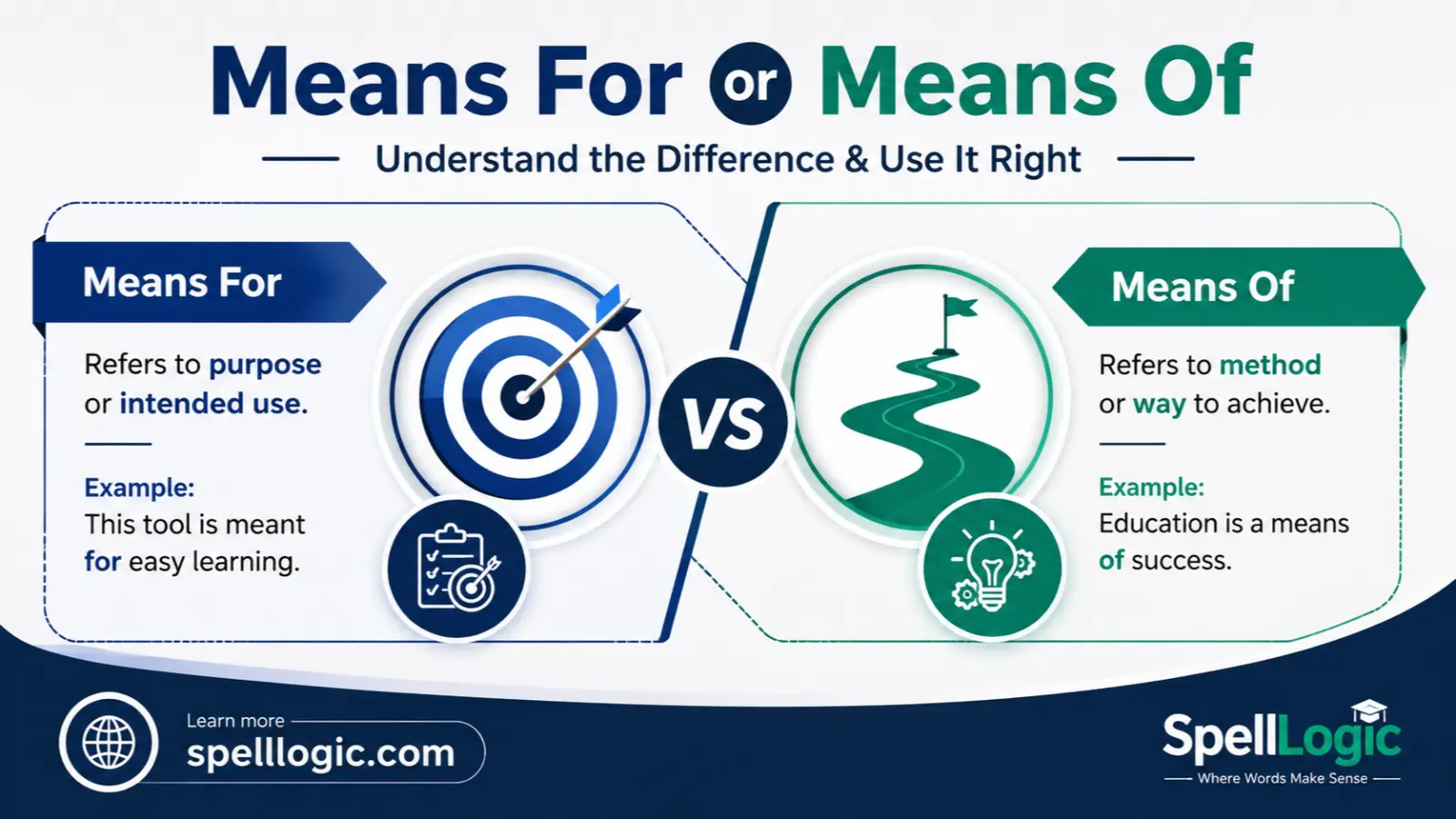
English learners often hesitate when they see expressions such as means for or means of. Both contain the word means, and both can appear when we talk about methods, tools, purposes, or ways of achieving something. However, they do not always work in exactly the same way. The expression means of is usually used to describe a method, way, or instrument used to achieve a result.
Means for can introduce a purpose, intended function, or intended user. Understanding means for or means of can make your English sound more natural and help you avoid awkward sentences. Once you understand the basic patterns, choosing the right expression becomes much easier.
Why “means for” and “means of” Are Confusing
The expressions means for or means of are easy to mix up because means has several related uses in English. It can refer to a method, resource, tool, or way of reaching a goal. The prepositions for and of then create slightly different relationships.
Similar pronunciation
The word means sounds the same in both expressions. The only difference in pronunciation comes from the short prepositions for and of. In fast speech, these small words can be difficult for learners to distinguish.
Similar spelling
Both expressions begin with the same word, means. Because the spelling looks almost identical, learners may choose a preposition based only on the general meaning of the sentence.
Context confusion
Context is the main source of difficulty. When means means “a method” or “a way,” means of is generally the established choice. For example, “Reading is a means of learning.”
By contrast, for can connect a means with an intended purpose, function, or user. For example, “The website provides a means for users to report errors.”
This distinction is important when learning means for or means of.
Common learner mistakes
A common mistake is treating the two expressions as completely interchangeable. Learners may write “a means for communication” when “a means of communication” is the conventional expression.
Another mistake is assuming that for must always be used when a sentence expresses purpose. Instead, consider the exact grammatical relationship and the natural English collocation.
“means for” vs “means of” Explained Simply
The easiest explanation of means for or means of is to focus on the role of the preposition.
Means of usually means a method, way, or instrument used to achieve something.
Means for can mean a means intended or designed for a particular purpose, function, or user.
One-line distinction
“Means for” emphasizes intended purpose or function, while “means of” usually emphasizes a method or way of achieving something.
Example sentences
- Education is a means of improving people’s opportunities.
- The website provides a means for users to submit feedback.
In the first sentence, education is presented as a method of achieving improvement. In the second, the website provides something intended for users to perform a particular action.
For learners searching for means for or means of, the most useful rule is simple: when you mean “a way of doing something,” means of is normally the safer choice.
Understanding Homophones in English
What Are Homophones?
Homophones are words that have the same pronunciation but different meanings or spellings. For example, right and write sound alike but have different meanings.
The expressions means for or means of are not true homophones because the complete expressions have different prepositions. However, they can still cause a similar kind of confusion because the word means stays unchanged and the surrounding meanings overlap.
Why Homophones Cause Confusion
Learners cannot always depend on pronunciation to choose the correct word. They need to examine meaning, grammar, and context.
For example, right and write sound alike, but the sentence “Please ___ your name” requires write. Similarly, choosing between means for or means of requires attention to the relationship between means and the words that follow it.
What Does “means for” Mean?
Definition and Core Meaning
When considering means for or means of, means for generally describes a tool, system, resource, or method intended for a particular purpose or group.
For example:
The application provides a means for users to communicate securely.
Here, for users identifies the people for whom the means is provided, while to communicate explains the purpose.
The construction is grammatically possible, but it is not automatically the best choice whenever you mean “method.”
Origin and Historical Use
The noun means has roots connected with the idea of a middle, method, or intermediary. Over time, English speakers used it for something that helps a person reach a desired result.
The preposition for has long expressed purpose, intended use, benefit, and destination. Consequently, means for or means of can have different shades of meaning depending on the relationship expressed.
Modern Usage and Synonyms
Depending on context, useful alternatives to means for include:
- tool for
- method for
- system for
- resource for
- way to
- device for
- method intended for
Sometimes a simpler noun is more natural. Instead of saying “a means for editing photos,” you could say “a tool for editing photos.”
Example sentences
- The platform provides a means for users to share documents.
- The organization created a means for collecting public feedback.
- The device offers a means for measuring temperature.
- We need a reliable means for storing important files.
- The program gives students a means for practicing pronunciation.
These examples show why means for or means of cannot always be treated as a simple either-or choice.
What Does “means of” Mean?
Definition and Core Meaning
In discussions of means for or means of, means of usually means a method, way, process, or instrument used to achieve a result.
It is especially common in formal, academic, business, and everyday English.
For example:
Reading is a means of improving vocabulary.
Here, reading is a method through which vocabulary can improve.
Origin and Historical Context
The noun means has historically referred to resources or methods used to reach an end. The pattern means of became firmly established for describing methods, processes, and ways of accomplishing something.
That is why familiar combinations such as “means of communication” and “means of transportation” sound natural to native English speakers.
Modern Usage and Synonyms
Depending on the context, means of may be replaced by:
- method of
- way of
- manner of
- process of
- form of
- approach to
- method for
For example, “a means of communication” can often become “a way of communicating.”
Example sentences
- Email is an efficient means of communication.
- Walking is a simple means of staying active.
- Public transport is an affordable means of travel.
- The scholarship is a means of supporting talented students.
- Negotiation can be a means of resolving disagreements.
These are useful examples for anyone studying means for or means of.
“means for” vs “means of”: Key Differences at a Glance
| Word | Part of Speech | Meaning | Example Context |
|---|---|---|---|
| means for | Noun phrase | A means intended for a purpose, function, or user | A means for protecting data |
| means of | Noun phrase | A method, way, or instrument used to achieve something | A means of protecting data |
The key point in means for or means of is that means of is generally the standard choice when you simply mean “a method” or “a way.”
For example:
- a means of communication
- a means of payment
- a means of transportation
- a means of learning
- a means of solving problems
Means for becomes more natural when for clearly introduces purpose, function, or an intended group.
How to Remember the Difference Between “means for” and “means of”
Learning means for or means of becomes easier with a few simple memory techniques.
Easy memory trick
Remember:
Means of = method of doing.
If you can replace the expression with “a way of,” means of is usually appropriate.
- A means of learning = a way of learning.
- A means of communication = a way of communicating.
- A means of solving a problem = a way of solving a problem.
Association technique
Connect FOR with FUNCTION.
Both begin with the letter F:
FOR → FUNCTION
When you are describing what a tool or system is intended to do, for may be suitable.
Examples include:
- a tool for editing
- a system for tracking orders
- a device for measuring temperature
- a means for collecting information
This association can help you remember means for or means of without memorizing complicated grammar rules.
One memorable example
Remember this sentence:
Reading is a means of learning, while a reading app can be a means for practicing.
The first expression emphasizes the method of learning. The second emphasizes the intended function of the app.
Common Mistakes and Confusions
Learners sometimes translate prepositions directly from their first language. Unfortunately, English prepositions do not always correspond exactly to prepositions in other languages.
Mistake 1
✘ Education is a means for improving vocabulary.
✔ Education is a means of improving vocabulary.
Explanation: The sentence presents education as a method of improving vocabulary, so means of is the more natural choice.
Mistake 2
✘ Email is a means for communication.
✔ Email is a means of communication.
Explanation: “Means of communication” is a well-established English collocation.
Mistake 3
✘ The machine is a means of produce labels.
✔ The machine is a means of producing labels.
Explanation: After of, an -ing form is needed when describing an activity. This is an important grammatical pattern when learning means for or means of.
Mistake 4
✘ The website provides a means of users to report problems.
✔ The website provides a means for users to report problems.
Explanation: For users identifies the intended users. This makes for appropriate in the corrected sentence.
Important point
Do not assume that one expression is always right and the other is always wrong. Both can be grammatical, but they can emphasize different relationships. Context determines the most natural choice.
Examples Section: Correct and Incorrect Usage
Example 1
✔ Correct: Exercise is a means of maintaining good fitness.
✘ Incorrect: Exercise is a means for maintaining good fitness.
Explanation: The sentence describes exercise as a method of maintaining fitness, so means of is the conventional choice.
Example 2
✔ Correct: The website provides a means for users to report problems.
✘ Incorrect: The website provides a means of users to report problems.
Explanation: For users identifies the people who are intended to use the system.
Example 3
✔ Correct: Public transport is a means of reducing traffic.
✘ Incorrect: Public transport is a means for reducing traffic.
Explanation: The focus is on public transport as a method of reducing traffic, making means of more natural.
Example 4
✔ Correct: The device is a means for measuring humidity.
✘ Incorrect: The device is a means of measure humidity.
Explanation: After of, use measuring, not the base verb measure.
Example 5
✔ Correct: Cash remains a means of payment in many places.
✘ Incorrect: Cash remains a means for payment in many places.
Explanation: “Means of payment” is a standard collocation.
These examples give practical guidance for anyone searching for means for or means of in everyday English.
Self Assessment: Test Your Knowledge
Fill in each blank with means for or means of.
- Reading is an effective ______ improving vocabulary.
- The platform provides a ______ users to share files securely.
- Public transportation is a common ______ getting around a city.
- The new device offers a ______ monitoring energy use.
Before checking the answers, use the main rule for means for or means of: ask whether the sentence focuses on a method or an intended purpose/user.
Self Assessment Answers
- means of — Reading is an effective means of improving vocabulary.
- means for — The platform provides a means for users to share files securely.
- means of — Public transportation is a common means of getting around a city.
- means of — The new device offers a means of monitoring energy use.
The fourth answer focuses on the method of monitoring. However, a sentence that emphasizes an intended function could use for.
FAQs
1. Is “means of” grammatically correct?
Yes. Means of is grammatically correct and very common when means means a method, way, or instrument.
2. Is “means for” correct English?
Yes. Means for can be correct when for introduces an intended purpose, function, or group of users.
3. Which is more common: “means for” or “means of”?
Means of is generally more common when discussing a method or way. Common expressions include “means of communication” and “means of payment.”
4. Can “means of” be followed by an -ing form?
Yes. This is a very common structure: “a means of learning,” “a means of improving,” and “a means of solving.”
5. Can “means for” be followed by an -ing form?
Yes. Means for reducing waste, for example, is possible when the phrase emphasizes purpose or intended function. However, means of reducing waste may sound more natural when the focus is the method.
6. Are the two expressions interchangeable?
Not always. They can overlap, but means of normally emphasizes the method, while means for can emphasize intended purpose, function, or users.
7. What is the easiest rule for remembering them?
For means for or means of, remember: OF = method; FOR = function or purpose. This is a useful guideline, although context should always be considered.
Final Conclusion: Using “means for” and “means of” Correctly
Understanding means for or means of becomes much easier when you focus on the relationship expressed by the preposition. Means of is the usual choice when means means a method, way, or instrument used to achieve a result. That is why expressions such as “a means of communication,” “a means of payment,” and “a means of learning” are so natural in English. Means for is also a valid construction, but it often emphasizes an intended purpose, function, use, or group of users, as in “a means for users to report problems.”
When you are unsure about means for or means of, try replacing the phrase with “a way of.” If the replacement sounds natural, means of is usually the better choice. If you are describing what something is intended or designed to do, for may be appropriate. Another helpful memory trick is OF = method and FOR = function. Most importantly, pay attention to common English collocations instead of translating prepositions word for word. With regular reading, listening, and sentence practice, these patterns will become easier to recognize. Keep practicing, and you will soon be able to choose the natural expression confidently.