English learners often wonder whether they should say on the island or in the island when talking about an island location. The confusion happens because both on and in can describe places, but they are not normally interchangeable. Choosing the correct preposition depends on how English speakers view the location: an island is generally treated as a piece of land with a surface, so on is usually the natural choice.
Understanding this small difference can make your English sound much more natural and help you avoid common preposition mistakes. In this guide, we will explain the difference clearly, provide practical examples, and show when each form may be appropriate.
Why “On the Island” and “In the Island” Are Confusing
The question on the island or in the island is common because both prepositions can describe physical locations. English learners often learn in for places such as cities, countries, rooms, and buildings, while on is often connected with surfaces. An island, however, is normally considered a piece of land surrounded by water.
Similar Pronunciation
The words on and in are short, common prepositions, and they frequently appear in everyday English. Because they are unstressed in natural speech, learners may not always notice which one native speakers use.
Similar Spelling
There is no spelling similarity between on and in, but both are very short prepositions. Their small size can make their differences seem less important to learners.
Context Confusion
Location prepositions depend heavily on context. We say in a country, in a city, and in a room, but we generally say on an island. This difference can be difficult to predict if you are translating directly from another language.
Common Learner Mistakes
A frequent mistake is choosing in simply because the speaker means “inside a geographical area.” However, an island is normally understood as land on which people, buildings, roads, forests, and villages exist.
“On the Island” vs “In the Island” Explained Simply
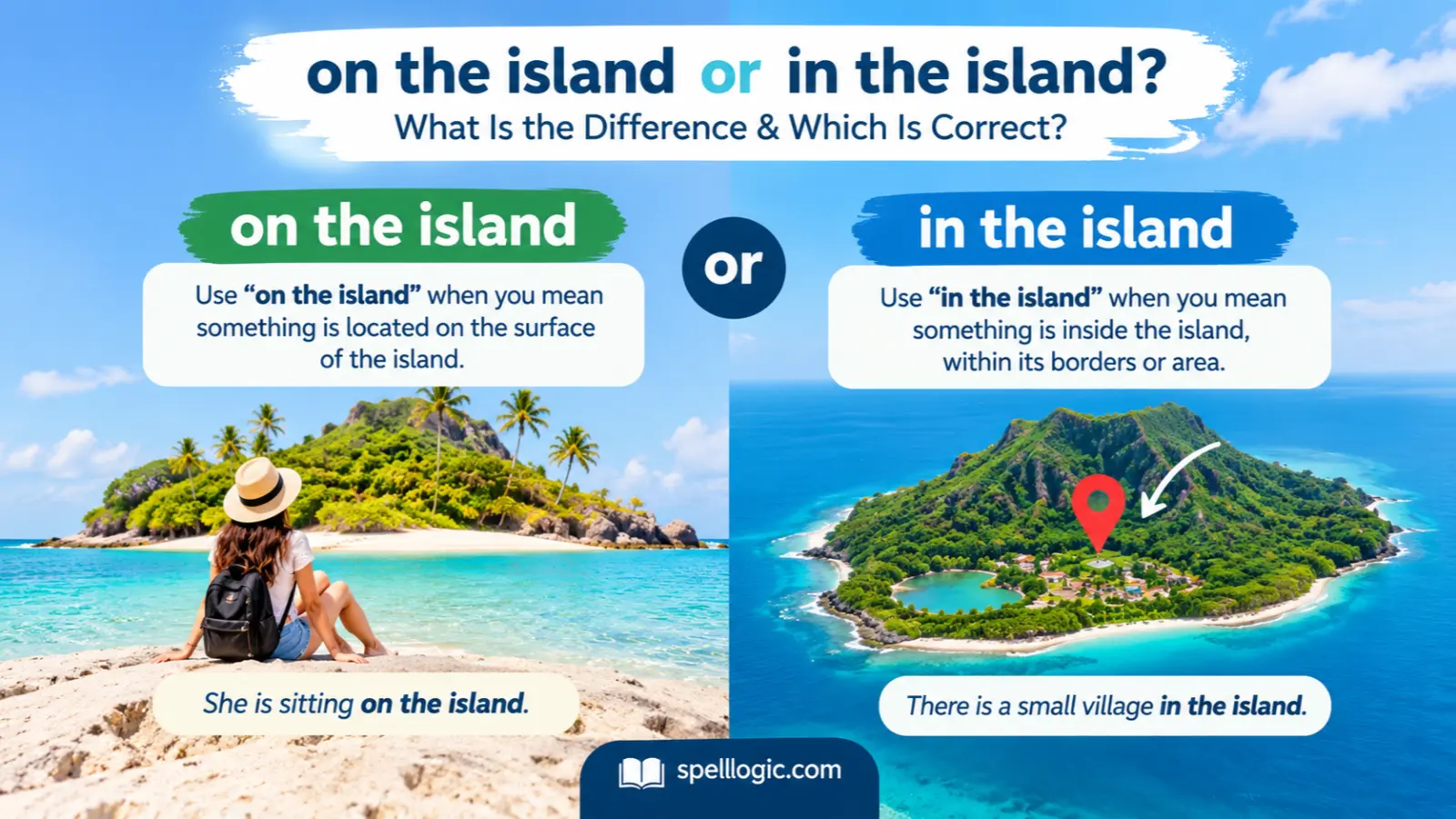
The basic rule for on the island or in the island is straightforward: use on when you mean that someone or something is located on the land that forms an island.
One-line distinction: On the island is the normal expression for being located on an island, while in the island is uncommon and usually requires a special context.
For example:
- We stayed on the island for three days.
- Several small villages are located on the island.
So, when asking on the island or in the island, remember that the ordinary geographical expression is on the island.
Understanding Homophones in English
The difference between on and in is not a homophone issue. They are different prepositions with different sounds and meanings. Nevertheless, understanding homophones is useful because English contains many pairs that sound alike but have different spellings or meanings.
What Are Homophones?
Homophones are words that have the same pronunciation but different meanings, and sometimes different spellings.
For example:
- two = the number 2
- too = also or excessively
The words sound alike, but their meanings and spellings are different.
Why Homophones Cause Confusion
Homophones can be especially difficult when listening because the sound alone does not reveal which word is intended. For example, in a sentence such as “I have two books,” context helps identify two.
The confusion surrounding on the island or in the island, however, comes from choosing the correct preposition rather than from homophones.
What Does “On the Island” Mean?
Definition and Core Meaning
On the island means located, living, staying, working, traveling, or existing on the land area of an island.
When discussing ordinary island geography, on is the standard preposition. An island is viewed as a surface or area of land surrounded by water.
For learners considering on the island or in the island, this is the form to choose in most everyday situations.
Origin and Historical Use
The preposition on has been used in English for centuries to express position on a surface or particular area. Over time, English developed conventional expressions for geographical locations, including on an island.
This usage is now firmly established in standard English.
Modern Usage and Synonyms
In modern English, on the island can describe many situations:
- living on an island
- staying on an island
- working on an island
- traveling around an island
- building something on an island
- finding wildlife on an island
Depending on the sentence, alternatives can include on the land, there, or a specific location such as at the village.
Example Sentences
- My grandparents live on the island.
- We spent our vacation on the island.
- There is a small airport on the island.
- Many rare birds live on the island.
- The hotel is located on the island.
When you are unsure about on the island or in the island, these examples show the normal choice clearly.
What Does “In the Island” Mean?
Definition and Core Meaning
In the island is not normally used to mean simply “located on an island.” In standard everyday English, saying that someone lives in the island usually sounds unnatural.
The phrase can sometimes occur when in belongs to a larger structure or when the speaker is referring to something physically inside the island itself. Such contexts are much less common.
Origin and Historical Context
English uses in to express being inside an enclosed space, area, or container. For example, we say in a room, in a box, and in a city. An island, however, is generally conceptualized as land on which something exists rather than a container surrounding something.
That is why on normally appears with islands.
Modern Usage and Synonyms
If you want to describe ordinary island locations, use expressions such as:
- on the island
- on an island
- on the small island
- on the island of Bali
- on the island’s northern coast
There are specialized situations where in may be possible. For example, if discussing a tunnel, cave, geological formation, or another structure physically located within an island, the surrounding wording may justify in.
For ordinary location questions, however, on the island or in the island has a clear practical answer: on the island is normally correct.
Example Sentences
- The fishermen live on the island.
- We found a beautiful beach on the island.
- The research center is on the island.
- A large cave extends deep into the island.
- Scientists discovered minerals within the island.
Notice that specialized expressions may use in, within, or into when the intended meaning is literally inside the land.
“On the Island” vs “In the Island”: Key Differences at a Glance
The following table makes the difference between on the island or in the island easier to understand:
| Word | Part of Speech | Meaning | Example Context |
|---|---|---|---|
| on | Preposition | Located on the surface or land of an island | We live on the island. |
| in | Preposition | Located inside an enclosed area or something with an interior | The explorers went into the cave. |
| on the island | Prepositional phrase | Located on an island | The hotel is on the island. |
| in the island | Prepositional phrase | Literally inside the island; uncommon for ordinary location | A tunnel runs inside the island. |
For normal geographical situations, on the island is the established choice.
How to Remember the Difference Between On the Island and In the Island
Remembering on the island or in the island becomes easier if you connect on with land and surfaces.
Easy Memory Tricks
Think:
Island = land surrounded by water → you are ON the land.
This simple association works in most everyday situations.
Another useful rule is:
- on an island
- on a beach
- on a coast
- on a mountain
- on a road
These locations are generally treated as surfaces or areas where something can be positioned.
Association Techniques
Imagine standing on an island. Your feet are touching its land. Therefore, you are on the island.
By contrast, imagine entering a room. You cross the doorway and are physically inside it. Therefore, you are in the room.
This physical picture can help you decide between the two prepositions.
One Memorable Example
Think of this sentence:
We arrived on the island and stayed on the island for a week.
If you are talking about where people live, stay, work, or travel, on will usually be the natural choice.
Common Mistakes and Confusions
Many English learners make mistakes because they apply the general rule in = place too broadly.
Wrong Example 1
✘ We stayed in the island for five days.
This sounds unnatural when the intended meaning is that you stayed on the island.
✔ We stayed on the island for five days.
Wrong Example 2
✘ My uncle lives in the island.
For ordinary residence, the standard form is:
✔ My uncle lives on the island.
Wrong Example 3
✘ There are several villages in the island.
A more natural sentence is:
✔ There are several villages on the island.
When “In” Can Make Sense
The important point is that in is not impossible in every imaginable context. If you mean something physically located inside the island, a phrase containing in may be appropriate.
For example:
✔ There is a large underground tunnel in the island.
Even here, many speakers may prefer inside the island or another more precise construction depending on the intended meaning.
Therefore, when choosing on the island or in the island, first ask whether you mean ordinary location on the island’s land or literal physical interior.
Examples Section: Correct and Incorrect Usage
Example 1
✔ Correct: We spent our summer vacation on the island.
✘ Incorrect: We spent our summer vacation in the island.
Explanation: The vacation took place on the island’s land, so on is natural.
Example 2
✔ Correct: There are many beautiful beaches on the island.
✘ Incorrect: There are many beautiful beaches in the island.
Explanation: Beaches are geographical features located on an island.
Example 3
✔ Correct: She works at a hotel on the island.
✘ Incorrect: She works at a hotel in the island.
Explanation: The hotel is situated on the island.
Example 4
✔ Correct: They discovered an underground chamber inside the island.
✘ Incorrect: They discovered an underground chamber on the island.
Explanation: Here, the intended meaning is that the chamber is physically below or inside the land. A more specific word such as inside makes the meaning clearer.
Example 5
✔ Correct: We met several local families on the island.
✘ Incorrect: We met several local families in the island.
Explanation: People living in an island community are normally described as living on the island.
Self Assessment: Test Your Knowledge
Choose the correct preposition for each sentence.
- We stayed ___ the island during our holiday.
a) on
b) in - Many small villages are located ___ the island.
a) on
b) in - The scientists explored a tunnel deep ___ the island.
a) on
b) inside - My friends live ___ the island.
a) on
b) in
Self Assessment Answers
- on — We stayed on the island during our holiday.
- on — Many small villages are located on the island.
- inside — The tunnel is physically within the island.
- on — My friends live on the island.
The key lesson is simple: for normal geographical locations, on is generally the correct preposition.
FAQs
1. Is “on the island” grammatically correct?
Yes. On the island is the standard expression when you mean that someone or something is located on an island.
2. Is “in the island” ever correct?
It can occur in specialized contexts where in refers to something physically inside the island. However, it is not normally used simply to mean “on an island.”
3. Should I say “live on the island” or “live in the island”?
Say live on the island when describing someone’s residence on an island.
4. Why do we say “on an island”?
An island is generally treated as a piece or surface of land surrounded by water. Therefore, English normally uses on for ordinary location.
5. Is “on the island or in the island” a common English question?
Yes. English learners often search for this distinction because prepositions do not always follow the same rules as their first language.
6. Do we say “on the island of Hawaii”?
Yes. A natural construction is on the island of Hawaii when referring to the geographical island.
7. What is the easiest way to remember the rule?
Think on = land or surface. If you mean that someone is living, staying, working, or traveling on an island, on is usually the correct choice.
Final Conclusion: Using “On the Island” and “In the Island” Correctly
Understanding on the island or in the island is mainly a matter of learning how English treats islands as geographical surfaces or areas of land. In ordinary situations, on the island is the natural and standard expression. We use it when talking about people who live there, tourists who stay there, buildings that are located there, villages that exist there, or natural features found there. For example, we say, “They live on the island,” and “The hotel is on the island.”
The expression in the island is much less common when used by itself. It may appear in a specialized context where something is literally inside the island, but speakers will often choose clearer expressions such as inside the island, within the island, or into the island, depending on the meaning.
A useful memory trick is to connect on with land and surfaces. You can be on an island, just as you can be on a beach or on a mountain. By contrast, in commonly describes being inside an enclosed place, such as a room or building. Once you picture yourself standing on an island, the correct preposition becomes easier to remember. Keep practicing these patterns in real sentences, and choosing the right preposition will become more natural with time.