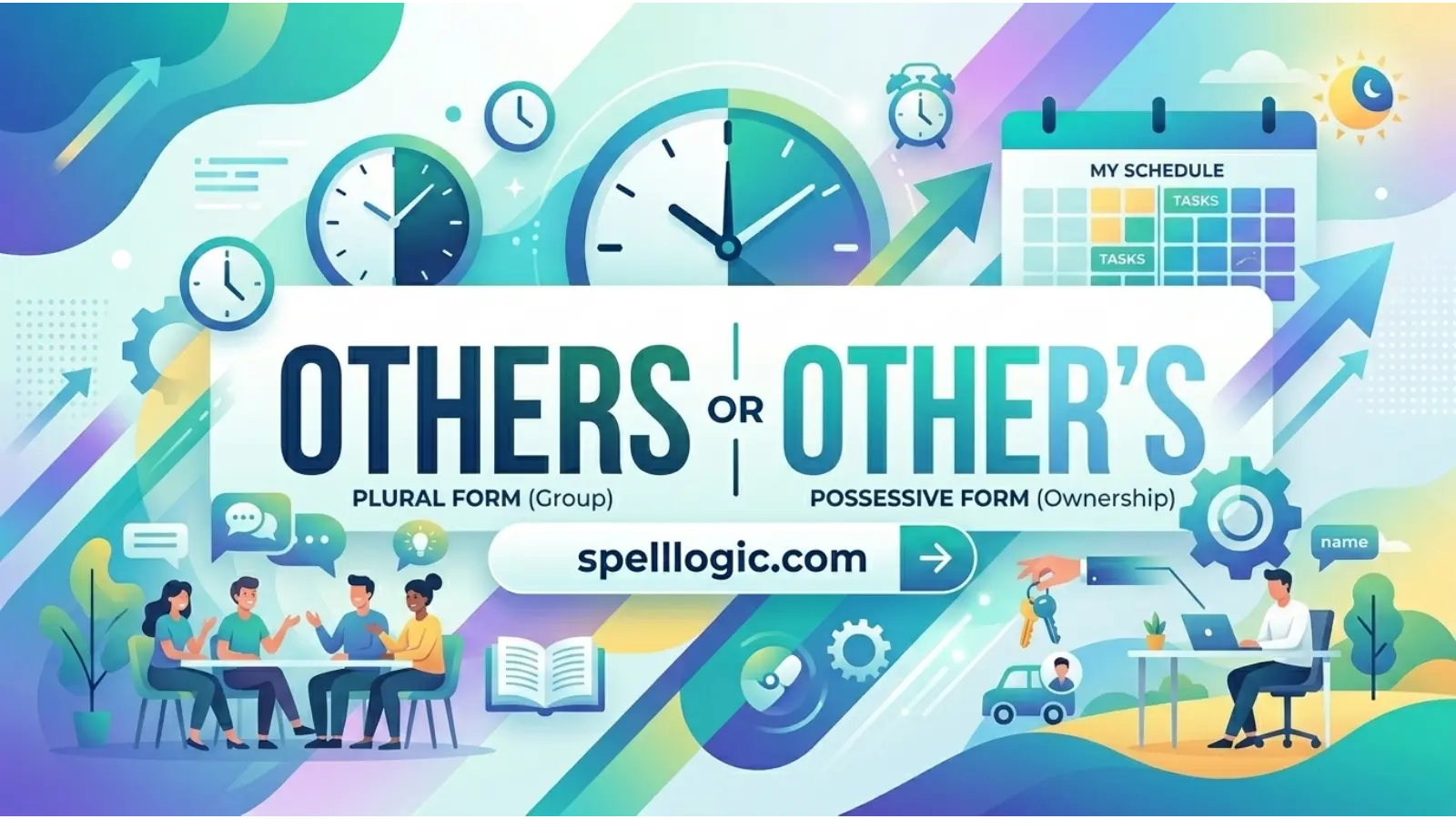
English learners often confuse others or other’s because the two forms look almost identical. However, the apostrophe in other’s changes its grammatical function completely. One form is a plural pronoun, while the other is a possessive form of the word “other.” Understanding this small punctuation difference can help you write clearer sentences, avoid common grammar mistakes, and communicate your ideas more naturally.
Whether you are writing an email, an academic assignment, or everyday messages, choosing the correct form matters. In this guide, we will explain the difference in simple English, provide practical examples, and show you an easy way to remember which form to use.
Why “Others or Other’s” Are Confusing
The expressions others or other’s are confusing mainly because they contain the same basic word, “other.” The only visible difference is the apostrophe, but that punctuation mark signals a completely different grammatical meaning.
Similar Pronunciation
In normal speech, “others” and “other’s” can sound very similar. This makes the distinction difficult to notice when people learn English through conversation.
For example:
- “Some students helped the others.”
- “The other’s answer was correct.”
The pronunciation alone may not tell you which form the speaker intends. Therefore, learners need to understand the grammatical role of each form.
Similar Spelling
The spelling of “other” appears in both forms. The added s in “others” creates a plural pronoun, while the apostrophe and s in “other’s” create a possessive form.
That tiny punctuation difference causes many writing errors.
Context Confusion
Another reason for confusion is that both forms can appear when people discuss different people or things.
For example:
- “Some people agreed, while others disagreed.”
- “The other’s opinion was different.”
The first sentence refers to additional people. The second indicates that something belongs to one “other” person.
Common Learner Mistakes
English learners commonly make these mistakes:
- Using “other’s” when they mean additional people.
- Adding an apostrophe simply because a word ends in s.
- Using “others” before a noun when “other” or “other’s” is needed.
- Confusing plural forms with possessive forms.
Remember that an apostrophe does not normally make a word plural. It often indicates possession.
Others vs Other’s Explained Simply
The easiest way to understand others or other’s is to focus on whether you are talking about additional people or things or showing ownership.
Others means additional people or things and usually works as a plural pronoun.
Other’s means that something belongs to one person or thing described as “other.” It is a possessive form and is usually followed by a noun.
One-Line Distinction
Others = additional people or things; other’s = something belonging to one “other” person or thing.
Examples
- Some students finished their work, while others continued studying.
- I respected the other’s opinion because it was carefully explained.
In the first sentence, “others” refers to additional students. In the second, “other’s” shows possession: the opinion belongs to the other person.
The key difference between others or other’s is therefore plural reference versus possession.
Understanding Homophones in English
Although others or other’s may sound alike or nearly alike in some varieties of English, they are not technically homophones in every pronunciation. Their main difficulty comes from their similar spelling and sound rather than from being exact homophones.
What Are Homophones?
Homophones are words that have the same pronunciation but different meanings or spellings.
For example:
- right = correct
- write = to form words with letters
These words sound the same but have different meanings and spellings.
Why Homophones Cause Confusion
When words sound alike, listeners cannot always identify the correct spelling from pronunciation alone. They must use context.
For example, when someone says “write,” you need the sentence to understand whether the speaker means the action of writing or is referring to something else that sounds similar.
With others or other’s, punctuation and grammar provide the important clues.
What Does “Others” Mean?
Definition and Core Meaning
“Others” is the plural form used to refer to additional people or things that have already been mentioned or are understood from context.
It is commonly used as a pronoun, so it can stand in place of a plural noun.
For example:
- Some people like tea, while others prefer coffee.
- I chose these books and left the others on the shelf.
- Some employees arrived early; others arrived later.
The word “others” does not normally need another noun immediately after it because it already represents the people or things being discussed.
Origin and Historical Use
“Other” has a long history in English and comes from Old English forms related to the idea of something different, additional, or remaining. Over time, English developed different forms to express singular, plural, and possessive meanings.
The plural “others” became a useful way to refer to additional people or things without repeating the noun.
Modern Usage and Synonyms
Today, “others” is common in both formal and informal English.
Depending on the context, related expressions include:
- additional people
- additional things
- the remaining ones
- different people
- different ones
- other people
A useful grammar rule is that “others” can stand alone as a pronoun.
Example Sentences
- Some children played outside, while others stayed indoors.
- I liked these shoes more than the others.
- Some answers were correct, but others contained errors.
- She helped several people and encouraged others to do the same.
When comparing others or other’s, choose “others” when you mean more than one additional person or thing.
What Does “Other’s” Mean?
Definition and Core Meaning
“Other’s” is the possessive form of the singular word “other.” It indicates that something belongs to one “other” person or thing.
For example:
- I accepted the other’s suggestion.
- The other’s color was brighter.
- We compared one design with the other’s layout.
Here, the apostrophe shows possession.
However, this form is less common than “another person’s,” “the other person’s,” or a more specific possessive expression. In many situations, those alternatives sound more natural.
Origin and Historical Context
The possessive apostrophe developed in English as a way to mark relationships such as ownership, association, or belonging. In modern English, an apostrophe followed by s commonly forms the possessive of a singular noun.
For example:
- the teacher’s book
- the student’s desk
- the other person’s idea
Because “other” can function as a singular noun in certain contexts, “other’s” can also express possession.
Modern Usage and Synonyms
“Other’s” is grammatically possible, but its naturalness depends heavily on context. Writers often choose a clearer phrase when the meaning could be misunderstood.
Possible alternatives include:
- another person’s
- the other person’s
- the other one’s
- belonging to the other person
Example Sentences
- I preferred my answer to the other’s.
- The first team’s strategy differed from the other’s.
- Her opinion was different from the other’s.
- We used our plan instead of the other’s.
When deciding between others or other’s, use the possessive form only when you need to show that something belongs to one “other” person or thing.
Others vs Other’s: Key Differences at a Glance
| Word | Part of Speech | Meaning | Example Context |
|---|---|---|---|
| Others | Pronoun | Additional people or things | Some agreed, while others disagreed. |
| Other’s | Possessive form | Belonging to one “other” person or thing | I preferred the other’s suggestion. |
The biggest difference between others or other’s is grammatical. “Others” identifies additional people or things, while “other’s” expresses possession.
Notice that “others” does not require an apostrophe simply because it ends in s. The s is part of its plural form.
By contrast, the apostrophe in “other’s” has a grammatical purpose. It tells the reader that the following or implied item belongs to one “other.”
How to Remember the Difference Between Others and Other’s
A few simple memory tricks can make others or other’s much easier to distinguish.
Memory Trick 1: Think “More”
When you mean more people or things, think of others.
Some students studied; others played.
The word refers to more students.
Memory Trick 2: Think “Belongs”
When you see an apostrophe, ask whether something belongs to someone or something.
The other’s book was missing.
The book belongs to the other person.
Memory Trick 3: Watch the Apostrophe
An apostrophe is not needed to make “other” plural.
- other → others
- other → other’s for possession
Do not automatically add an apostrophe before s.
Association Technique
You can connect others with the phrase other people/things:
others = other people or things
Connect other’s with belongs to the other:
other’s = belonging to the other
One Memorable Example
Some students brought their laptops, while others used the computers. I borrowed the other’s charger.
The first form identifies additional students. The second indicates possession of a charger.
This simple contrast is useful when deciding between others or other’s in everyday writing.
Common Mistakes and Confusions
Mistake 1: Using “other’s” for a Plural Meaning
✘ Some students finished early, while other’s waited.
✔ Some students finished early, while others waited.
Explanation: The sentence refers to additional students, so the plural pronoun “others” is correct.
Mistake 2: Adding an Apostrophe to Make a Plural
✘ I asked the other’s to leave.
✔ I asked the others to leave.
Explanation: Apostrophes do not normally form plurals. “Others” is already the correct plural form.
Mistake 3: Using “others” to Show Possession
✘ I used the others computer.
✔ I used the other’s computer.
Explanation: The computer belongs to one other person, so the possessive form is required.
However, in natural English, “the other person’s computer” may sound clearer.
Mistake 4: Confusing “Other,” “Others,” and “Other’s”
These three forms have different functions:
- other = an additional or different person/thing, usually before a noun
- others = additional people/things, used as a pronoun
- other’s = belonging to one other person/thing
For example:
- I need other options.
- I need to compare these with others.
- I prefer the other’s design.
Understanding this distinction makes the choice between others or other’s much easier.
Examples Section: Correct and Incorrect Usage
Example 1
✔ Correct: Some workers arrived early, while others arrived late.
✘ Incorrect: Some workers arrived early, while other’s arrived late.
Why? “Others” refers to additional workers.
Example 2
✔ Correct: I liked my design more than the other’s.
✘ Incorrect: I liked my design more than the others.
Why? The intended meaning is that one other person’s design is being compared with yours.
Example 3
✔ Correct: Some customers wanted refunds, while others wanted replacements.
✘ Incorrect: Some customers wanted refunds, while other’s wanted replacements.
Why? “Others” refers to additional customers.
Example 4
✔ Correct: The first team’s results were better than the other’s.
✘ Incorrect: The first team’s results were better than the others.
Why? The sentence compares one team’s results with those belonging to one other team.
Example 5
✔ Correct: I chose these books instead of the others.
✘ Incorrect: I chose these books instead of the other’s.
Why? “Others” refers to multiple remaining books.
Example 6
✔ Correct: Her opinion was different from the other’s.
✘ Incorrect: Her opinion was different from the others.
Why? The intended comparison is with one other person’s opinion.
Self Assessment: Test Your Knowledge
Fill in each blank with others or other’s.
- Some employees supported the idea, while ______ disagreed.
- I preferred my solution to the ______.
- Some children were reading, while ______ were drawing.
- The first design was simple, but the ______ design was more colorful.
Self Assessment Answers
- others — It refers to additional employees.
- other’s — It shows possession by one other person.
- others — It refers to additional children.
- other’s — It indicates that the design belongs to or is associated with the other one/person, depending on context.
A useful way to check your answers is to ask: Am I referring to additional people or things, or am I showing possession?
FAQs
1. Is “others” grammatically correct?
Yes. “Others” is a standard plural pronoun used for additional people or things.
2. Is “other’s” a correct word?
Yes, but it is a possessive form and is less common. It means that something belongs to one “other” person or thing.
3. What is the main difference between others or other’s?
The main difference is that others refers to additional people or things, while other’s shows possession by one “other” person or thing.
4. Does “others” need an apostrophe?
No. The plural pronoun “others” does not need an apostrophe.
5. Can I use “other’s” before a noun?
Yes, when you need to show possession. For example, “the other’s opinion” means the opinion belonging to the other person.
6. Is “others” a noun or pronoun?
“Others” is commonly used as a pronoun. It can stand for additional people or things without repeating the noun.
7. How can I quickly remember the correct form?
Think others = additional ones and other’s = belongs to one other. This distinction will help you choose correctly in most situations.
Final Conclusion: Using “Others” and “Other’s” Correctly
Understanding others or other’s becomes much easier when you focus on meaning instead of appearance. “Others” is a plural pronoun that refers to additional people or things. For example, “Some students were ready, while others needed more time.” Here, “others” replaces “other students.” On the other hand, “other’s” is a possessive form that indicates something belongs to one other person or thing, as in “I preferred the other’s suggestion.” The apostrophe is important because it signals possession rather than plurality.
A simple memory rule can help: think “others = additional ones” and “other’s = belongs to the other.” Also, remember that apostrophes do not normally create plural words. When you are writing, pause and ask yourself whether you mean several additional people or things or whether you are showing ownership. With regular practice, this small punctuation distinction will become much easier to recognize. English learners do not need to memorize complicated rules; they simply need to notice the role each word plays in a sentence. Keep practicing with real examples, and you will soon use these forms naturally and confidently.