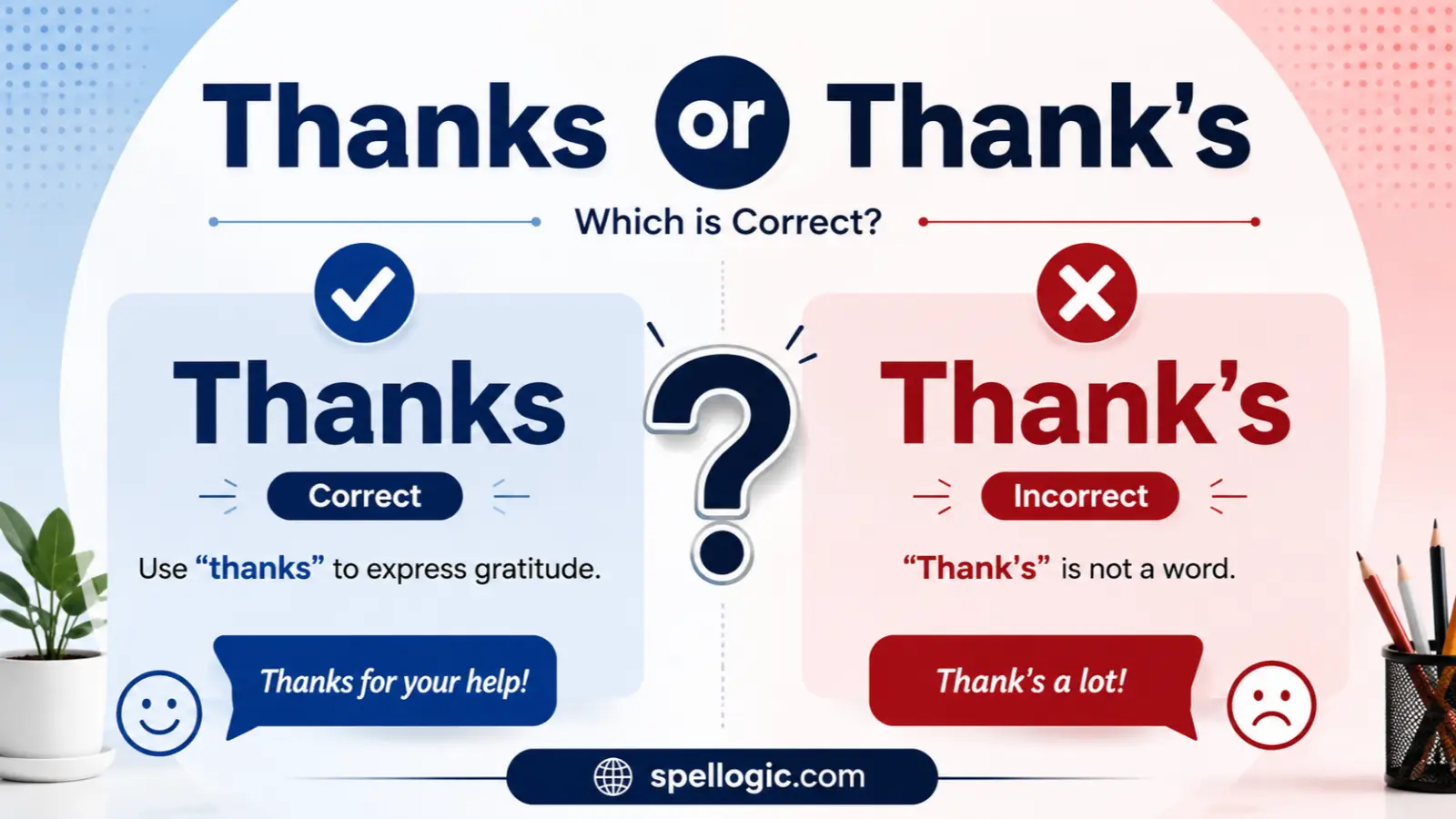
English learners often hesitate between thanks and thank’s because the two forms look almost identical. However, only one is correct in standard English. The apostrophe in thank’s can seem natural because English uses apostrophes for possession and contractions, but it does not belong in this expression.
Understanding thanks or thank’s is useful because the word appears frequently in emails, messages, conversations, cards, and everyday speech. In this guide, we will explain thanks or thank’s in simple language, show the correct spelling, examine common mistakes, and provide practical examples. By the end, you will know exactly when to use thanks and why thank’s should normally be avoided.
Why “Thanks” and “Thank’s” Are Confusing
The confusion between thanks or thank’s mainly comes from the unnecessary apostrophe in the second form. Both forms appear visually similar, and when people hear the word in conversation, they cannot see whether an apostrophe is present.
Similar pronunciation
Thanks and thank’s would normally be pronounced the same if someone wrote the second form. This makes the distinction especially difficult when learners hear the word before seeing it in writing.
Similar spelling
The only visible difference is the apostrophe. Because apostrophes are common in English, learners may assume that thank’s is a shortened or possessive form.
Context confusion
English uses apostrophes in words such as don’t, it’s, and John’s. Learners sometimes transfer this pattern to expressions of gratitude and create thank’s.
Common learner mistakes
A frequent spelling mistake is adding an apostrophe before the final s. Learners may also think the apostrophe shows that the word belongs to someone. In standard English, however, thanks does not need an apostrophe.
Thanks vs Thank’s Explained Simply
The simplest way to understand thanks or thank’s is to remember that thanks is the standard spelling used to express gratitude.
One-line distinction: Thanks is the correct standard form, while thank’s is generally an incorrect spelling when you mean “thank you.”
Here are two examples:
- Thanks for helping me with my homework.
- Thanks for your quick reply.
So, thanks or thank’s can be reduced to one simple rule: thanks means an expression of gratitude, while thank’s is not the standard spelling for that meaning.
Understanding Homophones in English
What Are Homophones?
Homophones are words that sound the same or very similarly but have different spellings and meanings. For example, right and write have the same pronunciation but different meanings.
The issue with thanks or thank’s is slightly different because the two written forms are not normally treated as two standard English words with separate meanings. Instead, one is the accepted spelling and the other is generally an incorrect form.
Why Homophones Cause Confusion
When learners hear a word, they cannot always determine its spelling from pronunciation alone. For example, someone may hear “right” and need the context to decide whether the speaker means right or write.
With thanks or thank’s, pronunciation does not provide a useful clue about the apostrophe. Therefore, learners need to remember the standard written form.
What Does “Thanks” Mean?
Definition and Core Meaning
Thanks is an expression used to show gratitude or appreciation. It is common in both spoken and written English.
For example:
- Thanks for the information.
- Thanks for your support.
- Thanks a lot!
- Many thanks for your help.
The word can be used by itself or followed by information about what you appreciate.
Origin and Historical Use
Thanks comes from the noun thank, which is connected to the idea of gratitude and appreciation. The word has a long history in English and is related to older Germanic words expressing gratitude or thoughtfulness.
Over time, thanks became a common everyday expression. Today, it is one of the simplest ways to acknowledge someone’s help, kindness, information, or effort.
Modern Usage and Synonyms
In modern English, thanks is widely used in casual and semi-formal communication.
Related expressions include:
- Thank you
- Many thanks
- Thanks a lot
- Thanks so much
- I appreciate it
- Much appreciated
- Cheers — in some informal varieties of English
The choice depends on the situation. Thank you can sound more neutral or polite, while thanks is often shorter and more conversational.
Example Sentences
- Thanks for sending the document.
- Thanks for waiting for me.
- Many thanks for your assistance.
- Thanks, I really appreciate it.
- Thanks for letting me know.
When deciding between thanks or thank’s, choose thanks when you want to express gratitude.
What Does “Thank’s” Mean?
Definition and Core Meaning
Thank’s is generally not the correct standard-English spelling when someone wants to say thanks. The apostrophe does not belong in the ordinary expression of gratitude.
Therefore, learners should not treat thank’s as a normal alternative spelling.
Origin and Historical Context
The confusion comes from the broader rules of English apostrophes. Apostrophes can indicate possession, as in Sarah’s book, or contractions, as in it’s for it is.
However, neither rule requires an apostrophe in thanks. The final s simply forms the plural noun or contributes to the established expression.
Modern Usage and Synonyms
If you want to express appreciation, use standard forms such as:
- Thanks
- Thank you
- Many thanks
- Thanks so much
- Thank you very much
- I appreciate your help
In edited writing, professional communication, schoolwork, and formal documents, avoid using thank’s as a spelling of thanks.
Example Sentences
Instead of writing:
- Thank’s for your email.
- Thank’s a lot.
write:
- Thanks for your email.
- Thanks a lot.
The important lesson about thanks or thank’s is that the apostrophe does not make the expression more correct or more polite.
Thanks vs Thank’s: Key Differences at a Glance
| Word | Part of Speech | Meaning | Example Context |
|---|---|---|---|
| Thanks | Noun / interjection-like expression | Gratitude or appreciation | “Thanks for your help.” |
| Thank’s | Incorrect standard spelling in this use | Not a standard form of the expression | Avoid in normal English writing |
This comparison makes thanks or thank’s easier to understand: use thanks when expressing appreciation.
How to Remember the Difference Between Thanks and Thank’s
Remembering thanks or thank’s is easy if you focus on one rule: No apostrophe in thanks.
Easy memory tricks
1. Think: “Thanks needs no apostrophe.”
The word is simply spelled t-h-a-n-k-s.
2. Save apostrophes for real jobs.
Apostrophes commonly show possession or contractions. Thanks does neither in its normal use.
3. Compare it with “thank you.”
If you can write thank you without an apostrophe, you can remember that the shortened expression thanks also does not need one.
Association technique
Imagine receiving help from a friend. You say:
“Thanks!”
Now imagine writing the word. Picture the word as THANKS, with no mark between k and s.
One memorable example
Thanks for helping me.
If you remember this sentence, you also remember the correct spelling.
Common Mistakes and Confusions
The most common problem with thanks or thank’s is treating the apostrophe as if it were necessary before the final s.
Wrong example
✘ Thank’s for your help.
Correct version
✔ Thanks for your help.
The apostrophe is unnecessary because thanks is not a contraction such as can’t or don’t.
Another common mistake
✘ Thank’s a lot for the information.
✔ Thanks a lot for the information.
The same rule applies whether the expression appears in a text message, email, note, or conversation.
Why learners make this mistake
Learners often see apostrophes before s in words such as Ali’s, teacher’s, and company’s. Those forms can show possession. They may therefore assume that every word ending in s needs an apostrophe. That is not the case.
Examples Section: Correct and Incorrect Usage
Understanding thanks or thank’s becomes easier when you compare real sentences.
Example 1
✔ Correct: Thanks for your message.
✘ Incorrect: Thank’s for your message.
Explanation: Use thanks when showing appreciation for a message.
Example 2
✔ Correct: Thanks for helping me today.
✘ Incorrect: Thank’s for helping me today.
Explanation: The expression of gratitude does not require an apostrophe.
Example 3
✔ Correct: Many thanks for your assistance.
✘ Incorrect: Many thank’s for your assistance.
Explanation: Many thanks is a standard expression used in both personal and professional communication.
Example 4
✔ Correct: Thanks a lot for explaining the problem.
✘ Incorrect: Thank’s a lot for explaining the problem.
Explanation: The correct spelling remains thanks, even when the expression is followed by a lot.
Example 5
✔ Correct: Thanks, I really appreciate your advice.
✘ Incorrect: Thank’s, I really appreciate your advice.
Explanation: A comma may follow thanks when it introduces a separate statement, but an apostrophe is not needed.
Self Assessment: Test Your Knowledge
Fill in each blank with the correct form.
- ______ for helping me finish the project.
- ______ a lot for your kind words.
- Many ______ for your quick response.
- ______ for explaining the lesson so clearly.
Choose between thanks and thank’s for each sentence.
Self Assessment Answers
- Thanks for helping me finish the project.
- Thanks a lot for your kind words.
- Many thanks for your quick response.
- Thanks for explaining the lesson so clearly.
In every answer, the correct form is thanks because the sentences express gratitude.
FAQs
1. Is “thanks” or “thank’s” correct?
Thanks is the correct standard spelling when you want to express gratitude. Thank’s is generally an incorrect spelling in this context.
2. Why is “thank’s” wrong?
The apostrophe is unnecessary. Thanks is not a contraction and does not show possession, so there is no grammatical reason to insert an apostrophe.
3. Can I write “thanks” in a formal email?
Yes. Thanks is acceptable in many professional emails, especially when the tone is friendly. For a more formal tone, thank you or many thanks may be preferable.
4. Is “thanks” short for “thank you”?
Not exactly in a strict grammatical sense, but it is a common expression of gratitude that can perform a similar communicative function to thank you.
5. Does “thanks” need an apostrophe?
No. The standard spelling is thanks, without an apostrophe.
6. Is “thank’s” ever correct?
In ordinary modern English, thank’s is not the standard spelling of the expression of gratitude. In normal writing, use thanks.
7. What is the easiest way to remember the spelling?
Remember this sentence: Thanks for your help. The word thanks contains no apostrophe.
Final Conclusion: Using “Thanks” and “Thank’s” Correctly
The difference between thanks or thank’s is simple once you understand the role of the apostrophe. Thanks is the standard and correct form used to express gratitude, appreciation, or acknowledgment. You can use it in everyday conversations, text messages, emails, notes, and many professional situations. Thank’s, on the other hand, is generally an incorrect spelling when you mean “thanks.” The apostrophe is unnecessary because the word is not functioning as a contraction or a possessive form.
A useful memory trick is to remember that thanks needs no apostrophe. If you are writing “Thanks for your help,” “Thanks a lot,” or “Many thanks,” keep the word exactly as thanks. When greater formality is appropriate, you can use thank you, thank you very much, or many thanks instead.
Understanding thanks or thank’s may seem like a small grammar point, but correct spelling makes your writing clearer and more professional. Keep practicing these everyday expressions in real sentences, and the correct form will soon become automatic. Small improvements in spelling can make a big difference in confident English communication.