English learners often hesitate when choosing between two forms of the verb be in the past tense. One common confusion involves the forms used with you. Because you can refer to one person or several people, learners sometimes wonder whether the singular form of the verb should be used. This confusion is especially common when people hear informal speech, regional dialects, or nonstandard grammar.
Learning the standard rule is important because it helps you write and speak clearly in school, work, emails, and everyday conversations. Once you understand how you works with the past tense of be, choosing the correct form becomes simple and automatic.
Why “You Were” and “You Was” Are Confusing
Many learners mix up these forms because you has a special place in English grammar. Unlike some languages, standard English uses the same pronoun you for both one person and more than one person. Therefore, learners may expect the verb to change depending on whether they are speaking to one person or a group.
Similar pronunciation
The two expressions are easy to distinguish in writing, but fast speech can make verb forms harder to notice. Learners who mainly learn English through conversation may also hear regional or informal varieties in which nonstandard forms occur.
Similar spelling
Both were and was are past-tense forms of be. Since both refer to something that happened in the past, learners may focus on the time rather than the subject.
Context confusion
The word you can mean one person:
- You were late.
It can also mean several people:
- You were late.
The verb remains the same in both sentences. This is one reason learners may incorrectly choose was when talking to one person.
Common learner mistakes
A common mistake is to think that a singular meaning requires was. However, standard English does not use was after you. The correct form is were, whether you refers to one person or several people.
“You Were” vs “You Was” Explained Simply
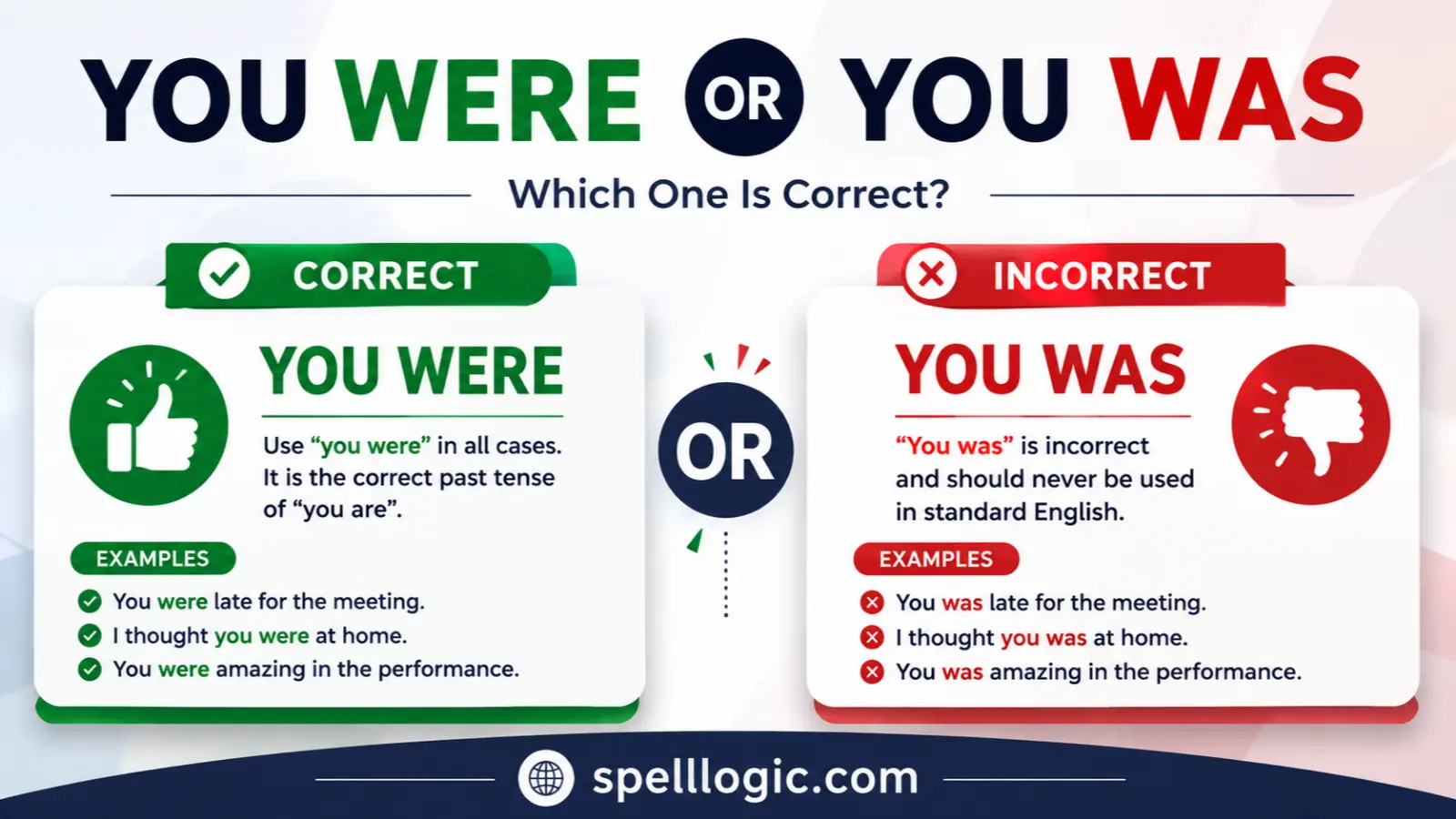
In standard English, were is the correct past-tense form of be after you. Was is normally used with I, he, she, and it, but not with the subject you.
One-line distinction: Use were after you in standard English; was after you is generally nonstandard.
For example:
- You were very helpful yesterday.
- You were at home when I called.
The key rule is simple: you + were, not you + was, when describing a normal past situation.
Understanding Homophones in English
What Are Homophones?
Homophones are words that sound the same or nearly the same but have different meanings, spellings, or grammatical functions. For example, right and write can sound alike but have different meanings and spellings.
The two forms discussed here are not true homophones. They are different verb forms with different pronunciations and spellings. The confusion comes mainly from grammar and from exposure to different varieties of spoken English.
Why Homophones Cause Confusion
Homophones can make English spelling difficult because listening alone does not always tell you which word a speaker means. For example, someone hearing write must use the sentence context to know that the speaker does not mean right.
Similarly, learners who hear different varieties of English may encounter forms that differ from standard written grammar. Understanding the standard rule helps them choose the appropriate form when writing.
What Does “You Were” Mean?
Definition and Core Meaning
You were is the standard past-tense form of the verb be when the subject is you. It can describe a past state, condition, location, identity, or situation.
It works for both singular and plural you:
- You were tired.
- You were tired.
The first sentence can address one person, while the second can address several people. The verb does not change.
Origin and Historical Use
The form were comes from the historical development of the verb be in English. Old and Middle English had several forms of this highly irregular verb. Over time, the modern forms am, is, are, was, and were developed.
Modern standard English preserves were with you in the past tense. This pattern is also connected to the older distinction between singular and plural pronouns, although modern English uses you for both.
Modern Usage and Synonyms
The expression is extremely common in modern English. It appears in conversation, formal writing, questions, stories, instructions, and descriptions.
Depending on the context, related expressions can include:
- were present
- existed
- remained
- seemed
- felt
- happened to be
These are not exact synonyms in every sentence, but they can sometimes replace the verb phrase while keeping a similar meaning.
Examples
- You were correct about the answer.
- You were absent yesterday.
- You were very kind to me.
- You were in the library when I arrived.
- You were responsible for the project.
- You were happy with the results.
Notice that the form stays were regardless of whether one person or several people are being addressed.
What Does “You Was” Mean?
Definition and Core Meaning
You was is generally considered nonstandard in modern Standard English. It may appear in some regional dialects, historical varieties, songs, informal speech, or dialogue intended to represent a particular way of speaking.
For learners who are studying standard English, it is best to avoid this form in ordinary formal and informal communication.
Origin and Historical Context
English has always contained regional and social varieties with different grammatical patterns. Some dialects use verb forms differently from Standard English. In certain varieties, was can occur after you in informal speech.
This does not mean that the form is appropriate for standard written English. A dialect can have its own consistent grammatical rules, while standard English follows another set of conventions.
Modern Usage and Synonyms
In contemporary English, this form may appear when writers intentionally reproduce spoken language or a particular dialect. It can also occur because a speaker has learned a nonstandard grammatical pattern.
For English learners, however, the safest standard pattern is:
- you were
- I was
- he was
- she was
- it was
- we were
- they were
Examples
Nonstandard:
- You was late yesterday.
Standard:
- You were late yesterday.
Nonstandard:
- You was very helpful.
Standard:
- You were very helpful.
The important point is not that every occurrence of you was is meaningless. Rather, it is not the standard form learners should normally use.
“You Were” vs “You Was”: Key Differences at a Glance
| Word | Part of Speech | Meaning | Example Context |
|---|---|---|---|
| You were | Pronoun + past-tense verb | Describes a past state, action-related condition, location, or situation involving you | “You were busy yesterday.” |
| You was | Pronoun + nonstandard past-tense verb form | Used in some dialects or informal speech but not standard English | Avoid in standard writing: “You was busy.” |
The most important difference is grammatical correctness in Standard English. If you are writing an essay, email, report, application, or professional message, choose were after you.
How to Remember the Difference Between “You Were” and “You Was”
Easy Memory Tricks
The simplest memory rule is:
You + were = standard English.
Do not let the singular meaning of you trick you into choosing was. The grammar depends on the pronoun you, not on whether you are talking to one person or several people.
Another useful pattern is to memorize the common forms together:
- I was
- You were
- He was
- She was
- It was
- We were
- They were
This pattern makes the correct form easier to recall.
Association Techniques
Think of you as having a special grammar partner: were.
You can also remember the pair by asking yourself:
“What follows you in the past tense?”
The answer should immediately be were.
One Memorable Example
Imagine speaking to your best friend:
You were my first teacher.
Now imagine speaking to ten classmates:
You were my classmates.
The number of people changes, but the verb stays were.
Common Mistakes and Confusions
Mistake 1: Treating singular “you” like “he” or “she”
✘ You was tired.
✔ You were tired.
Explanation: Although you can refer to one person, standard English still requires were.
Mistake 2: Changing the verb for one person
✘ You was at the store.
✔ You were at the store.
Explanation: The verb does not become was simply because the speaker is addressing one person.
Mistake 3: Copying nonstandard speech into formal writing
A learner may hear someone say you was and assume it is correct everywhere.
✔ You were right about the problem.
Explanation: Spoken dialects can differ from Standard English. For formal and standard communication, use were.
Mistake 4: Confusing the pattern with “I”
✔ I was tired.
✔ You were tired.
The difference comes from the subject. Was works with I, but were works with you.
Examples Section: Correct and Incorrect Usage
Example 1
✔ Correct: You were late for class yesterday.
✘ Incorrect: You was late for class yesterday.
Why? Standard English requires were after you.
Example 2
✔ Correct: You were very helpful during the meeting.
✘ Incorrect: You was very helpful during the meeting.
Why? The subject you takes were in the past tense.
Example 3
✔ Correct: Were you at home last night?
✘ Incorrect: Was you at home last night?
Why? Questions also use were with you.
Example 4
✔ Correct: I was surprised that you were there.
✘ Incorrect: I was surprised that you was there.
Why? The first verb agrees with I, while the second agrees with you.
Example 5
✔ Correct: You were the person I needed to speak with.
✘ Incorrect: You was the person I needed to speak with.
Why? The past form remains were with you.
Example 6
✔ Correct: You were both invited to the event.
✘ Incorrect: You was both invited to the event.
Why? Here you clearly refers to two people, but the same standard verb form is used.
Self Assessment: Test Your Knowledge
Fill in each blank with was or were.
- You ___ very happy after receiving the news.
- ___ you at the office yesterday?
- I knew that you ___ ready for the exam.
- You ___ my best friend when we were children.
Self Assessment Answers
- were — “You were very happy after receiving the news.”
- Were — “Were you at the office yesterday?”
- were — “I knew that you were ready for the exam.”
- were — “You were my best friend when we were children.”
Remember that was is normally used with I, he, she, and it, while were is used with you, we, and they in the standard past tense of be.
FAQs
Is “you were” always correct?
In Standard English, were is the correct past-tense form of be after you. It is used whether you refers to one person or multiple people.
Is “you was” grammatically correct?
In Standard English, you was is generally considered incorrect or nonstandard. It can occur in certain dialects, informal speech, or deliberately written dialogue, but learners should normally use you were.
Why do people say “you was”?
Some speakers use you was because of regional, social, or dialectal grammar patterns. It may also result from informal speech or language habits. Hearing it does not make it the standard form for formal English.
Should I use “you was” in an essay?
No. If you are writing a school essay, academic assignment, professional email, application, or formal document, use you were.
Can “you were” refer to one person?
Yes. You were can refer to one person or several people. For example, “You were my teacher” can be addressed to one teacher.
Is “were” singular or plural?
Were is used with both you and plural subjects such as we and they. It can therefore appear with singular you as well as plural you.
What is the easiest way to remember the rule?
Memorize this simple pair: I was, but you were. If the subject is you, use were in standard English.
Final Conclusion: Using “You Were” and “You Was” Correctly
Understanding the difference between these two forms is important for anyone learning standard English. The main rule is straightforward: you takes were in the past tense of be, whether it refers to one person or several people. Therefore, sentences such as “You were tired,” “You were correct,” and “Were you at home?” follow standard English grammar. The form you was can be heard in some dialects and informal varieties, but it is generally not appropriate in standard writing or formal communication.
The easiest memory trick is to learn the complete pattern: I was, you were, he was, she was, it was, we were, they were. This helps you recognize the correct verb without focusing on whether you means one person or a group. When speaking casually, you may encounter different regional patterns, and understanding them can improve listening skills. However, when writing for school, work, or professional situations, choose the standard form. Keep practicing with short sentences, and this grammar rule will soon feel natural. Every small grammar distinction you master makes your English clearer, more confident, and more effective.