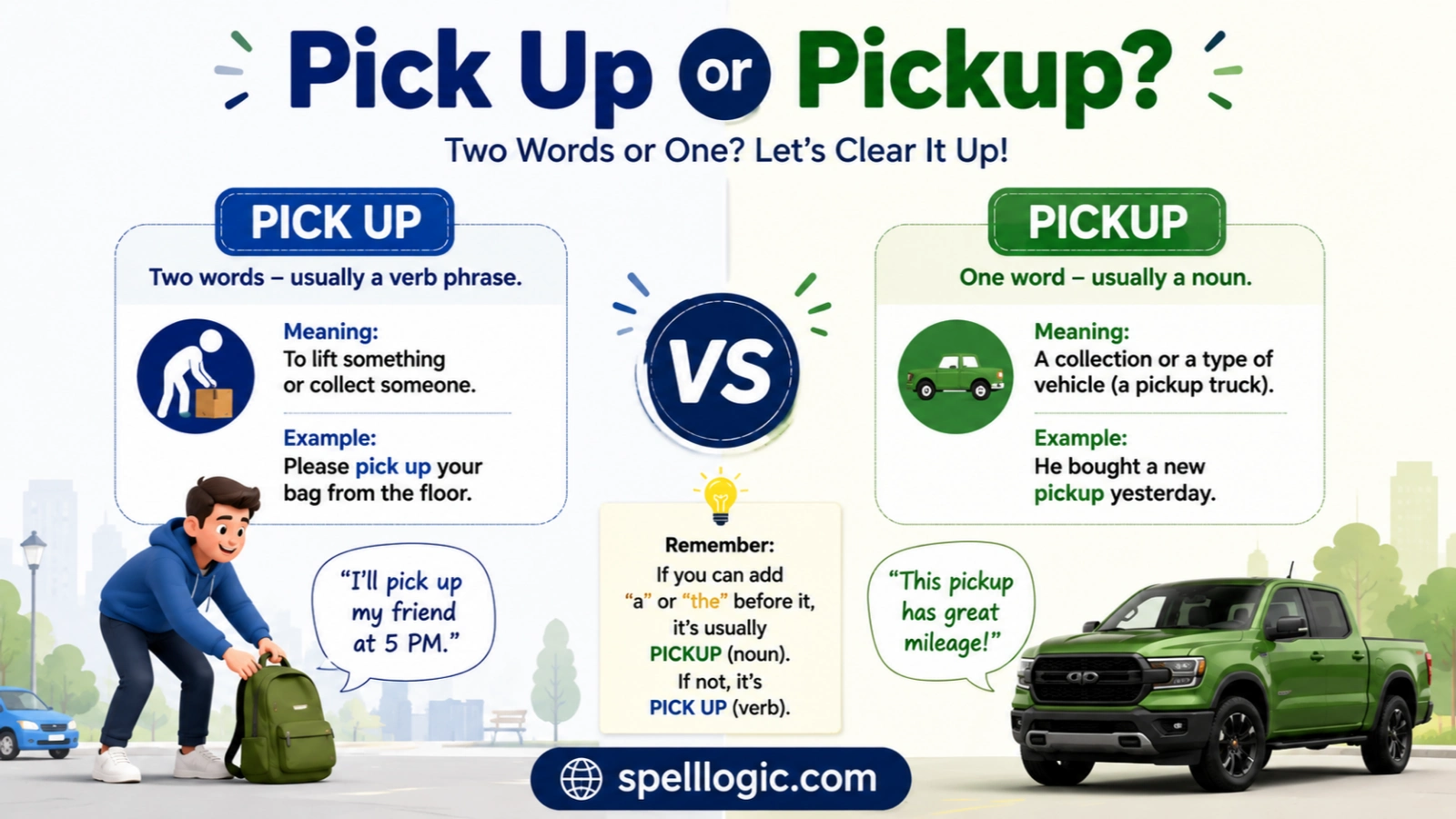
English learners often wonder whether pick up or pickup is the correct form because the two expressions look almost identical and sound the same. The confusion becomes stronger because English uses both forms, but they do not always work in the same grammatical position.
One form is commonly used as a verb or phrasal verb, while the other is usually a noun or adjective. Understanding this small difference can make your writing clearer and more natural. Whether you are talking about collecting something, giving someone a ride, or describing a service, knowing when to separate the words and when to combine them is useful for everyday English.
Why “Pick Up” and “Pickup” Are Confusing
Many learners mix up pick up or pickup because the pronunciation is normally identical. When people hear the expression in conversation, they cannot see whether the speaker intends a verb, noun, or adjective. The difference becomes clear only when the expression appears in writing.
Similar pronunciation
Both forms are generally pronounced in the same way. For example, in the sentence “I will pick up the package,” the two words sound like one natural phrase.
This similarity makes spelling mistakes easy to make, especially when writing quickly.
Similar spelling
The only visible difference is the space. Pick up contains two separate words, whereas pickup is written as one word. Because the meaning can be closely related, learners may assume that either spelling can be used everywhere.
Context confusion
Grammar usually tells you which form you need. When the expression describes an action, the two-word form is normally appropriate. When it names a thing, service, event, or type of vehicle, the one-word form is often used.
For example:
- “Please pick up your coat.” — action
- “The pickup is at 6 p.m.” — noun
Common learner mistakes
A common error is writing the noun as two words or writing the verb as one word. Learners may write “The pickup your brother” when they need the verb phrase “pick up your brother.”
The key is to look at the job the expression performs in the sentence, not just its meaning.
Pick Up vs Pickup Explained Simply
The basic distinction is simple:
Pick up is generally a verb or phrasal verb meaning to collect, lift, learn, improve, or obtain something. Pickup is generally a noun or adjective referring to a collection, a vehicle, a service, or something associated with collecting.
In other words, pick up or pickup depends mainly on grammar and sentence structure.
One-line distinction
Pick up usually describes an action, while pickup usually names a thing, event, service, or type of vehicle.
Two example sentences
- “I need to pick up my package after work.”
- “The store offers free pickup for online orders.”
The first sentence describes an action. The second sentence uses a noun to name a service.
Understanding Homophones in English
Although pick up or pickup is often discussed alongside pronunciation-based spelling confusion, these forms are not true homophones in the traditional grammatical sense. They are different written forms that share pronunciation and are closely related in meaning.
What Are Homophones?
Homophones are words that sound the same but have different meanings, spellings, or both. A classic example is two and too. Both sound alike, but they have different meanings and grammatical uses.
The confusion surrounding pick up or pickup is slightly different because the forms come from the same expression and are created through a change in word formation.
Why Homophones Cause Confusion
English learners often rely on pronunciation when spelling unfamiliar words. If two forms sound identical, it can be difficult to know whether they should be written separately or together.
For example, hearing “pickup service” gives no audible clue that pickup is functioning as a noun.
What Does “Pick Up” Mean?
Definition and Core Meaning
Pick up is a phrasal verb with several meanings. Its exact meaning depends on context. The most common meaning is to lift something from a surface or collect someone or something from a particular place.
For example:
- “Please pick up the book from the floor.”
- “I will pick up Sarah at eight.”
- “Can you pick up some milk on your way home?”
The phrase also has several figurative meanings.
Origin and Historical Use
The verb pick has been used in English for centuries with meanings connected to selecting, gathering, or removing something. The addition of up gradually created the phrasal verb with meanings involving lifting, collecting, recovering, or acquiring.
Phrasal verbs are especially common in everyday English. As a result, pick up is widely used in informal conversations, instructions, travel situations, and workplace communication.
Modern Usage and Synonyms
Depending on the context, possible synonyms include:
- collect
- lift
- gather
- retrieve
- acquire
- learn
- improve
- recover
However, these alternatives are not always interchangeable. For example, “pick up a language” can mean learn a language informally, while “collect a language” does not have the same natural meaning.
Common meanings include:
- Lift: “Pick up the box carefully.”
- Collect: “I will pick up the documents tomorrow.”
- Give someone a ride: “Can you pick me up at the station?”
- Learn: “She picked up some useful Spanish while traveling.”
- Improve: “Business has started to pick up.”
- Notice or detect: “The microphone picked up a strange sound.”
The correct form in these examples is pick up because it functions as a verb.
What Does “Pickup” Mean?
Definition and Core Meaning
Pickup is usually a noun. It can refer to the act or arrangement of collecting someone or something, a service that allows customers to collect purchases, or a pickup truck.
For example:
- “Your pickup is scheduled for Friday.”
- “The restaurant offers curbside pickup.”
- “He drives a pickup.”
It can also function as an adjective before another noun.
Origin and Historical Context
English often turns frequently used phrases into compound nouns over time. The noun pickup developed from the verb phrase pick up, eventually becoming established as a single written word in several contexts.
This process is common in English. Expressions that become familiar combinations may develop into compound nouns, especially when they describe a regular activity, object, or service.
Modern Usage and Synonyms
Modern uses of pickup include:
- Collection: “The pickup is ready.”
- Collection service: “We offer store pickup.”
- Pickup truck: “He bought a new pickup.”
- An improvement: “There was a pickup in sales.”
- An informal social encounter: In some contexts, “pickup” can refer to casual romantic approaches or related activities.
Depending on the meaning, related terms may include:
- collection
- retrieval
- truck
- improvement
- service
The exact synonym depends on the context.
A useful test is to replace the word with a noun such as “collection” or “service.” If the sentence still makes sense, pickup may be the correct choice.
Pick Up vs Pickup: Key Differences at a Glance
| Word | Part of Speech | Meaning | Example Context |
|---|---|---|---|
| Pick up | Verb / phrasal verb | To lift, collect, obtain, learn, or improve | “I will pick up the parcel.” |
| Pickup | Noun | A collection, collection service, vehicle, or improvement | “The pickup is scheduled for noon.” |
| Pickup | Adjective | Related to a collection arrangement or pickup vehicle | “Use the pickup counter.” |
The most important difference between pick up or pickup is grammatical function. If you are describing something someone does, the two-word form is normally required. If you are naming something, the one-word form is often appropriate.
How to Remember the Difference Between Pick Up and Pickup
Learning pick up or pickup becomes easier when you connect the spelling with grammar.
Easy memory tricks
Think “action = space.”
When someone is doing the action, use pick up as two words.
- “I will pick up the children.”
- “Please pick up the phone.”
Think “thing = one word.”
When the expression names a thing, service, or event, use pickup.
- “The pickup is at noon.”
- “We selected store pickup.”
Association techniques
Ask yourself one simple question:
Am I describing an action or naming something?
If you are describing an action, choose the separated form. If you are naming a service, event, object, or vehicle, the combined form is usually better.
One memorable example
Remember this pair:
“I will pick up the order.”
“The order is ready for pickup.”
The first sentence tells us what someone will do. The second names the collection arrangement.
This simple contrast is one of the easiest ways to remember pick up or pickup.
Common Mistakes and Confusions
Learners often make mistakes because the two forms sound identical.
Wrong example 1
✘ “I will pickup my sister at the airport.”
Correct version
✔ “I will pick up my sister at the airport.”
Here, the expression is a verb because it describes an action.
Wrong example 2
✘ “The store offers free pick up.”
Correct version
✔ “The store offers free pickup.”
Here, pickup is a noun describing a service.
Wrong example 3
✘ “The pickup your package before five.”
Correct version
✔ “Please pick up your package before five.”
The sentence needs a verb, so the two-word form is required.
Wrong example 4
✘ “We chose store pick up.”
Correct version
✔ “We chose store pickup.”
In this sentence, the expression names a collection option, so the compound noun is appropriate.
One important point is that usage can vary in specific style guides and regional contexts. However, the action-versus-noun distinction is a reliable rule for everyday standard English.
Examples Section: Correct and Incorrect Usage
Example 1
✔ Correct: “Can you pick up some bread?”
✘ Incorrect: “Can you pickup some bread?”
Explanation: The phrase describes an action performed by the person, so use the phrasal verb.
Example 2
✔ Correct: “The bakery offers curbside pickup.”
✘ Incorrect: “The bakery offers curbside pick up.”
Explanation: Here, the expression names a service, so the noun form is appropriate.
Example 3
✔ Correct: “I need to pick up my prescription.”
✘ Incorrect: “I need to pickup my prescription.”
Explanation: The phrase follows “need to” and functions as a verb.
Example 4
✔ Correct: “Your order is ready for pickup.”
✘ Incorrect: “Your order is ready for pick up.”
Explanation: The word names the process or arrangement for collecting an order.
Example 5
✔ Correct: “He drives a pickup.”
✘ Incorrect: “He drives a pick up.”
Explanation: In this context, pickup is a noun referring to a pickup truck.
Example 6
✔ Correct: “Sales should pick up next month.”
✘ Incorrect: “Sales should pickup next month.”
Explanation: Here, the phrase means that sales should improve, so it functions as a verb.
Self Assessment: Test Your Knowledge
Fill in each blank with pick up or pickup.
- I need to ______ my friend from the airport.
- The shop provides free curbside ______.
- Please ______ your clothes from the floor.
- Our order is ready for ______ after 5 p.m.
Self Assessment Answers
- pick up — It describes the action of collecting a person.
- pickup — It names a collection service.
- pick up — It describes the action of lifting or collecting something.
- pickup — It refers to the collection arrangement.
These examples show why grammar is more useful than pronunciation when choosing between pick up or pickup.
FAQs About “Pick Up and Pickup”
1. Is “pick up” or “pickup” correct?
Both forms are correct, but they have different grammatical functions. Pick up is generally a verb, while pickup is generally a noun or adjective.
2. Is pickup one word or two words?
When it is used as a noun, pickup is normally written as one word. For example, “The store offers free pickup.”
3. Is “pick up” a phrasal verb?
Yes. Pick up is a common phrasal verb. It can mean to lift, collect, obtain, learn, improve, or give someone a ride, depending on context.
4. Should I write “pick up service” or “pickup service”?
Pickup service is the standard compound form when the phrase functions as a noun modifier. For example, “The company offers a pickup service.”
5. Is “pickup” a noun or verb?
Pickup is commonly a noun. The verb is written as two words: pick up. For example, “I will pick up the package.”
6. What is the difference between “pick up” and “pickup truck”?
Pick up is a verb, while pickup truck is a noun phrase referring to a type of vehicle. The vehicle name uses pickup as one word.
7. How can I quickly remember the correct form?
Think about the sentence’s grammar. If someone is doing the action, use pick up. If you are naming a service, thing, event, or vehicle, use pickup.
Final Conclusion: Using Pick Up and Pickup Correctly
Understanding pick up or pickup is mainly a matter of recognizing how the expression functions in a sentence. Pick up is normally used as a phrasal verb. It can mean lifting something, collecting a person or object, learning something informally, noticing something, or improving. For example, you might pick up a package, pick up a friend, or notice that business is starting to pick up.
Pickup, on the other hand, is generally a noun or adjective. It can describe a collection service, a collection arrangement, a pickup truck, or an improvement in a situation. The easiest memory trick is “action = two words, thing or service = one word.” When you are writing, do not rely only on pronunciation because both forms sound alike. Instead, look at the grammatical role of the expression. With regular practice and attention to context, choosing the correct form will become natural. Keep learning these small but important differences, because mastering them can make your English writing clearer, more accurate, and more confident.