English learners often become confused by mismatch or mix match because the two expressions look and sound closely related. However, they do not function in the same way, and one form is usually written as a single word while the other is normally part of a different expression. Understanding this distinction can help you write more naturally and avoid common spelling and usage errors.
The confusion becomes especially common when describing clothes, colors, ideas, or things that do not go well together. In this guide, you will learn the meanings, origins, grammatical roles, correct examples, common mistakes, and simple memory tricks that make the difference easy to remember.
Why “Mismatch or Mix Match” Are Confusing
The confusion surrounding mismatch or mix match comes mainly from similar sounds, related ideas, and the fact that English frequently combines words in different ways.
Similar pronunciation
“Mismatch” is pronounced roughly like mis-match. The words “mix” and “match” also naturally appear close together when people talk about combining different things. Because of this, learners may hear a phrase and write it as “mix match.”
Similar spelling
Both forms contain words associated with combining or comparing things. This visual similarity can make the incorrect form seem reasonable, especially to learners who are still developing English vocabulary.
Context confusion
People often use these expressions when discussing clothes, colors, furniture, designs, or ideas. For example, a shirt and trousers can mismatch, while a person may deliberately mix and match different clothes.
Common learner mistakes
A frequent error is writing “mix match” when the intended meaning is “not matching.” Another mistake is confusing mismatch with the correct expression mix and match.
The key is to identify whether you mean a lack of agreement or compatibility or the deliberate combination of different items.
Mismatch or Mix Match Explained Simply
Here is the easiest way to understand mismatch or mix match:
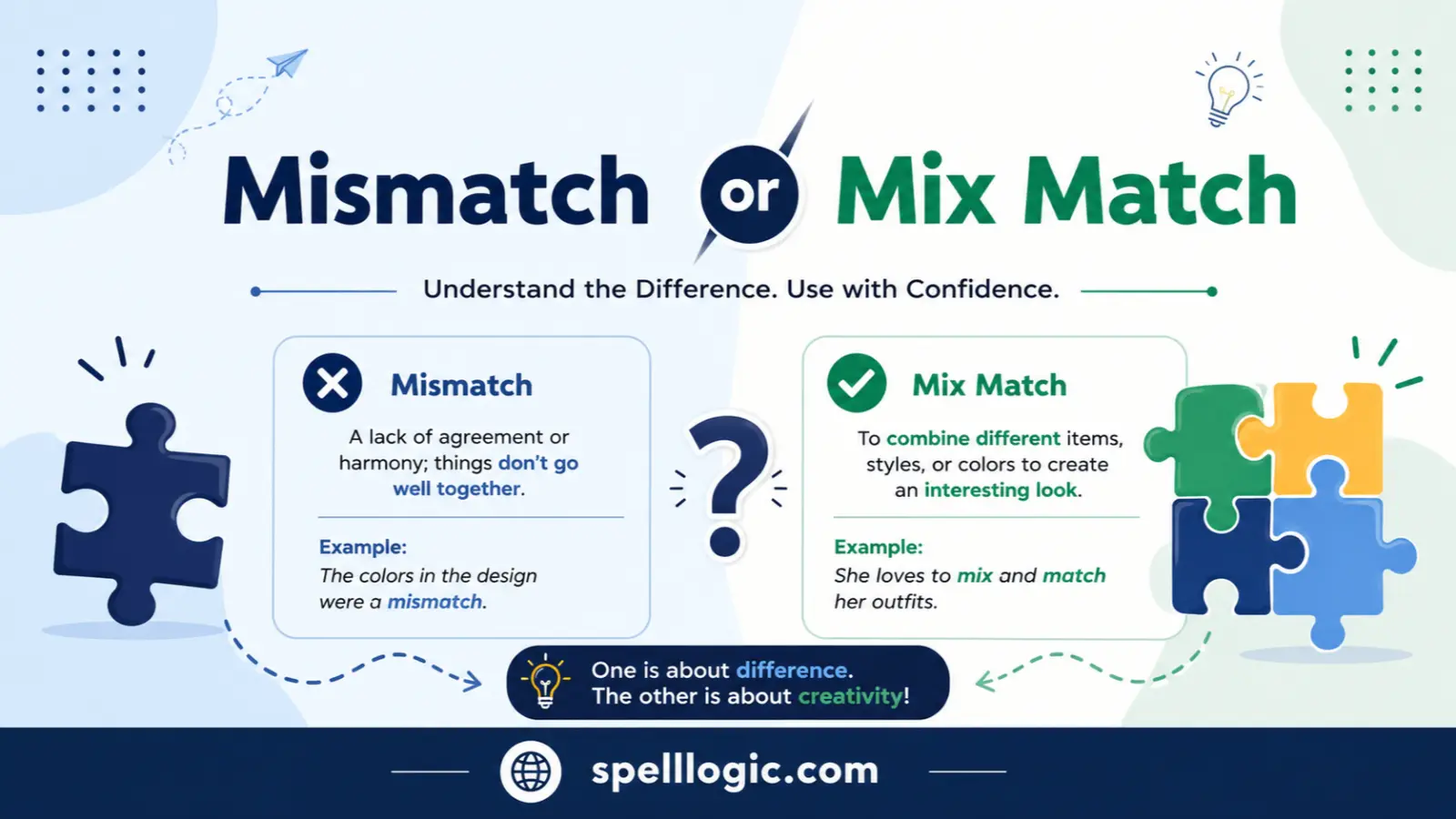
- Mismatch is a standard English word meaning that two or more things do not match, agree, or work well together.
- Mix match by itself is generally not the standard expression intended when describing things that do not match.
- The common expression for deliberately combining different things is mix and match.
One-line distinction: Mismatch describes things that do not match, while mix and match means choosing and combining different things.
Examples
- There is a mismatch between the two colors.
- You can mix and match these shirts with different trousers.
So, mismatch or mix match is not simply a choice between two interchangeable spellings. The intended meaning determines the appropriate form.
Understanding Homophones in English
What Are Homophones?
Homophones are words that sound the same or very similar but have different meanings, spellings, or grammatical functions. For example, “right” and “write” sound alike but have different meanings.
The terms in mismatch or mix match are not true homophones. Instead, their similarity comes from pronunciation, spelling, and related contexts.
Why Homophones Cause Confusion
Sound can influence spelling. When learners hear a familiar sound without seeing the written form, they may choose a spelling that seems logical.
For example, someone may hear a sentence about clothes that do not match and mistakenly write “mix match” instead of mismatch. Learning the meaning and grammatical role of each expression helps prevent this problem.
What Does “Mismatch” Mean?
Definition and Core Meaning
Mismatch is a noun and a verb. It refers to a situation in which two or more things do not correspond, agree, fit, or look suitable together.
As a noun, it means an unsuitable or unsuccessful combination.
- There is a mismatch between the colors.
- The interview revealed a mismatch between the candidate’s skills and the job.
- The shoes were a mismatch with the formal outfit.
As a verb, “mismatch” means to combine things that do not match or to pair unsuitable things.
- The designer mismatched the patterns intentionally.
- The system mismatched the records.
- The socks were mismatched.
Origin and Historical Use
“Mismatch” developed from the prefix mis-, meaning wrongly, badly, or incorrectly, and the word match, meaning to correspond or pair successfully. The combination therefore carries the basic idea of an incorrect or unsuitable match.
English has long used mis- to form words describing something done incorrectly or unsuccessfully. Examples include misunderstand, misplace, and miscalculate.
Modern Usage and Synonyms
Today, “mismatch” is common in everyday and professional English.
Depending on the context, useful synonyms include:
- incompatibility
- discrepancy
- inconsistency
- imbalance
- poor fit
- unsuitable combination
- disagreement
The best synonym depends on the situation. For clothing, poor combination may work, while in business, incompatibility or discrepancy may be more appropriate.
Common Uses of “Mismatch”
- Color mismatch: colors do not work well together.
- Size mismatch: something is too large or too small for another item.
- Skills mismatch: a person’s abilities do not meet a job’s requirements.
- Data mismatch: two sets of information do not agree.
- Style mismatch: two styles are unsuitable together.
- Expectation mismatch: reality differs from what someone expected.
Example Sentences
- The jacket and trousers create a noticeable mismatch.
- There is a mismatch between the two reports.
- The company discovered a skills mismatch.
- The software detected a data mismatch.
- Their expectations were a mismatch from the beginning.
What Does “Mix Match” Mean?
Definition and Core Meaning
The important point about mismatch or mix match is that “mix match” is generally not the standard standalone expression used in English for either of the meanings learners usually intend.
When the meaning is deliberately combining different items, the natural expression is “mix and match.”
“Mix” means to combine things, while “match” means to select things that work well together. Therefore, mix and match means to combine different choices, often freely or creatively.
- You can mix and match colors.
- Customers can mix and match different styles.
- I like to mix and match accessories.
When the meaning is that things do not correspond or fit together, use mismatch.
Origin and Historical Context
The verb mix has a long history in English and refers to combining substances, ideas, people, or other things. Match has also been used for centuries to describe things that correspond or belong together.
The expression mix and match developed naturally from these two ideas. It emphasizes selecting different items and combining them according to preference.
Modern Usage and Synonyms
Modern English commonly uses mix and match in shopping, fashion, design, food, technology, and everyday conversation.
Possible alternatives include:
- combine
- coordinate
- pair
- combine freely
- choose different combinations
- put together
However, these alternatives do not always carry exactly the same meaning.
Example Sentences
- You can mix and match the pieces to create different outfits.
- The website lets customers mix and match colors.
- We decided to mix and match several design styles.
- She likes to mix and match modern and traditional furniture.
- The teacher allowed students to mix and match the activities.
Mismatch or Mix Match: Key Differences at a Glance
The main distinction in mismatch or mix match becomes clearer when the words are compared directly.
| Word | Part of Speech | Meaning | Example Context |
|---|---|---|---|
| Mismatch | Noun / Verb | A lack of agreement, suitability, or correspondence | There is a mismatch between the colors. |
| Mix | Verb / Noun | To combine different things | Mix the ingredients together. |
| Match | Verb / Noun | To correspond, pair, or be suitable | These shoes match the dress. |
| Mix and match | Verb phrase | To combine different items or choices | Mix and match the available styles. |
Therefore, mismatch or mix match should not be treated as two interchangeable spellings. Use mismatch for incompatibility and mix and match for deliberate combination.
How to Remember the Difference Between Mismatch and Mix Match
A few simple memory tricks can make this distinction much easier.
Memory Trick 1: “Mis” Means Wrong
Think about the prefix mis-. It often suggests something wrong or incorrect.
- misplace = place incorrectly
- misunderstand = understand incorrectly
- mismatch = fail to match
So, when things do not match, remember mismatch.
Memory Trick 2: “Mix and Match” Has Three Words
If you mean choosing different things and combining them, remember the complete expression:
Mix + and + match
Do not remove and in standard usage.
Memory Trick 3: Think About Intention
Ask yourself:
“Are these things failing to match, or am I deliberately combining different choices?”
If they fail to match, use mismatch.
If you deliberately combine choices, use mix and match.
One Memorable Example
The colors are a mismatch, but you can mix and match different colors to create a new outfit.
This single sentence shows both meanings clearly.
Common Mistakes and Confusions
Learners often make mistakes because they treat mismatch or mix match as if both were standard alternatives.
Mistake 1: Using “mix match” for a poor combination
Wrong: There is a mix match between the colors.
Correct: There is a mismatch between the colors.
Explanation: “Mismatch” is the noun that describes an unsuitable combination.
Mistake 2: Removing “and” from “mix and match”
Wrong: You can mix match these clothes.
Correct: You can mix and match these clothes.
Explanation: The established expression includes and.
Mistake 3: Confusing “mismatch” with “mix and match”
Wrong: I mismatch different shirts to create new outfits.
Better: I mix and match different shirts to create new outfits.
Explanation: The speaker is deliberately combining choices, so “mix and match” is more natural.
Mistake 4: Using “mismatch” when the combination is intentional
Wrong: I mismatch these accessories every morning.
Better: I mix and match these accessories every morning.
Explanation: Deliberate selection and combination call for “mix and match.”
Examples Section: Correct and Incorrect Usage
Example 1
✔ Correct: There is a mismatch between the two records.
✘ Incorrect: There is a mix match between the two records.
The first sentence correctly describes information that does not agree.
Example 2
✔ Correct: You can mix and match the available colors.
✘ Incorrect: You can mix match the available colors.
The phrase requires and between “mix” and “match.”
Example 3
✔ Correct: His skills are a mismatch for the position.
✘ Incorrect: His skills are a mix match for the position.
The sentence describes an unsuitable relationship, so mismatch is appropriate.
Example 4
✔ Correct: She likes to mix and match different accessories.
✘ Incorrect: She likes to mismatch different accessories.
The speaker is intentionally combining different accessories, so mix and match is the natural choice.
Example 5
✔ Correct: The software found a mismatch in the data.
✘ Incorrect: The software found a mix match in the data.
A disagreement between data sets is a mismatch.
Example 6
✔ Correct: We can mix and match the furniture pieces.
✘ Incorrect: We can mix match the furniture pieces.
Again, the standard phrase for combining choices is mix and match.
Self Assessment: Test Your Knowledge
Fill in each blank with mismatch, mix and match, or the appropriate form.
- There is a ________ between the two sets of figures.
- You can ________ the colors to create a different look.
- The shoes are a complete ________ with the formal suit.
- Customers may ________ different options before buying.
Self Assessment Answers
- mismatch — The figures do not agree.
- mix and match — The colors are being deliberately combined.
- mismatch — The shoes and suit are unsuitable together.
- mix and match — Customers are combining different choices.
FAQs About Mismatch and Mix Match
1. Is “mismatch” one word?
Yes. Mismatch is normally written as one word when it functions as a noun or verb.
2. Is “mix match” correct English?
Usually, no, when used alone to mean either an unsuitable combination or deliberate combination. The standard forms are mismatch and mix and match, depending on the intended meaning.
3. What is the difference between mismatch and mix and match?
Mismatch means that things do not correspond, fit, or work well together. Mix and match means deliberately combining different choices.
4. Should I write “mix-match”?
In ordinary modern English, mix and match is the standard expression. “Mix-match” is not normally the form learners should use in standard writing.
5. Can “mismatch” be a verb?
Yes. “Mismatch” can function as a verb meaning to pair things incorrectly or make them unsuitable together.
6. What is an example of mismatch?
There is a mismatch between the customer’s expectations and the actual service.
7. What is an example of mix and match?
You can mix and match these pieces to create several different outfits.
Final Conclusion: Using Mismatch and Mix Match Correctly
Understanding mismatch or mix match becomes simple once you focus on the meaning rather than the sound. Mismatch is a standard English word used when two or more things do not match, fit, agree, or work well together. It can describe clothing, colors, information, skills, expectations, sizes, and many other relationships. On the other hand, when you mean deliberately combining different choices, the natural expression is mix and match, not “mix match.” Remember the helpful clue: mis- often suggests something wrong, so mismatch describes a failure to match.
Meanwhile, mix and match contains the word and because it describes two actions working together—mixing different choices and matching them into combinations. Once you connect each expression with its meaning, the distinction becomes much easier to use in everyday conversation and formal writing. Keep practicing with real examples, and soon you will recognize the correct form automatically. Learning small differences like this can make your English more accurate, natural, and confident.

Naveed Ahmed is a Master’s graduate, content writer, and contributor at SpellLogic.com. He specializes in spelling, grammar, and English language content, helping readers improve their writing with clear and accurate guidance. His goal is to make language learning simple, practical, and accessible for students, writers, and professionals.