English learners often wonder whether pricey or pricy is the correct spelling when describing something that costs a lot of money. The confusion is understandable because both forms look almost identical and have exactly the same pronunciation. In fact, both spellings are recognized in English, but one is much more common in modern writing.
Understanding the difference can help you choose the form that sounds natural and professional in emails, articles, conversations, and everyday writing. This guide explains the meaning, spelling, usage, history, and common mistakes surrounding these two forms so you can use them confidently.
Why “Pricey or Pricy” Are Confusing
The forms pricey or pricy confuse writers because they have the same pronunciation and nearly the same spelling. More importantly, they have the same basic meaning: something that is expensive or costs more than expected.
Similar pronunciation
Both forms are pronounced approximately “PRY-see.” There is no meaningful pronunciation difference between them in standard English.
For example:
- “That restaurant is pricey.”
- “That restaurant is pricy.”
The sentences sound the same when spoken.
Similar spelling
The only visible difference is the letter e:
- pricey = p-r-i-c-e-y
- pricy = p-r-i-c-y
Because the noun price already contains an e, many writers naturally keep it when adding -y.
Context confusion
Both forms can describe restaurants, hotels, clothes, cars, services, products, vacations, or anything else that costs a relatively large amount of money.
For instance, pricey or pricy can describe a hotel room that costs more than you expected.
Common learner mistakes
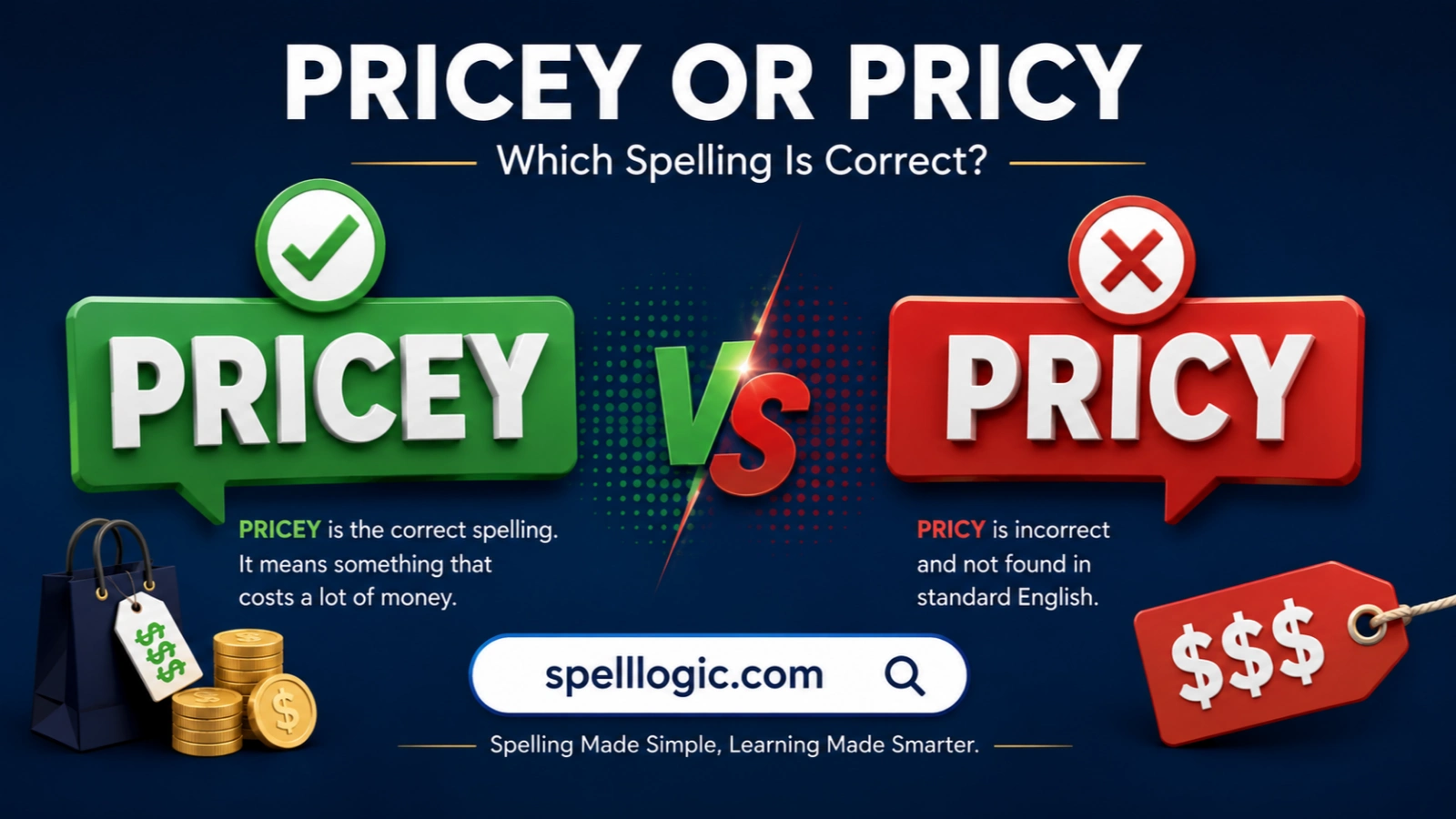
A common mistake is assuming that one spelling is completely wrong. That is not the case. Pricey is the more common and generally safer choice, while pricy is also an accepted spelling, especially in some dictionaries and varieties of English.
Pricey vs Pricy Explained Simply
The easiest way to understand pricey or pricy is to remember that they are spelling variants rather than words with different meanings.
One-line distinction: Pricey and pricy both mean “expensive,” but pricey is the more widely used spelling.
Two examples:
- “The hotel was pricey, but the service was excellent.”
- “That new laptop is quite pricy.”
In other words, pricey or pricy means that something has a high price or costs more than you would normally expect.
If you are choosing one form for general writing, pricey is usually the best option because it is more familiar to most readers.
Understanding Homophones in English
What Are Homophones?
Homophones are words that have the same pronunciation but different meanings or spellings.
For example, “flower” and “flour” sound the same, but they have completely different meanings.
The pair pricey or pricy is slightly different. Although both forms sound the same, they also have essentially the same meaning. Therefore, they are better described as spelling variants, not traditional homophones.
Why Homophones Cause Confusion
Homophones can be difficult because spoken English does not always show spelling differences. A listener may understand the meaning from context but still be unsure which spelling to use.
With pricey or pricy, the problem is mainly written rather than spoken because there is no difference in pronunciation or meaning.
What Does “Pricey” Mean?
Definition and Core Meaning
Pricey is an adjective meaning expensive or relatively costly. It is often used when something costs more money than a person considers reasonable, affordable, or expected.
For example:
- “The tickets were pricey.”
- “That coffee shop is a little pricey.”
- “We found a beautiful but pricey apartment.”
The word often has a slightly informal or conversational tone.
Origin and Historical Use
Pricey developed from the noun price with the adjective-forming suffix -y. The suffix -y is commonly used in English to create adjectives suggesting that something has a particular quality.
For example:
- cloud → cloudy
- taste → tasty
- noise → noisy
- price → pricey
Over time, pricey became an established informal adjective for something expensive.
Modern Usage and Synonyms
Today, pricey is common in everyday speech, online writing, reviews, journalism, and informal communication. It is especially useful when you want to say that something is expensive without using the more direct word expensive.
Useful synonyms include:
- expensive
- costly
- high-priced
- dear
- overpriced
- extravagant
However, these synonyms are not always exact replacements. Overpriced, for example, suggests that the speaker thinks something costs more than it is worth.
Example Sentences
- “The new smartphone is quite pricey.”
- “Eating at that restaurant can be pricey.”
- “She bought a pricey designer handbag.”
- “The concert tickets were too pricey for me.”
- “Living in the city center is often pricey.”
What Does “Pricy” Mean?
Definition and Core Meaning
Pricy is also an adjective meaning expensive or costing a lot of money. In practical terms, its meaning is the same as pricey.
For example:
- “The hotel was pricy.”
- “That car is too pricy for my budget.”
- “The repairs turned out to be pricy.”
Although pricy is valid, many readers are more accustomed to seeing pricey.
Origin and Historical Context
Pricy developed as a shorter spelling of the same adjective formed from price. English spelling often develops alternative forms when speakers and writers try to simplify words or regularize their spelling.
The form pricy removes the e before adding -y, producing a shorter spelling.
Modern Usage and Synonyms
In modern English, pricy can appear in dictionaries, websites, reviews, newspapers, and informal writing. However, its frequency is generally lower than pricey.
Useful synonyms include:
- expensive
- costly
- high-priced
- expensive-looking
- extravagant
Example Sentences
- “The new restaurant is rather pricy.”
- “That jacket is too pricy for me.”
- “We stayed at a pricy hotel near the beach.”
- “The repair was surprisingly pricy.”
- “Some organic products can be pricy.”
The important point is that pricey or pricy does not describe two different levels of cost. Both forms communicate the idea of something being expensive.
Pricey vs Pricy: Key Differences at a Glance
| Word | Part of Speech | Meaning | Example Context |
|---|---|---|---|
| Pricey | Adjective | Expensive or relatively costly | “The restaurant is pricey.” |
| Pricy | Adjective | Expensive or relatively costly | “The restaurant is pricy.” |
The main difference is spelling and usage frequency, not meaning. When deciding between pricey or pricy, remember that pricey is generally the more familiar choice.
Neither spelling changes the grammatical role of the word. Both are adjectives and can appear before a noun or after a linking verb.
Before a noun:
“It’s a pricey hotel.”
After a linking verb:
“The hotel is pricey.”
The same structures work with pricy.
How to Remember the Difference Between Pricey and Pricy
Remembering pricey or pricy is easy if you connect the preferred spelling with the word price.
Easy memory tricks
Think:
price + y = pricey
The word price already has an e, so keeping that e gives you the familiar spelling pricey.
Association techniques
You can use this simple association:
PRICE has an E, so PRICEY keeps the E.
This is not a rule that makes pricy incorrect, but it helps you remember the spelling most commonly encountered in everyday English.
One memorable example
Imagine seeing an expensive restaurant and saying:
“The pricey restaurant has excellent food.”
Connect price with pricey, and the spelling becomes easier to remember.
When choosing between pricey or pricy, use pricey when you want the spelling that is more familiar to a broad English-speaking audience.
Common Mistakes and Confusions
One common error is treating pricy as a spelling mistake. Although pricey is more common, pricy is also an established variant.
Wrong assumption
✘ “Pricy is always incorrect.”
Better understanding
✔ “Pricy is an accepted spelling, but pricey is more common.”
Another mistake is believing that the two spellings have different meanings.
✘ “Pricey means very expensive, while pricy means slightly expensive.”
✔ Both words can describe something expensive. The spelling does not create a different price level.
A third mistake is using pricey when a formal word such as expensive would be more appropriate.
For example:
- Informal: “The hotel is pricey.”
- More neutral: “The hotel is expensive.”
- Formal: “The accommodation is relatively costly.”
Therefore, choosing between pricey or pricy is only one part of good word choice. You should also consider the tone and audience.
Examples Section: Correct and Incorrect Usage
Example 1
✔ Correct: “That restaurant is pricey.”
✘ Incorrect: “That restaurant is priceey.”
Explanation: The standard spelling is pricey, not “priceey.”
Example 2
✔ Correct: “The new car is pricy.”
✘ Incorrect: “The new car is pricyer.”
Explanation: Pricy is an adjective, but its comparative form is normally pricier, not “pricyer.”
Example 3
✔ Correct: “The hotel was quite pricey.”
✘ Incorrect: “The hotel was quite price.”
Explanation: Price is a noun, while pricey is an adjective.
Example 4
✔ Correct: “Those shoes are too pricey for my budget.”
✘ Incorrect: “Those shoes are too price for my budget.”
Explanation: The adjective pricey is needed after the linking verb are.
Example 5
✔ Correct: “The repairs were unexpectedly pricy.”
✘ Incorrect: “The repairs were unexpectedly expensivey.”
Explanation: Pricy and pricey are adjectives meaning expensive. “Expensivey” is not a standard English word.
These examples show why understanding pricey or pricy is useful when writing about prices, shopping, travel, restaurants, and services.
Self Assessment: Test Your Knowledge
Fill in each blank with pricey or pricy.
- The new apartment is quite ________, but it has a great location.
- Those concert tickets are too ________ for my budget.
- We stayed at a ________ hotel during our vacation.
- The restaurant looked affordable, but the menu was surprisingly ________.
Self Assessment Answers
- pricey — This is the more common spelling.
- pricey or pricy — Both forms are correct.
- pricey or pricy — Both forms can describe an expensive hotel.
- pricey or pricy — Both forms mean expensive.
For general-purpose writing, pricey is usually the safest and most familiar option.
FAQs
1. Is “pricey” or “pricy” correct?
Both are correct spellings. Pricey is more common, while pricy is an accepted variant.
2. Is pricy a real word?
Yes. Pricy is a recognized English adjective meaning expensive or relatively costly.
3. Which spelling is more common?
Pricey is generally more common and more familiar to English readers.
4. Do pricey and pricy have different meanings?
No. Pricey and pricy have essentially the same meaning. Both describe something that costs a lot of money.
5. Is pricey formal or informal?
Pricey is generally informal or conversational. In formal writing, expensive or costly may be a better choice depending on the context.
6. Can I use pricy in professional writing?
Yes, but pricey may look more familiar to many readers. For highly formal writing, consider expensive, costly, or high-priced.
7. How should English learners remember the spelling?
A useful trick is to connect price with pricey: price + y = pricey. This helps you remember the more common form.
Final Conclusion: Using “Pricey” and “Pricy” Correctly
Understanding pricey or pricy is simpler than it first appears because the two forms do not represent different meanings. Both are adjectives used to describe something that is expensive, costly, or higher in price than expected. The main distinction is spelling and frequency of use. Pricey is the more common and familiar spelling, making it the best choice for most everyday writing, online content, reviews, conversations, and general communication. Pricy is also an accepted variant, so seeing it in a dictionary, article, or advertisement does not mean that the writer has made a spelling error.
For English learners, the easiest memory trick is to connect price with pricey. Since price contains an e, remembering “price + y” can help you reproduce the more common spelling. At the same time, do not worry if you encounter pricy; it carries the same basic meaning. Finally, remember that pricey can sound informal, so words such as expensive or costly may work better in formal contexts. Once you understand these small differences, choosing the right form becomes easy. Keep noticing these spelling variations in real English, and your vocabulary and writing confidence will continue to grow.