English learners often wonder whether to say “each has” or “each have.” The confusion is understandable because each refers to more than one person or thing, so it can feel natural to use a plural verb. However, grammar follows a different rule here: each is grammatically singular when it is the subject of a sentence.
This means it normally takes has, not have, in the present tense. Learning this rule helps you write and speak more accurately, especially in formal English, academic writing, emails, and everyday conversation. Once you understand how “each” works, the choice becomes simple and predictable.
Why “each has or have” Is Confusing
The main reason learners confuse these forms is that each can refer to several people or things. Consider “Each student.” Although the noun students represents a group, the word each focuses on members one at a time. Therefore, the verb is singular.
The question “each has or have” is really a question about subject-verb agreement.
Similar pronunciation
The words has and have are both common forms of the verb to have. In fast speech, learners may focus on the meaning rather than the grammatical form. This can make the wrong choice sound acceptable.
Similar spelling
The two forms are closely related because they come from the same verb. However, their grammatical uses are different. Has is used with singular third-person subjects, while have is used with plural subjects and with I and you.
Context confusion
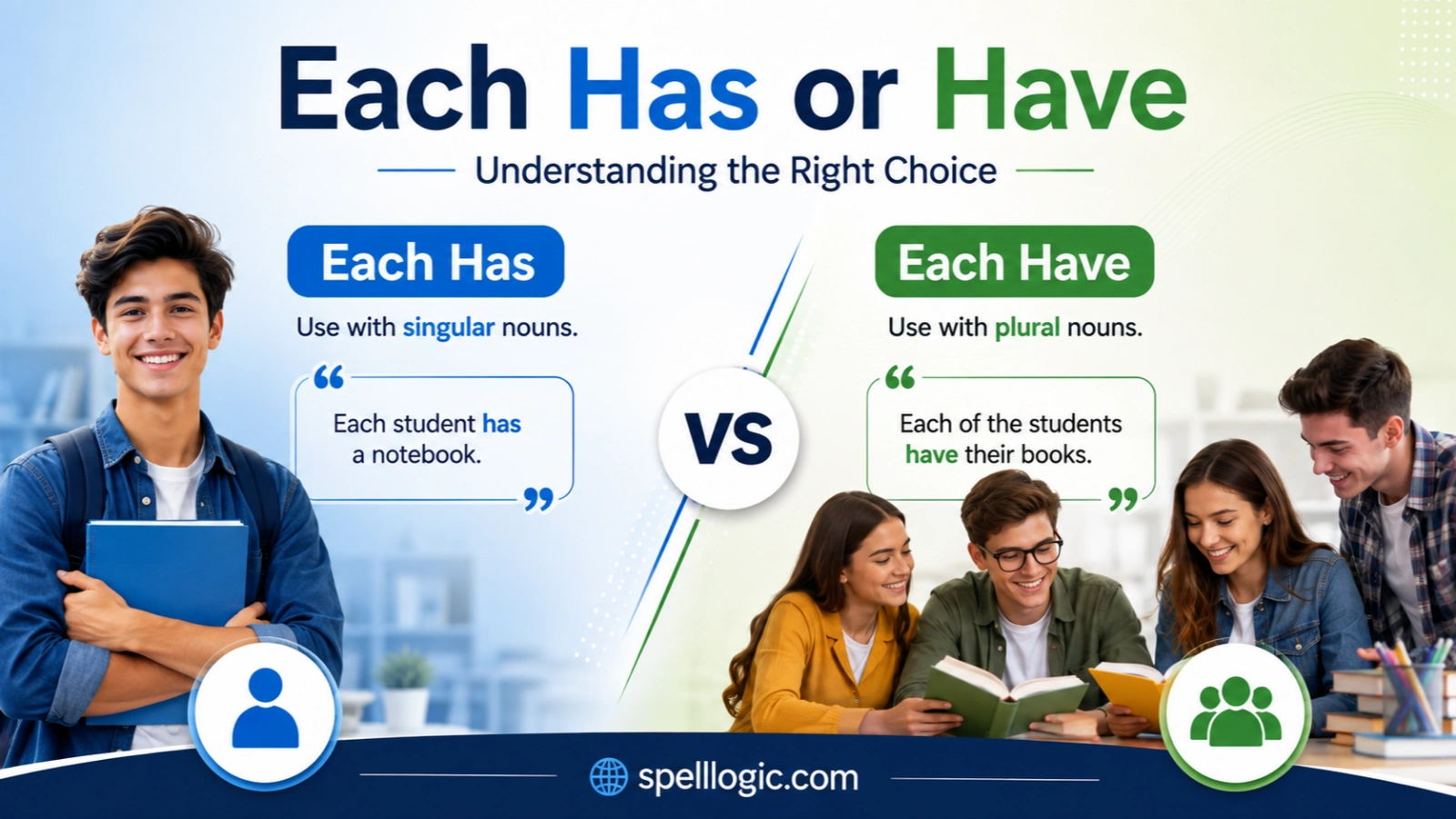
The noun after each can be plural, which often causes the confusion. For example, “Each of the players has a locker” contains the plural noun players, but the subject is each, so the verb is has.
When learners search for “each has or have,” the key is to identify the subject first.
Common learner mistakes
A common error is to look at the noun closest to the verb instead of identifying the true subject. Learners may write “Each of the employees have a badge” because employees is plural. The correct sentence is “Each of the employees has a badge.”
In the “each has or have” choice, the word closest to the verb is not always the subject.
each has or have Explained Simply
The basic rule is straightforward. When each is used as the subject, it is treated as singular. Therefore, use has in the present tense.
The “each has or have” distinction depends on whether each or another plural word is controlling the verb.
One-line distinction: “Each has” is normally grammatically correct when each is the subject; “each have” is normally incorrect in standard English in that structure.
- “Each has a different opinion.”
- “Each of the children has a lunchbox.”
In short, each has means that every individual person or thing in a group possesses, experiences, or contains something. The expression each have is generally not correct when each itself is the subject.
For the “each has or have” question, meaning alone does not determine the verb; grammar does.
Understanding Homophones in English
Although this topic involves a common grammar confusion, has and have are not homophones. They are different forms of the same verb. Still, understanding homophones can help learners recognize why sound alone is not always enough when learning English grammar.
What Are Homophones?
Homophones are words that sound the same but have different meanings, spellings, or both. For example, right and write sound alike but have different meanings and spellings.
Why Homophones Cause Confusion
When two words sound alike, learners may choose a form based on pronunciation rather than grammar. For example, someone might confuse there, their, and they’re because they sound similar. Grammar and sentence structure provide the clues needed to choose correctly.
What Does “each has or have” Mean?
Definition and Core Meaning
The expression each has is used when each is the singular subject and the verb has describes possession, experience, or a state.
For example, “Each has a ticket” means that every person in the group has an individual ticket.
The important point is that each emphasizes individuals separately. Even when the group contains many members, the grammar treats each member individually.
Origin and Historical Use
The word each has a long history in English and developed from older Germanic forms meaning “every one” or “each one.” Its individualizing meaning has remained stable over centuries. The verb has is the third-person singular present form of have, a very old and frequently used English verb.
Remember that the “each has or have” question becomes easier when you replace each with “every one.”
Modern Usage and Synonyms
In modern English, each has appears in everyday speech and writing, as well as academic, professional, and formal contexts.
Related expressions include:
- every one has
- each individual has
- every member has
- each person has
- each item has
Example Sentences
- Each has a unique identification number.
- Each student has a separate desk.
- Each team member has a specific responsibility.
- Each house has a small garden.
- Each answer has a different explanation.
Notice that the noun following each does not change the singular verb rule.
The “each has or have” rule is especially useful in formal English and academic writing.
What Does “each has or have” Mean?
Definition and Core Meaning
In standard English, each have is generally not used when each is the subject of a present-tense sentence. The problem is subject-verb agreement: each normally requires the singular verb has.
However, have can appear near each when another grammatical structure controls the verb. For example, “They each have a ticket” is correct. Here, they is the subject, and the plural subject takes have. The word each simply modifies the subject.
This distinction is extremely useful for learners:
- “Each has a ticket.” ✔
- “They each have a ticket.” ✔
Origin and Historical Context
Have comes from an old Germanic verb that has existed in English for centuries. In modern English, it serves as a main verb and an auxiliary verb. Its form changes according to the subject in the present tense: has is used with third-person singular subjects, while have is used with plural subjects and with I and you.
Modern Usage and Synonyms
When a plural subject comes before each, have can be completely correct.
Useful structures include:
- They each have
- We each have
- You each have
- The players each have
- The students each have
Example Sentences
- They each have a key.
- We each have a different goal.
- The players each have a locker.
- The teachers each have a copy.
- You each have an opportunity to improve.
The key is to identify the subject before choosing the verb.
The “each has or have” distinction also applies when a plural noun follows “of.”
each has or have: Key Differences at a Glance
| Word | Part of Speech | Meaning | Example Context |
|---|---|---|---|
| Each has | Pronoun + verb | Every individual possesses or experiences something | Each has a different role. |
| Each have | Usually incorrect as a subject-verb structure | Does not normally agree with singular each | Avoid: Each have a role. |
| They each have | Pronoun + adverb + verb | Every member of a plural subject possesses something | They each have a role. |
| We each have | Pronoun + adverb + verb | Every member of a group possesses something | We each have an assignment. |
The comparison shows that the issue is not simply about the word each. It is about identifying the grammatical subject.
How to Remember the Difference Between each has or have
A simple memory trick is:
Each = one at a time → has.
Imagine a teacher looking at students individually and saying, “Each student has a book.” The group may contain twenty students, but the sentence considers them one by one.
The question “each has or have” is common because English uses singular agreement with this distributive word.
Association technique
Connect each with every single one. If you can replace each with every one, use has:
- Each has a name.
- Every one has a name.
Another useful trick is to remember that they each have is different because they is the subject:
- Each has a book. ✔
- They each have a book. ✔
One memorable example
Think of five boxes. If you inspect them individually, you can say:
“Each has a label.”
But if you start with the boxes as a plural subject, say:
“They each have a label.”
The “each has or have” choice depends on sentence structure rather than the size of the group.
Common Mistakes and Confusions
Mistake 1: Following the plural noun
✘ “Each of the workers have a uniform.”
✔ “Each of the workers has a uniform.”
Explanation: Workers is plural, but the subject is each. Therefore, use the singular verb has.
Mistake 2: Assuming “each” means plural
✘ “Each have their own opinion.”
✔ “Each has their own opinion.”
Explanation: Each member may be part of a group, but the word each focuses on one member at a time.
Mistake 3: Confusing two different structures
✘ “The students each has a notebook.”
✔ “The students each have a notebook.”
Explanation: Here, students is the subject. Because it is plural, the correct verb is have.
Mistake 4: Forgetting that “each” can follow a plural subject
✔ “They each have a different answer.”
This sentence is correct because they controls the verb. Each adds the idea of individuality.
The “each has or have” rule does not mean that “have” is always wrong after the word each.
Examples Section: Correct and Incorrect Usage
Example 1
✔ Correct: Each has a personal account.
✘ Incorrect: Each have a personal account.
The subject is each, so the singular verb has is required.
Example 2
✔ Correct: Each of the books has a different cover.
✘ Incorrect: Each of the books have a different cover.
The phrase of the books does not change the subject from each to books.
Example 3
✔ Correct: They each have a personal account.
✘ Incorrect: They each has a personal account.
The subject is they, which requires have. Each describes the members individually.
Example 4
✔ Correct: Each member has a responsibility.
✘ Incorrect: Each member have a responsibility.
The subject is the singular noun phrase each member, so has is correct.
Example 5
✔ Correct: We each have our own goals.
✘ Incorrect: We each has our own goals.
The subject is we, so the correct verb is have.
Understanding the “each has or have” pattern can improve accuracy in emails, reports, and essays.
Self Assessment: Test Your Knowledge
Fill in each blank with has or have.
- Each of the students ___ a notebook.
- They each ___ a different task.
- Each ___ a chance to succeed.
- We each ___ a responsibility in the project.
The “each has or have” question is common because English uses singular agreement with this distributive word.
For quick proofreading, check the “each has or have” pattern whenever each begins a sentence.
You can master the “each has or have” pattern by practicing both singular and plural subject structures.
Keep the “each has or have” rule in mind whenever you describe members of a group individually.
Self Assessment Answers
- has — “Each of the students has a notebook.”
- have — “They each have a different task.”
- has — “Each has a chance to succeed.”
- have — “We each have a responsibility in the project.”
The easiest way to check your answer is to identify the true subject before choosing the verb.
If you are unsure about “each has or have,” read the sentence slowly and identify its subject.
FAQs About “each has or have”
Is “each has” grammatically correct?
Yes. It is correct when each is the subject of a present-tense sentence. For example, “Each has a different opinion.”
Is “each have” ever correct?
It can appear when each follows a plural subject, as in “They each have a ticket.” However, “each have” is normally incorrect when each itself is the subject.
Should I use “each has” or “each have” after “of”?
Use has: “Each of the players has a locker.” The phrase after of does not control the verb.
Why does “each” take a singular verb?
Because each refers to individual members one at a time. Grammatically, it behaves as singular when it is the subject.
Is “they each have” correct?
Yes. In “They each have a book,” they is the subject and takes the plural verb have. Each emphasizes the individuals within the group.
What is the easiest rule to remember?
Remember: Each → one at a time → has. If a plural subject such as they, we, or the students controls the verb, use have.
Which form is better in formal writing?
Use has when each is the subject. For example, “Each participant has an assigned number.” This follows standard subject-verb agreement.
Final Conclusion: Using each has or have Correctly
Understanding the difference between each has and each have becomes much easier once you focus on the grammatical subject. When each is the subject, it is treated as singular, so has is normally the correct present-tense form: “Each has a different role.” This remains true even when a plural noun follows of, as in “Each of the employees has an identification card.” However, have is correct when a plural subject controls the verb, as in “They each have an identification card” or “We each have a responsibility.”
The most useful memory rule is simple: each means one at a time, so use has when each is the subject. Before choosing the verb, look past the nearby plural noun and identify who or what is actually performing the action. With regular practice, this subject-verb agreement rule will become automatic. Keep reading, writing, and checking your examples, and you will quickly become more confident using English grammar accurately.

Naveed Ahmed is a Master’s graduate, content writer, and contributor at SpellLogic.com. He specializes in spelling, grammar, and English language content, helping readers improve their writing with clear and accurate guidance. His goal is to make language learning simple, practical, and accessible for students, writers, and professionals.