English learners often wonder whether meet up or meetup is the correct form because the two expressions look almost identical and refer to the same general idea. The difference is mainly grammatical: one form is normally used as a verb phrase, while the other is commonly used as a noun.
Understanding this distinction can help you write natural messages, emails, invitations, and social posts. Although both forms are related to getting together with someone, they do not always fit in the same sentence. Once you learn how each form works, choosing the right one becomes simple. This guide explains their meanings, usage, examples, common mistakes, and easy memory tricks.
Why “Meet Up” and “Meetup” Are Confusing
The expressions meet up or meetup are easy to confuse because they have the same basic pronunciation and share the same two words. The spelling difference is small, but their grammatical roles are different.
Similar pronunciation
In ordinary speech, the two forms can sound almost exactly the same. When people hear rather than see the expression, they cannot easily tell whether the speaker means the verb phrase or the noun.
For example:
- “Let’s meet up after work.”
- “We are planning a meetup after work.”
The pronunciation does not clearly reveal the grammatical difference.
Similar spelling
The main visual difference is the space. The verb phrase consists of two words, whereas the noun is generally written as one word.
This small spelling distinction can cause problems, especially when learners are writing quickly.
Context confusion
Both expressions involve people getting together. However, the sentence structure tells you which form is appropriate.
When you describe the action of getting together, use the verb phrase. When you refer to an event or gathering, the noun is usually appropriate.
Common learner mistakes
Common errors include writing the noun as two words or using the noun where a verb is required.
For example:
- Incorrect: “We will meetup at six.”
- Correct: “We will meet up at six.”
The first sentence needs a verb, so the two-word form is appropriate.
Meet Up vs Meetup Explained Simply
The easiest way to understand meet up or meetup is to focus on their parts of speech.
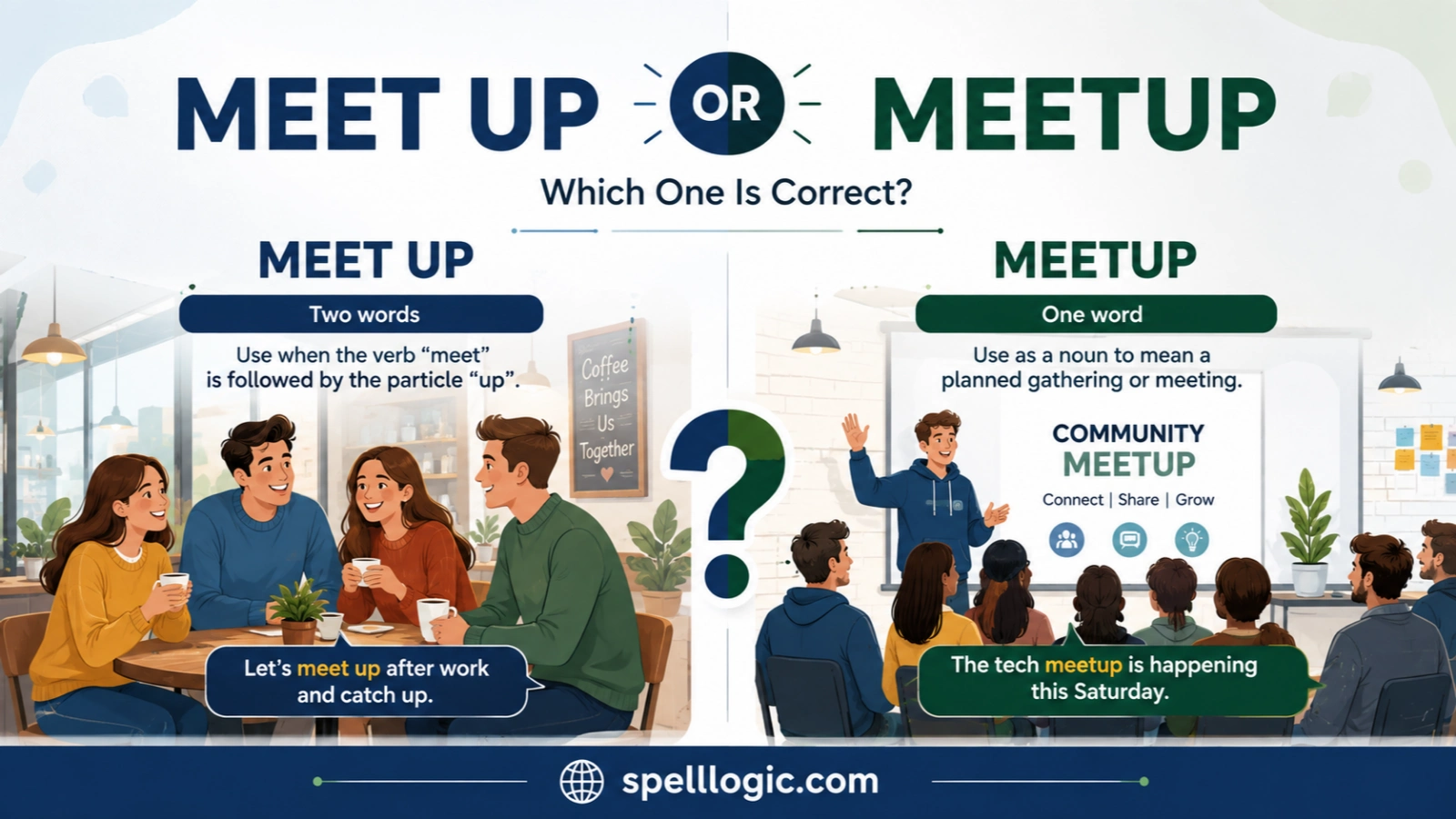
Meet up means to get together with another person or group, usually informally. It functions as a verb phrase.
Meetup means an organized or informal social gathering or event. It functions as a noun.
One-line distinction
Meet up describes the action of getting together, while meetup names the gathering or event itself.
Examples
- “I want to meet up with my classmates after lunch.”
- “The local writers are holding a meetup on Saturday.”
In the first sentence, the speaker describes an action. In the second, the speaker names an event.
Understanding Homophones in English
What Are Homophones?
Homophones are words that sound the same or very similarly but have different spellings and meanings. For example, right and write have the same pronunciation but different meanings and grammatical uses.
Not every spelling pair that sounds alike is technically a pair of homophones. In this case, the important issue is not true homophony but the fact that the two forms can sound nearly identical in everyday speech.
Why Homophones Cause Confusion
Sound alone does not always tell us which written form to choose. For example, if someone says, “We should meet up tomorrow,” you understand the meaning from the sentence, but you must know the grammar to spell it correctly.
This is why learning words in context is especially useful for English learners.
What Does “Meet Up” Mean?
Definition and Core Meaning
Meet up is a phrasal verb meaning to come together or get together with someone, usually at an agreed time and place. It is common in informal and conversational English.
For example:
- “Can we meet up tomorrow?”
- “I’m going to meet up with Sarah after work.”
- “They met up at the café.”
- “Let’s meet up near the station.”
The expression often suggests a planned or casual meeting between friends, colleagues, classmates, or other people.
Origin and Historical Use
The verb meet has a very old history in English and is related to words found in other Germanic languages. The addition of up developed into a phrasal-verb construction that can emphasize coming together or gathering.
Over time, the expression became particularly common in informal modern English. It is now widely used in conversations, text messages, social media, and everyday writing.
Modern Usage and Synonyms
Today, meet up is especially natural when talking about casual social plans.
Useful synonyms and related expressions include:
- get together
- gather
- see someone
- come together
- rendezvous
- join someone
- socialize
However, these alternatives are not always interchangeable. “Meet up” is particularly natural for informal arrangements.
Example Sentences
- “Let’s meet up for coffee this afternoon.”
- “I met up with my old friend last weekend.”
- “Where should we meet up?”
- “The students decided to meet up before the exam.”
- “We can meet up outside the library.”
Notice that the phrase functions as an action. It can follow modal verbs such as can, will, and should, or appear in different verb tenses.
What Does “Meetup” Mean?
Definition and Core Meaning
Meetup is a noun that refers to a gathering or event where people come together, often because they share an interest, profession, hobby, or community.
For example:
- “There is a technology meetup tonight.”
- “I attended a photography meetup last month.”
- “The meetup attracted many local developers.”
The word can describe both casual gatherings and organized events.
Origin and Historical Context
The noun developed from the idea expressed by the phrasal verb meet up. Its use became increasingly popular in modern English, particularly in connection with groups and communities that organize gatherings around shared interests.
The word also became strongly associated with organized social and professional events in the internet age. In modern usage, it may refer to a small gathering, networking event, hobby group, or community meeting.
Modern Usage and Synonyms
Common synonyms and related expressions include:
- gathering
- social event
- get-together
- group meeting
- community event
- networking event
- informal gathering
The exact meaning depends on context. A meetup might be very casual, such as friends gathering for coffee, or more organized, such as professionals discussing technology.
Example Sentences
- “Our photography meetup starts at 7 p.m.”
- “She organized a meetup for local writers.”
- “The monthly meetup is held at the community center.”
- “I found an interesting language-learning meetup online.”
- “The meetup brought together people from several companies.”
Here, the word refers to a thing or event rather than the action of meeting.
Meet Up vs Meetup: Key Differences at a Glance
| Word | Part of Speech | Meaning | Example Context |
|---|---|---|---|
| Meet up | Phrasal verb | To get together with someone | “Let’s meet up after work.” |
| Meetup | Noun | A gathering or organized event | “The meetup begins at six.” |
The most important distinction is grammatical. Meet up tells us what people do, while meetup tells us what the gathering is.
This simple test works in many situations. If you can replace the expression with get together, you probably need the verb phrase. If you can replace it with gathering or event, the noun is probably the better choice.
How to Remember the Difference Between Meet Up and Meetup
A simple memory trick is to remember:
Two words = an action. One word = an event.
Think of meet up as something you do:
“We will meet up at the café.”
Think of meetup as something you attend:
“We will attend a meetup at the café.”
Association techniques
You can also connect the forms with common grammar patterns.
Meet up often follows:
- can
- will
- should
- want to
- plan to
- need to
Examples:
- “We can meet up later.”
- “I want to meet up with them.”
- “They plan to meet up tomorrow.”
Meetup can follow:
- a
- the
- this
- that
- our
- an
Examples:
- “a meetup”
- “the meetup”
- “our meetup”
- “this meetup”
One memorable example
Remember this pair:
“Let’s meet up before the meetup.”
The first expression describes the action. The second names the event.
Common Mistakes and Confusions
Mistake 1: Using the noun as a verb
✘ “We will meetup at 5 p.m.”
✔ “We will meet up at 5 p.m.”
Explanation: After will, you need a verb. The two-word phrasal verb is correct.
Mistake 2: Writing the event as two words
✘ “The meet up starts at 7 p.m.”
✔ “The meetup starts at 7 p.m.”
Explanation: When you mean a gathering or event, the noun is normally written as one word.
Mistake 3: Confusing an action with an event
✘ “I attended a meet up for programmers.”
✔ “I attended a meetup for programmers.”
Explanation: You attend an event, so the noun form works naturally.
Mistake 4: Using the noun after “to”
✘ “I want to meetup with my friends.”
✔ “I want to meet up with my friends.”
Explanation: The structure want to + verb requires the verb phrase.
Mistake 5: Forgetting that “meet” can stand alone
Sometimes you do not need either expression.
For example:
- “I will meet my manager at noon.”
- “We will meet at the office.”
If the meaning is already clear, simple meet may be enough.
Examples Section: Correct and Incorrect Usage
Example 1
✔ Correct: “Let’s meet up after dinner.”
✘ Incorrect: “Let’s meetup after dinner.”
Why? The sentence describes an action after the word let’s, so the verb phrase is needed.
Example 2
✔ Correct: “The meetup is scheduled for Saturday.”
✘ Incorrect: “The meet up is scheduled for Saturday.”
Why? The sentence refers to an event, so the noun form is appropriate.
Example 3
✔ Correct: “I plan to meet up with my cousins.”
✘ Incorrect: “I plan to meetup with my cousins.”
Why? The structure plan to + verb requires the two-word verb phrase.
Example 4
✔ Correct: “Our monthly meetup attracts many students.”
✘ Incorrect: “Our monthly meet up attracts many students.”
Why? The sentence names a recurring gathering, so the noun form is used.
Example 5
✔ Correct: “Can we meet up near the station?”
✘ Incorrect: “Can we meetup near the station?”
Why? Can is followed by the base form of a verb, so the two-word expression is required.
Example 6
✔ Correct: “She organized a meetup for language learners.”
✘ Incorrect: “She organized a meet up for language learners.”
Why? The word follows the article a and names an event, so the noun form is appropriate.
Self Assessment: Test Your Knowledge
Fill in each blank with meet up or meetup.
- Let’s ________ at the restaurant around 7 p.m.
- The local photography ________ takes place every Friday.
- I would like to ________ with my old classmates.
- Our next ________ will focus on creative writing.
Self Assessment Answers
- meet up — It describes the action of getting together.
- meetup — It refers to an event or gathering.
- meet up — The phrase follows “would like to” and functions as a verb.
- meetup — It names the gathering.
A useful rule is to ask yourself: Am I talking about doing something or naming something? If you are describing the action, choose the two-word form. If you are naming the event, choose the one-word noun.
FAQs About “Meet Up and Meetup”
Is “meet up” one word or two words?
As a verb phrase, it is normally written as meet up, with two words. It means to get together with someone.
Is “meetup” a real English word?
Yes. Meetup is an established noun used for a gathering or event, especially one involving people with a shared interest.
Can I use “meetup” as a verb?
In standard English, it is better to use meet up as the verb. For example, write “We will meet up tomorrow,” not “We will meetup tomorrow.”
Is “meetup” formal or informal?
Meetup is generally associated with informal, social, community, hobby, and professional-interest gatherings. In very formal contexts, meeting, conference, or gathering may be more appropriate depending on the situation.
Can “meet up” refer to a planned meeting?
Yes. It can describe both planned and casual arrangements. For example, “We will meet up at the station at 5 p.m.”
What is the easiest way to remember the difference?
Remember: meet up = do, while meetup = thing. You meet up with people, but you attend or organize a meetup.
Are “meet up” and “get together” synonyms?
They are often interchangeable in casual conversation. Both can describe people coming together, although the exact choice depends on the sentence and context.
Final Conclusion: Using “Meet Up” and “Meetup” Correctly
Knowing the difference between meet up and meetup makes everyday English more accurate and natural. The key is to understand their grammatical roles rather than focusing only on their similar pronunciation. Meet up is a two-word phrasal verb that describes the action of getting together with someone. For example, you might say, “Let’s meet up after work.” Meetup, on the other hand, is a noun that refers to a gathering or event, as in “The meetup starts at seven.” A quick memory trick is to connect the verb with doing and the noun with a thing or event. If you can replace the expression with “get together,” the verb form is probably right.
If you can replace it with “gathering” or “event,” the noun is likely the better choice. With regular practice, these forms become easy to recognize. Pay attention to sentence structure, especially words such as to, will, can, a, and the. The more you notice these patterns in real English, the more confidently you will use them in conversations, messages, emails, and professional writing. Keep practicing, and small grammar distinctions like this will become much easier.

Naveed Ahmed is a Master’s graduate, content writer, and contributor at SpellLogic.com. He specializes in spelling, grammar, and English language content, helping readers improve their writing with clear and accurate guidance. His goal is to make language learning simple, practical, and accessible for students, writers, and professionals.