Many English learners feel confused when they see moms and mom’s because these words look almost identical but have different meanings and grammar rules. The confusion often comes from the apostrophe, which changes the purpose of the word. Using the wrong form can make your writing look incorrect, especially in school assignments, emails, or professional communication.
Fortunately, the difference is simple once you understand it. In this guide, you’ll learn what moms and mom’s mean, when to use each one, common mistakes to avoid, and easy memory tricks to help you remember the correct form every time.
Why “Moms” and “Mom’s” Are Confusing
Many people mix up moms and mom’s because they sound exactly the same when spoken. However, they serve different grammatical purposes.
Similar Pronunciation
- Both words are pronounced the same.
- The apostrophe is silent in speech.
Similar Spelling
- The only visible difference is the apostrophe.
- Many writers accidentally add or remove the apostrophe.
Context Confusion
The meaning depends on how the word is used.
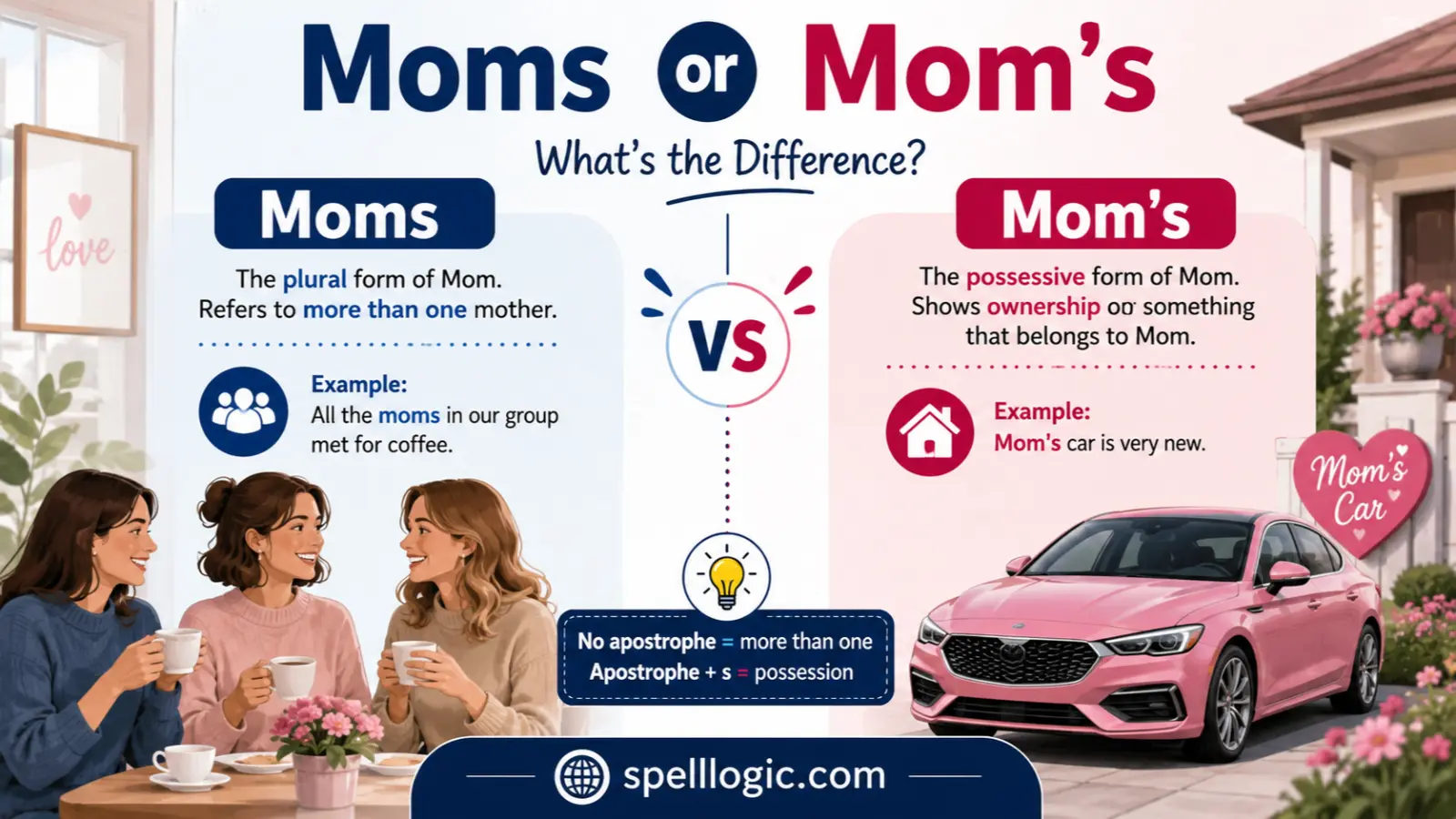
- Moms refers to more than one mother.
- Mom’s shows possession or ownership by one mother.
Common Learner Mistakes
Learners often write:
- Mom’s love their children. ❌
- The moms car is outside. ❌
These mistakes happen because plural nouns and possessive nouns are easy to confuse.
Moms vs Mom’s Explained Simply
The easiest way to understand these words is to remember their grammar.
Moms means more than one mom, while mom’s means something belongs to one mom.
One-Line Distinction
Moms is a plural noun, while mom’s is a singular possessive noun.
Examples
Moms
- Many moms attended the school meeting.
- Working moms often balance multiple responsibilities.
Mom’s
- My mom’s phone is on the table.
- Mom’s favorite flower is a rose.
Understanding Homophones in English
Although moms and mom’s are not true homophones in the strict grammatical sense because one includes punctuation, they sound identical in everyday speech.
What Are Homophones?
Homophones are words that sound the same but have different meanings or spellings.
Example:
- Flower
- Flour
These words sound alike but mean different things.
Why Homophones Cause Confusion
When speaking, listeners cannot hear punctuation like apostrophes. As a result, writers often rely on pronunciation instead of grammar.
Example:
- The dog’s toy.
- The dogs are barking.
Both begin with dog, but one is possessive and the other is plural.
What Does “Moms” Mean?
Definition and Core Meaning
Moms is the plural form of mom.
It refers to two or more mothers.
Origin and Historical Use
The word mom developed as an informal family term for mother. Over time, English speakers added -s to create the regular plural form moms.
Modern Usage and Synonyms
Today, moms commonly appears in conversations, parenting articles, advertisements, and everyday writing.
Similar words include:
- Mothers
- Parents (depending on context)
- Mamas
- Moms-to-be
Key Points
- Plural noun
- Refers to multiple mothers
- No apostrophe
- Does not show ownership
Example Sentences
- Moms from the neighborhood organized a picnic.
- Many moms volunteer at local schools.
- New moms often appreciate extra support.
- The event welcomed moms and dads alike.
What Does “Mom’s” Mean?
Definition and Core Meaning
Mom’s is the singular possessive form of mom.
It shows that one mother owns or is connected to something.
Origin and Historical Context
English has used apostrophes for centuries to indicate possession.
Adding ‘s to a singular noun shows ownership.
Modern Usage and Synonyms
Mom’s appears whenever something belongs to one mother.
Examples include:
- Mom’s car
- Mom’s advice
- Mom’s birthday
- Mom’s cooking
Key Points
- Singular possessive noun
- Shows ownership or relationship
- Always includes an apostrophe before s
- Refers to one mother
Example Sentences
- Mom’s purse is in the kitchen.
- I borrowed Mom’s jacket.
- Mom’s smile brightened everyone’s day.
- We celebrated Mom’s birthday yesterday.
Moms vs Mom’s: Key Differences at a Glance
| Word | Part of Speech | Meaning | Example Context |
|---|---|---|---|
| Moms | Plural noun | More than one mother | The moms met after school. |
| Mom’s | Singular possessive noun | Belonging to one mother | Mom’s bag is on the chair. |
How to Remember the Difference Between Moms and Mom’s
Learning a few simple tricks can help you avoid mistakes.
Easy Memory Tricks
- No apostrophe = More than one.
- Apostrophe = Ownership.
Association Techniques
Imagine the apostrophe as a tiny hook.
If something belongs to Mom, the hook connects it to her.
Example:
Mom’s keys
The keys belong to Mom.
One Memorable Example
- Moms are shopping together.
- Mom’s shopping bag is heavy.
One sentence talks about many mothers.
The other talks about one mother’s bag.
Common Mistakes and Confusions
Here are mistakes learners frequently make.
Wrong
Mom’s are amazing.
Correct
Moms are amazing.
Explanation: No ownership is shown. You simply mean several mothers.
Wrong
The moms car is blue.
Correct
The mom’s car is blue.
Explanation: The car belongs to one mom.
Wrong
Three mom’s attended the meeting.
Correct
Three moms attended the meeting.
Explanation: This sentence needs the plural form, not the possessive form.
Wrong
My moms phone rang.
Correct
My mom’s phone rang.
Explanation: The phone belongs to one mom.
Examples Section: Correct and Incorrect Usage
Example 1
✔ Correct: The moms planned a charity event.
✘ Incorrect: The mom’s planned a charity event.
Example 2
✔ Correct: Mom’s cookies are delicious.
✘ Incorrect: Moms cookies are delicious.
Example 3
✔ Correct: Many moms enjoy reading parenting books.
✘ Incorrect: Many mom’s enjoy reading parenting books.
Example 4
✔ Correct: Mom’s computer needs an update.
✘ Incorrect: Moms computer needs an update.
Example 5
✔ Correct: The moms shared helpful advice.
✘ Incorrect: The mom’s shared helpful advice.
Self Assessment: Test Your Knowledge
Fill in the blanks using moms or mom’s.
- ________ purse is on the sofa.
- Many ________ attended the school concert.
- I borrowed ________ umbrella this morning.
- The ________ volunteered to organize the fundraiser.
Self Assessment Answers
- Mom’s
- Moms
- Mom’s
- Moms
FAQs About “Moms” and “Mom’s”
1. Is “moms” a correct English word?
Yes. Moms is the plural form of mom and refers to more than one mother.
2. What does “mom’s” mean?
Mom’s means something belongs to one mother.
3. When should I use an apostrophe with “mom”?
Use an apostrophe when showing possession, such as Mom’s car or Mom’s advice.
4. Can “mom’s” mean “mom is”?
Yes. In informal writing, mom’s can also be a contraction for mom is, as in Mom’s coming home soon. The meaning is clear from the context.
5. Is “moms” possessive?
No. Moms is only plural. It does not show ownership.
6. What is the possessive form of multiple moms?
If something belongs to multiple mothers, use moms’ with the apostrophe after the s.
Example:
The moms’ meeting lasted two hours.
7. Why do learners confuse these words?
Because they sound the same, and many people mistakenly think every word ending in s needs an apostrophe.
Final Conclusion: Using “Moms” and “Mom’s” Correctly
Understanding the difference between moms and mom’s is an important step toward writing accurate English. Although these words look almost identical and are pronounced the same, they serve very different grammatical purposes. Moms is simply the plural form of mom, referring to two or more mothers. Mom’s, on the other hand, is the singular possessive form, showing that something belongs to one mother. In some informal contexts, mom’s can also be a contraction of mom is, making context especially important.
A simple rule can help you remember the difference: if you mean more than one mother, use “moms.” If something belongs to one mother, use “mom’s.” Whenever you’re unsure, ask yourself whether you’re talking about ownership or simply about several mothers. If ownership is involved, the apostrophe belongs there. If not, leave it out.
Reading books, paying attention to punctuation, and practicing with real-life examples will make these grammar rules feel natural over time. Every small improvement strengthens your writing skills and helps you communicate more clearly. Keep practicing, review these examples whenever needed, and you’ll soon use moms and mom’s with confidence in both everyday conversations and formal writing