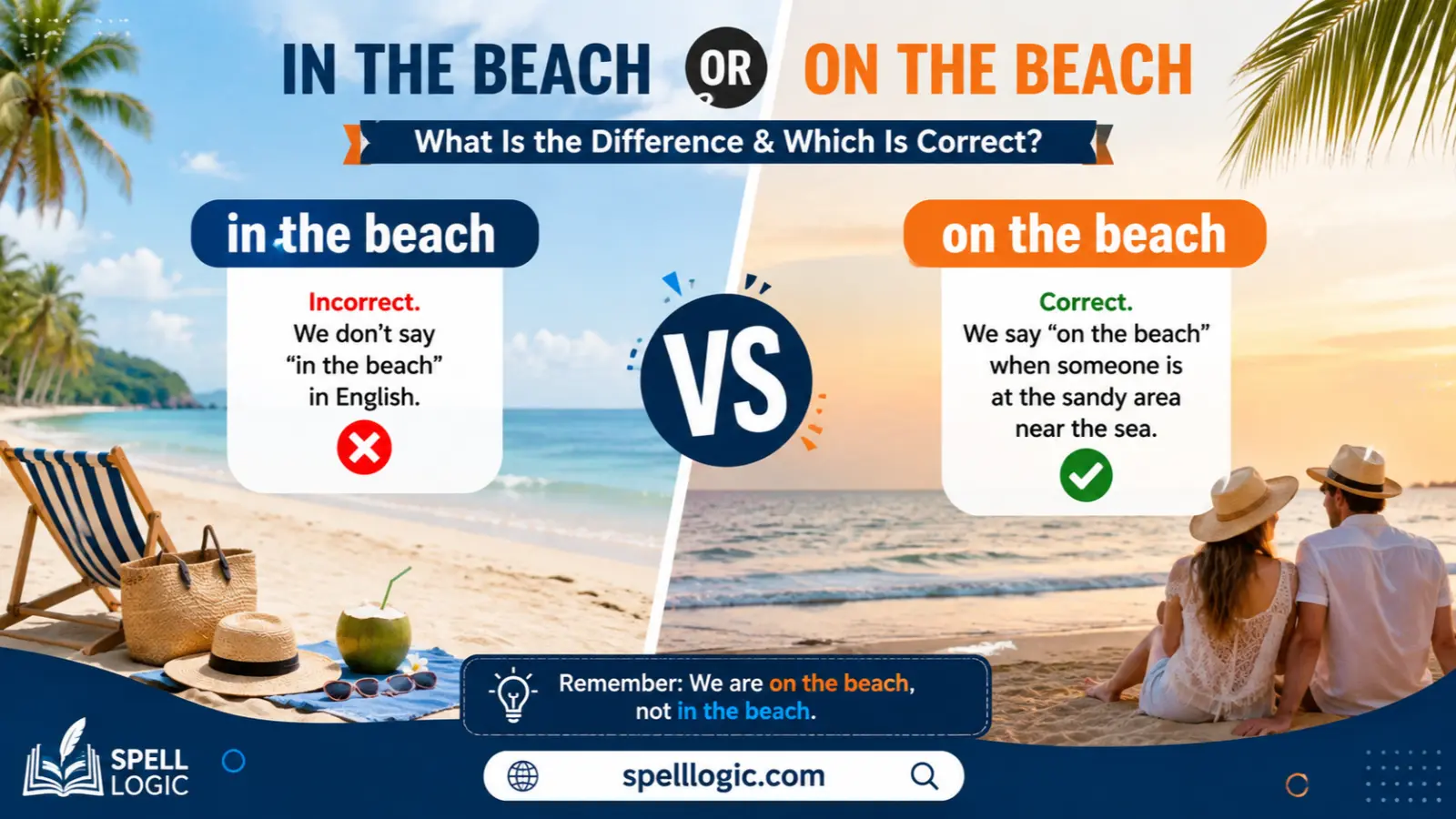
Many English learners wonder whether they should say “in the beach” or “on the beach.” At first glance, both phrases seem reasonable because they refer to the same place. However, only one is correct in most everyday situations. Choosing the wrong preposition can make your English sound unnatural, even if people still understand what you mean.
Learning the difference between these expressions will help you speak and write more confidently. In this guide, you’ll discover the meanings, correct usage, common mistakes, memory tips, and practical examples so you can always choose the right phrase.
Why “In the Beach” and “On the Beach” Are Confusing
Many English learners confuse these expressions because prepositions often change from one language to another.
Similar Pronunciation
The phrases sound very similar, especially in fast speech. The only difference is the preposition in or on.
Similar Spelling
Both expressions contain the same words except for one small preposition. This makes them easy to mix up.
Context Confusion
Learners often think in and on can both describe location. While this is true in some situations, English has specific rules for places like beaches.
Common Learner Mistakes
- Saying “We walked in the beach.”
- Writing “They relaxed in the beach.”
- Translating directly from another language.
- Assuming every location uses in instead of on.
In the Beach vs On the Beach Explained Simply
The simple rule is easy to remember.
“In the beach” is generally incorrect when talking about being at the seaside.
“On the beach” is the correct expression because people stand, walk, or relax on the surface of the beach.
One-Line Distinction
“In the beach” is usually incorrect, while “on the beach” is the natural English expression for being at the beach.
Example Sentences
- We spent the afternoon on the beach.
- The children built sandcastles on the beach.
Incorrect:
- We spent the afternoon in the beach.
- They played volleyball in the beach.
Understanding Homophones in English
Although in and on are not homophones, English learners often confuse them because they are both common prepositions.
What Are Homophones?
Homophones are words that sound the same but have different meanings and spellings.
Example:
- Sea and see
These words sound alike but have different meanings.
Why Homophones Cause Confusion
When words sound alike, learners may choose the wrong one in writing.
Example:
- I can see the ocean.
- We sailed across the sea.
Although in and on are not homophones, they create similar confusion because prepositions follow special grammar rules.
What Does “In the Beach” Mean?
Definition and Core Meaning
The phrase “in the beach” is not standard English when referring to a beach as a place.
However, in may be correct when talking about something physically inside the sand.
Examples:
- There are shells in the beach sand.
- Treasure was buried in the beach (meaning inside the sand).
When talking about visiting a beach, avoid this phrase.
Origin and Historical Use
English has traditionally used on for surfaces such as:
- on the floor
- on the ground
- on the beach
Using in the beach for location has never become common in standard English.
Modern Usage and Synonyms
Generally avoided when referring to location.
Related expressions:
- inside the sand
- buried beneath the beach
- within the sand
Example Sentences
- The coins were buried in the beach sand.
- Crabs hide in the sand near the beach.
What Does “On the Beach” Mean?
Definition and Core Meaning
On the beach means located at the beach or on its sandy surface.
It is the standard English expression.
Origin and Historical Context
The preposition on has long been used for surfaces.
Examples include:
- on the table
- on the road
- on the beach
This usage has remained consistent for centuries.
Modern Usage and Synonyms
Common alternatives include:
- at the beach
- along the beach
- by the beach (slightly different meaning)
Example Sentences
- We had a picnic on the beach.
- She fell asleep on the beach.
- Tourists walked on the beach at sunset.
- Children collected shells on the beach.
In the Beach vs On the Beach: Key Differences at a Glance
| Word | Part of Speech | Meaning | Example Context |
|---|---|---|---|
| In the beach | Prepositional phrase | Usually incorrect for location; may refer to something inside the sand | Treasure was buried in the beach sand. |
| On the beach | Prepositional phrase | Located at or on the sandy surface of a beach | We relaxed on the beach all day. |
How to Remember the Difference Between In the Beach and On the Beach
Here are some simple tricks.
Easy Memory Tricks
- People walk on surfaces.
- A beach is a surface.
- Therefore, use on the beach.
Association Techniques
Think about these examples:
- on the floor
- on the road
- on the beach
All are surfaces.
One Memorable Example
Imagine spreading a towel.
You place your towel on the beach, not in the beach.
That image makes the correct phrase easy to remember.
Common Mistakes and Confusions
Wrong Example
❌ We played football in the beach.
✅ We played football on the beach.
Explanation: A beach is treated as a surface.
Wrong Example
❌ They slept in the beach.
✅ They slept on the beach.
Explanation: People rest on the sand.
Wrong Example
❌ She read a book in the beach.
✅ She read a book on the beach.
Explanation: The activity happens on the sandy area.
Wrong Example
❌ We ate lunch in the beach.
✅ We ate lunch on the beach.
Explanation: The location is the beach surface.
Examples Section: Correct and Incorrect Usage
Example 1
✔ Correct: We walked on the beach before sunrise.
✘ Incorrect: We walked in the beach before sunrise.
Example 2
✔ Correct: The children played on the beach.
✘ Incorrect: The children played in the beach.
Example 3
✔ Correct: We watched the sunset on the beach.
✘ Incorrect: We watched the sunset in the beach.
Example 4
✔ Correct: My sunglasses fell into the sand on the beach.
✘ Incorrect: My sunglasses fell in the beach.
Example 5
✔ Correct: We spent our vacation on the beach.
✘ Incorrect: We spent our vacation in the beach.
Self Assessment: Test Your Knowledge
Fill in the blanks.
- We had a picnic ________ the beach.
- The children built sandcastles ________ the beach.
- My keys disappeared ________ the sand.
- We enjoyed walking ________ the beach at sunset.
Self Assessment Answers
- on
- on
- in
- on
FAQs
1. Is “in the beach” grammatically correct?
Usually no. Native speakers normally say on the beach.
2. Why do people say “on the beach”?
Because a beach is considered a surface where people stand, sit, and walk.
3. Can “in the beach” ever be correct?
Yes. It can refer to something physically inside the sand, although in the sand is usually clearer.
4. Is “at the beach” the same as “on the beach”?
Not exactly. At the beach means you are at the beach area. On the beach specifically means on the sand.
5. Which phrase should English learners use?
Use on the beach when talking about activities on the sand.
6. Why do learners make this mistake?
Many languages use different prepositions, so learners often translate directly into English.
7. What is the easiest rule to remember?
If you can stand, sit, or lie on it, use on. A beach is a surface, so say on the beach.
Final Conclusion: Using “In the Beach” and “On the Beach” Correctly
Understanding the difference between “in the beach” and “on the beach” is simpler than it first appears. In everyday English, “on the beach” is the correct and natural expression because a beach is viewed as a surface where people walk, relax, swim nearby, play games, or enjoy the scenery. Although “in the beach” may occasionally appear when describing something buried inside the sand, it is not the phrase native speakers use to describe being at the beach. In most situations, you should choose “on the beach” with confidence.
A helpful way to remember the rule is to compare a beach with other surfaces. Just as you say on the floor, on the ground, or on the road, you also say on the beach. Visualizing yourself placing a towel on the sand is another easy memory trick that reinforces the correct preposition. As you continue learning English, pay close attention to common prepositional phrases because they often do not translate directly from other languages. Reading authentic English, listening to native speakers, and practicing with your own sentences will help these patterns become natural. With regular practice, choosing “on the beach” instead of “in the beach” will soon become automatic, making your spoken and written English sound more fluent, natural, and accurate.

Naveed Ahmed is a Master’s graduate, content writer, and contributor at SpellLogic.com. He specializes in spelling, grammar, and English language content, helping readers improve their writing with clear and accurate guidance. His goal is to make language learning simple, practical, and accessible for students, writers, and professionals.