English learners often wonder whether to say “funnier” or “more funny” when comparing two people, situations, jokes, or experiences. Both forms can be understood, but they are not equally natural in everyday English. The confusion comes from the fact that funny is an adjective that can form its comparative in more than one way.
Understanding funnier or more funny helps learners choose the form that sounds natural and grammatically correct. In most ordinary situations, funnier is the preferred comparative form. However, more funny can sometimes appear when a speaker wants to emphasize the quality of being funny or create a particular contrast.
Why “Funnier” and “More Funny” Are Confusing
The question of funnier or more funny is common because English has several ways to form comparative adjectives. Short adjectives often take -er, while longer adjectives usually use more.
Similar pronunciation
The two expressions do not have the same pronunciation. Funnier is pronounced approximately like “FUN-ee-er,” while more funny has two separate words. Because both express comparison, learners may treat them as interchangeable.
Similar spelling
The connection is easy to see because both forms contain funny. The word funnier changes the spelling of the adjective, while more funny keeps the original adjective after more.
Context confusion
Learners may hear both expressions in different contexts and assume they have exactly the same level of naturalness. Standard English normally prefers the shorter comparative form funnier when comparing two things.
For example:
- This movie is funnier than the first one.
- Ali is funnier than his brother.
Common learner mistakes
A frequent mistake is assuming that every adjective must use more in its comparative form. For example, learners may say “more fast” instead of “faster.” Similarly, funny normally becomes funnier, not more funny.
Funnier vs More Funny Explained Simply
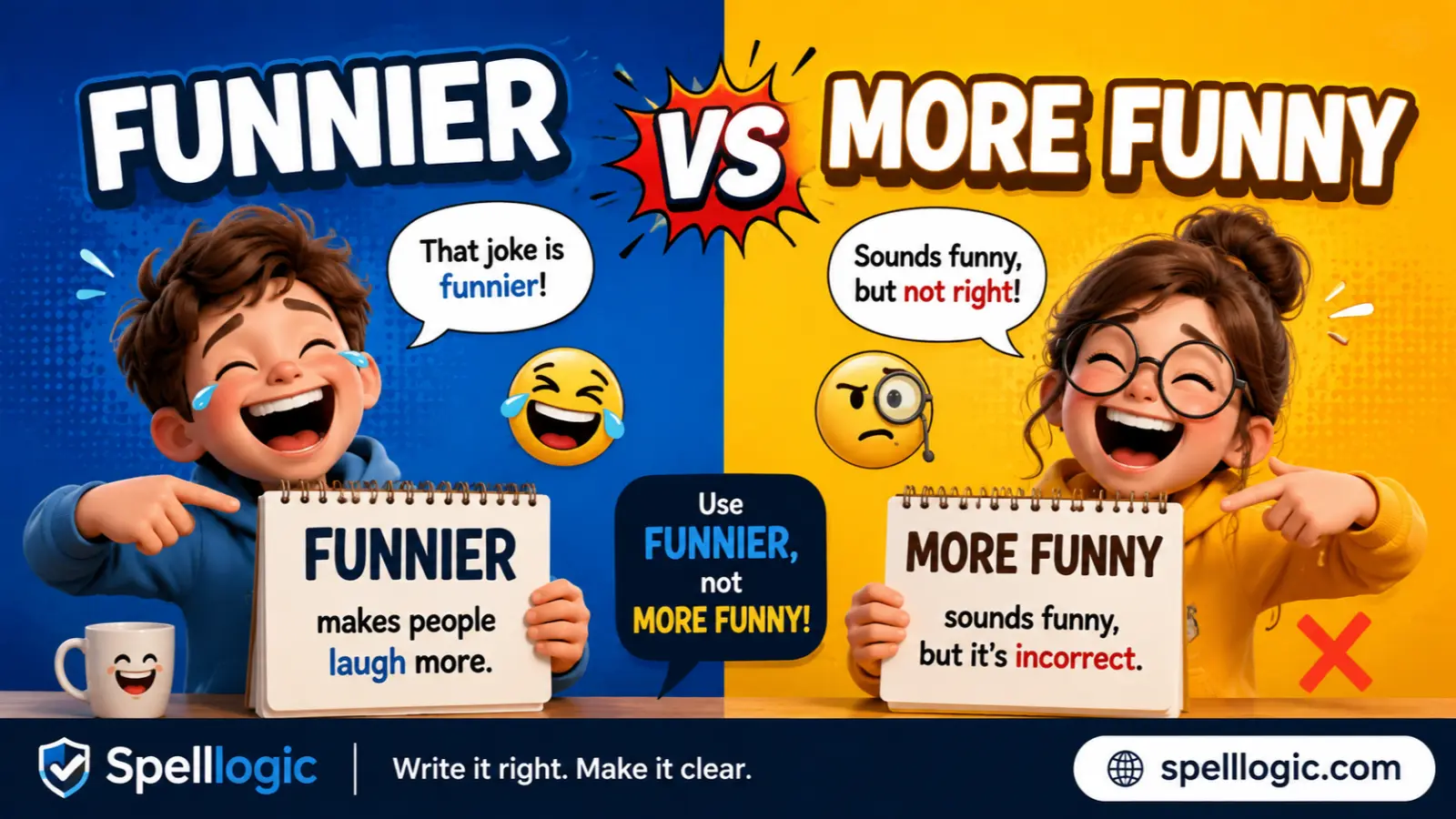
The basic rule for funnier or more funny is straightforward: funnier is the normal comparative form of funny.
Funnier means “more funny” or “more amusing” than another person or thing.
One-line distinction
Funnier is the standard and more natural comparative form, while more funny is possible in limited contexts but is usually less natural for ordinary comparison.
Examples
- My brother is funnier than me.
- That was the funnier of the two jokes.
The easiest way to remember funnier or more funny is to use funnier when you simply want to compare how amusing two things are.
Understanding Homophones in English
The issue of funnier or more funny is sometimes mistakenly connected with homophones, but these expressions are not homophones.
What Are Homophones?
Homophones are words that sound the same but have different meanings, and they may have different spellings.
For example:
- right — correct
- write — to put words on paper
These words sound alike but have different meanings.
Why Homophones Cause Confusion
Homophones can confuse learners because listening alone does not always reveal which word a speaker means. For example, “I want to write” and “I want the right answer” contain words that sound alike.
However, funnier or more funny is not a homophone problem. The difference concerns comparative adjective formation and natural English usage.
What Does “Funnier” Mean?
Definition and Core Meaning
Funnier is the comparative form of funny. It describes someone or something that produces more amusement, laughter, or enjoyment than another person or thing.
For example:
- This comedian is funnier than the previous one.
- Your second story was funnier than your first story.
The word can describe jokes, movies, people, stories, situations, comments, pictures, or anything else that can be considered amusing.
Origin and Historical Use
Funny developed from the noun fun, which is associated with amusement and enjoyment. Over time, funny acquired several related meanings, including amusing, strange, unusual, or difficult to explain.
The comparative ending -er has been a common feature of English adjective comparison for centuries. Therefore, funnier follows a familiar English pattern.
Notice the spelling change:
funny → funnier
The final y changes to i before -er.
Modern Usage and Synonyms
Today, funnier is extremely common in informal conversation, entertainment reviews, social media, and everyday writing.
Useful synonyms and related expressions include:
- more amusing
- more humorous
- more entertaining
- more comical
- more hilarious
- more entertainingly absurd
However, these words are not always exact replacements. Funnier is especially common when making a direct comparison.
Example Sentences
- Sarah is funnier than Mark.
- This episode is funnier than the last one.
- His latest joke was funnier than his first joke.
- The second cartoon is funnier.
- I thought the ending was funnier than the beginning.
When deciding funnier or more funny, these examples show why the first form is normally the better choice.
What Does “More Funny” Mean?
Definition and Core Meaning
More funny uses the adverb more before the adjective funny. Literally, it means a greater degree of funniness or amusement.
Although the expression can be grammatically understandable, native speakers generally prefer funnier for a simple comparison.
For example, instead of:
This joke is more funny than that one.
Most speakers would naturally say:
This joke is funnier than that one.
Origin and Historical Context
Using more with adjectives is an established English method of forming comparatives. It is especially common with longer adjectives, such as:
- beautiful → more beautiful
- interesting → more interesting
- difficult → more difficult
Because funny is a short adjective, however, English normally uses the -er pattern.
Modern Usage and Synonyms
More funny can occasionally occur when a writer or speaker wants to emphasize the word funny, create a contrast, or discuss different meanings of the adjective.
For example:
- I don’t mean more ridiculous; I mean more funny.
- The second version is more funny than serious.
Even in these situations, context matters. For an ordinary comparison, funnier is usually smoother.
Related alternatives include:
- funnier
- more amusing
- more humorous
- more entertaining
- more comical
Example Sentences
- The second scene is more funny than dramatic.
- His comment became more funny when everyone understood the context.
- The performance was more funny than frightening.
- The character becomes more funny as the story develops.
These examples show that more funny can be used, but it is not normally the first choice for a simple “A is more amusing than B” comparison.
Funnier vs More Funny: Key Differences at a Glance
| Word | Part of Speech | Meaning | Example Context |
|---|---|---|---|
| Funnier | Comparative adjective | More amusing than something else | This movie is funnier than the first one. |
| More funny | Comparative adjective phrase | Having a greater degree of funniness | The scene is more funny than serious. |
The key point in funnier or more funny is that funnier is the standard comparative form of funny.
How to Remember the Difference Between Funnier and More Funny
Learning funnier or more funny becomes easier when you remember a simple adjective rule.
Easy Memory Tricks
Think of this pattern:
funny → funnier → funniest
The three forms are:
- funny — positive form
- funnier — comparative form
- funniest — superlative form
This pattern is similar to:
- happy → happier → happiest
- easy → easier → easiest
- busy → busier → busiest
Association Techniques
Connect funny with other short adjectives that use -er.
For example:
- funny → funnier
- happy → happier
- silly → sillier
- pretty → prettier
This helps you remember that short adjectives ending in -y commonly change y to i before adding -er.
One Memorable Example
Imagine two comedians performing on the same night:
“Tom is funny, but Jerry is funnier.”
This simple sentence makes the comparison clear. If you are unsure about funnier or more funny, remember that everyday comparisons usually call for funnier.
Common Mistakes and Confusions
One common mistake is using more funny simply because the learner knows that more creates comparative adjectives.
Wrong Example
✘ This joke is more funny than yours.
Correct Version
✔ This joke is funnier than yours.
Explanation: Because funny is a short adjective, its normal comparative form is funnier.
Another Wrong Example
✘ My new teacher is more funny than my old teacher.
Correct Version
✔ My new teacher is funnier than my old teacher.
Again, funnier sounds more natural in an ordinary comparison.
When “More Funny” Can Work
It is important not to treat more funny as completely impossible. English allows speakers to use adjective phrases creatively, especially when contrasting two qualities.
For example:
✔ The movie was more funny than scary.
Here, the speaker contrasts funny with scary, rather than simply comparing two funny things. Still, funnier would usually be preferred when the comparison is straightforward.
Examples Section: Correct and Incorrect Usage
Example 1
✔ Correct: This comedian is funnier than the one we saw yesterday.
✘ Incorrect: This comedian is more funny than the one we saw yesterday.
Why? A simple comparison normally uses funnier.
Example 2
✔ Correct: Her second story was funnier than her first.
✘ Incorrect: Her second story was more funny than her first.
Why? The adjective funny naturally takes the comparative ending -er.
Example 3
✔ Correct: That was the funnier of the two jokes.
✘ Incorrect: That was the more funny of the two jokes.
Why? Funnier is the natural comparative form when selecting between two alternatives.
Example 4
✔ Correct: The scene was more funny than frightening.
✘ Less natural: The scene was funnier than frightening.
Why? In a contrast involving two different qualities, more funny than frightening can sound natural because the speaker is balancing two descriptions.
Self Assessment: Test Your Knowledge
Fill in each blank with funnier or more funny.
- This video is ______ than the one we watched yesterday.
- My younger brother is ______ than my older brother.
- The film was ______ than scary.
- Which of these two jokes is ______?
Self Assessment Answers
- funnier — This video is funnier than the one we watched yesterday.
- funnier — My younger brother is funnier than my older brother.
- more funny — The film was more funny than scary.
- funnier — Which of these two jokes is funnier?
The answers demonstrate the main rule: use funnier for a normal comparison, while more funny may be useful in a particular contrast.
FAQs
Is “funnier or more funny” correct?
Both forms can be understood, but funnier is normally the preferred comparative form. More funny is possible in certain contexts, especially when contrasting funny with another quality.
Is funnier grammatically correct?
Yes. Funnier is the standard comparative form of funny.
Can I say “more funny”?
Yes, but it is usually less natural than funnier for a direct comparison. Context can make more funny appropriate, especially in constructions such as “more funny than scary.”
Which is more common: funnier or more funny?
Funnier is much more common in ordinary English when comparing two people, jokes, movies, stories, or situations.
Why does funny become funnier?
Because funny is a short adjective ending in -y. When -er is added, the y changes to i: funny → funnier.
Is “funnier” the comparative or superlative form?
Funnier is the comparative form. The superlative form is funniest.
What is the easiest way to remember the rule?
Remember the sequence funny → funnier → funniest. When comparing two things, funnier is normally the best choice.
Final Conclusion: Using “Funnier” and “More Funny” Correctly
Understanding funnier or more funny is useful because comparative adjectives appear constantly in everyday English. When you compare two people, jokes, movies, stories, comments, or situations, funnier is normally the natural and standard choice. For example, “This movie is funnier than the first one” sounds smooth and immediately communicates the comparison. The spelling follows a simple pattern: funny changes to funnier, with the final y becoming i before -er.
Although more funny can sometimes be grammatically acceptable, it is usually less natural for a straightforward comparison. It can work better when the speaker contrasts funny with another quality, as in “The movie was more funny than frightening.” The best memory trick is therefore funny → funnier → funniest. Once you recognize this pattern, choosing between the two forms becomes much easier. Keep practicing with short, natural sentences, and pay attention to how native speakers use comparative adjectives in conversations, books, films, and online writing. With regular practice, you will be able to make these comparisons confidently and naturally.