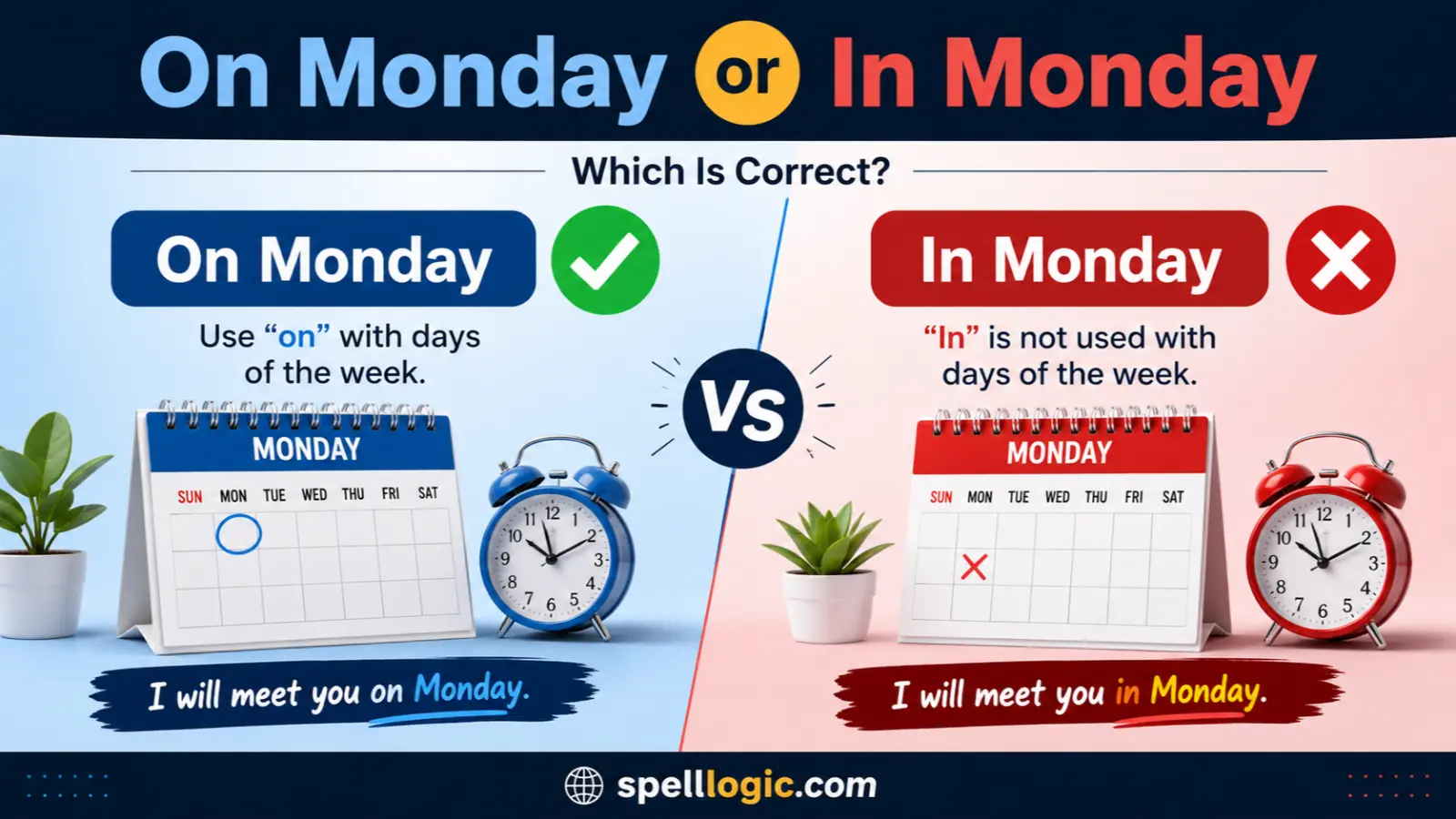
English learners often wonder whether to say on Monday or in Monday when talking about a specific day. Both prepositions, on and in, are common in English, but they are used differently with time expressions. This small difference can make a sentence sound either natural or incorrect.
The good news is that the rule is simple once you understand how English uses prepositions with days, months, years, and longer periods. In this guide, you will learn the correct form, understand why the other form does not normally work, and see plenty of practical examples. By the end, choosing the right expression will feel much easier.
Why “On Monday or in Monday” Are Confusing
Many learners confuse these expressions because on and in are both prepositions used for time. The problem is that English does not use them interchangeably. Each preposition usually connects to a particular type of time expression.
Similar pronunciation
The words on and in are short and very common. Because they often appear quickly in spoken English, learners may not notice the difference in usage. However, pronunciation is not the main reason for the confusion. The real issue is knowing which preposition belongs with a particular time expression.
Similar spelling
There is no major spelling similarity between the two expressions. Instead, learners tend to remember the words as complete phrases rather than learning the preposition rule behind them.
Context confusion
The biggest problem comes from comparing different time expressions. We say:
- on Monday
- on Friday
- in January
- in 2026
- in the morning
Because in works with several time expressions, learners sometimes extend the rule incorrectly to individual days.
Common learner mistakes
A frequent mistake is using in before the name of a weekday. For example, a learner may say, “I will call you in Monday.” Standard English uses on here because Monday is a specific day.
“On Monday or in Monday” Explained Simply
The basic rule is easy:
“On Monday” is the standard and correct expression when referring to a particular Monday. “In Monday” is not normally used in standard English for a specific day.
So, when deciding between on Monday or in Monday, choose on Monday.
One-line distinction
On is normally used with specific days and dates, while in is generally used with longer periods such as months, years, seasons, and parts of the day.
Examples
- I have an English class on Monday.
- We are meeting on Monday morning.
The natural choice is on Monday because Monday identifies a particular day.
Understanding Homophones in English
Although this topic is sometimes grouped with confusing-word lessons, these expressions are not homophones. Homophones are words that sound the same but have different meanings or spellings.
What Are Homophones?
Homophones are words that have the same or very similar pronunciation but different meanings and often different spellings.
For example:
- see = to look at something
- sea = a large body of salt water
The words sound alike, but their meanings and spellings differ.
Why Homophones Cause Confusion
Homophones can be difficult because listeners cannot always identify the correct word from sound alone. Context helps determine the meaning.
For example, “I can see the sea” contains two words that sound alike but have completely different meanings.
The confusion between on and in, however, is a preposition-use problem rather than a homophone problem.
What Does “On Monday” Mean?
Definition and Core Meaning
On Monday means at some point during a particular Monday. It is the standard way to refer to an event, activity, appointment, or situation happening on that day.
For example:
- The meeting is on Monday.
- She starts her new job on Monday.
- I usually go shopping on Monday.
- We visited the museum on Monday.
When you use the name of a specific weekday, on is normally the correct preposition.
Origin and Historical Use
The preposition on has a long history in English. It developed from older forms related to the idea of being positioned upon or at a particular point. Over time, English extended its use to specific days and dates.
The modern rule is straightforward: on commonly introduces a specific day or date.
Modern Usage and Synonyms
There is no perfect synonym for on Monday because the preposition is part of the normal grammatical structure. However, depending on the sentence, you can sometimes use expressions such as:
- that Monday
- during Monday
- on the Monday
- Monday
The simplest and most natural choice is usually on Monday.
Common uses
- on Monday afternoon
- on Monday evening
- on Monday morning
- on Monday, June 15
- on Mondays for repeated events
Example sentences
- Our exam is on Monday.
- He arrived on Monday evening.
- I will send the report on Monday morning.
- They play football on Mondays.
- The store was closed on Monday.
Notice that even when another time expression follows Monday, the preposition before the day remains on.
What Does “In Monday” Mean?
Definition and Core Meaning
In Monday is not the normal standard-English expression for referring to a particular Monday. In most everyday sentences, replacing on with in makes the sentence grammatically unnatural.
For example:
- Incorrect: I will see you in Monday.
- Correct: I will see you on Monday.
Origin and Historical Context
The preposition in traditionally expresses the idea of being inside or within something. In time expressions, it commonly describes a period rather than a specific named day.
For example:
- in January
- in 2026
- in summer
- in the morning
- in two weeks
Because these expressions describe periods or spans of time, in works naturally with them.
Modern Usage and Synonyms
Although in Monday is generally incorrect when referring to a weekday, the word in can appear near Monday in other grammatical structures. For example:
- In Monday’s meeting, we discussed the project.
- The changes were introduced in Monday’s newspaper.
Here, in does not directly modify Monday as a day. Instead, it introduces a larger phrase such as Monday’s meeting or Monday’s newspaper.
Example sentences
- I will finish the task on Monday.
- She is traveling on Monday.
- We met on Monday afternoon.
- The announcement appeared in Monday’s newspaper.
These examples show why context matters.
On Monday or in Monday: Key Differences at a Glance
| Word | Part of Speech | Meaning | Example Context |
|---|---|---|---|
| On Monday | Prepositional phrase | At some point on a specific Monday | The class is on Monday. |
| In Monday | Prepositional phrase | Not normally used for a specific Monday | In Monday’s meeting, we discussed the plan. |
The key difference is grammatical function. On directly introduces the specific day, whereas in normally introduces a period or another noun phrase.
A useful general rule is:
- on + day/date
- in + month/year/season
- at + exact time
For example:
- on Monday
- on July 10
- in July
- in 2026
- at 9:00 a.m.
This pattern makes time prepositions much easier to remember.
How to Remember the Difference Between On Monday and In Monday
Here are several simple memory techniques.
1. Think “on the calendar”
Imagine a calendar. A particular day appears as a specific box or date. You can think of yourself as placing an event on that day.
The meeting is on Monday.
2. Remember the time ladder
Use this simple pattern:
- At → exact point in time
- On → specific day or date
- In → longer period
For example:
- at 8:00
- on Monday
- in January
3. Connect “on” with weekdays
Whenever you see a weekday such as Monday, Tuesday, Wednesday, or Sunday, train yourself to think on.
- on Monday
- on Tuesday
- on Wednesday
- on Sunday
4. Use the calendar test
Ask yourself: Am I naming one particular day?
If the answer is yes, on is usually the right choice.
One memorable example
Think of this sentence:
“My English lesson is on Monday, but my vacation is in July.”
Monday is one specific day, while July is a longer period. This contrast makes the rule easy to remember.
Common Mistakes and Confusions
Mistake 1
Wrong: I will call you in Monday.
Correct: I will call you on Monday.
Explanation: Monday is a specific weekday, so use on.
Mistake 2
Wrong: Our test is in Monday.
Correct: Our test is on Monday.
Explanation: The test happens during a particular day.
Mistake 3
Wrong: She arrived in Monday morning.
Correct: She arrived on Monday morning.
Explanation: When morning is connected to a specific day, English normally uses on: on Monday morning.
Mistake 4
Wrong: We are leaving in Friday.
Correct: We are leaving on Friday.
Explanation: The same weekday rule applies to every day of the week.
Important exception to understand
You may see in near a weekday when it introduces a different phrase:
In Monday’s meeting, the manager announced the changes.
This is grammatical because in is connected to Monday’s meeting, not used directly before the weekday to indicate when the meeting happened.
Examples Section: Correct and Incorrect Usage
Example 1
✔ Correct: I have a doctor’s appointment on Monday.
✘ Incorrect: I have a doctor’s appointment in Monday.
The appointment takes place on a particular day.
Example 2
✔ Correct: We will discuss the project on Monday morning.
✘ Incorrect: We will discuss the project in Monday morning.
The complete time expression is on Monday morning.
Example 3
✔ Correct: She started her course on Monday.
✘ Incorrect: She started her course in Monday.
The name of the weekday requires on.
Example 4
✔ Correct: The office will reopen on Monday.
✘ Incorrect: The office will reopen in Monday.
Again, the event is connected to one specific day.
Example 5
✔ Correct: In Monday’s meeting, everyone shared their ideas.
✘ Incorrect: On Monday’s meeting, everyone shared their ideas.
This example shows that in can be correct when it introduces the larger noun phrase Monday’s meeting. However, if you mean the time when the meeting occurred, you could say, The meeting was on Monday.
Self Assessment: Test Your Knowledge
Fill in each blank with on or in.
- I will visit my teacher ___ Monday.
- The company announced the news ___ Monday’s meeting.
- We have a test ___ Monday morning.
- My family usually travels ___ December.
Self Assessment Answers
- on — I will visit my teacher on Monday.
- in — The company announced the news in Monday’s meeting.
- on — We have a test on Monday morning.
- in — My family usually travels in December.
The answers demonstrate the main distinction: use on with a specific day and in with longer periods or with a larger phrase such as Monday’s meeting.
FAQs
1. Is “on Monday” correct?
Yes. On Monday is the standard expression for referring to a particular Monday.
2. Is “in Monday” grammatically correct?
Generally, no, when you mean that something happens on a particular Monday. Standard English uses on Monday.
3. Should I say “on Monday morning” or “in Monday morning”?
Say on Monday morning. The specific weekday causes the phrase to use on.
4. Why do we use “on” with days?
English traditionally uses on for specific days and dates. This includes weekdays such as Monday and dates such as July 15.
5. Do we say “on Monday” for every weekday?
Yes. The same pattern applies to all weekdays: on Tuesday, on Wednesday, on Thursday, on Friday, on Saturday, and on Sunday.
6. Can “in” ever appear with Monday?
Yes, but usually as part of a larger phrase. For example, in Monday’s meeting is grammatical. Here, in introduces the meeting rather than functioning as the normal preposition before Monday.
7. What is an easy rule for time prepositions?
Remember: at is commonly used for exact times, on for specific days and dates, and in for longer periods such as months, years, and seasons.
Final Conclusion: Using On Monday and In Monday Correctly
Understanding on Monday or in Monday becomes much easier when you focus on the type of time expression rather than trying to memorize every sentence separately. On Monday is the standard choice when you are talking about a particular Monday. For example, you can say, “I have a meeting on Monday,” “She will arrive on Monday morning,” or “We are taking the test on Monday.” By contrast, in is generally used with longer periods, such as in January, in 2026, or in winter. You can also see in near Monday when it belongs to a larger phrase, such as in Monday’s meeting.
The easiest memory trick is to picture a calendar: a specific day is something you can place an event on, while a longer period is something an event happens in. Remember the simple pattern at + exact time, on + specific day/date, in + longer period. Once you recognize this pattern, choosing the right preposition becomes much more natural. Keep practicing with everyday sentences, and do not worry about making occasional mistakes. With regular exposure and use, these small grammar choices will become automatic. Keep learning, keep practicing, and your English will continue to become clearer and more confident.