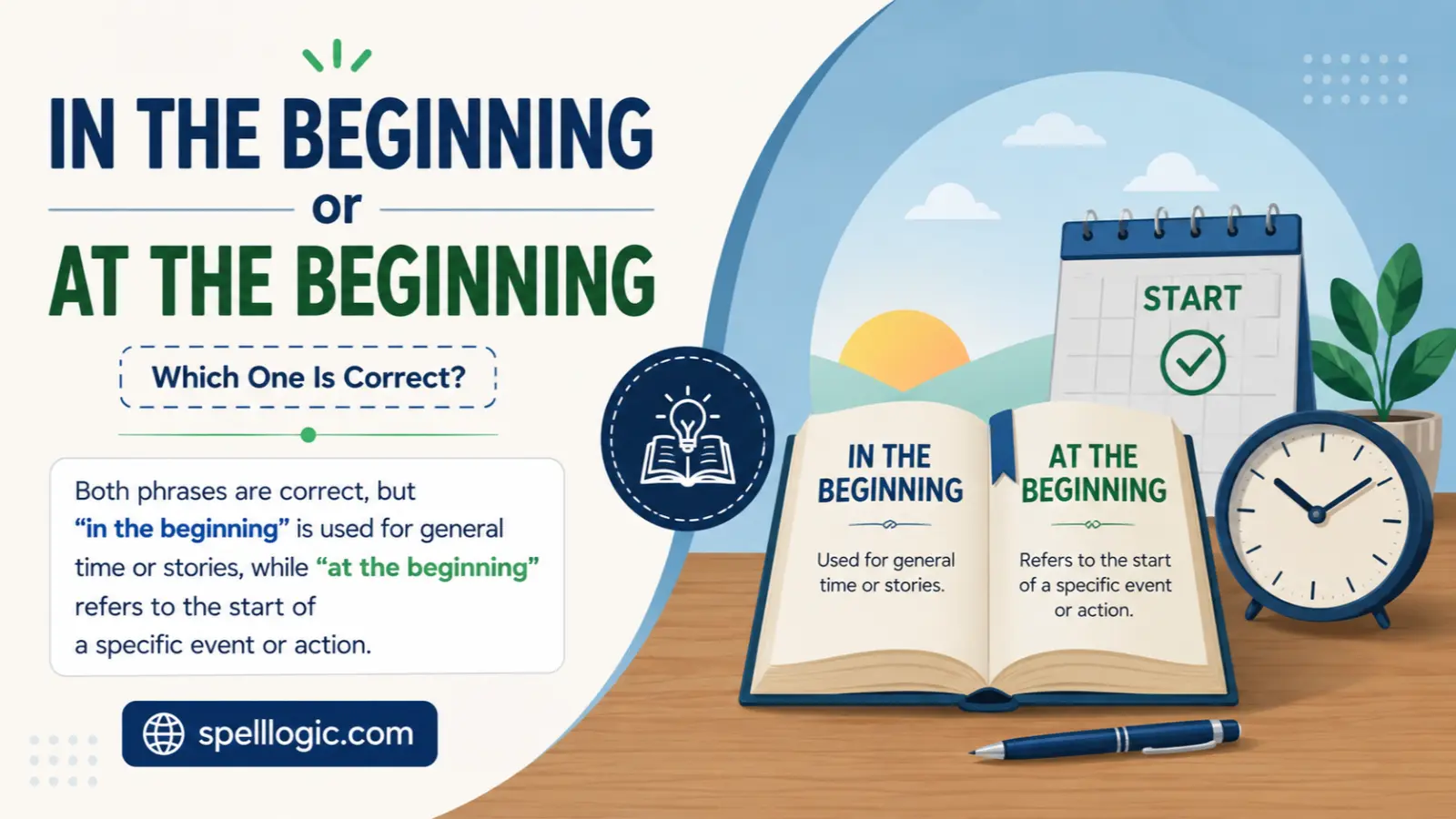
English learners often wonder whether in the beginning or at the beginning is the better expression because both phrases refer to an early point in time. Although they can sometimes appear in similar sentences, they do not always communicate exactly the same idea. The small difference is mainly about a period or stage versus a specific starting point.
Understanding this distinction can make your writing and speaking more natural, especially when discussing stories, projects, lessons, events, or processes. In this guide, you will learn when to use each expression, see clear examples, avoid common mistakes, and discover an easy way to remember the difference.
Why “In the Beginning or at the Beginning” Are Confusing
English learners often mix these expressions because both contain the word beginning and both point to an early stage. In everyday conversation, speakers may even use them in situations where either expression sounds understandable.
Similar pronunciation
The two expressions are pronounced similarly because they contain the same main noun, beginning. The difference comes from the prepositions in and at. Since prepositions are difficult to translate directly from one language to another, learners may choose the wrong one.
Similar spelling
The spelling is almost identical. The only important change is the preposition:
- in the beginning
- at the beginning
This tiny difference can change the focus of a sentence.
Context confusion
The main problem is context. In often presents the beginning as a period or early stage. At commonly identifies the beginning as a particular point or position.
For example, if you discuss how a person felt during the first part of a new job, in may be appropriate. If you describe something that happened immediately when the job started, at may be more natural.
Common learner mistakes
A frequent mistake is treating the two expressions as completely interchangeable. They overlap in some contexts, but they can emphasize different ideas. Another mistake is assuming that in the beginning always refers to the beginning of a story. In fact, it can describe the early stage of many situations.
“In the Beginning or at the Beginning” Explained Simply
The simplest way to understand the difference is to think about time span versus point.
In the beginning usually refers to an early period, stage, or phase. It can describe what was true during the first part of something.
At the beginning usually refers to a specific starting point or something located right at the start.
One-line distinction
“In the beginning” describes an early period, while “at the beginning” points to the starting point or position.
Examples
- In the beginning, I found the new software difficult to use.
- There is a short introduction at the beginning of the book.
The first sentence describes an experience during an early period. The second identifies the location of an introduction within the book.
Understanding Homophones in English
These expressions are sometimes discussed alongside confusing English word pairs, but they are not homophones. They are phrases that use different prepositions with the same noun.
What Are Homophones?
Homophones are words that have the same pronunciation but different meanings or spellings.
For example:
- right — correct
- write — to put words on paper
These words sound alike, but their meanings and spellings are different.
Why Homophones Cause Confusion
Homophones can be confusing because listeners cannot always identify the correct word from pronunciation alone. For example, when someone says “write,” you need the context to know whether the intended word is write or right.
The expressions discussed here create a different type of confusion. Their meanings are related, but the prepositions in and at guide the reader toward a different time relationship.
What Does “In the Beginning” Mean?
Definition and Core Meaning
In the beginning means during the first part of something, during an early period, or at an early stage. It often describes a situation that continued for some time rather than a single instant.
For example:
- In the beginning, learning Spanish was difficult.
- In the beginning, the business had only three employees.
- In the beginning, she was nervous about speaking in public.
In each example, the expression refers to an early phase.
Origin and Historical Use
The phrase has a long history in English and is especially familiar from traditional, literary, and religious language. One famous historical use appears in the opening of the Bible, which helped make the expression widely recognizable.
Over time, the phrase developed a broader everyday use. Today, it can describe the first stage of almost any situation, including education, relationships, businesses, projects, stories, and personal experiences.
Modern Usage and Synonyms
In modern English, useful alternatives include:
- at first
- initially
- during the early stages
- early on
- originally
These alternatives are not always perfect replacements, but they can help you understand the general meaning.
Key points
- It usually describes an early period.
- It often focuses on what happened during the first stage.
- It can describe experiences, conditions, opinions, or situations.
- It is common in both everyday and formal English.
- It can introduce a contrast with what happened later.
Example sentences
- In the beginning, the team struggled to communicate.
- In the beginning, I did not understand the instructions.
- In the beginning, the project seemed impossible.
- In the beginning, he wanted to become a teacher, but later he chose engineering.
Notice that each example describes a condition or experience during an early stage.
What Does “At the Beginning” Mean?
Definition and Core Meaning
At the beginning means at the starting point of something. It is often used when referring to an exact position, moment, section, or point where something starts.
For example:
- There is a title at the beginning of the article.
- Please write your name at the beginning of the form.
- We met at the beginning of the conference.
Here, the focus is on a particular starting position or moment.
Origin and Historical Context
The expression follows a basic English pattern in which at can identify a specific point or position. English commonly uses at for points in time and locations, such as “at noon,” “at the entrance,” and “at the start.”
As a result, the expression naturally developed as a way to identify something occurring right at the start of an event, activity, text, or process.
Modern Usage and Synonyms
Depending on the context, possible alternatives include:
- at the start
- when something starts
- initially
- at first
- from the outset
However, these alternatives can have slightly different meanings, so context remains important.
Key points
- It often identifies a specific starting point.
- It can refer to the first section of a text.
- It can identify the moment an event starts.
- It is useful for describing placement or position.
- It commonly appears with books, articles, meetings, lessons, journeys, and events.
Example sentences
- There is a useful summary at the beginning of the chapter.
- The teacher gave us instructions at the beginning of the lesson.
- We arrived at the beginning of the ceremony.
- Put the date at the beginning of your letter.
In these examples, the expression identifies something occurring at or located near the start.
In the Beginning or at the Beginning: Key Differences at a Glance
| Word | Part of Speech | Meaning | Example Context |
|---|---|---|---|
| In the beginning | Prepositional phrase | During the first period or early stage | In the beginning, the task seemed difficult. |
| At the beginning | Prepositional phrase | At the starting point or first position | There is a heading at the beginning of the page. |
The distinction is not an absolute rule. There are situations where both expressions may be grammatically possible, but the emphasis can change.
Compare:
- In the beginning, the students were quiet.
- At the beginning of the lesson, the students were quiet.
The first sentence emphasizes an early period. The second connects the quietness more directly to the starting point of the lesson.
This is why understanding context is more useful than simply memorizing a rule.
How to Remember the Difference Between In the Beginning or at the Beginning
A simple memory trick is to connect in with a period and at with a point.
Memory trick 1: IN = inside a period
Think of in as being inside a stretch of time.
In the beginning = during the early period.
For example:
In the beginning, I was unsure about the course.
You are imagining yourself inside the early stage of the course.
Memory trick 2: AT = a point
Think of at as pointing to a specific location on a timeline.
At the beginning = at the starting point.
For example:
At the beginning of the course, the teacher introduced the rules.
Here, the focus is on the starting point of the course.
Association technique
Imagine a timeline:
Beginning → Middle → End
If you are talking about a section of time, think in.
If you are pointing to the first point, think at.
One memorable example
In the beginning, I disliked the job, but at the beginning of each day, I still arrived on time.
The first expression refers to an early period of employment. The second identifies a particular point: the start of each day.
Common Mistakes and Confusions
Mistake 1: Treating the expressions as identical
✘ Incorrect idea: They always mean exactly the same thing.
✔ Better understanding: They are related, but in generally emphasizes an early period, while at often emphasizes a starting point.
Mistake 2: Using “at” for an extended early stage
✘ Incorrect: At the beginning, I spent several months learning the system.
✔ Better: In the beginning, I spent several months learning the system.
The second version makes the extended early period clearer.
Mistake 3: Using “in” for a specific location in a text
✘ Incorrect: There is a table in the beginning of the report.
✔ Correct: There is a table at the beginning of the report.
The table has a specific position: the start of the report.
Mistake 4: Forgetting the phrase “of”
When identifying the starting point of a particular thing, at the beginning of is very common.
✔ At the beginning of the meeting, everyone introduced themselves.
✔ At the beginning of the chapter, the author explains the main idea.
Mistake 5: Assuming “beginning” always needs the same preposition
English prepositions depend heavily on meaning and context. Learning the complete phrase is often more effective than translating in or at separately from your native language.
Examples Section: Correct and Incorrect Usage
Example 1
✔ Correct: In the beginning, the new routine felt strange.
✘ Incorrect: At the beginning, the new routine felt strange.
Explanation: The first sentence emphasizes the early period of adjusting to the routine. The second is not necessarily impossible, but it changes the emphasis toward a particular starting point.
Example 2
✔ Correct: There is a contents page at the beginning of the book.
✘ Incorrect: There is a contents page in the beginning of the book.
Explanation: The contents page has a particular location in the book, so at is the natural choice.
Example 3
✔ Correct: In the beginning, our team had very little experience.
✘ Incorrect: At the beginning, our team had very little experience.
Explanation: The intended meaning is an early phase of the team’s development.
Example 4
✔ Correct: At the beginning of the meeting, the manager explained the schedule.
✘ Incorrect: In the beginning of the meeting, the manager explained the schedule.
Explanation: The sentence identifies what happened at the starting point of a specific meeting. At the beginning of is the standard expression here.
Example 5
✔ Correct: In the beginning, I was afraid of making mistakes.
✘ Incorrect: At the beginning, I was afraid of making mistakes.
Explanation: The speaker is describing an early period of learning rather than pointing to one exact moment.
Self Assessment: Test Your Knowledge
Fill in each blank with in the beginning or at the beginning.
- ________, the students found the lesson difficult, but they improved later.
- The teacher wrote the date ________ of the worksheet.
- ________ of the film, we meet the main character.
- ________, I did not enjoy working from home, but my opinion changed.
Self Assessment Answers
- In the beginning — The sentence describes an early period of learning.
- At the beginning — The date has a specific position on the worksheet.
- At the beginning — The sentence refers to the opening point of the film.
- In the beginning — The sentence describes an early stage of the speaker’s experience.
FAQs
1. Is “in the beginning” grammatically correct?
Yes. It is a standard English expression used to describe an early period or stage of something.
2. Is “at the beginning” grammatically correct?
Yes. It is commonly used to identify a starting point, first section, or particular moment when something begins.
3. What is the main difference between the two expressions?
The main difference is emphasis. In usually presents the beginning as a period, while at usually presents it as a point or position.
4. Can both expressions be used in the same sentence?
Sometimes. The choice depends on what you want to emphasize. One may describe an early stage, while the other may point to a specific starting moment.
5. Should I say “at the beginning of the book”?
Yes. When referring to the first part or opening position of a book, at the beginning of the book is the natural choice.
6. Can “in the beginning” mean “at first”?
Yes. In many contexts, in the beginning can be replaced by at first or initially, especially when describing an early experience or condition.
7. Are these expressions homophones?
No. They are not homophones because they are phrases with different prepositions rather than different words that share the same pronunciation.
Final Conclusion: Using “In the Beginning or at the Beginning” Correctly
Learning the difference between in the beginning or at the beginning becomes much easier when you focus on the idea of period versus point. Use in the beginning when you are describing an early period, stage, condition, or experience. For example, “In the beginning, the project was difficult” describes an early phase of the project. Use at the beginning when you are identifying a specific starting point, first section, or position. For example, “At the beginning of the project, we created a plan” points to the project’s starting stage.
A useful memory trick is simple: think of in as being inside a period of time and at as pointing to a particular point. This idea can help you choose the correct expression in everyday conversations, academic writing, emails, reports, stories, and professional communication. Remember that context matters, and some sentences may allow both expressions with slightly different emphasis. Instead of memorizing isolated prepositions, learn the complete phrases and notice how native speakers use them. With regular reading and practice, this distinction will become natural. Keep practicing, and you will soon use these expressions confidently and accurately.