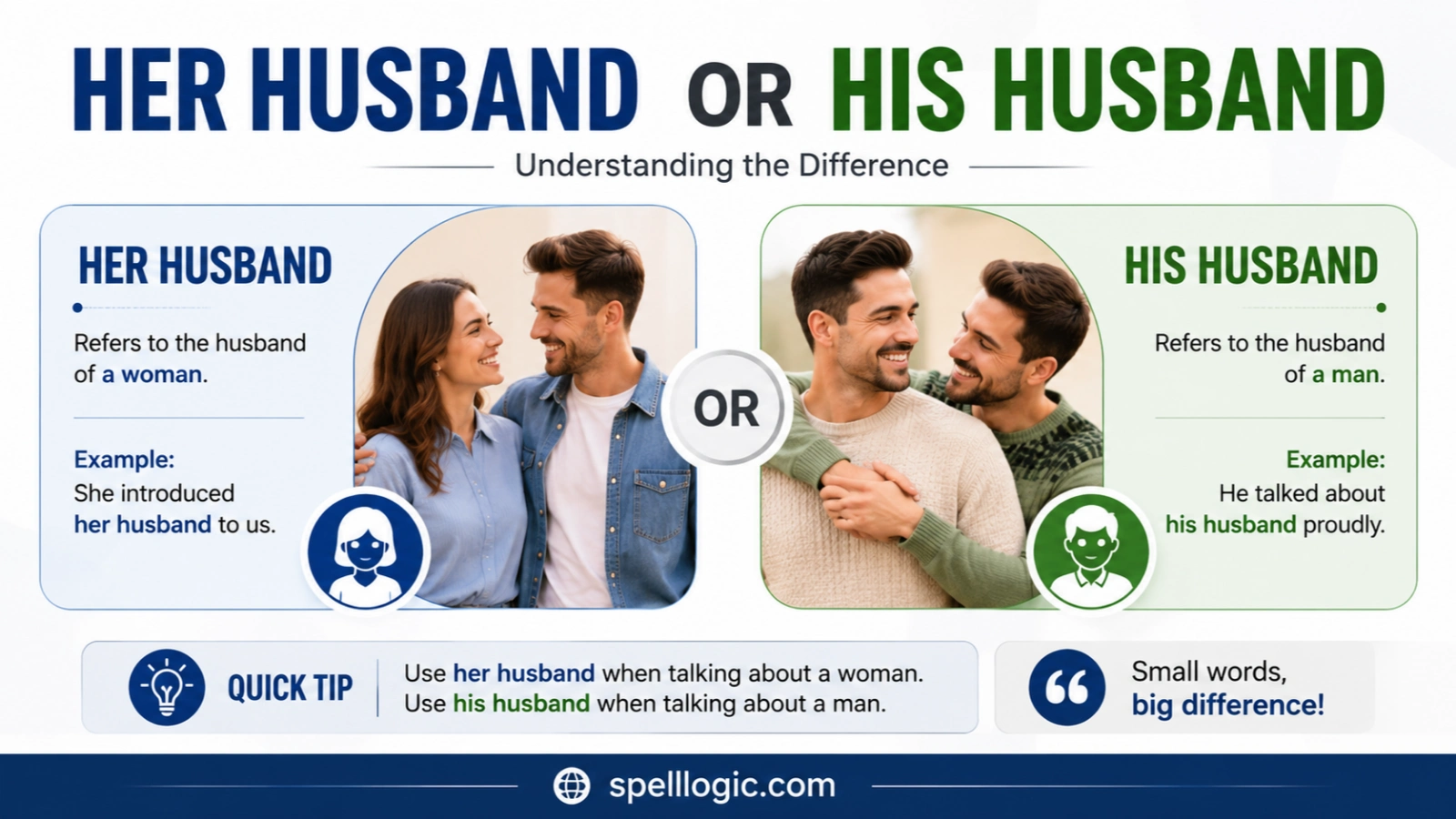
English learners often hesitate when choosing between possessive words such as “her” and “his.” The phrase her husband or his husband can be especially confusing because both forms look grammatically possible at first glance.
This distinction matters in everyday conversations, emails, introductions, and written English. Once you understand how her and his work, choosing the right expression becomes simple and natural.
Why “her husband or his husband” Are Confusing
People sometimes mix up her husband or his husband because her and his both indicate possession or association. The noun husband stays exactly the same, so the only visible difference is the possessive word before it.
Similar pronunciation
There is no true homophone problem here. Her and his have clearly different pronunciations. Still, in fast speech, learners may not notice the short possessive word, especially when listening to a complete sentence.
Similar spelling
Learners who are still developing confidence with pronouns may confuse their functions.
Context confusion
For her husband or his husband, the main issue is context. You need to know who the person is before selecting the possessive adjective.
Common learner mistakes
Common errors include choosing his simply because “husband” refers to a male person, or choosing her because the speaker knows a woman in the situation. The possessive adjective refers to the person who has the relationship, not necessarily to the gender of the noun after it.
her husband or his husband Explained Simply
The simplest rule for her husband or his husband is to identify the person whose husband you are talking about.
One-line distinction: her refers to a female person, while his traditionally refers to a male person.
In her husband or his husband, the word husband is the same; only the person being referred to changes.
- “Sara visited her husband after work.”
- “Ali introduced me to his husband at the event.”
In other words, her husband or his husband means the husband belonging to or partnered with a woman or man, respectively, in the context of the sentence.
Understanding Homophones in English
What Are Homophones?
Homophones are words that sound the same or nearly the same but have different meanings, spellings, or grammatical functions. For example, right and write sound alike but have different meanings.
The expressions her husband or his husband are not homophones. Their key difference is grammatical: her and his identify different possessors.
Why Homophones Cause Confusion
Homophones can confuse learners because listening alone may not reveal which spelling is intended. For example, “write” and “right” require context to understand. In contrast, her and his are distinguished by both sound and meaning, although quick speech can make the difference less noticeable.
What Does “her husband” Mean?
Definition and Core Meaning
“Her husband” refers to the man who is married to, or is the husband of, a woman or female person already identified in the context.
The word her is a possessive adjective. It comes before a noun and shows a relationship or association with a female person.
Origin and Historical Use
Her developed from older forms of English that marked feminine reference. Over centuries, English simplified many pronoun forms, but her remained an important object and possessive form for feminine reference.
The noun husband has Old English roots and historically referred to a householder or head of a household. Its meaning developed into its modern sense of a married male partner.
Modern Usage and Synonyms
Today, “her husband” is standard English when the person being referred to uses she/her pronouns or is otherwise identified as female in the context.
For her husband or his husband, related expressions include:
- her spouse
- her partner
- her married partner
- the husband of her
Example Sentences
- “Emma called her husband before leaving the office.”
- “The doctor spoke with Linda and her husband.”
- “She brought her husband to the family dinner.”
- “I met her husband last weekend.”
The important point is that her identifies the person connected to the husband. It does not describe the husband himself.
What Does “his husband” Mean?
Definition and Core Meaning
“His husband” refers to the male person who is married to, or is the husband of, a man already identified in the context. The possessive adjective his indicates that the husband is connected to a male person.
Origin and Historical Context
His developed from Old English forms used for masculine possession. Modern English uses his both as a possessive adjective before a noun and as a possessive pronoun, as in “The coat is his.”
The word husband, meanwhile, has a long history in English and has evolved from an older term connected with managing a household.
Modern Usage and Synonyms
In contemporary English, her husband or his husband depends on the person being referenced; “his husband” is standard when the person whose relationship is being described is male and uses he/him pronouns, or when that reference is otherwise established.
For her husband or his husband, related expressions include:
- his spouse
- his partner
- his married partner
- the husband of his
Example Sentences
- “James invited his husband to the ceremony.”
- “Michael spoke with his husband after the meeting.”
- “David introduced his husband to his colleagues.”
- “I saw his husband at the restaurant.”
The word his points back to the person who has the relationship. It does not mean that the husband himself is necessarily male because of the possessive word alone; the relationship and context determine the reference.
her husband or his husband: Key Differences at a Glance
| Word | Part of Speech | Meaning | Example Context |
|---|---|---|---|
| her husband | Possessive adjective + noun | The husband of a female person | “Nadia called her husband.” |
| his husband | Possessive adjective + noun | The husband of a male person | “Omar called his husband.” |
A useful grammatical point for her husband or his husband is that her and his are possessive adjectives, while husband is a noun.
How to Remember the Difference Between her husband and his husband
For her husband or his husband, use this simple memory trick:
Her → she → her husband
His → he → his husband
Easy memory tricks
- Think she → her.
- Think he → his.
- Ignore the gender of the noun husband when choosing the possessive adjective.
- Look backward in the sentence and ask, “Whose husband?”
Association techniques
Imagine two quick sentences:
- “She has a husband.” → “That is her husband.”
- “He has a husband.” → “That is his husband.”
One memorable example
“Maria met her husband, while John met his husband.”
This example about her husband or his husband shows that the possessive adjective changes according to the person connected to the husband.
Common Mistakes and Confusions
That is not how possessive adjectives work. The possessive adjective identifies the person who has the relationship.
Wrong and correct versions
Wrong: “Sarah went to the store with his husband.”
Correct: “Sarah went to the store with her husband.”
Why? Sarah is the person being referred to, so her is appropriate in this context.
Wrong: “Tom introduced her husband to his friends.”
Correct: “Tom introduced his husband to his friends.”
Why? If Tom is the person whose husband is being discussed, his is the appropriate possessive adjective.
Another important point when using her husband or his husband is that modern English should respect the pronouns a person uses. If a specific individual identifies differently, use the pronouns that person uses rather than relying on assumptions.
Examples Section: Correct and Incorrect Usage
Example 1
✔ Correct: “Anna visited her husband in the hospital.”
✘ Incorrect: “Anna visited his husband in the hospital.”
Here, Anna is the person whose husband is being discussed, so her is correct.
Example 2
✔ Correct: “Robert invited his husband to dinner.”
✘ Incorrect: “Robert invited her husband to dinner.”
Here, Robert is the person connected to the husband, so his is correct.
Example 3
✔ Correct: “I spoke to Lisa and her husband.”
✘ Incorrect: “I spoke to Lisa and his husband.”
The possessive adjective agrees with the person being referred to, not with the noun husband.
Example 4
✔ Correct: “Mark introduced his husband to his parents.”
✘ Incorrect: “Mark introduced her husband to his parents.”
The context identifies Mark as the person whose husband is being introduced.
Example 5
✔ Correct: “She brought her husband to the party.”
✘ Incorrect: “She brought his husband to the party.”
The pronoun she connects naturally with her, not his.
Self Assessment: Test Your Knowledge
For her husband or his husband, fill in each blank with her or his.
- Maria called ___ husband after work.
- Daniel introduced ___ husband to his neighbors.
- Sarah and ___ husband moved to a new home.
- Peter said that ___ husband would arrive later.
Self Assessment Answers
- her — Maria is the person being referred to, so her husband or his husband depends on the subject.
- his — Daniel is the person being referred to.
- her — Sarah is the person connected to the husband.
- his — Peter is the person connected to the husband.
FAQs About “her husband and his husband”
Is “her husband” grammatically correct?
Yes. Her husband is grammatically correct when the husband is connected to a woman or female person identified in the context.
Is “his husband” grammatically correct?
Yes. His husband is grammatically correct when the husband is connected to a man or male person identified in the context.
Which is correct: her husband or his husband?
For her husband or his husband, both can be correct. The correct choice depends on the person whose husband you are describing.
Why can’t I choose based on the word “husband”?
Because with her husband or his husband, her and his describe the possessor or relationship holder, not the noun that follows them. The word husband does not automatically require his.
Are “her” and “his” homophones?
No. They have different pronunciations and meanings. They are possessive adjectives used with different pronoun references.
Can “her husband” refer to a same-sex marriage?
Yes. The phrase describes a husband connected to a person who uses she/her pronouns or is otherwise identified as female. Relationship language should follow the person’s own established pronouns.
How can I remember the difference quickly?
To remember her husband or his husband, use the pair she → her and he → his. Then ask, “Whose husband?” This makes the correct choice much easier.
Final Conclusion: Using “her husband” and “his husband” Correctly
Understanding her husband or his husband becomes easy once you focus on the person being referred to rather than the noun husband. Her is the possessive adjective connected with she, while his is traditionally connected with he. Therefore, use her husband when the husband belongs to or is partnered with a woman or someone who uses she/her pronouns in the relevant context. Use his husband when the husband belongs to or is partnered with a man or someone who uses he/him pronouns in the relevant context.
For her husband or his husband, the most useful memory rule is simple: she → her and he → his. When you are unsure, ask yourself, “Whose husband am I talking about?” The answer will usually tell you which possessive adjective to use. Remember that the possessive word does not describe the husband’s gender; it identifies the person connected to him. When choosing her husband or his husband, context and a person’s stated pronouns should guide your choice.
In real-world communication, this distinction is useful in conversations, emails, introductions, and everyday writing. Keep practicing with short sentences, and you will soon use possessive adjectives with confidence.