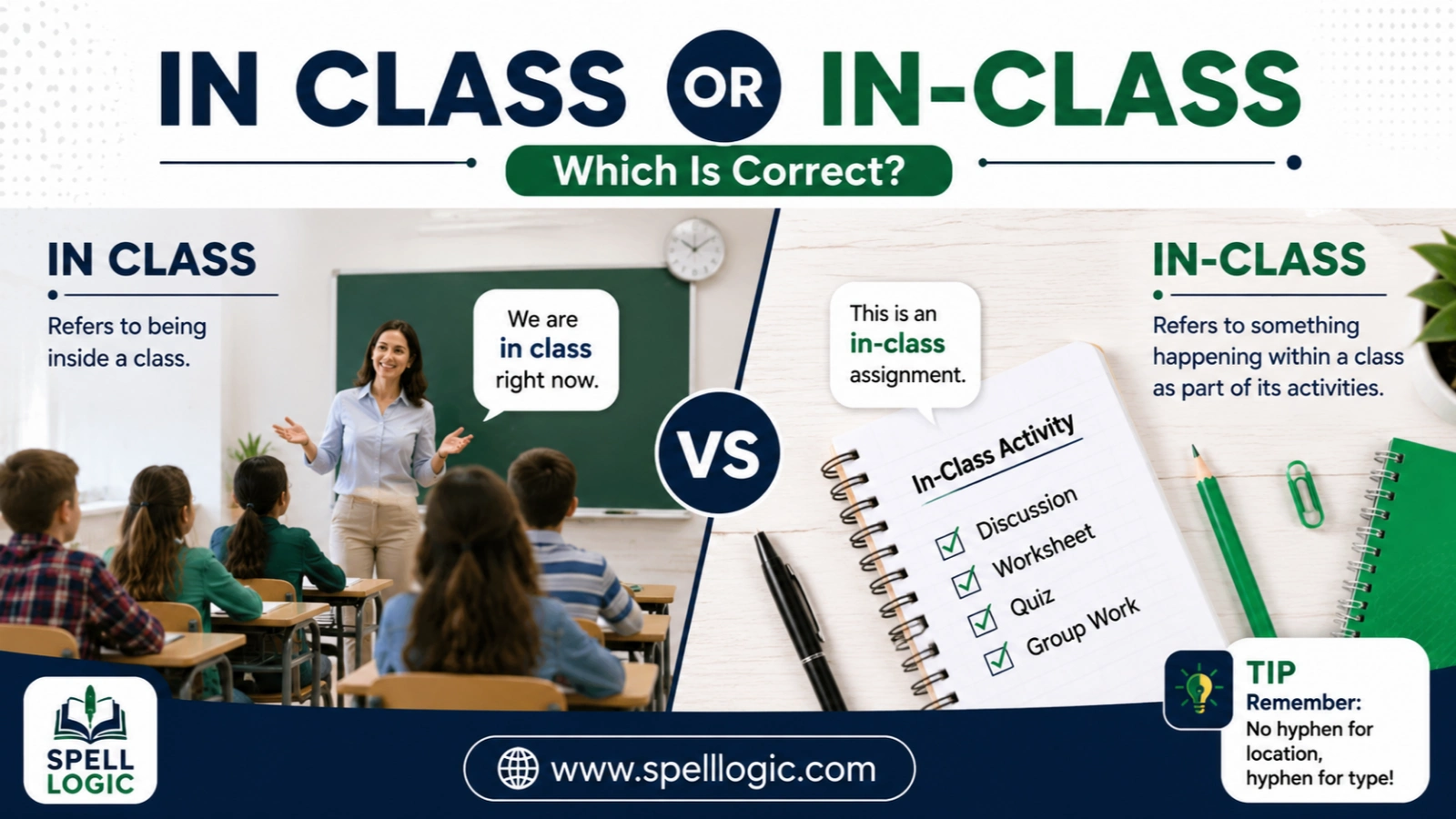
English learners often wonder whether in class or in-class is the correct form because the two expressions look almost identical. The difference is not about pronunciation or meaning alone; it is mainly about grammar and position in a sentence. One form is normally used as a phrase showing where or when something happens, while the hyphenated form is generally used before a noun as a compound adjective.
Understanding this small punctuation difference can make your writing clearer and more natural. In this guide, we will explain the rules in simple English, show common examples, and help you choose the right form with confidence. This guide treats in class or in-class as a grammar and punctuation question rather than a pronunciation question.
Why “in class” and “in-class” Are Confusing
The expressions in class or in-class are easy to mix up because they contain exactly the same words. The main difference is the hyphen, and punctuation can be difficult for English learners to notice or remember.
Similar pronunciation
There is normally no meaningful pronunciation difference between the two forms. When spoken aloud, the listener usually cannot hear whether the writer intends a space or a hyphen. Learning in class or in-class usage helps learners write more naturally.
Similar spelling
Both forms use in and class. The only visible difference is that in-class contains a hyphen. That small mark has a grammatical purpose. The basic rule for in class or in-class is based on sentence function.
Context confusion
The form without a hyphen usually functions as a phrase, especially after a verb. The hyphenated form usually works as a compound modifier before a noun. Context is especially important when choosing between in class or in-class.
For example:
- We discussed the topic in class.
- The teacher planned an in-class discussion.
Common learner mistakes
A common mistake is to hyphenate the expression every time it appears. Another is to leave out the hyphen when the expression is being used directly before a noun as a compound modifier. The safest approach is to look at what comes next and determine the grammatical job of the expression. Many school-related sentences provide useful practice with in class or in-class.
“in class” vs “in-class” Explained Simply
The basic rule is simple:
“in class” is normally a prepositional phrase that describes an activity or situation happening during a class. “in-class” is usually a compound adjective placed before a noun to describe something connected with or occurring during class.
In short, in class or in-class depends on how the expression functions in the sentence.
One-line distinction
In class describes what happens during a class, while in-class modifies a noun related to an activity or event during class. The distinction between in class or in-class is small but useful in formal English.
Two example sentences
- The students asked several questions in class.
- We have an in-class test tomorrow.
The first example tells us where or when the students asked questions. The second uses the hyphenated expression to describe the type of test. Writers can improve clarity by checking the position of in class or in-class in a sentence.
Understanding Homophones in English
What Are Homophones?
Homophones are words that have the same pronunciation but different meanings, spellings, or both. For example, flower and flour sound alike but refer to different things.
However, in class or in-class is not a homophone pair. The two forms are pronounced the same because the hyphen does not normally change pronunciation. They are better understood as different written forms of a related expression.
Why Homophones Cause Confusion
Homophones can confuse learners because speech does not show spelling differences. For example, someone may hear flour and need context to know which spelling is intended. In contrast, the issue with in class or in-class is mainly grammatical and typographical rather than a difference in sound. Students often encounter in class or in-class in school notices and assignments.
What Does “in class” Mean?
Definition and Core Meaning
In class is a prepositional phrase. It commonly means during a lesson or while attending a class. It can describe an action, event, behavior, or situation that takes place during class time.
For example:
- I took notes in class.
- She fell asleep in class.
- We learned about grammar in class.
- Please do not use your phone in class.
The expression is especially common after verbs that describe activities, such as study, learn, speak, listen, write, read, and participate. This guide treats in class or in-class as a useful distinction for everyday educational writing.
Origin and Historical Use
The word class has a long history in English. It comes from Latin classis, meaning a group or division, and English later developed the modern educational sense of a group of students or a lesson. The preposition in naturally combines with class to express participation or presence within that setting.
The open form has remained standard in ordinary sentences because it behaves like a normal prepositional phrase. The distinction between in class or in-class can therefore be understood through normal English sentence structure.
Modern Usage and Synonyms
Today, in class is extremely common in schools, colleges, universities, training programs, and other educational settings.
Example-related expressions include:
- during class
- during the lesson
- while in class
- in the classroom
The choice depends on the exact context. Understanding in class or in-class also makes educational writing easier to edit.
Example Sentences
- The teacher explained the rule in class.
- We completed the exercise in class.
- He made an interesting comment in class.
- They were asked to work quietly in class.
Notice that the expression is not directly modifying a noun in these examples. It tells us when or where the action happened.
What Does “in-class” Mean?
Definition and Core Meaning
In-class is a hyphenated compound modifier. It is most often used before a noun when the writer wants to describe something that occurs during class or is connected with classroom instruction.
For example:
- We have an in-class assignment.
- The professor gave us an in-class quiz.
- Students completed an in-class activity.
Here, the hyphen helps show that in and class work together as one modifier for the noun that follows. Good proofreading can quickly catch mistakes involving in class or in-class.
Origin and Historical Context
English uses hyphens to connect words when they work together as a descriptive unit. Modern style guides do not treat every compound in exactly the same way, and hyphenation can vary according to dictionary, publisher, or style guide.
Nevertheless, in-class is widely used as a compound adjective before nouns in educational writing. The same principle makes in class or in-class easier to recognize in longer sentences.
Modern Usage and Synonyms
Common related expressions include:
- classroom
- classroom-based
- instructional
- face-to-face, when the context specifically means live instruction
The best choice depends on context. Writers should also remember that in class or in-class is mainly a question of grammatical function and punctuation.
Example Sentences
- The students completed an in-class exercise.
- Our in-class presentation starts at noon.
- The instructor announced an in-class assessment.
- She prepared several in-class activities.
“in class” vs “in-class”: Key Differences at a Glance
| Word | Part of Speech | Meaning | Example Context |
|---|---|---|---|
| in class | Prepositional phrase | During or while attending a class | We practiced speaking in class. |
| in-class | Compound adjective/modifier | Happening during class or related to class | We had an in-class speaking test. |
The key distinction in in class or in-class is therefore function, not pronunciation. If the expression tells you when or where an action occurs, the open form is usually appropriate. If it directly modifies a noun, the hyphenated form is often appropriate.
How to Remember the Difference Between in class and in-class
A useful memory trick is:
Action = in class. Noun before it = in-class.
When the expression explains what someone does during a lesson, use the open form:
- We read in class.
When the expression describes a noun immediately afterward, consider the hyphenated form:
- We had an in-class reading exercise.
Association Techniques
Think of the hyphen as a small bridge connecting two words that work together to describe one noun.
- in class → describes an action or situation
- in-class + noun → describes the noun
Another helpful association is to ask: “What comes after it?” If a noun follows and the expression acts as one description, the hyphen can make the relationship clearer. When you learn in class or in-class, focus first on grammar rather than the hyphen itself.
One Memorable Example
Remember this pair:
I took the test in class.
I took an in-class test.
The meaning is closely related, but the grammar is different. This is the easiest way to remember in class or in-class. These examples show how in class or in-class changes according to its role.
Common Mistakes and Confusions
Mistake 1: Hyphenating the phrase after a verb
✘ We studied in-class yesterday.
✔ We studied in class yesterday.
Here, the expression tells us when the studying happened, so the open form is standard. Careful writers use context to decide whether in class or in-class needs a hyphen.
Mistake 2: Leaving out the hyphen before a noun
✘ We had an in class test.
✔ We had an in-class test.
Here, the expression modifies test, so the hyphenated form is appropriate. Regular practice with in class or in-class can build confidence.
Mistake 3: Thinking the hyphen changes the pronunciation
The hyphen generally does not create a different spoken form. It mainly signals that the words function together as a compound modifier. Keep in mind that in class or in-class is mainly a written distinction.
Mistake 4: Assuming every style guide uses exactly the same rule
Hyphenation can vary in compound modifiers, especially when a phrase becomes established as a fixed expression. For formal writing, follow the style guide used by your school, workplace, publisher, or institution. The same principle makes in class or in-class easier to recognize in longer sentences.
Examples Section: Correct and Incorrect Usage
Example 1
✔ Correct: The teacher answered my question in class.
✘ Incorrect: The teacher answered my question in-class.
Explanation: The expression describes when the teacher answered the question, so the open form is appropriate.
Example 2
✔ Correct: We have an in-class quiz today.
✘ Incorrect: We have an in class quiz today.
Explanation: The expression directly modifies quiz, so the hyphenated form makes the compound modifier clear.
Example 3
✔ Correct: She participated actively in class.
✘ Incorrect: She participated actively in-class.
Explanation: The phrase follows the verb and tells us where or when she participated.
Example 4
✔ Correct: The instructor assigned an in-class writing task.
✘ Incorrect: The instructor assigned an in class writing task.
Explanation: The compound modifier comes immediately before writing task. Understanding in class or in-class helps learners identify this pattern quickly.
Example 5
✔ Correct: We discussed the problem in class.
✘ Incorrect: We discussed the problem in-class.
Explanation: The phrase gives the setting for the discussion rather than modifying a following noun.
Example 6
✔ Correct: The course includes several in-class activities.
✘ Incorrect: The course includes several in class activities.
Explanation: The compound modifier describes the activities, so the hyphenated form is suitable.
Self Assessment: Test Your Knowledge
Fill in each blank with the correct form: in class or in-class.
- We completed an ______ assignment before lunch.
- The students learned this grammar rule ______.
- Our teacher gave us an ______ quiz.
- She asked an important question ______.
Self Assessment Answers
This quick test reinforces the main rule for in class or in-class.
- in-class — It modifies assignment.
- in class — It describes when the students learned.
- in-class — It modifies quiz.
- in class — It describes when she asked the question.
FAQs About “in class or in-class”
Is “in class” correct?
Yes. In class is the standard open form when the expression functions as a prepositional phrase, especially when it means during a class.
Is “in-class” correct?
Yes. In-class is commonly correct when it functions as a compound modifier before a noun, such as in-class test or in-class activity.
Is “in class or in-class” a spelling difference?
It is more accurately a difference in grammatical function and hyphenation. The words themselves are the same, but their role in the sentence changes.
Should I write “in-class activity”?
Yes. In-class activity is a common compound modifier. The hyphen connects the words so they clearly describe the noun activity.
Should I write “students studied in-class”?
Usually no. Write students studied in class because the phrase follows the verb and describes where or when the studying happened.
Is “in class” a noun or adjective?
By itself, in class is normally a prepositional phrase, not a single adjective. The hyphenated in-class can function as a compound adjective or modifier before a noun.
Is “in class or in-class” difficult for English learners?
It can seem difficult at first because the forms look almost identical. Once you remember the basic pattern—in class for an action or situation and in-class before a noun—the distinction becomes much easier.
Final Conclusion: Using “in class or in-class” Correctly
Knowing when to use in class or in-class can make everyday English writing more accurate and polished. The open form in class is generally used as a prepositional phrase to show that something happens during a lesson or while someone is attending a class. For example, “We practiced pronunciation in class” uses the phrase naturally. The hyphenated form in-class usually works as a compound modifier before a noun, as in “We completed an in-class exercise.”
The easiest memory tip is to look at the word that follows the expression. If you are describing an action, place, or situation, in class is usually the right choice. If the expression comes before a noun and acts as one descriptive unit, in-class is often the better choice. Also remember that these forms are not homophones in the usual grammatical sense; their pronunciation is generally the same, while their written function differs.
Do not worry if hyphenation feels confusing at first. Pay attention to sentence structure, practice with real examples, and check the style guide required for formal writing when necessary. With regular practice, choosing between the two forms will become natural. Keep learning, keep writing, and remember: small grammar details can make a big difference in clear English.