Many English learners struggle with tear and tare because these two words sound exactly the same but have completely different meanings. Since they are pronounced alike, people often choose the wrong spelling when writing, especially in exams, emails, or everyday conversations.
Understanding the difference between tear and tare helps you communicate more accurately and avoid common spelling mistakes. In this guide, you’ll learn the meanings, origins, examples, memory tricks, and practical tips that make these confusing words easy to understand and remember.
Why “Tear” and “Tare” Are Confusing
Many learners confuse tear and tare because they are homophones—words that sound the same but have different meanings and spellings.
Similar Pronunciation
Both tear (meaning to rip) and tare (used in weighing) are pronounced /teər/.
For example:
- tear the paper
- tare the scale
Although they sound identical, their meanings are unrelated.
Similar Spelling
The words differ by only one letter:
- tear
- tare
Because they look similar, spelling mistakes are common.
Context Confusion
People usually encounter tear in daily English, but tare appears mostly in scientific, industrial, cooking, and shipping contexts. Learners unfamiliar with weighing scales may not recognize tare.
Common Learner Mistakes
Some frequent errors include:
- Writing tare instead of tear when talking about ripping paper.
- Writing tear weight instead of tare weight in shipping documents.
- Assuming both words can be used interchangeably.
Tear vs Tare Explained Simply
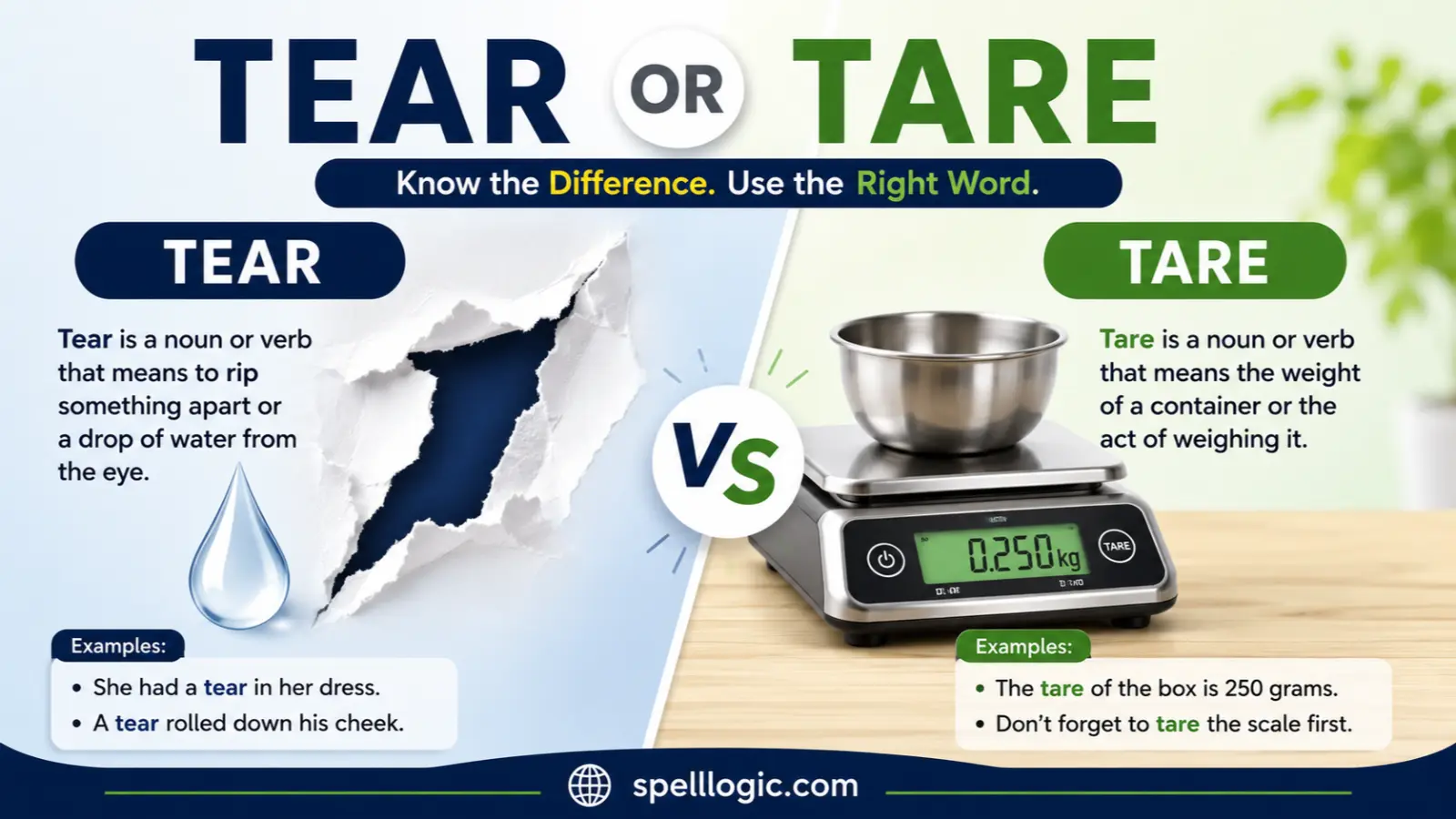
Tear means to rip something apart or a drop of liquid from your eye, while tare means the weight of an empty container or the act of resetting a scale to zero.
One-line distinction
Tear is about ripping or crying, while tare is about weighing.
Example Sentences
Tear
- Please don’t tear the letter.
- A tear rolled down her cheek.
Tare
- Press the tare button before weighing the flour.
- The worker recorded the tare weight of the box.
Understanding Homophones in English
What Are Homophones?
Homophones are words that sound the same but have different spellings and meanings.
Example:
- flower
- flour
Although they sound identical, they refer to different things.
Why Homophones Cause Confusion
English contains many homophones because pronunciation has changed over time while spellings have remained different.
Example:
- I saw a tear in the shirt.
- The scale displayed the tare weight.
Without context, both words sound exactly alike.
What Does “Tear” Mean?
Definition and Core Meaning
The word tear has multiple meanings depending on how it is used.
As a verb, it means:
- to rip
- to pull apart
- to damage by force
As a noun, it can mean:
- a drop of water from the eye
- a rip in cloth or paper
Origin and Historical Use
Tear comes from Old English and has been part of the language for centuries. Its meanings relating to ripping and crying have remained largely unchanged.
Modern Usage and Synonyms
Common meanings include:
- rip
- split
- shred
- pull apart
When referring to crying:
- teardrop
- droplet
Key Points
- Used every day
- Can be a noun or verb
- Often appears in literature and conversation
- Has more than one meaning
Example Sentences
- Be careful not to tear the photograph.
- She wiped away a tear after hearing the good news.
- Strong winds can tear branches from trees.
- The jacket has a small tear near the pocket.
What Does “Tare” Mean?
Definition and Core Meaning
Tare refers to the weight of an empty container. It also means resetting a digital scale to ignore the container’s weight.
Origin and Historical Context
The word comes from historical trade and commerce, where merchants needed to subtract container weight to determine the true weight of goods.
Today, the word is widely used in:
- kitchens
- laboratories
- shipping
- manufacturing
- warehouses
Modern Usage and Synonyms
Related terms include:
- container weight
- empty weight
- zero the scale
- reset weight
Key Points
- Mainly used in weighing
- Common on digital kitchen scales
- Important in shipping and logistics
- Usually appears as a noun or verb
Example Sentences
- Press tare before adding the ingredients.
- The package has a tare weight of 2 kilograms.
- The technician forgot to tare the balance.
- Always remove the tare weight before calculating shipping costs.
Tear vs Tare: Key Differences at a Glance
| Word | Part of Speech | Meaning | Example Context |
|---|---|---|---|
| Tear | Noun, Verb | A rip, a drop from the eye, or to rip something | Don’t tear the paper. |
| Tare | Noun, Verb | Empty container weight or resetting a scale | Press the tare button before weighing. |
How to Remember the Difference Between Tear and Tare
Learning these words becomes easier with simple memory tricks.
Easy Memory Tricks
- Tear has “ea”, reminding you of eyes, where tears come from.
- Tare has “ar”, which can remind you of scale and weight adjustment.
Association Techniques
Think of these images:
- Tear = ripped paper or crying eyes
- Tare = digital kitchen scale
Memorable Example
Before weighing sugar, press tare. If you accidentally rip the recipe, you’ve made a tear.
This sentence links both words in one situation.
Common Mistakes and Confusions
Wrong
❌ Please tare the paper carefully.
✅ Please tear the paper carefully.
Explanation: Here, the meaning is “rip,” so tear is correct.
Wrong
❌ The tear weight is 500 grams.
✅ The tare weight is 500 grams.
Explanation: Empty container weight is called tare weight.
Wrong
❌ Press tear before adding flour.
✅ Press tare before adding flour.
Explanation: Kitchen scales use the tare function.
Wrong
❌ There was a tare in my shirt.
✅ There was a tear in my shirt.
Explanation: A rip in clothing is a tear.
Examples Section: Correct and Incorrect Usage
Example 1
✔ Correct: She had a tear in her dress.
✘ Incorrect: She had a tare in her dress.
Example 2
✔ Correct: Press the tare button before measuring rice.
✘ Incorrect: Press the tear button before measuring rice.
Example 3
✔ Correct: A tear rolled down his face.
✘ Incorrect: A tare rolled down his face.
Example 4
✔ Correct: The shipping company recorded the tare weight.
✘ Incorrect: The shipping company recorded the tear weight.
Example 5
✔ Correct: Don’t tear the receipt.
✘ Incorrect: Don’t tare the receipt.
Example 6
✔ Correct: Always tare the scale before measuring ingredients.
✘ Incorrect: Always tear the scale before measuring ingredients.
Self Assessment: Test Your Knowledge
Fill in the blanks with tear or tare.
- Press the ______ button before weighing the bowl.
- She wiped away a ______ after the movie.
- Be careful not to ______ the envelope.
- The shipping company calculated the ______ weight first.
Self Assessment Answers
- tare
- tear
- tear
- tare
FAQs
1. Are tear and tare pronounced the same?
Yes. They are homophones and share the same pronunciation, although they have different meanings and spellings.
2. What does tare mean on a digital scale?
It resets the scale to zero so that only the contents are measured, not the container.
3. Can tear be both a noun and a verb?
Yes. It can refer to a rip or a drop from the eye (noun), or the act of ripping something (verb).
4. Is tare commonly used in everyday English?
It is less common than tear and is mainly used in cooking, science, shipping, and manufacturing.
5. How can I remember the difference between tear and tare?
Remember that tear relates to ripping or crying, while tare relates to weighing and scales.
6. What is tare weight?
Tare weight is the weight of an empty container before any contents are added.
7. Which word is more common?
Tear is far more common in everyday conversation, while tare is mostly used in technical or professional settings.
Final Conclusion: Using “Tear” and “Tare” Correctly
Although tear and tare sound exactly alike, they belong to very different parts of everyday English. Tear usually refers to ripping something, a rip in a material, or a drop of liquid from the eye. It is a common word that appears in conversations, books, news articles, and daily writing. Tare, on the other hand, is a specialized term used when weighing objects. It refers to the weight of an empty container or the action of resetting a scale so that only the contents are measured. Understanding this distinction makes your writing more precise and helps you avoid confusing these homophones.
A simple way to remember the difference is to connect tear with tears from your eyes or tearing paper, while linking tare with kitchen scales, laboratories, and shipping boxes. Whenever you read or hear these words, pay attention to the context because the surrounding sentence usually reveals which spelling is correct. Practicing with example sentences, completing exercises, and using the words in real-life situations will strengthen your understanding. Over time, choosing the correct word will become natural. Every new pair of confusing English words you master builds your confidence and improves your communication, so keep learning, keep practicing, and enjoy expanding your English vocabulary.