Many English learners wonder whether they should write time line or timeline. Since both forms have appeared in books, newspapers, and online content, it is easy to think they are equally correct in every situation. However, modern English has changed over time, and one version is now much more common than the other.
Understanding the difference helps you write more naturally, especially in school assignments, business writing, and professional communication. In this guide, you’ll learn the meanings, history, correct usage, examples, memory tips, and common mistakes so you can confidently choose the right spelling every time.
Table of Contents
- Introduction
- Why “Time Line” and “Timeline” Are Confusing
- Time Line vs Timeline Explained Simply
- Understanding Homophones in English
- What Does “Time Line” Mean?
- What Does “Timeline” Mean?
- Time Line vs Timeline: Key Differences at a Glance
- How to Remember the Difference Between Time Line and Timeline
- Common Mistakes and Confusions
- Examples Section: Correct and Incorrect Usage
- Self Assessment: Test Your Knowledge
- Self Assessment Answers
- FAQs About “Time Line” and “Timeline”
- Final Conclusion: Using “Time Line” and “Timeline” Correctly
Why “Time Line” and “Timeline” Are Confusing
Many people mix up time line and timeline because they look almost identical and have the same pronunciation.
Similar Pronunciation
Both are pronounced exactly the same:
/ˈtaɪm.laɪn/
Since there is no difference in pronunciation, listeners cannot tell which spelling is intended.
Similar Spelling
The only visible difference is the space:
- Time line (two words)
- Timeline (one word)
This small spelling difference often causes confusion.
Context Confusion
Historically, time line appeared as two separate words. Over time, English gradually combined them into the compound noun timeline, which is now the standard spelling in modern dictionaries and style guides.
Common Learner Mistakes
English learners often:
- Think both forms are equally common today.
- Use time line in formal writing.
- Assume the two-word version is more grammatically correct.
- Mix both spellings within the same document.
Time Line vs Timeline Explained Simply
The meanings are essentially the same.
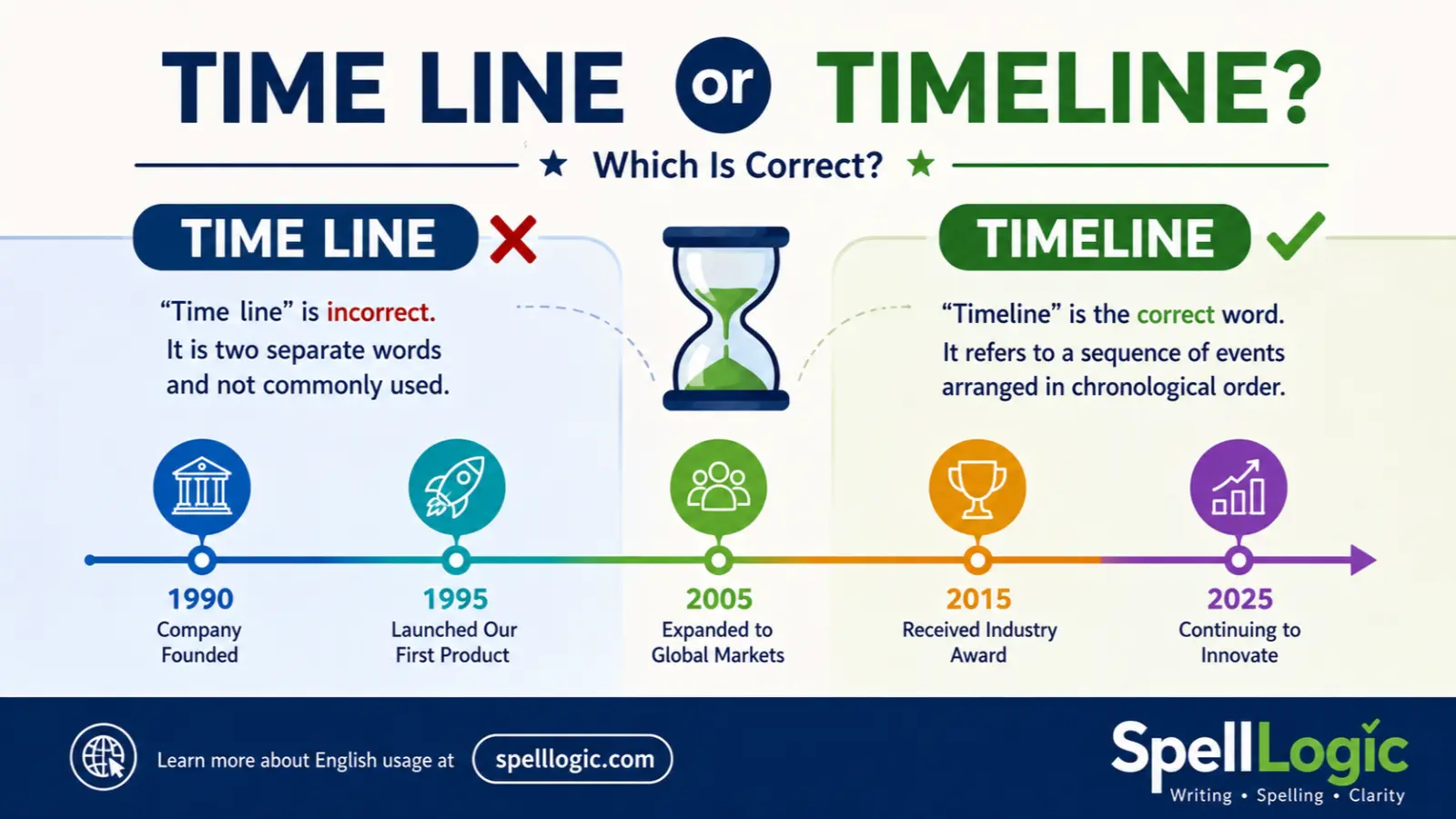
Time line is the older two-word spelling, while timeline is the modern, preferred spelling in contemporary English.
One-Line Distinction
Time line means the older spelling, while timeline is the modern standard spelling used in most writing today.
Example Sentences
- The museum created a detailed timeline of ancient civilizations.
- Our project timeline shows every important deadline.
Although you may occasionally find time line in older books, timeline is the spelling recommended for modern English
Understanding Homophones in English
What Are Homophones?
Homophones are words that sound the same but have different meanings or spellings.
Example:
- Sea
- See
They sound alike but have different meanings.
Time line and timeline are not true homophones because they represent different spellings of the same term rather than different words.
Why Homophones Cause Confusion
When words sound identical, writers often rely on memory rather than spelling rules.
For example:
- Their
- There
- They’re
Since time line and timeline sound exactly alike, writers may not realize that one spelling has become much more common in modern English.
What Does “Time Line” Mean?
Definition and Core Meaning
Time line is the older spelling of a word referring to a sequence of events arranged in chronological order.
Today, it is rarely used except in older publications or historical references.
Origin and Historical Use
Originally, English treated many compound nouns as separate words.
Examples include:
- Data base → Database
- Web site → Website
- Time line → Timeline
As language evolved, these compounds gradually merged into one word.
Modern Usage and Synonyms
Although still understandable, time line is now considered an older spelling.
Synonyms
- Chronology
- Sequence
- Schedule
- Event history
- Historical record
Key Points
- Older spelling
- Still understandable
- Rare in modern publications
- Usually replaced by timeline
Example Sentences
- The history textbook included a detailed time line of world events.
- Older manuals sometimes use the spelling time line.
What Does “Timeline” Mean?
Definition and Core Meaning
A timeline is a visual or written representation showing events in chronological order.
It is the standard spelling in modern English.
Origin and Historical Context
As English evolved, many compound nouns became single words.
Today, nearly all major dictionaries recognize timeline as the preferred spelling.
Modern Usage and Synonyms
Timeline is commonly used in:
- Schools
- Businesses
- Project management
- History books
- Social media
- Research papers
Synonyms
- Chronology
- Schedule
- Project plan
- Event sequence
- Historical record
Key Points
- Modern standard spelling
- Widely accepted
- Preferred in academic writing
- Used in professional communication
Example Sentences
- Please update the project timeline.
- The documentary follows the timeline of the war.
Time Line vs Timeline: Key Differences at a Glance
| Word | Part of Speech | Meaning | Example Context |
|---|---|---|---|
| Time line | Noun | Older spelling for a chronological sequence | An older textbook uses the term time line. |
| Timeline | Noun | Modern preferred spelling for a chronological sequence | The project timeline includes every milestone. |
How to Remember the Difference Between Time Line and Timeline
Fortunately, remembering the correct spelling is easy.
Easy Memory Tricks
- Modern English prefers timeline.
- Most current dictionaries list timeline.
- Business software almost always uses timeline.
Association Techniques
Think of these modern compound words:
- Notebook
- Website
- Keyboard
- Timeline
Since these are all written as one word, timeline fits the same pattern.
One Memorable Example
Imagine creating a school project.
Would your teacher expect a project timeline?
Almost certainly yes—not project time line.
Common Mistakes and Confusions
Wrong Example
❌ We finished the project time line yesterday.
✅ We finished the project timeline yesterday.
Explanation:
Modern English almost always prefers timeline.
Wrong Example
❌ Please update the marketing time line.
✅ Please update the marketing timeline.
Explanation:
Business documents nearly always use timeline.
Wrong Example
❌ The software displays a project time line.
✅ The software displays a project timeline.
Explanation:
Technology writing uses the one-word spelling.
Examples Section: Correct and Incorrect Usage
Example 1
✔ Correct: Our project timeline includes every milestone.
✘ Incorrect: Our project time line includes every milestone.
Example 2
✔ Correct: She created a timeline of her family’s history.
✘ Incorrect: She created a time line of her family’s history.
Example 3
✔ Correct: The presentation showed a timeline of important discoveries.
✘ Incorrect: The presentation showed a time line of important discoveries.
Example 4
✔ Correct: The software automatically builds a timeline.
✘ Incorrect: The software automatically builds a time line.
Self Assessment: Test Your Knowledge
Fill in the blanks.
- Our project ________ lists every deadline.
- The museum displayed a historical ________ of the empire.
- Modern English usually prefers ________ instead of time line.
- Most business reports use the word ________.
Self Assessment Answers
- timeline
- timeline
- timeline
- timeline
FAQs
1. Which spelling is correct: time line or timeline?
Timeline is the preferred and standard spelling in modern English.
2. Is “time line” wrong?
Not exactly. It is an older spelling, but it is uncommon today.
3. Which spelling should I use in academic writing?
Use timeline, as it is accepted by modern dictionaries and style guides.
4. Why do older books use “time line”?
English compound nouns often began as two words before becoming one word over time.
5. Is “timeline” one word in British English?
Yes. Both British and American English generally use timeline as one word.
6. Can I use both spellings in the same document?
No. For consistency and professionalism, use timeline throughout your writing.
7. Is “timeline” used in project management?
Yes. It is one of the most common terms in project management, planning, and scheduling.
Final Conclusion: Using “Time Line” and “Timeline” Correctly
Choosing between time line and timeline is much easier once you understand how English has evolved. Both forms refer to a sequence of events arranged in chronological order, but timeline has become the standard spelling in modern English. While you may still come across time line in older books or historical documents, it is rarely used in current academic, business, or everyday writing. If you want your English to sound natural and up to date, timeline is the spelling you should choose.
Remember the simple rule: modern compound nouns often become a single word over time. Just as website, notebook, and keyboard are written as one word, timeline follows the same pattern. Whenever you’re writing about project schedules, historical events, research, presentations, or personal planning, using timeline will help your writing look polished and professional.
The easiest way to remember this difference is to associate timeline with modern communication and digital tools, where the one-word spelling is used almost everywhere. Although understanding the older form can help you recognize it in older texts, using timeline consistently is the best choice for today’s English. Keep practicing with real examples, pay attention to how native speakers write, and review common compound words regularly. With a little practice, choosing the correct spelling will soon become second nature, making your English clearer, more accurate, and more confident.