Many English learners get confused by tear and tare because they sound almost the same but have completely different meanings. These words are examples of homophones, which are words that share the same pronunciation but differ in spelling and meaning. If you use the wrong one in writing or conversation, your sentence may become confusing or incorrect.
Learning the difference between tear and tare will help you communicate more accurately, whether you’re reading a book, writing an email, shopping, or working with measurements. This guide explains both words in simple English with clear examples, memory tips, and practice exercises.
Table of Contents
- Introduction
- Why “Tear” and “Tare” Are Confusing
- Tear vs Tare Explained Simply
- Understanding Homophones in English
- What Are Homophones?
- Why Homophones Cause Confusion
- What Does “Tear” Mean?
- What Does “Tare” Mean?
- Tear vs Tare: Key Differences at a Glance
- How to Remember the Difference Between Tear and Tare
- Common Mistakes and Confusions
- Examples Section: Correct and Incorrect Usage
- Self Assessment: Test Your Knowledge
- Self Assessment Answers
- FAQs About “Tear” and “Tare”
- Final Conclusion: Using “Tear” and “Tare” Correctly
Why “Tear” and “Tare” Are Confusing
Many people mix up tear and tare because they are pronounced the same in many English accents. Although they sound alike, they have different meanings and are used in different situations.
Similar Pronunciation
- Both tear (meaning to rip) and tare are commonly pronounced /teər/.
- This makes them difficult to distinguish when listening.
Similar Spelling
- The words differ by only one letter.
- Their nearly identical spelling can easily cause typing and spelling mistakes.
Context Confusion
- Tear is common in everyday English.
- Tare is mainly used in weighing, packaging, shipping, and science.
- Beginners may mistakenly replace one with the other because they are unfamiliar with tare.
Common Learner Mistakes
- Writing tare when talking about ripped paper.
- Using tear when referring to the weight of a container.
- Assuming both words have the same meaning because they sound alike.
Tear vs Tare Explained Simply
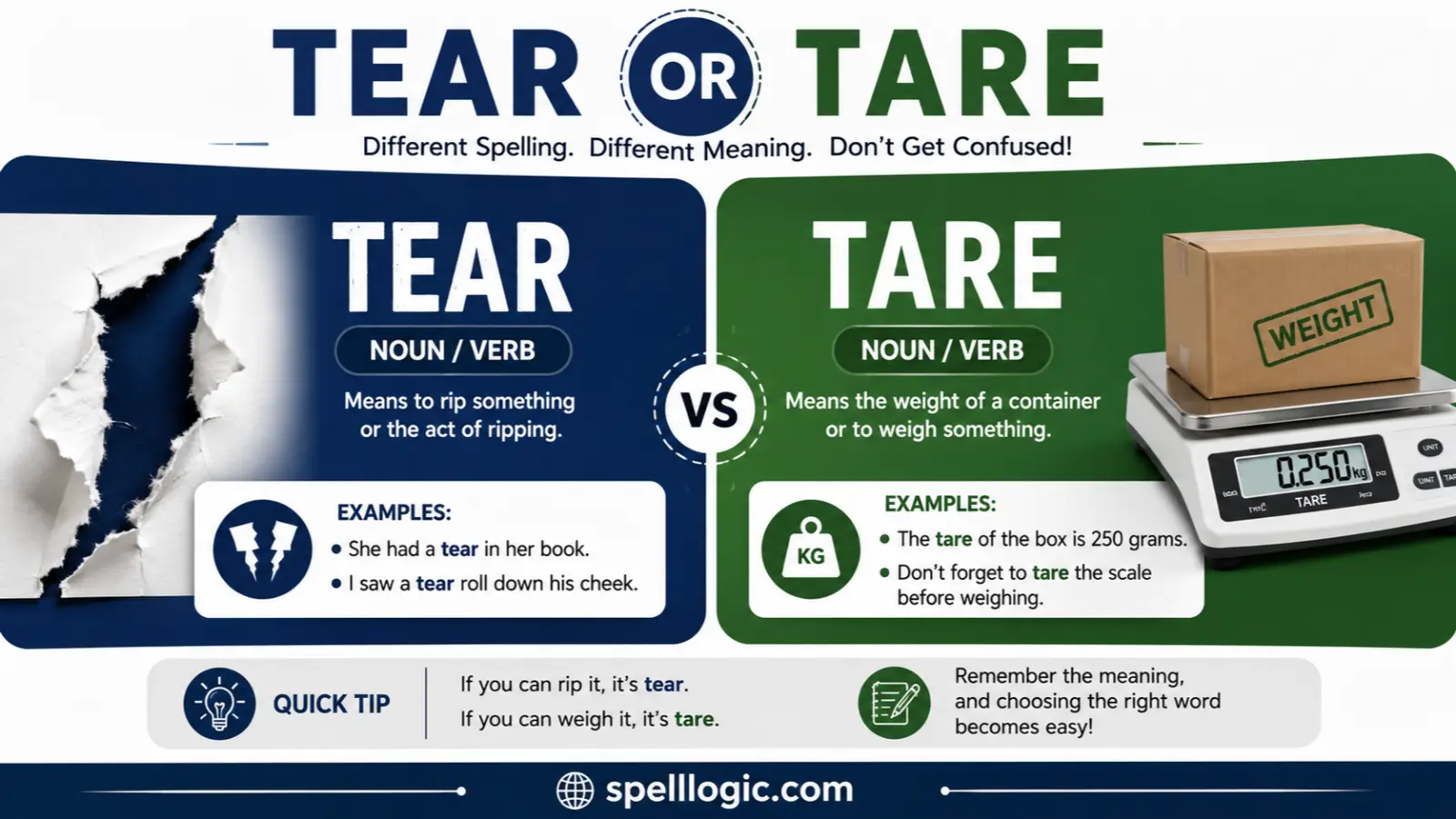
Tear means to rip something apart or a drop of liquid from the eye, while tare means the weight of an empty container or the process of resetting a scale to zero.
One-Line Distinction
Tear is about ripping or crying, while tare is about weighing.
Example Sentences
- She accidentally tore the letter while opening it.
- Please tare the digital scale before adding the flour.
Another pair of examples:
- A tear rolled down his cheek.
- The cashier pressed the tare button before weighing the vegetables.
Understanding Homophones in English
What Are Homophones?
Homophones are words that sound the same but have different spellings and meanings.
Example:
- Flour
- Flower
Although they sound alike, they mean completely different things.
Why Homophones Cause Confusion
Homophones can confuse learners because pronunciation alone does not reveal the correct spelling.
For example:
- I saw a tear in the shirt.
- The baker pressed tare on the scale.
The pronunciation is similar, but the meanings are entirely different.
What Does “Tear” Mean?
Definition and Core Meaning
The word tear has multiple meanings depending on how it is used.
It can mean:
- To rip or split something.
- A drop of liquid that comes from the eye.
- Damage caused by pulling or stretching.
The verb form changes to tore in the past tense.
Origin and Historical Use
The word tear comes from Old English teran, meaning “to pull apart or rip.” It has been used for centuries in English literature and everyday speech.
The noun meaning “a drop from the eye” comes from another Old English word, tēar.
Although these meanings developed separately, both became part of Modern English.
Modern Usage and Synonyms
As a verb
Synonyms include:
- Rip
- Split
- Shred
- Pull apart
- Break
As a noun
Synonyms include:
- Droplet
- Crying drop
- Water from the eye
Example Sentences
- Don’t tear the wrapping paper.
- The child began to tear the old newspaper.
- A tear ran down her face.
- His jacket has a small tear near the pocket.
- Strong winds can tear roofs from buildings.
What Does “Tare” Mean?
Definition and Core Meaning
Tare refers to:
- The weight of an empty container.
- The process of subtracting container weight from the total weight.
- Pressing the tare button on a scale to reset it to zero.
This allows only the contents to be measured.
Origin and Historical Context
The word tare comes from medieval trade and commerce. It entered English through French and Italian, ultimately tracing back to Arabic roots related to deductions in weight.
It became especially important in shipping, manufacturing, laboratories, and grocery stores.
Modern Usage and Synonyms
Common related words include:
- Container weight
- Empty weight
- Zero the scale
- Offset weight
- Reset scale
Example Sentences
- Press the tare button before weighing the bowl.
- The package label includes the tare weight.
- Always remove the tare before calculating shipping costs.
- Scientists use the tare function for accurate measurements.
- The grocery clerk tared the container before adding fruit.
Tear vs Tare: Key Differences at a Glance
| Word | Part of Speech | Meaning | Example Context |
|---|---|---|---|
| Tear | Verb, Noun | To rip something or a drop from the eye | She had a tear in her dress. |
| Tare | Noun, Verb | Empty container weight or reset a scale | Press tare before weighing the ingredients. |
How to Remember the Difference Between Tear and Tare
Here are some simple memory tricks.
Easy Memory Tricks
- Tear contains “ea”, reminding you of eyes, where tears come from.
- Tare contains “ar”, helping you remember weighing apparatus or scale.
Association Techniques
Imagine this scene:
Someone cries a tear after accidentally ripping a bag.
Before weighing a new bag, they press tare on the scale.
One word is about emotions or ripping.
The other is about accurate weight.
One Memorable Example
You wipe away a tear before pressing tare on the kitchen scale.
Common Mistakes and Confusions
Wrong Example
❌ Please tear the scale before weighing the apples.
Correct Version
✅ Please tare the scale before weighing the apples.
Explanation: A scale is tared, not torn.
Wrong Example
❌ There is a tare in my shirt.
Correct Version
✅ There is a tear in my shirt.
Explanation: Clothing can have a tear, not a tare.
Wrong Example
❌ A tare rolled down her cheek.
Correct Version
✅ A tear rolled down her cheek.
Explanation: Tears come from your eyes.
Wrong Example
❌ The package has a tear weight of two pounds.
Correct Version
✅ The package has a tare weight of two pounds.
Explanation: Packaging uses tare weight, not tear weight.
Examples Section: Correct and Incorrect Usage
Example 1
✔ Correct: She wiped away a tear after watching the movie.
✘ Incorrect: She wiped away a tare after watching the movie.
Example 2
✔ Correct: Press tare before adding the sugar.
✘ Incorrect: Press tear before adding the sugar.
Example 3
✔ Correct: The paper began to tear along the edge.
✘ Incorrect: The paper began to tare along the edge.
Example 4
✔ Correct: The laboratory technician used the tare function for accurate measurements.
✘ Incorrect: The laboratory technician used the tear function for accurate measurements.
Self Assessment: Test Your Knowledge
Fill in the blanks with tear or tare.
- Please press ______ before weighing the bowl.
- A ______ rolled down her face.
- There is a small ______ in my backpack.
- The shipping company recorded the ______ weight of the container.
Self Assessment Answers
- tare
- tear
- tear
- tare
FAQs
1. Are tear and tare homophones?
Yes. In many English accents, they are pronounced the same but have different meanings and spellings.
2. What does tear mean?
Tear means to rip something apart or refers to the drop of liquid that comes from your eye.
3. What does tare mean?
Tare is the weight of an empty container or the action of resetting a scale to zero.
4. Is tare commonly used in everyday English?
Not as often as tear. It is mostly used in cooking, laboratories, manufacturing, shipping, and grocery stores.
5. Can tear be both a noun and a verb?
Yes. It can refer to a drop from the eye or the act of ripping something.
6. Why do people confuse tear and tare?
They sound almost identical, making them easy to mix up when speaking or writing.
7. How can I remember the difference?
Remember that tear relates to ripping or crying, while tare relates to weighing and scales.
Final Conclusion: Using “Tear” and “Tare” Correctly
Understanding the difference between tear and tare becomes much easier once you know the situations in which each word is used. Tear is an everyday English word with two common meanings: it can describe ripping or splitting something, and it can also refer to the drops of water that come from your eyes when you cry. Tare, on the other hand, belongs mainly to the world of weighing and measurement. It refers to the weight of an empty container or the action of resetting a scale so that only the contents are measured.
Although these words are homophones and often sound the same in conversation, their meanings are completely different, and context will usually tell you which one is correct. A simple memory trick is to connect tear with eyes or ripped paper, while linking tare with scales and weight. Reading real examples, practicing with sentences, and paying attention to context will help you avoid common mistakes. The more you encounter these words in books, recipes, shipping labels, and everyday conversations, the more natural their correct usage will become. Keep practicing one pair of confusing English words at a time, and you’ll steadily build stronger vocabulary, better spelling, and greater confidence in both speaking and writing English.