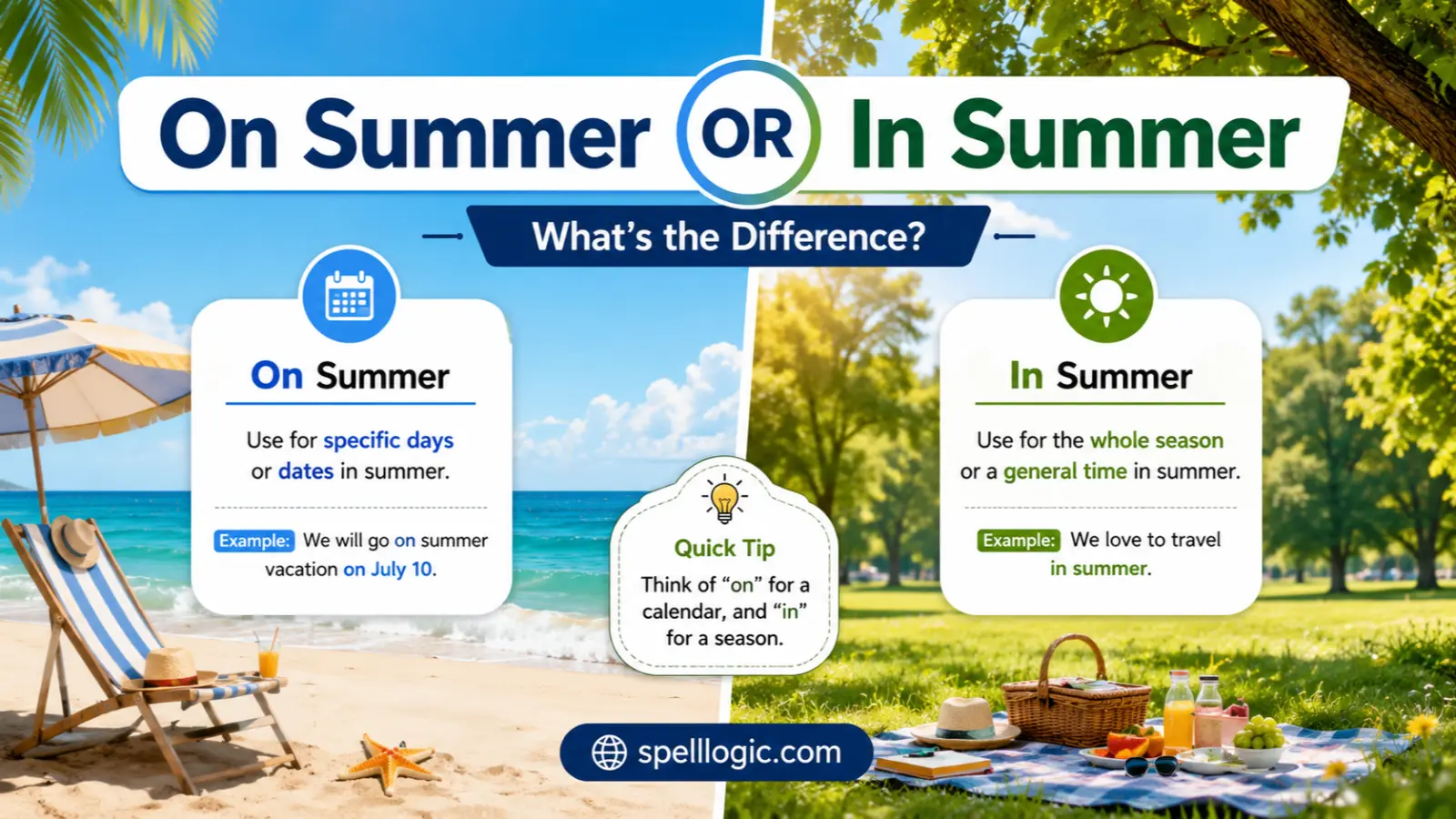
Many English learners wonder whether they should say “on summer” or “in summer.” These phrases look similar, but only one is correct in standard English. Choosing the right preposition can make your speaking and writing sound much more natural. Since prepositions often follow different grammar rules than learners expect, they are a common source of confusion.
In this guide, you’ll learn the difference between on summer and in summer, discover why one is correct and the other is not, and see plenty of simple examples. By the end, you’ll know exactly which phrase to use in everyday conversations and writing.
Why “On Summer” and “In Summer” Are Confusing
Many learners accidentally use on Sumar because they already know that on is used with dates and days, such as on Monday or on July 4th. Since summer is related to time, they assume the same rule applies.
Similar Pronunciation
- Both phrases sound very similar.
- The only difference is the preposition on or in, which can be difficult for beginners to notice.
Similar Spelling
- The word summer stays the same.
- Only the preposition changes, making the expressions look almost identical.
Context Confusion
English uses different prepositions for different time expressions:
- On → days and dates
- In → months, years, seasons, and long periods
- At → specific times
Because learners memorize these rules separately, they sometimes mix them up.
Common Learner Mistakes
People often write:
- ❌ I travel on summer.
- ❌ We go swimming on summer.
Instead, they should write:
- ✔ I travel in summer.
- ✔ We go swimming in summer.
On Summer vs In Summer Explained Simply
Simple Explanation
On summer is not standard English and is generally considered incorrect.
In summer is the correct phrase because summer is a season, and English uses in with seasons.
One-Line Distinction
“On summer” is incorrect, while “in summer” is the correct expression for talking about the season.
Example Sentences
- We usually visit our grandparents in summer.
- Flowers bloom beautifully in summer.
Understanding Homophones in English
Although on and in are not homophones, learners often confuse similar-looking English expressions. Understanding word confusion helps improve grammar and fluency.
What Are Homophones?
Homophones are words that sound the same but have different meanings and spellings.
Example:
- Sea
- See
Both are pronounced the same but have different meanings.
Why Homophones Cause Confusion
English learners often rely on pronunciation. If two words sound alike, they may choose the wrong one in writing.
Example:
- They’re going home.
- Their house is nearby.
Even native speakers occasionally confuse these words.
What Does “On Summer” Mean?
Definition and Core Meaning
On summer has no accepted meaning in standard English when referring to the season.
Native speakers almost never use this phrase.
Origin and Historical Use
There is no recognized grammatical rule that supports using on before the season summer.
The phrase may occasionally appear because of:
- Translation from another language
- Grammar mistakes
- Typing errors
Modern Usage and Synonyms
Instead of on summer, use:
- in summer
- during the summer
- throughout the summer
Key Points
- Not standard English
- Considered grammatically incorrect
- Avoid using it in formal or informal writing
Example Sentences
Incorrect:
- ❌ We travel on summer.
Correct:
- ✔ We travel in summer.
- ✔ We travel during the summer.
What Does “In Summer” Mean?
Definition and Core Meaning
In summer means during the summer season.
It refers to something that happens at any time throughout summer.
Origin and Historical Context
English has long used in with:
- seasons
- months
- years
- centuries
Examples include:
- in winter
- in spring
- in autumn
- in 2026
- in July
This pattern has been part of English grammar for centuries.
Modern Usage and Synonyms
Common alternatives include:
- during summer
- during the summer
- throughout the summer
Key Points
- Grammatically correct
- Used by native speakers
- Appropriate for speaking and writing
- Works in formal and informal English
Example Sentences
- Children enjoy long holidays in summer.
- Ice cream is popular in summer.
- Many families travel in summer.
- The weather becomes warmer in summer.
On Summer vs In Summer: Key Differences at a Glance
| Word | Part of Speech | Meaning | Example Context |
|---|---|---|---|
| On summer | Prepositional phrase | Incorrect expression for the season | ❌ We travel on summer. |
| In summer | Prepositional phrase | During the summer season | ✔ We travel in summer. |
How to Remember the Difference Between On Summer and In Summer
Here are a few easy memory tricks.
Easy Memory Tricks
Remember this grammar pattern:
- In → seasons
- In → months
- In → years
Examples:
- in summer
- in winter
- in March
- in 2026
Association Technique
Think of summer as a long period of time.
English uses in for long periods.
Memorable Example
Imagine yourself relaxing inside the summer season.
The word inside starts with in, helping you remember:
In summer = inside the season.
Common Mistakes and Confusions
Wrong Example
❌ We go camping on summer.
✔ We go camping in summer.
Explanation:
Summer is a season, so use in.
Wrong Example
❌ It gets very hot on summer.
✔ It gets very hot in summer.
Explanation:
Use in with seasons.
Wrong Example
❌ Schools close on summer.
✔ Schools close in summer.
Explanation:
The event happens during the season.
Wrong Example
❌ Birds migrate on summer.
✔ Some birds migrate in summer.
Explanation:
The action occurs during summer.
Examples Section: Correct and Incorrect Usage
Example 1
✔ Correct: We often visit the beach in summer.
✘ Incorrect: We often visit the beach on summer.
Example 2
✔ Correct: Many fruits grow in summer.
✘ Incorrect: Many fruits grow on summer.
Example 3
✔ Correct: The days are longer in summer.
✘ Incorrect: The days are longer on summer.
Example 4
✔ Correct: They usually travel abroad in summer.
✘ Incorrect: They usually travel abroad on summer.
Example 5
✔ Correct: We enjoy outdoor concerts in summer.
✘ Incorrect: We enjoy outdoor concerts on summer.
Self Assessment: Test Your Knowledge
Fill in the blanks with on or in.
- We usually go hiking ______ summer.
- Many flowers bloom ______ summer.
- Children have long vacations ______ summer.
- It is often very hot ______ summer.
Self Assessment Answers
- in
- in
- in
- in
FAQs
1. Is “on summer” grammatically correct?
No. Standard English uses in summer, not on summer, when talking about the season.
2. Why do we say “in summer”?
Because English uses in with seasons, months, years, and other longer periods of time.
3. Can native English speakers say “on summer”?
In standard English, native speakers generally do not say on summer to refer to the season. They say in summer or during the summer.
4. Is “during the summer” the same as “in summer”?
Yes. Both expressions are correct. During the summer is slightly more specific or formal in some contexts, while in summer is shorter and very common.
5. Which preposition is used with seasons?
The correct preposition is in.
Examples:
- in spring
- in summer
- in autumn (or in fall)
- in winter
6. Is “in the summer” also correct?
Yes. Both in summer and in the summer are correct. The version with the often refers to a particular summer or emphasizes the season in a specific context.
7. How can I remember the correct phrase?
Remember this simple rule:
- In → seasons, months, years
- On → days and dates
- At → exact times
Final Conclusion: Using “On Summer” and “In Summer” Correctly
Understanding the difference between on summer and in summer is easier once you know the basic rule for English time prepositions. In summer is the correct and natural expression because English uses in with seasons, months, years, and other longer periods of time. On the other hand, on summer is not considered standard English when referring to the season, so it should be avoided in both speaking and writing. Remember that on is mainly used with specific days and dates, such as on Monday or on July 10, while in fits broader periods like in summer, in April, or in 2026.
A simple memory trick is to think of yourself being inside the season—inside begins with in, making in summer easy to remember. As you continue learning English, pay close attention to prepositions because they play an important role in making your sentences sound natural and grammatically correct. Reading books, listening to native speakers, and practicing with real-life examples will help reinforce this rule. With regular practice, choosing in summer instead of on summer will become automatic, helping you communicate more confidently and accurately in everyday English.