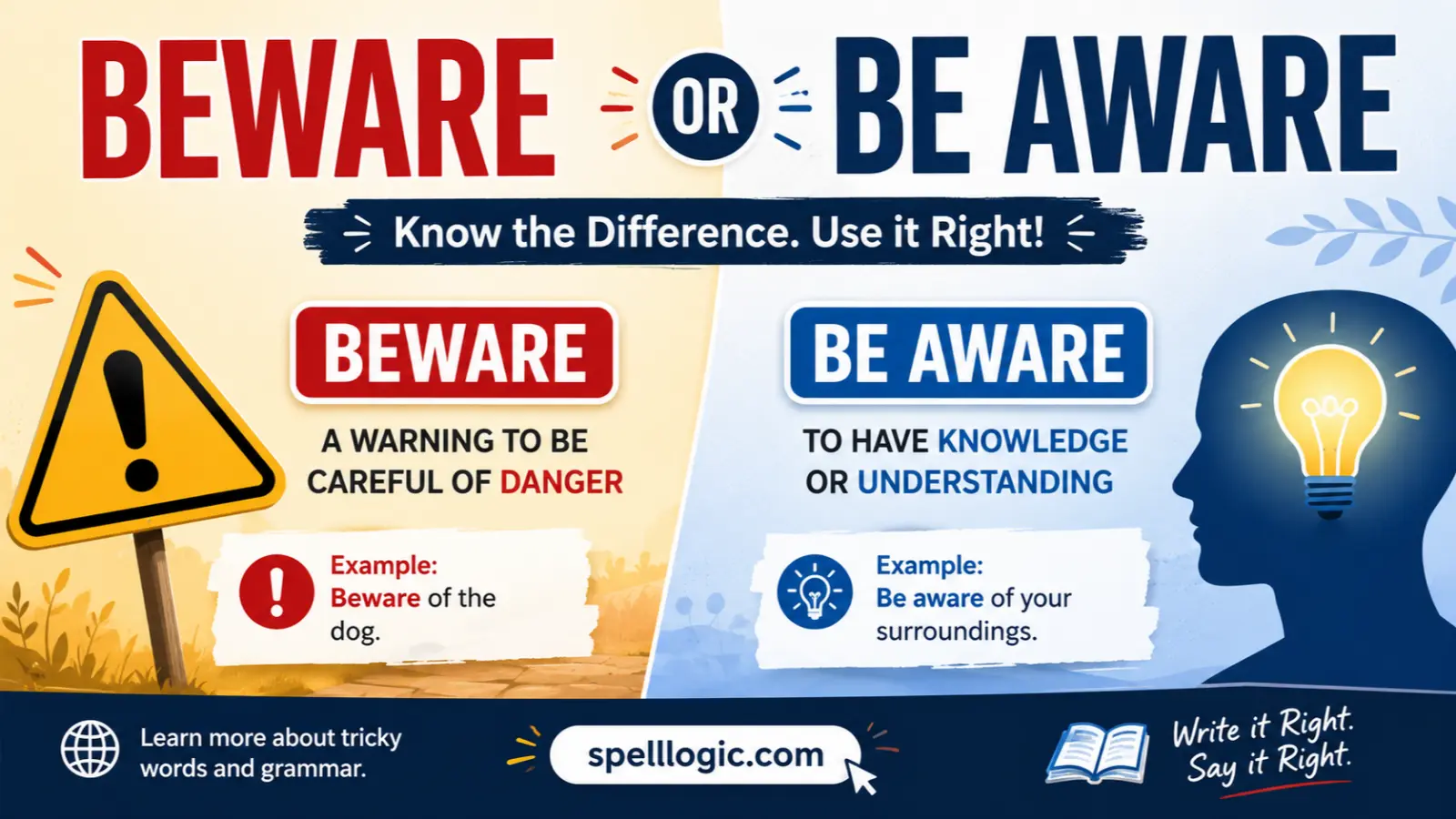
English learners often wonder about beware or be aware because both expressions relate to noticing danger, being careful, or paying attention. They also look and sound similar, but they do not work in exactly the same way. Beware is a verb that gives a warning about possible danger, while be aware means to know, notice, or understand something.
Choosing the right expression can make your writing and speaking clearer. Whether you are writing an email, giving advice, reading instructions, or having a conversation, understanding this small difference can prevent common grammar mistakes and help you communicate naturally.
Why “Beware” and “Be Aware” Are Confusing
The expressions beware or be aware are frequently mixed up because they contain closely related ideas. Both can appear when someone needs to pay attention, but their grammatical functions and meanings differ.
Similar pronunciation
The words can sound similar in connected speech, especially when be aware is spoken quickly. Learners may hear the two expressions and assume they are interchangeable.
However, pronunciation alone does not determine meaning. The surrounding sentence tells you which expression is appropriate.
Similar spelling
The expressions share the word aware, at least in the second expression, and beware visually resembles a combination of “be” and “ware.” This can make learners think that the two forms are simply different spellings of the same expression.
They are not.
Context confusion
Both expressions can occur in warnings or situations involving attention. For example, a sign might tell people to watch for a wet floor, while another sentence might explain that visitors should know about a particular rule.
The first situation may call for beware, whereas the second generally calls for be aware.
Common learner mistakes
A common mistake is using beware of when the intended meaning is simply “know about.” Another is using be aware when a short, direct warning would sound more natural with beware.
Understanding the grammatical pattern makes these choices much easier.
“Beware” vs “Be Aware” Explained Simply
The simplest way to understand beware or be aware is to focus on the purpose of the expression.
- Beware means “be careful because something may be dangerous or harmful.”
- Be aware means “know, notice, or understand something.”
One-line distinction: Beware gives a warning; be aware communicates knowledge or attention.
For example:
- Beware of the slippery steps.
- Please be aware that the store closes at 8 p.m.
In the first sentence, the speaker warns about possible danger. In the second, the speaker gives important information.
Therefore, beware or be aware should not be treated as interchangeable expressions.
Understanding Homophones in English
The confusion surrounding beware or be aware is sometimes connected to pronunciation, but these expressions are not true homophones.
What Are Homophones?
Homophones are words that have the same pronunciation but different meanings, and often different spellings. For example, flower and flour sound alike but refer to completely different things.
Beware and be aware do not fit this definition perfectly because their pronunciation and grammatical structure are different. Their similarity is mainly a matter of sound, spelling, and meaning.
Why Homophones Cause Confusion
English learners often depend on sound when learning new vocabulary. If two expressions sound similar, it can be difficult to identify the correct written form.
For example, hearing a warning quickly may make a learner unsure whether the speaker said beware or be aware. Looking at the complete sentence and considering its meaning can solve the problem.
What Does “Beware” Mean?
Definition and Core Meaning
Beware is a verb used to warn someone about possible danger, trouble, harm, or an unpleasant situation. It is often followed by of and a noun or noun phrase.
A useful pattern is:
Beware + of + something
Examples include:
- Beware of the dog.
- Beware of scams.
- Beware of falling rocks.
- Beware of dishonest sellers.
The expression is usually direct and warning-focused.
Origin and Historical Use
Beware developed from the older English expression meaning to be cautious or careful. Over time, it became established as a single verb.
Its structure is unusual because it looks as though it contains the word be, but modern English treats beware as its own verb. You do not normally conjugate it like the ordinary phrase “be careful.”
Historically and traditionally, it has appeared in warnings, literature, notices, and formal language.
Modern Usage and Synonyms
Today, beware is common in signs, warnings, instructions, advertisements, and dramatic language. It can sound strong or direct.
Useful synonyms and related expressions include:
- be careful
- watch out
- take care
- look out
- guard against
- be on your guard
Examples:
- Beware of fake websites when shopping online.
- Travelers should beware of unofficial transportation services.
- Beware of the wet paint.
- You should beware of offers that seem too good to be true.
A key point is that beware usually focuses on a threat or potential problem.
What Does “Be Aware” Mean?
Definition and Core Meaning
Be aware means to know about something, recognize something, notice something, or understand a situation. It does not automatically suggest danger.
The common pattern is:
Be aware + of + something
It can also be followed by a clause beginning with that:
Be aware that + clause
Examples include:
- Be aware of the new policy.
- Be aware of your surroundings.
- Please be aware that prices may change.
- She was aware of the problem.
Origin and Historical Context
The word aware comes from an old English form connected with being watchful, cautious, or conscious of something. Its meaning developed into the modern idea of having knowledge or understanding.
Unlike beware, be aware is an ordinary verb phrase. The verb be changes according to the subject and tense:
- I am aware.
- She is aware.
- They are aware.
- We were aware.
Modern Usage and Synonyms
Be aware is extremely common in modern English. It is useful in everyday conversation, professional writing, academic contexts, announcements, and instructions.
Depending on context, possible synonyms include:
- know
- notice
- recognize
- understand
- realize
- be conscious of
- be informed about
Examples:
- Please be aware of the deadline.
- Are you aware of the changes?
- I was not aware that the meeting had moved.
- Drivers should be aware of pedestrians.
The important point is that be aware describes a state of knowledge or attention rather than directly warning someone about danger.
“Beware” vs “Be Aware”: Key Differences at a Glance
| Word | Part of Speech | Meaning | Example Context |
|---|---|---|---|
| Beware | Verb | Be careful because something may cause danger or harm | Beware of icy roads. |
| Be aware | Verb phrase | Know, notice, or understand something | Be aware of the new rules. |
The main difference between beware or be aware is therefore the purpose of the expression. One normally warns against a potential problem, while the other communicates awareness or knowledge.
How to Remember the Difference Between Beware and Be Aware
A few simple memory tricks can make beware or be aware much easier to remember.
Memory Trick 1: “Beware” = Warning
Think of beware as a warning sign.
Beware of the dog.
The speaker wants you to take care because the dog could be dangerous.
Memory Trick 2: “Be aware” = Know
Connect aware with knowledge.
If you are aware of something, you know about it or recognize it.
I am aware of the problem.
You are not necessarily being warned. You simply know the problem exists.
Memory Trick 3: Look for the purpose
Ask yourself:
“Am I warning someone about danger, or am I giving information?”
If you are warning someone, beware may be appropriate. If you are communicating knowledge or attention, be aware is usually the better choice.
One memorable example
Beware of the traffic, but be aware of the traffic rules.
The first expression warns about a possible danger. The second tells someone to know or understand the rules.
This simple contrast is an effective way to remember the difference.
Common Mistakes and Confusions
Learners often make mistakes because beware and be aware can both be followed by of.
Mistake 1
✘ Be beware of the dog.
✔ Beware of the dog.
Explanation: “Be beware” is incorrect because beware is already a verb. Do not add be before it.
Mistake 2
✘ Beware that the office closes at five.
✔ Be aware that the office closes at five.
Explanation: When the purpose is simply to give information, be aware that is generally more natural.
Mistake 3
✘ I beware of the new schedule.
✔ I am aware of the new schedule.
Explanation: In this sentence, the intended meaning is that the speaker knows about the schedule. The phrase am aware is required.
Mistake 4
✘ Please be aware of dangerous dogs.
✔ Beware of dangerous dogs.
Both can be grammatically possible depending on context, but the second is a more direct warning. The first may simply ask someone to recognize or keep the possibility in mind.
Examples Section: Correct and Incorrect Usage
Example 1
✔ Correct: Beware of the broken glass.
✘ Incorrect: Be beware of the broken glass.
The correct sentence uses beware as a complete verb.
Example 2
✔ Correct: Please be aware of the updated schedule.
✘ Incorrect: Please beware of the updated schedule.
The first sentence means “please know or take note of the updated schedule.” The second suggests that the schedule itself may be dangerous or harmful.
Example 3
✔ Correct: Beware of online scams.
✘ Incorrect: Be aware of online scams.
The second sentence is not necessarily grammatically wrong. It simply has a different meaning and tone. It asks someone to recognize scams rather than directly warning them.
Example 4
✔ Correct: I am aware of the problem.
✘ Incorrect: I beware of the problem.
The speaker is saying that they know about the problem, so am aware is the appropriate construction.
Example 5
✔ Correct: Be aware that the road may be closed.
✘ Incorrect: Beware that the road may be closed.
The first sentence provides information. Beware normally works better with a specific danger or threat, often using of.
Self Assessment: Test Your Knowledge
Fill in each blank with beware or be aware in the appropriate form.
- Please ______ of the wet floor near the entrance.
- Are you ______ of the changes to the schedule?
- ______ of fake messages asking for your password.
- Please ______ that the application deadline is Friday.
Self Assessment Answers
- beware
- aware
- Beware
- be aware
Remember that the correct choice depends on meaning, not simply on how similar the expressions look or sound.
FAQs
1. What is the main difference between beware and be aware?
The key difference is that beware is mainly used as a warning, while be aware means to know, notice, or understand something.
2. Is “beware of” grammatically correct?
Yes. Beware of is a standard construction used to warn someone about a possible danger, problem, or threat.
3. Is “be aware of” correct English?
Yes. Be aware of is very common and means to know about, notice, or understand something.
4. Can beware and be aware be used interchangeably?
No. Although their meanings can overlap around the idea of attention, they are not interchangeable. The intended meaning determines the correct expression.
5. Should I say “be beware of”?
No. Beware already functions as a verb, so be beware of is incorrect in standard English.
6. Does beware always mean danger?
Usually, beware introduces a warning about something potentially harmful, troublesome, deceptive, or unpleasant. The danger does not have to be physical.
7. Which expression is more common in professional English?
Be aware is often more neutral and suitable for professional, academic, and informational writing. Beware is more direct and warning-focused.
Final Conclusion: Using Beware and Be Aware Correctly
Understanding beware or be aware becomes much easier when you focus on the purpose of each expression. Beware is a verb that gives a warning. It tells someone to be careful because a person, object, situation, or action may cause harm or trouble. For example, “Beware of fake websites” directly warns readers about a possible threat. Be aware, on the other hand, is a verb phrase that means to know, notice, recognize, or understand something. For example, “Please be aware of the new deadline” simply asks someone to take important information into account.
When choosing between these expressions, ask yourself whether you are warning someone or simply telling them to know or notice something. That quick question can prevent many common mistakes. Also remember that beware already works as a verb, so “be beware” is incorrect. In contrast, be aware naturally changes with the subject, as in “I am aware,” “she is aware,” and “they are aware.” With regular practice, this distinction will become natural. Keep using short example sentences, pay attention to context, and remember: beware = warning, be aware = know or notice. With these simple rules, you can use both expressions confidently in everyday English.