Many English learners wonder whether they should say in stock or on stock when talking about products that are available to buy. The confusion happens because both phrases contain the word stock, and some languages use similar expressions that translate differently into English. However, only one of these phrases is standard in everyday English.
Learning the correct expression will help you sound more natural in conversations, online shopping, business emails, and customer service. In this guide, you’ll discover the difference between in stock and on stock, understand when to use each one, and avoid one of the most common English vocabulary mistakes.
Many people mistakenly use on stock because it sounds similar to in stock. Let’s look at why this confusion happens.
Similar Pronunciation
The words in and on are both short prepositions. When spoken quickly, they may sound similar, especially to English learners.
Similar Spelling
The two phrases differ by only one small word:
- In stock
- On stock
Because the difference is so small, learners often choose the wrong preposition.
Context Confusion
Both expressions appear to relate to products and inventory. Since many languages use different prepositions for availability, learners sometimes translate directly into English.
Common Learner Mistakes
People often write:
- “This phone is on stock.”
- “The shoes are on stock now.”
These are incorrect in standard English.
The correct phrase is:
- “This phone is in stock.”
- “The shoes are in stock now.”
In Stock vs On Stock Explained Simply
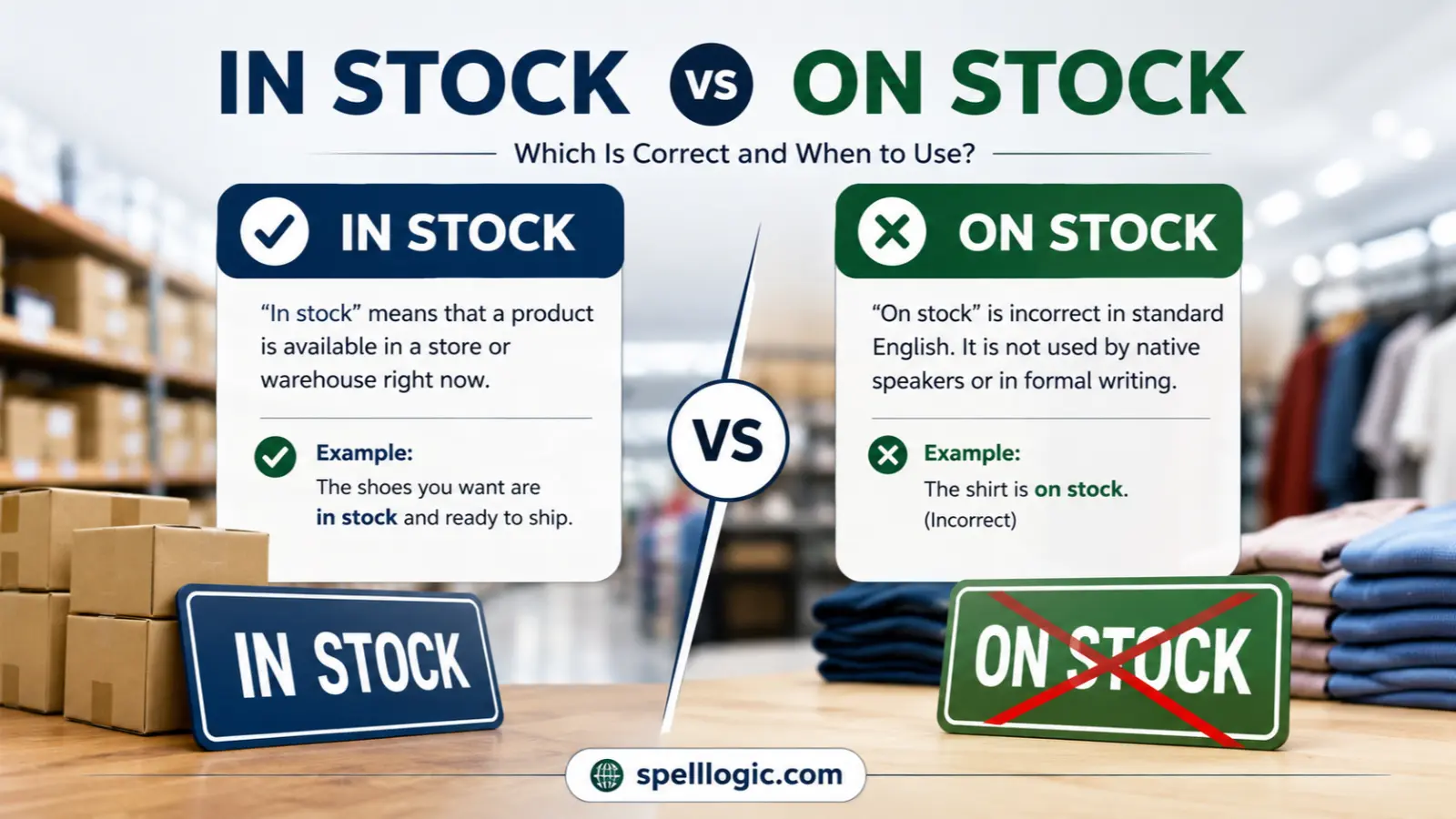
In stock means that a product is available for purchase because the seller currently has it.
On stock is not a standard English expression when talking about product availability.
One-line distinction
“In stock” means available to buy, while “on stock” is generally incorrect in modern English.
Example Sentences
- The laptop is in stock, so you can order it today.
- Only three copies are in stock at the bookstore.
Incorrect examples:
- The laptop is on stock.
- We have this item on stock.
Understanding Homophones in English
Although in stock and on stock are not homophones, learners often confuse similar-sounding words and phrases.
What Are Homophones?
Homophones are words that sound the same but have different meanings and spellings.
Example:
- Sea
- See
They sound alike but have different meanings.
Why Homophones Cause Confusion
English contains many words that sound alike. Learners sometimes rely on pronunciation instead of spelling or grammar.
Example:
- I can see the ocean.
- The sea is calm today.
Likewise, although in stock and on stock are not homophones, they are easily confused because they look and sound similar.
What Does “In Stock” Mean?
Definition and Core Meaning
In stock means that a product or item is currently available because it is stored in inventory.
It tells customers they can buy the product immediately.
Origin and Historical Use
The word stock originally referred to goods kept for sale by merchants. Over time, the expression in stock became the standard business phrase for items available in inventory.
Today, retailers, manufacturers, warehouses, and online stores all use this expression.
Modern Usage and Synonyms
Common meanings include:
- Available
- Ready for sale
- Available for purchase
- In inventory
- Available now
Key Points
- Correct English expression
- Used in shopping and business
- Refers to available inventory
- Common in online stores
Example Sentences
- The new smartphone is in stock.
- This book is currently in stock.
- Most sizes are in stock today.
- The warehouse keeps thousands of products in stock.
What Does “On Stock” Mean?
Definition and Core Meaning
On stock is not a standard English expression for product availability.
Native English speakers almost always say in stock instead.
Origin and Historical Context
Some non-native speakers use on stock because of direct translation from other languages or confusion over English prepositions.
Occasionally, you may see on stock in poorly translated websites or documents, but it is considered incorrect in standard English.
Modern Usage and Synonyms
There are no accepted synonyms because on stock should generally be replaced with:
- In stock
- Available
- Ready for purchase
Key Points
- Not standard English
- Common learner mistake
- Usually caused by direct translation
- Replace with in stock
Incorrect Examples
- ✘ This camera is on stock.
- ✘ The shoes are on stock today.
Correct Versions
- ✔ This camera is in stock.
- ✔ The shoes are in stock today.
In Stock vs On Stock: Key Differences at a Glance
| Word | Part of Speech | Meaning | Example Context |
|---|---|---|---|
| In stock | Prepositional phrase | Available for sale or currently in inventory | The product is in stock. |
| On stock | Non-standard phrase | Incorrect for product availability | ✘ The product is on stock. |
How to Remember the Difference Between In Stock and On Stock
Here are a few easy tricks.
Easy Memory Tricks
- Think IN = Inside the store’s inventory.
- If an item is available, it is in the inventory.
Association Technique
Imagine products sitting inside a warehouse.
They are in stock, not on stock.
Memorable Example
Picture a shelf full of books.
Since the books are inside the store’s inventory, they are in stock.
Common Mistakes and Confusions
Wrong
❌ This television is on stock.
Correct
✔ This television is in stock.
Explanation: English uses in stock for available inventory.
Wrong
❌ The shoes will be on stock tomorrow.
Correct
✔ The shoes will be in stock tomorrow.
Explanation: The expression in stock remains correct whether talking about the present or future.
Wrong
❌ We keep hundreds of products on stock.
Correct
✔ We keep hundreds of products in stock.
Explanation: Inventory is always described as being in stock.
Examples Section: Correct and Incorrect Usage
Example 1
✔ Correct: The headphones are in stock today.
✘ Incorrect: The headphones are on stock today.
Example 2
✔ Correct: Our warehouse has the item in stock.
✘ Incorrect: Our warehouse has the item on stock.
Example 3
✔ Correct: The jacket is no longer in stock.
✘ Incorrect: The jacket is no longer on stock.
Example 4
✔ Correct: Check whether your size is in stock.
✘ Incorrect: Check whether your size is on stock.
Self Assessment: Test Your Knowledge
Fill in the blanks.
- The new laptop is ________ now.
- Is this dress ________?
- We expect the product to be ________ next week.
- Which phrase is correct: in stock or on stock?
Self Assessment Answers
- in stock
- in stock
- in stock
- in stock
FAQs
1. Is “on stock” correct English?
No. Standard English uses in stock to describe products that are available.
2. What does “in stock” mean?
It means an item is currently available in inventory and can usually be purchased immediately.
3. Why do some people say “on stock”?
This usually happens because of direct translation from another language or confusion about English prepositions.
4. Can businesses use “on stock”?
Professional businesses, retailers, and native English speakers almost always use in stock instead.
5. What is the opposite of “in stock”?
The opposite is out of stock, which means the item is unavailable.
6. Is “in stock” used in British and American English?
Yes. Both British English and American English use in stock.
7. Can I say “currently in stock”?
Yes. Phrases such as currently in stock, back in stock, and now in stock are all common and correct.
Final Conclusion: Using “In Stock” and “On Stock” Correctly
Understanding the difference between in stock and on stock is simple once you know the standard English expression. In stock is the correct phrase and means that a product is available in a store’s inventory and ready for purchase. Whether you are shopping online, writing a business email, managing inventory, or speaking with customers, using in stock will make your English sound natural and professional. On the other hand, on stock is not considered standard English for describing product availability. Although you may occasionally see it on poorly translated websites or hear it from non-native speakers, it should be avoided in formal and everyday communication.
A helpful way to remember the difference is to think of products as being inside a store’s inventory. If they are available, they are in stock. If they are unavailable, they are out of stock. This simple memory trick can help you choose the correct phrase every time. As you continue learning English, paying attention to common expressions like these will improve your vocabulary, writing, and speaking skills. Keep practicing with real-life examples, notice how native speakers use these phrases, and don’t be afraid to review common mistakes. Every small improvement brings you one step closer to speaking and writing English with greater confidence and accuracy.