English learners often see words that look almost identical but do not have the same status or meaning. The pair manual or manuel is a good example. Manual is a common English word, while manuel is usually a misspelling when someone intends to write the English word manual.
However, Manuel can also be a proper name in some languages and cultures. Because the two forms are close in spelling and sound, learners may accidentally choose the wrong one in writing. Understanding the difference matters because spelling errors can make instructions, schoolwork, emails, and professional documents look less clear. Once you know what each form means and where it belongs, choosing the correct spelling becomes simple.
Why “manual” and “manuel” Are Confusing
The pair manual or manuel is confusing mainly because the letters are arranged in a very similar way. A learner who hears the word before seeing it may remember the sound but not the exact spelling.
Similar pronunciation
When checking manual or manuel, pronunciation can explain why learners hesitate over the spelling.
The English word manual is commonly pronounced roughly like MAN-yoo-uhl. Because the unstressed sounds can be difficult to hear clearly, some learners may write manuel after hearing the word.
However, pronunciation alone should not determine spelling. English contains many words whose sounds do not make their spelling obvious.
Similar spelling
The forms differ by only one letter arrangement, so a quick typographical mistake is easy to make. This is especially common when someone is typing quickly or has learned English mainly through listening.
The spelling difference in manual or manuel is small, so proofreading is useful.
Context confusion
Context quickly separates manual or manuel because one is an ordinary English word and the other is normally a name.
The form Manuel, with a capital M, is different when it is used as a personal name. For example, “Manuel lives in Madrid” uses a name, not the English noun meaning a guide.
Common learner mistakes
The most frequent manual or manuel mistake is using manuel for an instruction guide.
Common errors include writing “user manuel” instead of “user manual” or “instruction manuel” instead of “instruction manual.” These mistakes do not usually change the intended idea, but they are still spelling errors in standard English.
manual vs manuel Explained Simply
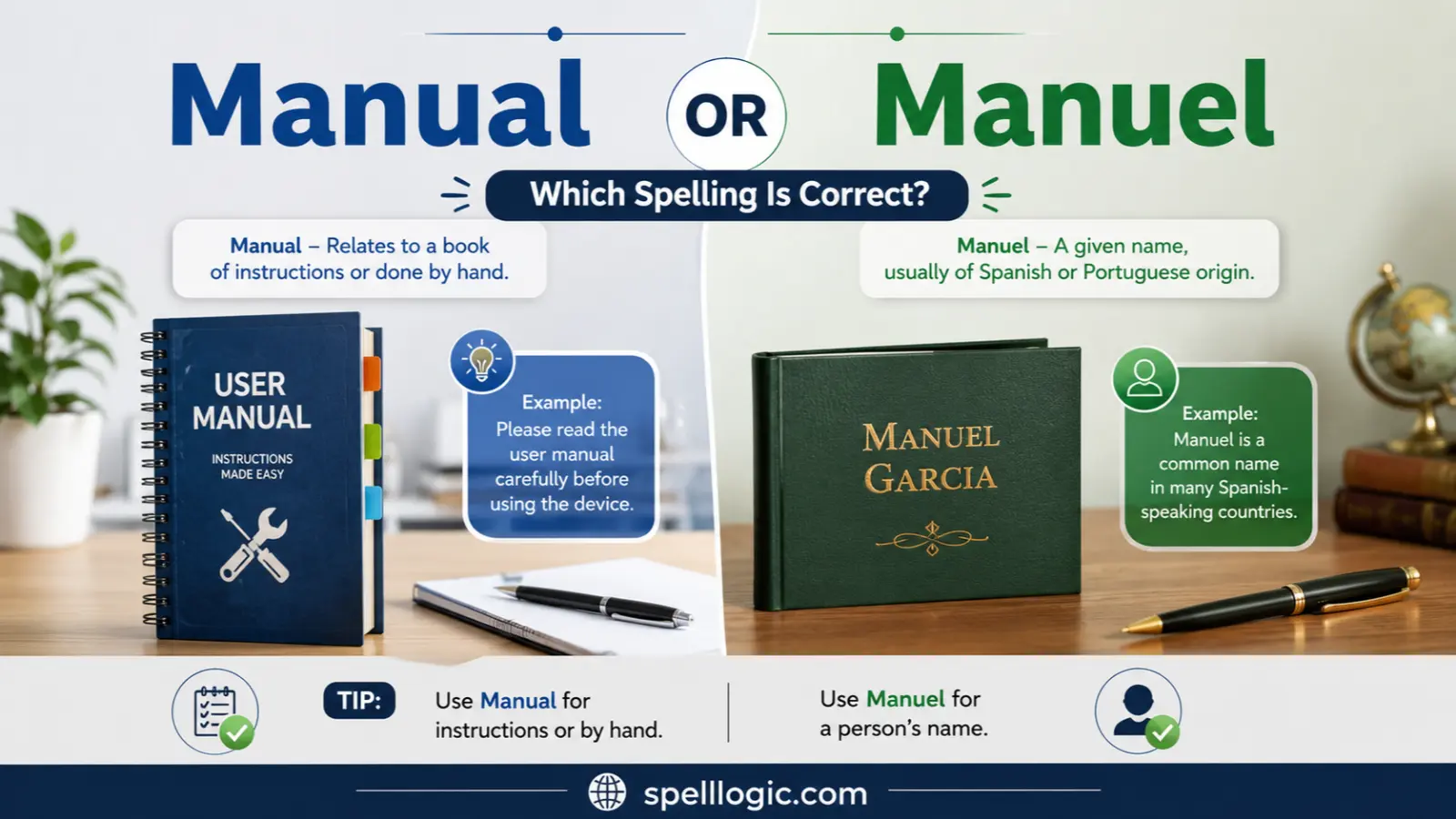
The simplest way to understand manual or manuel is to remember that manual is the normal English spelling for the word meaning a guide, something done by hand, or work involving the hands.
By contrast, manuel is not normally the correct spelling of that English word. Manuel is commonly used as a personal name, especially in Spanish and Portuguese contexts.
One-line distinction: Manual is a standard English word; Manuel is usually a proper name, not a spelling variant of manual.
Examples
A quick comparison of manual or manuel also helps learners see the difference in real sentences.
- Please read the manual before operating the machine.
- Manuel joined the meeting a few minutes late.
So, in the pair manual or manuel, use manual when you mean an instruction book or something related to the hands, and use Manuel when referring to a person with that name.
Understanding Homophones in English
Learners sometimes assume that every pair with a similar sound is a homophone. That is not always true. Understanding the term can help prevent spelling confusion.
What Are Homophones?
Homophones are words that have the same pronunciation but different meanings and usually different spellings. A familiar example is right and write. They sound alike, but right can describe correctness or direction, while write means to produce words.
The pair manual or manuel should not normally be classified as standard English homophones. Their similarity is mainly a spelling and pronunciation issue, and Manuel is generally a name rather than an alternative English word.
Why Homophones Cause Confusion
When people learn a word by hearing it, they may know the sound without knowing the spelling. For example, a learner may hear “write” and need context to decide which spelling is intended. The same general listening-to-spelling problem can lead someone to type manuel when they mean manual.
What Does “manual” Mean?
Definition and Core Meaning
Manual has several related meanings. As a noun, it can mean a book or document that gives instructions about how to use, operate, repair, or understand something.
As an adjective, manual can describe something done with the hands rather than automatically or by machine. It can also refer to physical work performed by people.
For manual or manuel, meaning is the first clue to the correct form.
The key meanings include:
- Instruction book: a guide containing directions or information.
- Done by hand: an activity performed without automatic machinery.
- Physical work: labor involving the hands or physical effort.
- Human-controlled process: an action completed by a person rather than by an automated system.
Origin and Historical Use
The word manual comes through French and Latin. Its Latin connection is associated with the hand, which explains why the modern word can describe actions performed by hand. Over time, the noun sense developed around books of practical instructions, while the adjective continued to describe hand-based activity.
The history behind manual or manuel also explains why the two forms should not be treated as variants.
Modern Usage and Synonyms
Today, manual is common in technology, education, manufacturing, workplaces, and everyday life. You may see phrases such as:
- user manual
- instruction manual
- employee manual
- repair manual
- manual labor
- manual process
- manual transmission
Modern English uses manual or manuel in very different ways, depending on whether the word is vocabulary or a name.
Example Sentences
These examples make manual or manuel easier to recognize in everyday writing.
- I checked the manual to find the installation instructions.
- The technician followed the repair manual carefully.
- The factory still uses a manual inspection process.
- He prefers a car with a manual transmission.
- The workers performed the task manually rather than using an automated system.
What Does “manuel” Mean?
Definition and Core Meaning
In standard English, manuel is generally not the correct spelling when you mean the common word manual. Therefore, a sentence such as “Read the equipment manuel” contains a spelling error if it is intended to refer to an instruction book.
However, Manuel is a real personal name. It is widely used as a masculine given name in Spanish- and Portuguese-speaking cultures and is also found in other languages and regions.
With manual or manuel, capitalization can also provide an important clue.
Origin and Historical Context
The name Manuel has a different history from the English word manual. It is a form of Immanuel/Emmanuel, a name of Hebrew origin traditionally understood to mean “God is with us.” The name entered European languages through historical religious and linguistic traditions.
The background of manual or manuel is different because the English word and the personal name have separate histories.
Modern Usage and Names
When Manuel is a person’s name, it should normally begin with a capital letter. For example:
- Manuel is my new colleague.
- I spoke with Manuel yesterday.
- Manuel brought the documents to the office.
In practical writing, manual or manuel should be selected according to whether you mean an object or a person.
Example Sentences
These examples show how manual or manuel changes according to context.
- Manuel works at the local library.
- I sent the email to Manuel this morning.
- Manuel helped us organize the event.
- Please read the manual before using the device.
manual vs manuel: Key Differences at a Glance
The clearest comparison of manual or manuel is shown in the table below.
| Word | Part of Speech | Meaning | Example Context |
|---|---|---|---|
| manual | Noun, adjective | A guide; done by hand; involving physical work | “Read the user manual.” |
| Manuel | Proper noun | A personal name | “Manuel called this morning.” |
This table makes the main difference clear: manual belongs to ordinary English vocabulary, while Manuel is normally used as a person’s name.
How to Remember the Difference Between manual and manuel
Easy memory tricks
A good memory rule for manual or manuel is to connect manual with hands and Manuel with a name.
Think MANUAL = instructions or hands. The word is connected with practical action, guides, and hand-based work.
Think MANUEL = a name. If you are talking about a person called Manuel, capitalize the first letter.
Association techniques
Association is especially helpful when manual or manuel looks confusing during fast writing.
When you write “user manual,” picture a booklet sitting beside a machine. When you write “Manuel,” picture a person introducing himself: “Hi, my name is Manuel.”
Another useful technique is to remember the phrase “manual for machines, Manuel for a man”. It is not a rule about every person’s gender or name, but it is an easy spelling association for learners.
One memorable example
This sentence puts manual or manuel side by side so the contrast is easy to remember.
“Manuel read the manual before repairing the computer.”
This sentence puts both forms together and shows their different roles.
Common Mistakes and Confusions
Most errors with manual or manuel happen when a learner remembers the sound but not the spelling.
A common mistake is to treat manuel as a spelling alternative to manual. In standard English, that is incorrect when the intended meaning is an instruction guide or hand-operated activity.
Wrong and correct examples
- ✘ “Please download the product manuel.”
- ✔ “Please download the product manual.”
Explanation: The document containing product instructions is a manual.
- ✘ “The machine requires manuel operation.”
- ✔ “The machine requires manual operation.”
Explanation: The process is performed by a person rather than automatically, so manual is correct.
- ✘ “I spoke to manual yesterday.”
- ✔ “I spoke to Manuel yesterday.”
Explanation: Here the word refers to a person whose name is Manuel.
Examples Section: Correct and Incorrect Usage
Example 1
This first example of manual or manuel uses the word for an instruction guide.
✔ Correct: Please keep the user manual in a safe place.
✘ Incorrect: Please keep the user manuel in a safe place.
The document is an instruction guide, so manual is correct.
Example 2
The second example of manual or manuel uses the personal name.
✔ Correct: Manuel will meet us at the station.
✘ Incorrect: Manual will meet us at the station.
The sentence refers to a person’s name, so Manuel is correct.
Example 3
✔ Correct: The company reduced the amount of manual work.
✘ Incorrect: The company reduced the amount of manuel work.
The sentence describes physical work, so manual is the correct adjective.
Example 4
✔ Correct: The technician opened the repair manual.
✘ Incorrect: The technician opened the repair manuel.
The technician is using an instruction book, so manual is correct.
Example 5
✔ Correct: I sent the report to Manuel.
✘ Incorrect: I sent the report to manual.
The sentence names a person, so the capitalized name Manuel is required.
Self Assessment: Test Your Knowledge
These questions test whether you can choose manual or manuel from context.
Fill in each blank with manual or Manuel.
- Please read the car ______ before changing the settings.
- ______ is joining our team next Monday.
- The company still performs some ______ inspections.
- I asked ______ to send me the documents.
Self Assessment Answers
The answers reinforce the main rule for manual or manuel.
- manual — It means an instruction book.
- Manuel — It is a person’s name.
- manual — It describes work done by people rather than automatically.
- Manuel — The sentence refers to a person.
FAQs
These common questions about manual or manuel address spelling, pronunciation, capitalization, and usage.
Is “manuel” a correct English word?
Usually, no, not when you mean the English word manual. In that context, manuel is a spelling mistake. However, Manuel is a valid personal name.
Is “manual” or “manuel” correct for an instruction book?
Manual is correct. For example, “Read the instruction manual before using the product.”
Are manual and Manuel homophones?
Not in the usual English sense. Manual is a common English vocabulary word, while Manuel is primarily a personal name. Their similar appearance can still cause spelling confusion.
Why do people spell manual as manuel?
The error often comes from similar pronunciation and from learning the word by listening before learning its written form. Fast typing can also cause the mistake.
Should Manuel always be capitalized?
Yes, when it is used as a personal name, it should be capitalized: “Manuel is here.” The common English word manual is normally lowercase unless it starts a sentence or appears in a title where capitalization is required.
What is the plural of manual?
The plural noun is manuals. For example, “The office has several equipment manuals.”
Can manual be an adjective?
Yes. Manual can describe something done by hand or controlled by a person. For example, “The worker entered the data manually,” or “The machine has a manual control.”
Final Conclusion: Using “manual” and “manuel” Correctly
Understanding the difference between manual or manuel is mainly a matter of recognizing meaning and context. Manual is the standard English word used for an instruction book, a guide, work done by hand, or a process controlled by a person rather than an automatic system. Manuel, especially with a capital M, is normally a personal name. It should not be used as an alternative spelling of manual when you are writing about instructions, equipment, physical work, or hand-operated processes.
For English learners, the easiest memory trick is to connect manual with hands and instructions, while connecting Manuel with a person’s name. If you are writing “user manual,” “repair manual,” or “manual work,” choose manual. If you are introducing or addressing someone named Manuel, use the capitalized name.
Remember that similar sounds do not always produce identical spellings. Checking the meaning and context before writing can prevent many small errors. Keep noticing these small spelling differences as you learn English, because mastering them will make your writing clearer, more accurate, and more confident.