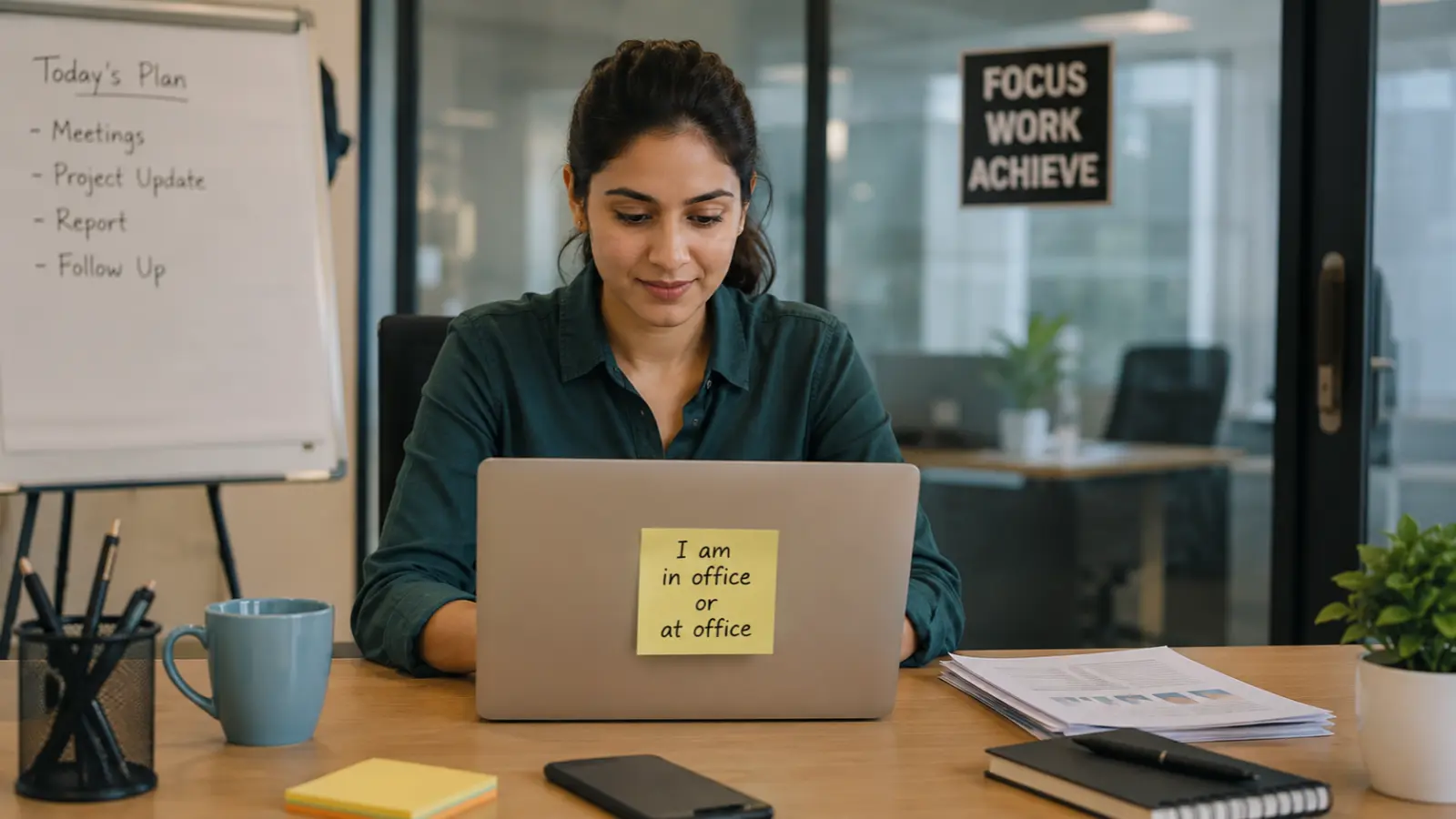
English learners often wonder whether to say “I am in office” or “I am at office” when talking about their workplace. Both expressions can seem logical because English uses different prepositions for locations. “I am at the office” is usually the most natural expression for a workplace location, while “I am in the office” emphasizes being inside. “I am at office” is not standard in most everyday English.
Learning this difference helps workplace conversations, emails, and messages sound more natural. The question i am in office or at office is therefore useful for understanding how English prepositions and articles work together.
Why “i am in office or at office” Is Confusing
The question i am in office or at office often comes from translating location expressions directly. English learners may know that in means being inside something and at identifies a location, but workplace expressions can make the choice less obvious.
Similar pronunciation
When learners ask i am in office or at office, they may hear the short prepositions less clearly in fast speech. The words in and at are short and common, so learners often focus on office rather than the preposition.
Similar spelling
There is no major spelling similarity between in and at, but both are short prepositions that appear in many location expressions. This can make their patterns difficult for learners to memorize.
Context confusion
The phrase i am in office or at office becomes easier once the location context is clear.
- “I am at the office” means I am at my workplace.
- “I am in the office” means I am physically inside the office.
Common learner mistakes
A frequent mistake is saying “I am at office” without the. In standard English, a specific workplace usually needs an article or another determiner: at the office, at my office, or at our office.
Another common mistake is assuming that in the office and at the office always have exactly the same meaning. They can overlap, but the focus can be different.
“i am in office or at office” Explained Simply
For i am in office or at office, the important choice is between in the office and at the office.
“I am at the office” is the usual choice when you simply want to say that you are at your workplace.
“I am in the office” is also correct. It usually emphasizes that you are physically inside the office, especially when contrasting your location with another place.
One-line distinction: At the office identifies your workplace as the location; in the office emphasizes that you are inside the office.
Examples:
- “I am at the office today, so you can call me there.”
- “I am in the office, but I cannot talk right now.”
So, when asking i am in office or at office, remember that both at the office and in the office can be correct, but at office without the is generally not natural in standard English.
Understanding Homophones in English
Although i am in office or at office is not a homophone question, it is a useful example of a preposition problem. Understanding homophones can still help learners recognize why English location expressions sometimes cause difficulty.
What Are Homophones?
Homophones are words that sound the same, or nearly the same, but have different meanings or spellings.
For example, “two” and “too” sound the same but have different meanings. “I have two books” uses the number, while “I want to go too” uses too to mean also.
Why Homophones Cause Confusion
When words sound alike, learners cannot always rely on pronunciation to identify the correct word. However, in and at are not homophones. Their difficulty comes from learning which preposition naturally fits a particular situation.
For example, English learners may understand “office” perfectly but still hesitate between at the office and in the office because both describe a location.
What Does “I Am in Office” Mean?
Learners searching i am in office or at office should first notice that in office and in the office can differ in meaning.
Definition and Core Meaning
“I am in the office” means that you are physically inside an office or workplace. The phrase places attention on your position within the building or room.
For example, if someone asks where you are and you are sitting at your desk, you can say, “I am in the office.”
However, “in office” without the, my, our, or another determiner has a different use in certain contexts. In political or organizational English, in office can mean holding an official position.
For example:
- “The president has been in office for two years.”
- “She remained in office after the election.”
Therefore, learners should distinguish in the office from in office.
Origin and Historical Use
The preposition in has a long history in English and is related to words expressing position within a place or boundary. English has used forms of in for centuries to indicate being inside an area, container, building, or situation.
Modern Usage and Synonyms
In workplace English, i am in office or at office should usually be rewritten with the article the when referring to a specific office.
Today, in the office is common in workplace conversations, emails, schedules, and messages.
It can be replaced in some contexts by expressions such as:
- inside the office
- at my desk
- in my workplace
- at work
Examples:
- “I am in the office until five.”
- “We are in the office today.”
- “He is not in the office this morning.”
Notice that the article the matters when referring to a specific office.
What Does “I Am at Office” Mean?
The query i am in office or at office often leads learners to the useful correction I am at the office.
Definition and Core Meaning
“I am at office” is generally not the standard form used in everyday English when referring to a workplace. The natural expression is usually “I am at the office.”
The preposition at often identifies a place as a point or location. That is why English commonly uses at the office, at school, at work, and at home.
The article changes the expression depending on the noun:
- “I am at the office.”
- “I am at my office.”
- “I am at our office.”
But with work, English normally says at work, not at the work.
Origin and Historical Context
The preposition at has Germanic roots and has long been used in English to identify a position, place, or point. Its meaning expanded over time, allowing speakers to describe locations, activities, and situations.
Modern Usage and Synonyms
For everyday communication, i am in office or at office is usually answered with at the office when the workplace is the main location.
Related expressions include:
- at the office
- at work
- at my workplace
- at my desk
Examples:
- “I am at the office today.”
- “Are you at the office or working from home?”
- “I left my notebook at the office.”
The key point is that at the office is a standard location phrase, while at office is usually missing the article needed before this countable noun.
Key Differences at a Glance
This table makes i am in office or at office easier to understand at a glance.
| Word | Part of Speech | Meaning | Example Context |
|---|---|---|---|
| in | Preposition | Inside a place or area | “I am in the office.” |
| at | Preposition | At a particular location | “I am at the office.” |
| the office | Noun phrase | A specific workplace or office | “The office is closed.” |
| office | Noun | A workplace, room, position, or duty | “Her office is upstairs.” |
In ordinary workplace English, I am in the office and I am at the office are both grammatical, while I am at office is generally incorrect or unnatural.
How to Remember the Difference Between I Am in Office and I Am at Office
A quick memory rule can solve the i am in office or at office question in most workplace situations.
Easy memory tricks
Use this simple rule:
- AT = location
- IN = inside
Think of at as pointing to a place on a map. Think of in as placing you inside a space.
For example:
“I am at the office” = My workplace is my current location.
“I am in the office” = I am physically inside the office.
Association techniques
Use these patterns whenever i am in office or at office comes to mind.
Connect at with general workplace location:
- at the office
- at work
- at school
- at the station
Connect in with an enclosed space:
- in the office
- in the room
- in the building
- in the meeting room
One memorable example
Imagine calling a colleague from the parking lot:
“I am at the office, but I am not in the office yet.”
You have reached the workplace but have not entered it. This makes the difference easy to visualize.
Common Mistakes and Confusions
Many mistakes with i am in office or at office happen because learners leave out the.
Mistake 1
The first correction is important for anyone learning i am in office or at office.
✘ “I am at office today.”
✔ “I am at the office today.”
Explanation: A specific workplace normally needs the, my, our, or another determiner.
Mistake 2
✘ “I am in office and waiting for you.”
✔ “I am in the office and waiting for you.”
Explanation: Here, you mean that you are physically inside a particular office.
Mistake 3
✘ “Are you in the office or at home?”
✔ “Are you in the office or at home?”
Explanation: This sentence is already correct. In the office contrasts physical presence inside the workplace with being at home.
Examples Section: Correct and Incorrect Usage
These examples show how to handle i am in office or at office naturally.
Example 1
This first example answers the practical question i am in office or at office in a common workplace situation.
✔ Correct: “I am at the office today.”
✘ Incorrect: “I am at office today.”
The first sentence uses the natural article and preposition combination.
Example 2
✔ Correct: “I am in the office right now.”
✘ Incorrect: “I am in office right now.”
The second version can sound incomplete when you mean physical presence inside a specific office.
Example 3
✔ Correct: “She is at the office, so please call her.”
✘ Incorrect: “She is at office, so please call her.”
The article the makes the location phrase natural.
Example 4
✔ Correct: “Are you at the office today?”
✘ Incorrect: “Are you at office today?”
The correct version sounds natural in everyday workplace conversation.
Self Assessment: Test Your Knowledge
Use the following questions to check your understanding of i am in office or at office.
Fill in each blank with in the office, at the office, or another appropriate expression.
- I am ______ today, so you can visit me after lunch.
- She is ______, but she is currently in a meeting.
- Are you ______ or working from home?
- I arrived ______ early this morning.
Self Assessment Answers
- at the office — This identifies the workplace as your current location.
- in the office — This emphasizes that she is physically inside the office.
- at the office — This asks whether the person is at the workplace.
- at the office — This is natural when talking about arriving at the workplace.
Remember that in the office can also be appropriate when the sentence emphasizes being inside the building or room.
FAQs About “i am in office or at office”
These FAQs address common searches for i am in office or at office.
Is “I am at office” correct English?
Usually, no. In standard everyday English, say “I am at the office.” The article the is normally needed when referring to a specific workplace.
Is “I am in the office” correct?
Yes. “I am in the office” is completely correct when you mean that you are physically inside the office.
Is “I am at the office” correct?
Yes. “I am at the office” is natural and very common when you want to say that you are at your workplace.
What is the difference between “in the office” and “at the office”?
At the office focuses on the workplace as a location. In the office focuses more on being physically inside the office.
Should I say “at office” or “at the office”?
In most everyday situations, use “at the office.” You can also say “at my office” or “at our office” when a possessive determiner is appropriate.
Can “in office” be correct without “the”?
Yes, but it can have a different meaning. In office can mean holding an official position, as in “The mayor has been in office for three years.” For physical location, use in the office.
Which phrase should English learners use most often?
For a simple workplace location, “I am at the office” is a safe and natural choice. Use “I am in the office” when you want to emphasize that you are inside.
Final Conclusion: Using “i am in office or at office” Correctly
The easiest way to remember i am in office or at office is to connect at with a location and in with being inside. In everyday English, “I am at the office” is the natural way to say that your workplace is your current location. On the other hand, “I am in the office” is also correct when you want to emphasize that you are physically inside the office. When considering i am in office or at office, the expression “I am at office” is generally not standard because office usually needs the, my, our, or another determiner in this context.
A useful memory trick is simple: think of at as a location and in as being inside. If you have arrived at your workplace, you can say you are at the office. If you are sitting inside the building or room, you can say you are in the office. Also remember that in office without the can have a different meaning, especially when someone holds an official position.
With practice, these preposition differences become easier. Notice how speakers use at the office, in the office, and at work in real conversations and writing.