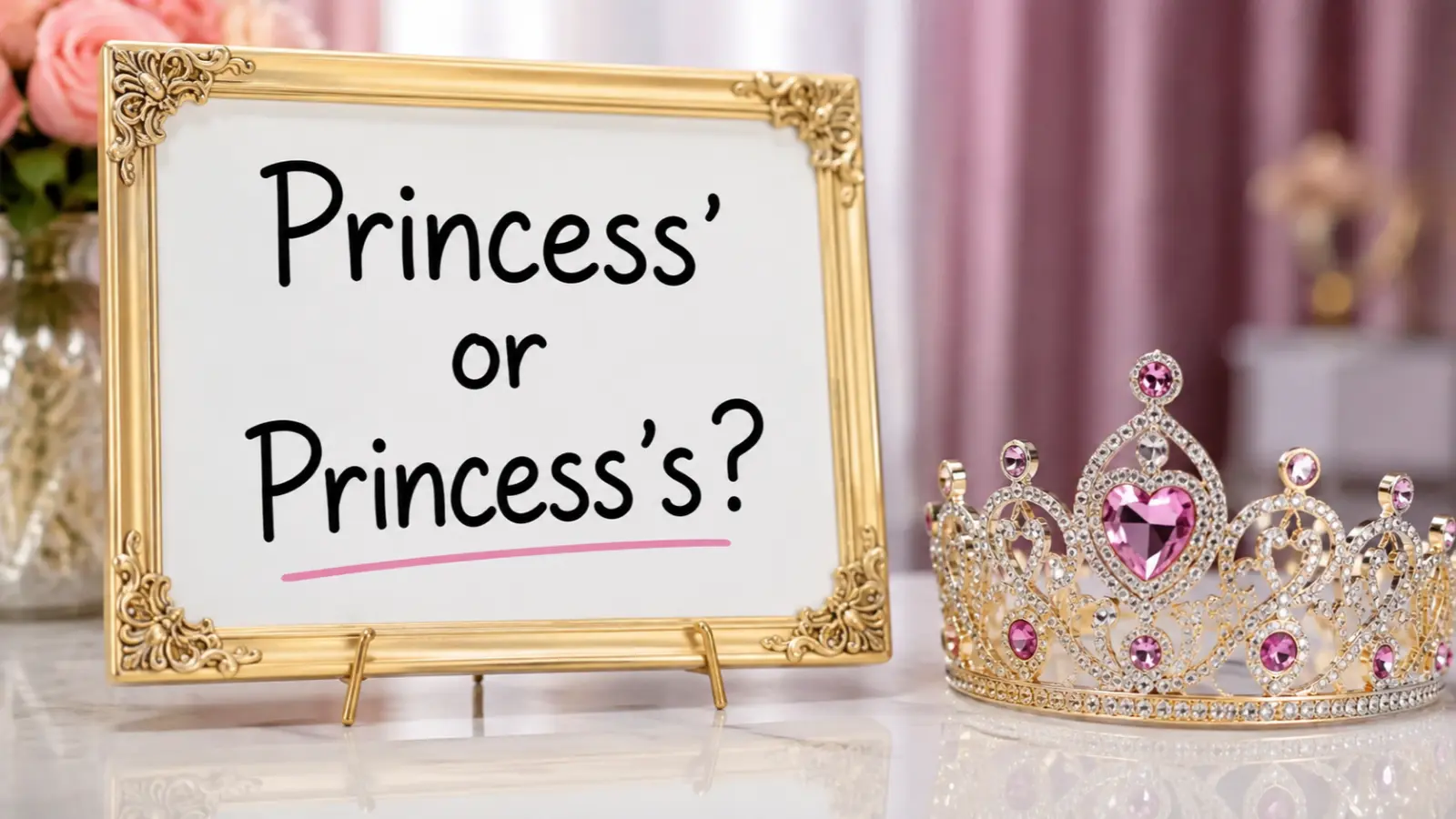
English possessives can be confusing, especially when a singular noun already ends in s. The question of princess’ or princess’s often causes uncertainty because both forms appear in books, websites, newspapers, and everyday writing. Many learners wonder whether they should add only an apostrophe or use apostrophe + s.
The good news is that the basic rule is simple: princess’s is the standard possessive form for the singular noun princess, while princess’ is also found in some traditional style systems. Understanding this difference helps you write more accurately and choose the form that fits your preferred style guide.
Why “Princess’ or Princess’s” Are Confusing
The confusion surrounding princess’ or princess’s mainly comes from the rules for forming possessives with nouns that end in s. English has several possessive patterns, and different style guides sometimes recommend different treatments of singular nouns ending in s.
Similar pronunciation
In many situations, princess’s is pronounced with an extra /ɪz/ or /əz/ sound, as in “princess-iz.” The form princess’ may be pronounced the same way in speech when it represents possession. Because spoken English does not always make the spelling difference obvious, learners may be unsure which written form to choose.
Similar spelling
The two forms look almost identical. One has an apostrophe after the s, while the other has an apostrophe followed by another s. This small spelling difference creates a surprisingly common grammar question.
Context confusion
Possessive nouns show ownership, association, relationship, or connection. For example, you might write about a princess’s crown, a princess’s palace, or a princess’s dress. Since princess already ends in s, learners often wonder whether another s is necessary.
Common learner mistakes
A frequent mistake is assuming that every noun ending in s must take only an apostrophe. Another mistake is believing that princess’ is always wrong. In reality, usage depends partly on whether the noun is singular or plural and partly on the style guide being followed.
Princess’ or Princess’s Explained Simply
The simplest rule for princess’ or princess’s is this: when princess is singular and you need to show possession, princess’s is the clearest standard form in most modern English style guides.
One-line distinction: Princess’s is the standard singular possessive form, while princess’ is an alternative form accepted by some style guides.
For example:
- The princess’s crown was decorated with jewels.
- The princess’ crown was decorated with jewels.
The first sentence follows the widely used rule of adding ‘s to a singular noun. The second can be acceptable under certain style conventions, but it is less universally preferred.
Therefore, when learners are unsure about princess’ or princess’s, choosing princess’s is usually the safest option unless a particular publication or style guide requires otherwise.
Understanding Homophones in English
What Are Homophones?
Homophones are words that sound the same but have different meanings, spellings, or both. For example, flower and flour sound alike but refer to completely different things.
The forms discussed here are not true homophones. The difference between princess’ and princess’s is primarily a difference in written possessive form, not a difference between two separate words with unrelated meanings.
Why Homophones Cause Confusion
Homophones can make English spelling difficult because listening alone does not tell you which spelling is correct. For example, someone may hear “I bought some flour” but need the context to know whether the speaker means flour or flower.
With possessive forms, context and grammar are also important. When deciding between princess’ or princess’s, learners should first identify whether princess is singular and possessive.
What Does “Princess’” Mean?
Definition and Core Meaning
Princess’ is an alternative singular possessive spelling of princess. It indicates that something belongs to, relates to, or is associated with one princess.
For example:
- The princess’ carriage waited outside the palace.
- The princess’ decision surprised everyone.
- The princess’ story became famous.
The form is not the most universally recommended choice for singular possession. Some style guides prefer princess’s, while others permit or recommend an apostrophe alone for certain singular names or nouns ending in s.
Origin and Historical Use
English possessive punctuation has developed over many centuries. Older writing traditions did not always follow the consistent rules used in modern English. As a result, different publishing traditions developed different approaches to singular nouns ending in s.
This historical variation explains why readers may encounter princess’ in edited books, newspapers, historical writing, or formal publications even when another source uses princess’s.
Modern Usage and Synonyms
Today, princess’ can appear in formal and edited writing, but its acceptability depends on the style being followed. It should not automatically be treated as a spelling error.
There is no true synonym for the possessive form itself, but the meaning can sometimes be rewritten:
- the princess’s dress
- the dress belonging to the princess
- the princess’s palace
- the palace associated with the princess
Key points
- It refers to possession or association with one princess.
- It contains an apostrophe after the final s.
- Some style guides accept it for singular possession.
- It is less universally preferred than princess’s.
- Always follow the style guide required by your school, employer, or publication.
What Does “Princess’s” Mean?
Definition and Core Meaning
Princess’s is the standard singular possessive form of princess in many modern English style guides. It shows that something belongs to or is connected with one princess.
For example:
- The princess’s crown was made of gold.
- Everyone admired the princess’s courage.
- The princess’s horse ran across the field.
When learners ask about princess’ or princess’s, this is generally the form they should choose when following the common modern rule for singular possessive nouns.
Origin and Historical Context
The apostrophe in English possessives developed from older forms that indicated relationships such as ownership or association. Over time, English spelling conventions became more standardized, but variation remained for nouns ending in s.
Modern style guides differ in some details. However, many recommend adding ‘s to a singular noun, even when that noun already ends in s. Thus, princess becomes princess’s.
Modern Usage and Synonyms
Princess’s is common in contemporary writing because it clearly shows that the noun is singular and possessive.
Related wording can sometimes express the same idea without a possessive:
- the princess’s crown
- the crown belonging to the princess
- the princess’s palace
- the palace of the princess
Key points
- It is the singular possessive form in widely used modern style systems.
- It clearly identifies one princess as the possessor.
- It is common in academic, professional, educational, and general writing.
- It can be used before a noun to show ownership or association.
- It is usually the safest choice for English learners.
Princess’ or Princess’s: Key Differences at a Glance
| Word | Part of Speech | Meaning | Example Context |
|---|---|---|---|
| Princess’ | Singular possessive noun | Belonging to or associated with one princess | The princess’ gown was beautiful. |
| Princess’s | Singular possessive noun | Belonging to or associated with one princess | The princess’s gown was beautiful. |
The important point is that both forms can represent singular possession in certain style systems. The difference is mainly a matter of possessive spelling convention rather than a difference in meaning.
For most learners, princess’s is the clearest and safest form. If you are writing for a newspaper, academic institution, publisher, or organization with a specific style guide, follow that guide consistently.
Also remember that the plural possessive is different. The plural noun is princesses, and its possessive form is princesses’:
- The princesses’ dresses were displayed in the museum.
How to Remember the Difference Between Princess’ and Princess’s
Learning princess’ or princess’s becomes easier when you connect the rule to the number of people involved.
Easy memory trick
Think:
One princess → princess’s
Several princesses → princesses’
This simple pattern helps separate singular and plural possessives.
Association technique
Imagine a single princess holding a crown. Ask, “Whose crown is it?” The answer is “the princess’s crown.”
Now imagine three princesses sharing several crowns. You would write “the princesses’ crowns.”
One memorable example
Remember this sentence:
The princess’s crown sparkled while the princesses’ crowns were displayed nearby.
The first possessive refers to one princess, so it uses ‘s. The second refers to multiple princesses, so the apostrophe follows the plural s.
When deciding between princess’ or princess’s, first ask whether the noun is singular or plural. For one princess, the standard modern choice is princess’s.
Common Mistakes and Confusions
One common error is assuming that the singular possessive must always end with an apostrophe only.
Wrong example
The princess’ necklace was made of diamonds.
This form may be accepted by some style guides, but it can be marked as incorrect in systems that require ‘s for singular nouns ending in s.
Preferred version
The princess’s necklace was made of diamonds.
This follows the widely taught modern rule for singular possessives.
Another common mistake is confusing singular and plural possessives.
Wrong example
The princess’s were waiting outside.
This is incorrect because princess’s is possessive, not plural.
Correct version
The princesses were waiting outside.
The plural of princess is princesses, without an apostrophe.
A different sentence would be:
The princesses’ parents were waiting outside.
Here, princesses’ is plural possessive because the parents belong to or are associated with multiple princesses.
Examples Section: Correct and Incorrect Usage
Here are practical examples to make the distinction clearer.
Example 1
✔ Correct: The princess’s room was decorated with flowers.
✘ Incorrect: The princesss room was decorated with flowers.
Explanation: The singular possessive requires an apostrophe. The standard modern form is princess’s.
Example 2
✔ Correct: The princesses’ rooms were on the second floor.
✘ Incorrect: The princess’s rooms were on the second floor.
Explanation: Several princesses have rooms, so the plural possessive princesses’ is needed.
Example 3
✔ Correct: The princess’s speech impressed the audience.
✘ Incorrect: The princess speech impressed the audience.
Explanation: The speech is associated with one princess, so a possessive form is needed.
Example 4
✔ Correct: The princess’ speech impressed the audience.
✘ Incorrect: The princess’ were waiting for the ceremony.
Explanation: Some style guides allow princess’ as a singular possessive, but princess’ cannot be used as the plural form. The plural noun is princesses.
Self Assessment: Test Your Knowledge
Fill in each blank with the most appropriate form: princess’, princess’s, princesses, or princesses’.
- The ______ crown was kept in a glass case.
- Several ______ attended the royal ceremony.
- The ______ gowns were designed by a famous artist.
- The ______ decision changed the course of the story.
FAQs
Is “princess’s” grammatically correct?
Yes. Princess’s is grammatically correct and is the standard singular possessive form in many modern English style guides.
Is “princess’” correct?
It can be correct depending on the style guide. Some traditional and editorial systems allow or prefer an apostrophe alone after a singular noun ending in s.
Which is better: princess’ or princess’s?
For most English learners, princess’s is the safest choice because many modern style guides use ‘s for singular possessives, including singular nouns ending in s.
What is the plural of princess?
The plural is princesses. Do not add an apostrophe simply to make the noun plural.
What is the plural possessive of princess?
The plural possessive is princesses’.
Is princess’ a plural form?
No. Princess’ is not the normal plural of princess. The plural is princesses.
Is princess’ or princess’s used in formal writing?
Both may appear in formal writing, depending on the chosen style guide. However, princess’s is generally the clearer choice when you need a standard modern singular possessive form.
Final Conclusion: Using Princess’ and Princess’s Correctly
Understanding princess’ or princess’s is easier once you separate singular possession from plural possession. The form princess’ can also appear in edited English because some style guides allow an apostrophe alone after a singular noun ending in s.
The most useful rule for learners is to use princess’s unless a specific style guide tells you otherwise. For several princesses, use princesses’, as in the princesses’ crowns. Remember the simple pattern: one princess → princess’s; several princesses → princesses’. Once you understand this pattern, possessive nouns ending in s become much easier to handle. Keep practicing with real sentences, and you will soon recognize the correct form naturally.